



A cyclist who was seriously injured after a van driver ‘doored’ him was 50 per cent to blame and should have been cycling “further away” at the time of the collision, the vehicle’s insurers attempted to claim.
Edinburgh cyclist Archie was cycling to work along Abercromby Place in the centre of the Scottish capital when a van driver, parked at the side of the road, opened their door straight into his path. The cyclist collided with the door headfirst, suffering facial fractures which required emergency surgery, as well as a head injury.

Following the crash, Archie contacted Cycle Law Scotland, who intimated the claim to the van’s insurers. Initially, the insurers agreed to settle the claim and provide funding for the cyclist to receive the treatment he required for his injuries.
However, two years later, during discussions surrounding a full and final settlement, the van’s insurers adopted a somewhat different approach, instead arguing that Archie was 50 per cent to blame for the crash.
The insurers argued that, on the basis that the Highway Code advises cyclists to avoid riding within a door’s width of parked cars, had Archie left a greater distance between himself and the van, the collision would not have occurred.
Rule 67 of the Highway Code advises that cyclists “should take care when passing parked vehicles, leaving enough room (a door’s width or one metre) to avoid being hit if a car door is opened”.

Faced with the insurer’s new stance, Cycle Law Scotland’s lawyers pointed out that when the term ‘should’ is used in the Highway Code, it refers to best guidance and advice on how collisions can be avoided.
They contrasted this with the rules within the Highway Code which use the term ‘must’, including rule 239, pertaining to drivers opening their doors.
According to the Highway Code, drivers “MUST ensure you do not hit anyone when you open your door. Check for cyclists or other traffic by looking all around and using your mirrors”.
As we pointed out in our guide to the legal ramifications of dooring, the rule is supported by legislation, with regulation 105 of The Road Vehicles (Construction and Use) Regulations 1986 stating that: “No person shall open, or cause or permit to be opened, any door of a vehicle on a road so as to injure or endanger any person.”
The Highway Code also advises drivers to adopt the ‘Dutch Reach’ method of opening vehicle doors, in order to avoid hitting pedestrians or cyclists.

“Where you are able to do so, you should open the door using your hand on the opposite side to the door you are opening; for example, use your left hand to open a door on your right-hand side,” the rule states.
“This will make you turn your head to look over your shoulder. You are then more likely to avoid causing injury to cyclists or motorcyclists passing you on the road, or to people on the pavement.”
Focusing on the “actual cause” of Archie’s collision, Cycle Law Scotland told the insurers that the crash “only happened because the driver failed in their duty to make sure that their door did not hit anyone, and we were adamant that Archie should not accept any blame for the accident”.
The case was taken to court, with the Edinburgh cyclist soon receiving a full offer in settlement of the claim.
“Whilst the Highway Code does recommend that cyclists should give room to parked cars, this is advice which has to be balanced against real-life conditions,” Cycle Law Scotland said in a statement this week.
“Cyclists may be avoiding potholes, oncoming cars, puddles, pedestrians, and a whole number of other hazards that may inform their choice of road positioning. The duty is on the driver to make sure it is safe before opening their door.”
According to Cycling UK, within Great Britain more than 500 cyclist casualties a year are due to dooring – although the charity adds that with many such incidents going unreported, the true figure is likely to be much higher.
While the majority of cases result in the cyclist sustaining minor injuries, in some instances a driver or passenger opening a car door without checking to see if a rider is approaching can result in very serious injury or death.
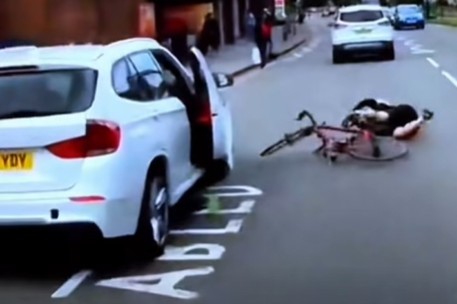
Earlier this week, we reported on the live blog that another dooring incident involving a cyclist, captured on camera, had sparked a debate surrounding liability on social media.
“This cyclist should have kept a door’s width – or at least a one metre gap – between them and the parked car,” Big Jobber, a content creator and liability expert who works in the motor insurance industry, said in his narration of the clip, which shows a driver opening the door of their parked car into the path of a cyclist, sending him clattering to the ground.
“Does that mean they are in any way responsible for this incident? Absolutely not. The driver of the vehicle will take 100 per cent of the responsibility.”
He continued: “Did the cyclist [riding] along closer than a door’s width to the car cause the collision? No, it didn’t. Because if the door wasn’t opened, the collision wouldn’t have happened.
“Therefore, the negligent act in this situation is the car driver opening their door without checking it was safe or clear to do so, and not following the recommended method of using their opposing hand, so you can check your blind spot as you open the door, otherwise known as the Dutch Reach.
“So, in this case, the car driver has opened the car door into the path of the cyclist, and it’s that act where negligence is decided and the driver of the vehicle is found to be completely responsible. This is no different to if somebody opens their door into the path of another vehicle. Many people think there is a minimum width for cars passing another vehicle, and there isn’t.”

















8 thoughts on “Cyclist doored by driver 50% to blame for crash, insurers said – claiming seriously injured victim should have been cycling “further away””
I suspect there is a “Cheeky Friday” experience in insurance: every once on a while, perhaps with the mind on an after-work drink with the team, they’ll send back a reply trying it on. It can always be blamed on a “long week” and an absent-minded approach, but every once in a while, they’ll get away with it. Nothing to lose; plenty to gain (money saved plus bragging rights).
Cheeky Friday offers/challenges should always be dealt with out of hand with reference to the Foreign Office, and reference to emerging additional damages.
When the cycle lane >IS< the 'door zone', you're left with either pressing your luck or riding outside the 'door zone'. Cycle lane or not, I've had too many close calls and near misses to trust anyone! But, by riding outside the 'door zone', I've been close passed, had my tail ridden, cursed at, and even have had things thrown at me. Damned if I do and damned if I don't!!!
Speaking as someone who has been car doored into a somersault while cycling in the cycle lane (by a taxi allowing their customer to get out while stopped in traffic behind a red light). You tend to not trust any vehicle stopped or driving slowly. I got lucky that most of the inertia was absorbed by his door and broke the door hinge. But “once bitten twice shy” is certainly true. I’ve witnessed it a few times happening to riders too. People complain about the barriers around cycle lanes, while they’re an inconvenience for drivers they protect cyclists from serious accidents that absolutely should not happen and they give me a bit more comfort that I’m not going to be hospitalised on my commute because of a lack of awareness.
@Collie147 The only time I’ve been doored was when I was filtering through traffic. The woman driving a Ford Fiesta decided unexpectedly to get out of her car in the middle of a traffic jam. I made a mistake by trying to go round the door and sustained a nasty hand injury. I should’ve aimed for the door frame. And bent the door all the way open, which would’ve cushioned the impact for me. She seemed to think it was my fault. I thought otherwise. Words were used. I didn’t hang about.
FFS, name the insurance company! We need to use people power to get cyclists to boycott them en masses, their actions were disgusting.
I suspect a chunk of this is similar to insurers arguing contributory negligence due to not wearing a helmet.
Almost never accepted and where it is accepted results in a tiny change, but the ‘cheeky’ attempt usually doesn’t cost them much, has enough backing to take to court without getting slapped down by judge for wasting time/not negotiating in good faith (HW code advises it) and often will have an opposed party that doesn’t have an expert (expensive with cost recovery limits) who knows the argument won’t be accepted in the pre-court negotiation phase.
I could see valid arguments for some reduction for not keeping clear of parked cars door. But we are talking about 5-10% in most cases. And even this becomes difficult – if you argue cyclists need to be 1m clear of doors then a 1.5m wide cargo bike (legal max width for bicycles) needs a 3.5m wide gap between parked cars (+ margin of error for rider not being perfect – so 4m wide gap…) – I suspect a LOT of places people park on both sides would stop being legal…
@qwerty360 – an important difference is that the court cases that involve bike helmets can be complicated as to where the blame lies, whereas there should be no debate about who is to blame when someone opens a door and hits someone with it.
@hawkinspeter No, court cases that involve bikes can be complicated as to where the blame lies, helmets are always a distraction.