


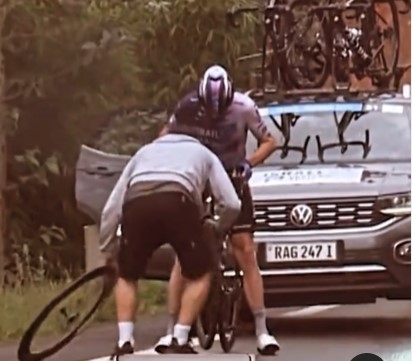

We’ve had our first sticky bottle of 2023, now the pro cycling season has gone into yet another gear with Chris Froome’s first dig at disc brakes… and it’s only February! The Israel–Premier Tech rider and seven-time Grand Tour champion took to Instagram today to post a montage of mechanics struggling to change his wheels while a charging peloton breezed past him, accompanied by the simple caption: “Rim brakes > Disc brakes”.
On Stage 5 of the Tour du Rwanda last week, 37-year-old Froome showed glimpses of his era-defining dominance of the 2010s and his famous solo Giro d’Italia win in 2018 when he launched an audacious attack 75km out from the finish; however, he needed two wheel changes and then crashed into a race vehicle in a day that was ultimately marred by misfortune, and ended up finishing over four minutes down on the stage winner.
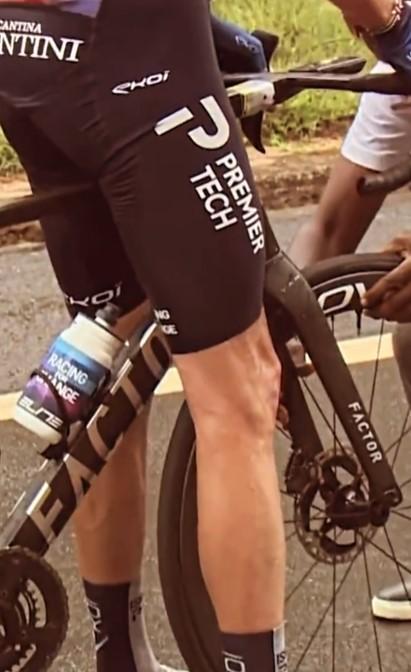
After the stage, Froome (fairly diplomatically) explained the wheel change issues: “I got a front wheel puncture and I didn’t have a team car behind me as they had already pulled the team car out. I managed to get another wheel from neutral service but it wasn’t really compatible with the bike so I had to stop again and change it with my team car. Then the peloton caught me and surged over the top of the climb and that’s where the lights went out for me.”
On social media today, however, Froome pulled no punches…
While the post appears to suggest the disc brake wheels themselves are to blame for the slow wheel changes, some of his followers were quick to point the finger at the not-so-quick mechanics handling Froome’s wheel changes, with one suggesting the caption should instead read: “Quick mechanic > Slow mechanic”.
As we’ve already alluded to, this is very much not the first time Froome has taken aim at disc brakes, and his problems extend far beyond allegedly slower wheel changes. Way back in 2016 he suggested “having different braking systems in the peloton would be more dangerous”; and when that ceased to be a problem as the whole peloton adopted disc brakes in the 2020s, Froome ramped up his disc brake doubts in 2021 when he said that the technology was not “quite where it needs to be yet” because the “…distance between the disc and rotors is still too narrow.”
> What’s wrong with Chris Froome’s disc brakes?
In March of last year, Froome said that he still regularly experienced issues with his disc brakes and had started wearing headphones so he couldn’t hear them rubbing. In April his team mechanic concurred, saying: “Chris is not a huge fan. There’s the noise factor, it’s not super-reliable, wheel changes are way slower – so I think those are aspects that can improve.”
So, what will it take to persuade Froome to get fully on board with the disc brake revolution? Well, the recent viral footage showing Tom Pidcock – of Froome’s former team Ineos Grenadiers – expertly roaring down Tuna Canyon on his disc brake-equipped Pinarello Dogma might convince Froome that the extra confidence a rider may get from having more powerful brakes makes disc superior to rim brakes. Although Froome isn’t half bad at going downhill himself, and was performing mind-blowing descents way before disc brakes were ubiquitous in the pro peloton…


















80 thoughts on “Fed up Froome denounces disc brake wheels on Instagram Reel”
A bit of personal
A bit of personal confirmation bias for me – disc brakes make much more sense that rim brakes for most of us, but for racing, the opposite is true.
Agreed, but now that the
Agreed, but now that the whole peloton has moved to disc brakes the point is moot. Also everyone else in the peloton is equally subject to the same wheel swap delays as well so Froome’s situation sucks but it wasn’t unfair. I have to agree with him on the tech not being there yet; yes disc brakes are superior on a per bike basis but I hope to see it reach a point where calipers self adjust to different wheel sets, or at least, have more built in tolerance than they do currently.
When it comes to racing I
When it comes to racing I dont want to see the event ruined by mechanicals. Too many times have I seen a riders race blown apart by totally avoidable issues. Going back down the years it may have been incompatible drive trains with campag/Shimano , neutral bikes with the wrong pedal system for the rider. Its nothing new but it does taint the sports credibility at times when the race can be effected by something outside of the riders control.
For me, discs make a lot of sense when I am riding. But I also ride tubeless and havent had a puncture in well over a year. but even tubeless isnt perfect and you still lose some pressure which at the very pinnacle of the sport makes a huge difference. I would happily see the pro peloton return to rim brakes. I wouldnt even mind about them dropping the weight limit to makes bikes sub 6kg or less. Maybe just dont make those bikes available to the public to buy. I cant buy a road legal F1 car or MOTOGP bike. They are the cutting edge but that shouldnt mean Joe Bloggs gets to ride it. The bike brands can still produce ‘road legal’ dumbed down versions of their pro race bikes but keep the tech exclusive for the pro riders.
I agree. I want to see the
I agree. I want to see the peloton on identical steel-framed bikes, with box section wheels. They can have a choice of frame size, stem, handle-bar width and saddle (within limits). Spec bikes, like Keirin racing in Japan. And get rid of TT bikes too.
I want to see a battle of the riders. Those who want to see aero engineers compete by proxy already have Formula-Snore.
Thats not what I said and you
.
Which would immediately mean
Which would immediately mean that there was no mileage in bike companies sponsoring or providing free equipment to teams. Given that most teams seem to be dancing a financial tightrope at the best of times, what would make up that shortfall? Anyway, despite the endless claims of manufacturers to have found a way of saving a quarter of a second over a 40 km time trial, the bikes really are still much of a muchness; the top riders would still win on any machine in the peloton and it will always remain that way, there just isn’t that much that you can improve on a bike to make it go roaring ahead of all the others.
Steve K wrote:
Why?
Duh.
Duh.
Destroyer666 wrote:
Back under your bridge.
Why?
Why?
Secret_squirrel wrote:
Advantages of disk brakes –
– better braking in the wet; but I don’t think that’s as big an issue for the pros, who aren’t dealing with (eg) drivers doing stupid things (or at least shouldn’t be).
– you don’t wear your rims out as quickly – not an issue for the pros.
Disadvantages of disks
– slower wheel change; issue for the pros, but not really anyone else
– extra weight, ditto.
I don’t know about you but
I don’t know about you but when I am on my weekly ride I don’t want to be waiting 30s for my support team to change my wheel, I need it now!
I did get a puncture the other day that didn’t seal on its own so I had to put a tube in it which was a right bugger at the side of the road. Best thing was taking a chunk out of my finger that wouldn’t stop bleeding and being told by my mate “I saw the glass, I just assume you did too”
mctrials23 wrote:
It’s the waiting that’s frustrating, when I’m out on a club ride and need a wheel change, I put my arm in the air and wait for a mechanic to pull up alongside in a team car – never any joy, so I always end up doing it myself. Also doing it oneself on a club ride, the whole process is improved and assisted by having your puncture repair skills observed and critiqued by your fellow riders.
Also, I appear not to be able
Also, I appear not to be able to spell disc. I blame computers.
Pity the time triallers and
Pity the time triallers and triatheletes.
“Pass me the disc wheel.”
“The disc disc wheel or the rim disc wheel?”
The wheel changes are slow
The wheel changes are slow because noone puts the effort into practice doing it properly, its not the fault of the brake tech.
Weve seen it all before, theres a puncture, the rider panics, the team panics the mechanics who maybe were thinking about what to have for tea are suddenly on point, QUICK stop the car, QUICK get the right wheel, QUICK get the tools, argh I’m under pressure QUICK got to undo the bolt, oh no the tool fumbles because I hadnt faced it up square, QUICKER trying to make up time I’m forcing the wheel out so it sticks MUCH QUICKER now the wheel wont go back in and I fumble the tool again arrgh this is a disaster!!
I think it was last season the neutral service mechanic had a dud battery in their drill to “speed up” removing the thru axle, probably because theyd not checked it before the stage properly.
Practice the swaps and theyll be much quicker.
Awavey wrote:
Why is that? You’d think, in the era of marginal gains (or are we past that?) this would be a no brainer. Look at F1 pitstops, which are practiced to within an inch of their lives.
no idea, youd think Ineos
no idea, youd think Ineos with their ties to Mercedes F1 would have thought of looking into it by now.
but nope it seems just easier to complain about the tech of discs, and keep with stuffing a team helper in the back of a car with a wheel and hoping theyll just work it out if it happens.
Steve K wrote:
Slower wheel change – that ones rubbish. Different positioning of disc between hub models would be my correction.
Extra weight – irrelevant. Every pro is riding kit thats capable of hitting the 6.8kg limit – and 90%of the time at Pro speeds Aero trumps weight.
Leaving aside the disc vs
Leaving aside the disc vs rims debate, why didn’t the neutral service have a compatible wheel? IPT run Factor Ostro Vams which are kitted out with Dura Ace, not as though he was asking for a replacement Classified hub wheel. Why wouldn’t a team make sure that their setup is compatible with what neutral service carries before the start of the race?
It’s not entirely clear what
It’s not entirely clear what the “compatibility” issue was, but my hunch would be that the tolerances on different hubs aren’t good enough to ensure perfect rotor alignment. I think Froome’s original wheels were Black Inc where as it appears the neutral service supplied Roval wheels. It’s therefore quite possible that the difference in rotor alignment meant that the wheel supplied would not spin freely. (This would also mean it is very much part and parcel of the disc vs rims debate).
So on paper the wheels supplied by neutral service would have been “compatible”, but would require adjusting the brake caliper position to be usable.
I’ve got two sets of wheels for my gravel bike, both on Hope hubs (one pair RS4 and the other Pro4) and I had to shim out the rotors on one of the sets to avoid rubbing.
That sounds plausible.
That sounds plausible. Forgive my ignorance though, aren’t hydraulic brakes meant to be self adjusting, and so surely a few squeezes on the lever should be sufficient to reset the pads to the new rotor? Or are wheel manufacturers so out of sync with each other that the tolerances are so different they are too much for the self-adjustment to cope with?
You can certainly buy a very
You can certainly buy a very thin ‘washer’ to add to your wheel so that where you swap wheels over, the rotor will line up.
It was illustrated recently but I can’t remember which article or forum it was.
They can self-adjust for pad
Hydraulic disc brakes can self-adjust for pad/rotor wear (the pistons symmetrically push out further as the pads/rotor get thinner), but the issue with installing a different wheel is that, due to small variations in hub tolerances, the new rotor might not be properly centered in the caliper/between the pads, causing either rubbing or asymmetric clamping on the rotor.
The self-adjusting feature of hydraulic discs can’t do anything about that; you either need to adjust the rotor offset on the wheel itself (for example, by using a shim), or loosen the caliper bolts and re-center the caliper/pads over the new rotor.
I see, thanks. I wasn’t aware
I see, thanks. I wasn’t aware of that, although I should have been as I have had several times to reset calipers for new wheels. It’s absurd that manufacturers can’t agree on a standard width though.
I don’t *think* it’s about
I don’t *think* it’s about agreeing on a standard. I believe the problem is more that the pad-to-rotor clearance–and therefore the room for error–is so incredibly small that even tiny incidental variations in the manufacturing of hub shells and end caps, centerlock mounts, rotor mounts and blades, etc., can throw things off enough to make trouble, even across products from a single manufacturer. Call it a fundamental problem with disc brakes perhaps (I’m still a fan).
This is the spacer that was
This is the spacer that was mentioned
https://www.wiggle.co.uk/hope-rotor-spacer
My guess is it’s this. Peak
My guess is it’s this. Peak Torque (on YouTube) has mentioned this sort of issue before – different hubs space the rotor different distances from the end-cap, and this can require adjusting the pistons/pads to avoid rub.
Would that mean that every
Would that mean that every team must change the sponsored equipment they use to align with what neutral service carries? Would a Shimano wheel work in a bike running Campagnolo or SRAM? I’m assuming not but not sure.
Although neutral service is
Although neutral service is sponsored by Shimano in most European races, they also carry Campag and SRAM spares. They carry replacement rear wheels from their competitors but not fronts, so I assume it’s possible to fit a Shimano front disc wheel into SRAM and Campag calipers and the spare rears are due to drivetrain incompatibility, not brake caliper incompatibility.
I get what you’re saying, but
I get what you’re saying, but I don’t think neutral service vehicles could be firstly expected to have a set of compatible wheels for every team, and secondly for the neutral service staff to know which wheels are for which team. All to be picked and fitted in seconds.
I’m there with Chris. Disc
I’m there with Chris. Disc brakes on racing bikes and similar: solution looking for a problem (i.e. money spinner for bike industry).
marmotte27 wrote:
Surely, if the industry were conspiring to get more money off us, they would all want us buying bikes with rim brakes, and then selling us expensive carbon wheels with carbon brake surfaces that you wear through at a rediculous rate (given carbon is a terrible material when it comes to abbrasion).
Disc brakes mean carbon wheels last years, decades even. Rim brakes mean you have to go back in a couple of years or so and buy replacement rims/wheels. Which is the bigger money spinner for the industry?
“Which is the bigger money
“Which is the bigger money spinner for the industry?”
Selling a whole new fleet of new bikes to all and sundry at todays inflated prices. And trust them to come up with the next new thing soon. In fact they alread have, haven’t they.
that’s why there is only a
that’s why there is only a riche-niche market for carbon rims in the auto industry isnt it? – because carbon works sooo much better on rough roads with potholes etc.
I agree here. I switched from
I agree here. I switched from rim brakes to disc when I replaced my winter bike. Previously, I had my LBS replace my worn rims every year after thousands of winter miles destroyed them, even having tyres peeling the rim edge off. 3.5 years old now, my disc winter bike wheels are still as good as new. But my best bike still has rim brakes, and a ‘proper’ mechanical groupset.
joules1975 wrote:
Except the opposite is true. Carbon rims hardly wear at all from rim brakes. It’s the pads that wear.
Except the opposite is true.
Except the opposite is true. Carbon rims hardly wear at all from rim brakes. It’s the pads that wear
Well, I have no experience at all of carbon rims, and no intention of ever getting another rim brake bike, but I find this statement very difficult to believe. The problem is that anybody claiming rim brakes and carbon rims on here is likely to be a crazed anti-disc propagandist. Any reasoned comments in favour or against this proposition: carbon rims do not wear out from abrasion, even though we know aluminium ones most certainly do? Is it just that carbon rims are on best bikes that don’t go out in bad weather on gritty roads?
marmotte27 wrote:
Sort of agree.
Discs have been game changers for mountain bikes and cross bikes. They’re also great on winter bikes, commuter bikes and in wet conditions.
But I do think they’re unecessary for race bikes when competing on dry roads – especially when racing in the UK where dedicated closed circuits are sweeping all before them.
A bad workman blames his
A bad workman blames his tools
7 times GC winner. Terrible
7 times Grand tour winner. Terrible workman obvs
Off the back wrote:
Last gen tour winner who won against last gen kit and riders. He’s a legend but he’s no Pog.
Sebastian Vettel to George Russell. (Not sure which pro cyclist Hamilton is in this crappy analogy – Thus endeth my F1 knowledge)..
Clearly not, however, it
Clearly not, however, it seems like he is trying to blame disc brakes for his performance when nearly everyone else is running discs too.
He isnt the only rider to
He isnt the only rider to complain about disc brakes. Loads of riders in the pro peloton have complained about issues from changing wheels to disc rotors causing injuries (proven or not) they have still had negative things to say. He was dismissing them long before he had his big crash which is what ultimately ended his competitive edge.
Wake up. The disc is a
Wake up. The disc is a sheeple invention. It is unnecessarily more expensive, wasteful (hydraulic oil, WTF?) and the Corporate has brainwashed you.
Having worn a few wheels out
Having worn a few wheels out in rim brakes, how are wheel manufacturers going to get any money out of me on discs ?
You aren’t looking at the whole picture.
Puzzled as to how a front
Puzzled as to how a front wheel change could possibly be made longer by discs, particularly with the rider holding the bike. Tolerances aren’t tight and it’s quick to spin the lever single handled whilst holding the wheel with the other. Wheel in left hand, axle in right, kneel in front of the bike, done.
On a rim brake bike you need to get the wheel centred, remember to flip the caliper unlocked, use two hands to tighten the QR, and relock the caliper.
Wonder if there’s an engineering solution, some way to retain the axle in the dropout?
I posted a thread in the
I posted a thread in the forum about this. I cant see any way in the world how a disc wheel change can take longer given competent mechanics.
Well there is your answer..
Well there is your answer…how often do you see team mechanics or neutral service practice quick wheel changes ?
So that its second nature muscle memory when the real time pressure is on and they arent panicking.
Perhaps they shoud talk to
Perhaps they shoud talk to the F1 guys about how to change wheels fast. Guy Martin’s programme indicated the lengths they go to in order to shave fractions of seconds off their wheel changes. But they do use bespoke systems not available to normal car users.
plus some freaky secret
plus some freaky secret technology, he had to sign an NDA before they even let him on the wheel changing team. Im sure they could easily come up with something that would take care of it.
but for instance Adam Yates threw away a second place GC at the UAE tour because he spent the couple of seconds he had in hand over Plapp celebrating his stage victory. his DS should have been onto that, but I bet they were too busy celebrating the stage win too.
Puzzled how you don’t realize
Puzzled how you don’t realize the sillines of your own argument: You argue against rim brakes because of the need to use two hands, but assume two people when referring to disc brake wheel change. And claim that tolerances are not tight on disc brakes when everybody knows that they are much tighter than when compared to rim brakes. And what on earth is the argument that on a rim brake bike you need to get the wheel centered?? On a disc brake bike you don’t?
Sure, believe in all that, and those that actually use brakes and ride bikes, like Froome and millions of others, know that the reality is completely else.
This, on a properly built
This, on a properly built bike, there isn’t a problem centering a wheel with correctly aligned drop outs. Also two hands to operate the QR? You may want to hit the weights. Unlocking the caliper, you do that before you stop.
Because a pro bike will have
Because a pro bike will have the lawyer tabs filed off the front drop outs, and the spare wheels will have the quick releases set up with the correct amount of tension.
Also, a lot of pro bikes ran with the brakes a lot more ‘open’ than us amatuers tend to, hell some were deliberately set up with the brake release open as standard, so that the riders could tighten over a stage, if it was wet and miserable. Basically, a lot of bikes didn’t even need you to touch the brake quick release to enable a wheel change.
So… rim braked bike… done right, requires the open of a quick release – one single movement; the wheel removed, new wheel slammed in, lever closed again, go!
Nobody had to physically undo a thru-axle, potentially with a tool. No one had to remove the thru-axle and put this somewhere whilst the wheels swap took place. No one had to carefully put the wheel in, to ensure the ~2mm wide rotor slipped into the ~4mm gap in the caliper (1mm for error either way). No one then had to reinsert the thru-axle, reapply the tool, and tighten back up again. Plus, as adjustments can’t be done on the fly with a disc brake, no one had to check the wheel turned OK before sending the rider on their way.
Night and day difference.
Quite right. So much so, that
Quite right. So much so, that teams do not bother with wheel changes anymore, normally they change the whole bike now. But that way when the team car cannot get to you real quick it’s over.
Of course, it was disc brakes
Of course, it was disc brakes to blame for his serious crash, that he hasn’t really recovered from.
Give it up Chris, retire and enjoy your achievements.
With the greatest respect to
With the greatest respect to Chris Froome, I don’t think a poor wheel change is his main issue, and him raging about it is I suspect a proxy for venting about his seeming inability to get back to the top.
Also, perhaps rather than venting about changing a wheel, maybe look at reducing/removing the chance of puncturing in the first place? Sure, you can’t avoid all punctures, but sealant deals with most without the rider even knowing. Chris Boardman made this point years ago – loose a watt or two/forgo a bit of extra weight by running sealant – whether tubed, tubesless or tubular – as the time loss and/or additional riding effort is basically non-existant, whereas getting a puncture costs a good chunck of time and/or effort.
Bring back pre-2000s bikes,
Bring back pre-2000s bikes, when a mechanic could change a front wheel in 5 secs and a rear in 10.
The key part is theyd pulled
The key part is theyd pulled the team car out which meant the gap from him to the peloton was under 30secs anyway and likely shrinking anyway.
I suspect his second stop was more the bike rider wants the perfect setup rather than the wheel was incompatible as such. Weve seen that with riders forced to swap bikes or taking neutral service wheels before.
I’m no racer- I am a rider
I’m no racer- I am a rider and there’s no way do I want to be stuck with a bike that has the issues with discs that I am hearing about. Disc brake tech is not going to last. Rim braking will remain because it is simpler- you disc guys just bought into the con; and you will be sold another one later on. Suckers.
You’re no racer but you’ll
You’re no racer but you’ll make a buying decision based on what a racer sees as a problem.
Disc aren’t perfect but neither are rims. No one’s making you buy a disc brakes bike but you’re cutting yourself off from a vast range of new bikes doing so.
I suspect most ppl don’t give a damn what brakes they use. 20% love discs 5% love rims.
No. Manufacturers, retailers
No. Manufacturers, retailers are losing out on sales to discerning cyclists that decline to purchase their disc drenched monstrosities.
Rimmers (yes, I said it. What?) are always in favour of buying quality second hand or accommodating, new rim alternatives. There are many of us.
Rimming is winning…
I’m no racer- I am a rider
I’m no racer- I am a rider
No, you’re a dimwit. ‘Disc brake tech is not going to last’?!
Laz wrote:
This is not relateable. Rim
This is not relateable. Rim brakes are entirely effective. Minimum fuss.
Get over it.
I can’t resist it.
Just take a look at a rotor trueing tool. WTAF!
Fignon’s ghost wrote:
I have nothing to get over. I don’t give a fuck who uses what brakes. I have bikes with disc and rim brakes. My relatable point made above is that people get so bent out of shape about this, when nobody is removing any choice. Probably still point at aeroplanes.
My point. The choice of
My point. The choice of ready built new road bikes is massively populated by disc brake setups. This is not, imo, encouraging for newbies or kids. As soon as the disc system starts playing up (aka, a grain of sand). The bike gets shelved as the disc system maintenance becomes overbearing (unless you are well versed).
Rim brakes are simple to maintain.
Achieve all the benefits. They need to be brought back into the mainstream of sales for all road bikes.
mark1a wrote:
There’s still a place for foot braking… normally that place is when I’ve let the maintenance slip.
Amen, disc brakes are for
Amen, disc brakes are for proper mugs.
Rim brakes FTW, never had a problem with slowing or stopping over tens of thousands of miles, and when worn out slide on a new pair for a fiver, even my 8 year old can do it.
No wonder the bike industry hate it, where’s the profit in that?
Chris Froome is washed up and
Chris Froome is washed up and a has been, but he is still right about a lot of things. Disc brakes are a scam.
ChuckSneed wrote:
Of absoloutely zero use in a
Of absoloutely zero use in a race. Which is Froomes point.
Perhaps, but my point is that
Perhaps, but my point is that ChuckSneed is an annoying, attention-seeking brat who doesn’t know his head from his arse.
Oh I agree, not questioning
Oh I agree, not questioning that
Chris is right. We will go
Chris is right. We will go full circle. Rim brakes are the best all round solution for road bikes.
Disc brakes are a sad gimmick forced upon the masses for corporate revenue. Too fiddly, overbearing and they overheat.
We’ve gone from round wheels to oval wheels. Odious and pointless.
Rimming is winning.
Fignon's ghost wrote:
Wait – I didn’t get that memo?!
Are round wheels banned under The Rules now? Was it done for aero reasons by a novice engineer? Or is this for Biopace / oval chain ring compatibility?
If *slightly* oval wheels (or very small ones) are permitted I’m wondering if that might tame vibration on Edinburgh’s cobbles though? Hmm… Will have to check the small print for city compatibility, wouldn’t want to mistakenly get a pavé bike for Scottish city use!
You’re welcome to carry on
You’re welcome to carry on rimming if that’s what floats your boat 🙂
Yes. And I’m very glad that
Yes. And I’m very glad that many others also share my love of rimming. There’s no alternative ?.
Oh bore off, froome. Retire
Oh bore off, froome. Retire already and stop whinging about discs. Does anybody even care anymore?
Great point, I mean who would
Great point, I mean who would ever want to listen to the views of a 7 times Grand Tour winner, who the hell does he think he is?