If you’ve enjoyed this article, then please consider subscribing to road.cc from as little as £2.49. Our mission is to bring you all the news that’s relevant to you as a cyclist, independent reviews, impartial buying advice and more. Your subscription will help us to do more.
Mat has been in cycling media since 1996, on titles including BikeRadar, Total Bike, Total Mountain Bike, What Mountain Bike and Mountain Biking UK, and he has been editor of 220 Triathlon and Cycling Plus. Mat has been road.cc technical editor for over a decade, testing bikes, fettling the latest kit, and trying out the most up-to-the-minute clothing. He has won his category in Ironman UK 70.3 and finished on the podium in both marathons he has run. Mat is a Cambridge graduate who did a post-grad in magazine journalism, and he is a winner of the Cycling Media Award for Specialist Online Writer. Now over 50 – comfortably over, actually – he’s riding road and gravel bikes most days for fun and fitness rather than training for competitions.
as per other comments, and as a roadie who strays onto bridleways and light gravel when routes require, I would be a little concerned about the cracked rim - not clear how fast or hard that rock was hit or if a significant pothole might cause the same damage. Would help if the difference between this and the road version was noted - does that imply the latter would be less resilient?
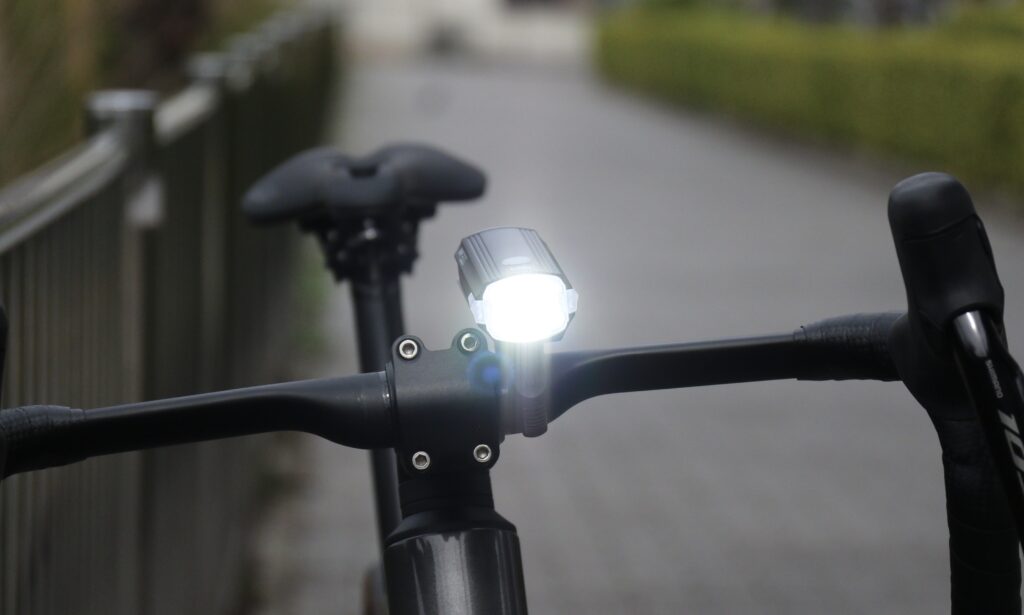
@tomlew My first reaction to the park photo was wow, that does not look like a 2200lumen light. I have a Light & Motion Taz 2000 lumen light and it does not create that level of brightness ... up to the tree stump, the pavement is washed out. I do not know, but it does seem that the camera settings are suspicious. There used to be sites like MTBR that did really good controlled images and comparative reviews of lights.
Personally, I think 2000 lumen is the minimum for road commuting and not really sufficient for MTB. So, likely this light is quite good for commuting.
@tomlew You claimed you were certain the photo was edited, now you're backtracking on that. It's really quite difficult to get a photo of a torch's performance without seeing it in person, as you have to balance for the darkness of the night and the brightness of the light. Obviously the two are really quite the opposite, so it's hard to get the middle ground which would represent the in-person experience.
I know this article is an ad, which is a shame, but that's how RoadCC stays afloat. I can appreciate that without assuming the whole article is a con.
Maybe have a bit more faith in people rather than assume the worst.
@tomlew "we’re talking about professionals" lol.
"it tells a lot." What does it tell? Are these photographer's sneaky? or lackadaisical? Are you concerned many viewers don't possess the technical to unpack a photo? Or is your concern wider in the possible sense millions may be affected by viewing an unrealistic photo and this renders detriment on the public square? If its the last one I'm in because its an inquiry not too far from cycling through a busy city.
@mdavidford Though the official proceedings of the Grand Prix begin Thursday morning, guessing his team want him there at least a day in advance so he will have to arrive by the end of today (Tuesday) so presumably he will complete the final 82 km today. Whilst "insane" might be slightly hyperbolic it's certainly a mighty impressive shift considering that Formula One is (as far as I understand it, which is not very far) one of the most physically demanding sports around.
@Terry Hutt Sure, we don't know the parameters. BUT. If you're a professional and still publish a photo which is so badly unrealistic, it tells a lot.
I was really hoping to avoid this, but you provoked me ;) Presenting a powerful lamp with no beam cutoff in an urban context just shows how badly the manufacturer does not understand urban cycling. Assuming the lamp needs to shine as much light on the tarmac as on the drivers' retinas is just poor engineering IMHO.
@Boopop Choosing a photo which obviously fakes the message does count as unfair tweaking in my book.
It would've been a different story if one was an amateur (or even a cycling blogger with no education in photography) and just took a random photo in the park.
Here we're talking about professionals who must have taken hundreds of photos in that session and had all the equipment and knownledge necessary to take a good, realistic photo.
Instead, they chose a picture that does anything but showing reality. This way, even if the lamp itself is good, I personally just steer clear of it because of the ad.
And quite honestly, I don't know which worries me more: that they did it or that there are people actually defending this obvious manipulation, who may one day fall victim of similar practices.
Really? Even if we allow that it's five days, rather than a full week, it's only averaging 37.5 miles a day. Taking out his imperial century leaves him an average of a whopping, er, 22 miles to do on the other four days.
@tomlew I think Terry's reply is a bit more sensible than yours. It's easy to make any light look like that with the right camera settings and a long enough exposure time. Suggesting it has to be photoshopped to achieve that effect suggests a poor understanding of how cameras can be used.
As for the colours... the grass is green, the tree bark is brown... *shrug*. White balance setting on the camera can affect colours too, do you consider that "tweaking"? You have to choose a white balance, you can't take a photo without the white balance set.