



Welcome to Thursday’s live blog, with Jack Sexty, Simon MacMichael and the rest of the team…

11 July 2019, 18:07
Froome experiencing major FOMO ahead of Tour's toughest stage
Massive FOMO today
Won my first @letour stage on La Planche des Belles Filles in 2012. What I wouldn’t give to be there racing it today
Please smash it @TeamINEOS https://t.co/3QVjDxbcEb— Chris Froome (@chrisfroome) 11 July 2019
That’s ‘fear of missing out’ if you weren’t aware, as stage six heads towards the place where Froome won his first Tour de France stage back in 2012.
11 July 2019, 18:07
Peter Sagan double-header
Sagan was back to his best yesterday, taking stage five in emphatic style – and once more gave something back to his eyewear sponsor 100% by donning one of their ski masks.
In other Sagan news, here he is convincing us the world is flat thanks to the Specialized range of e-bikes. The man can do no wrong…
11 July 2019, 18:07
Sir Dave Brailsford plays down rumours that he's set to step down as Ineos cycling team manager to take on wider role for the company

Ineos CEO Jim Radcliffe is known to be an admirer of his new cycling team’s general manager, and it was reported yesterday evening in the Telegraph that Brailsford could be set for a new role that would see him oversee all of Ineos’ sporting interests – which is growing at an alarming rate, having just purchased French League 1 football club Nice.
However, the Guardian reports that Brailsford was dismissive of the rumours when speaking to press before yesterday’s Tour de France stage, saying he doesn’t want to leave cycling completely: “You are constantly looking for things to challenge you and push you on. I don’t want to leave cycling, I love it too much, but equally I think this could be quite a challenge and it feels really invigorating.”
Brailsford is already set to be involved in Eliud Kipchoge’s second attempt to break two hours in the marathon , which is being organised by Ineos and will take place in Austria this October – do you think Brailsford will be tempted by a new challenge, and would the team be as successful without him?
11 July 2019, 18:07
Huge doping probe by Europol results in 234 arrests and 3.8 million substances seized

A big investigation by Europol, the European Union’s law enforcement agency, has led to a huge seizure of doping substances and led to 234 arrests, according to their press release. In all the bust shut down 17 organised groups, stopped operation at nine underground labs and seized 3.8 million doping substances and counterfeit medicines. Mario Thevis, head of Europol’s doping analysis lab in Cologne, said: “We learn from the case that obviously there is a big market. Only if there is a large market will imports and structures of this kind be built.“
It follows on from Operation Aderlass, when a number of pro cyclists and cross country skiers were caught in raids across Germany and Austria. No names in cycling have been implicated yet, but we’ll update if there are further developments.
11 July 2019, 18:07
Sagan's dad is pure gold
Well, @petosagan if we don’t see you on the start line bright and early, we know where you’ll be! #TDF2019 @BORAhansgrohe pic.twitter.com/6Ops3w1qn8
— Le Tour de France UK (@letour_uk) 10 July 2019
After three world championships and 11 stage victories at the Tour de France, it’s (sort of) lovely to see Peter Sagan’s old man acting like a complete loon celebrating his son’s twelfth TDF stage victory!
11 July 2019, 18:07
Adam Blythe rides today's brutal TdF stage finish on a Brompton - and pops a wheelie
How do you make a devastating climb look easy? Wheelie your way up… @AdamBlythe89 tackles La Planche des Belles Filles in the stage six recon finish #TDF2019 #TheBreakaway pic.twitter.com/mizH7BRwhs
— Eurosport UK (@Eurosport_UK) July 11, 2019
11 July 2019, 18:07
Dylan Teuns victorious on brutal stage 6 summit finish
Victory for @dylan_teuns!
Victoire pour @dylan_teuns !#TDF2019 pic.twitter.com/ySZiNdNMP7— Tour de France (@LeTour) 11 July 2019
Behind him, Geraint Thomas made up some time over other GC contenders with a very strong finish on the savage gradients and Giulio Ciccone put himself in the yellow jersey – full story to follow.
11 July 2019, 18:07
Strava vs Relive continued

With both sides blaming the other, Strava have made a new statement in response to Relive’s, standing by their view that Relive broke API terms by using the data of Strava members. Here’s the statement in full:
“We have strict standards for how our API partners utilise our member data. We deeply respect the trust of our member community and expect our partners to do the same.
“Relive’s current use of Strava member data violates our API agreement and we have ended its integration with Strava. We are disappointed that Relive was unwilling to make the changes necessary to comply with the agreement.”
11 July 2019, 18:07
The BBC tries to explain how a bicycle stays upright - and road.cc's John Stevenson points out where they went wrong
With bikes in the news after Channel 5’s portrayal of us cyclists as lawless killers, the BBC has gone after a bit of cycling-related website traffic with an article that asks the question ‘How does a bike stay upright?’
Good question, you might say, and it is. But unfortunately the article doesn’t get even close to answering it, and makes at least one serious error while failing to reach that destination.
After quite a lot of waffle about the gyroscopic effect of a spinning wheel, the piece concludes that this isn’t actually what keeps a bike upright as it rolls along. It cites Dr Hugh Hunt from the University of Cambridge, as having built bikes with extra, contra-rotating wheels cancelling out the gyro effect of the wheels on the ground. Turns out they’re still stable.
Rider skill, the article concludes, is what keeps a bike upright, which would be fine if it weren’t for the fact that you can push a riderless bike off down a slope and above a certain speed it will keep going.
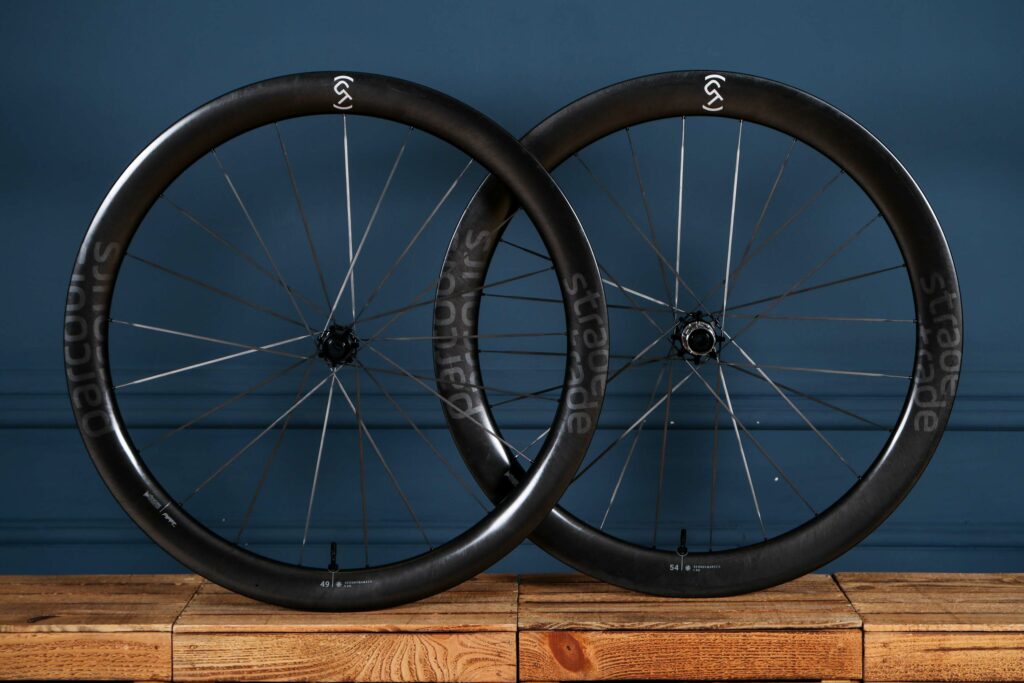
As well as failing to explain what keeps a moving bike upright, the Beeb repeats common misconception about wheels. It says: “when you sit on the bike, the axle pulls down on the rim and acts like an arch … you are, in effect, hanging off the rim of the wheel.”
Except you’re not. If that was how wheels worked, then the upper spokes in a loaded wheel would have higher tension than when not loaded. A few minutes with a spoke tensiometer reveals that they don’t change, but in fact the tension in the lower spokes reduces.
This matters because it implies something important about building wheels: high tension is good. If the tension in a spoke drops to zero, the nipple is free to turn, allowing the wheel to go out of true. If several spokes end up with zero tension, the wheel can collapse because the spokes are no longer holding the rim in place.
A good wheelbuilder therefore builds with as much spoke tension as the rim can take, and well-designed rims have sturdy spoke beds to take the load from the nipples. If spokes increased in tension when a wheel’s loaded none of this would matter, but observation confirms that under-tensioned wheels quickly develop problems and high-tension wheels don’t.









5 thoughts on “Live blog: Strava cuts ties with Relive, says new updates violate contract; road.cc’s John puts BBC straight on how bikes stay upright + more”
that peter fella is gold for
that peter fella is gold for our sport
You can link the following
You can link the following with Relive.cc too:
Endomondo, Garmin Connect, Runtastic, Suunto, MapMyRun | Walk | Ride | Hike & Polar Flow.
Redvee wrote:
i read it as “Relieve” and was thinking “top spots to pee while you’re riding- that’s brilliant”
“If that was how wheels
“If that was how wheels worked, then the upper spokes in a loaded wheel would have higher tension than when not loaded. A few minutes with a spoke tensiometer reveals that they don’t change, but in fact the tension in the lower spokes reduces.”
This doesn’t make sense. First part of the sentence says the tension doesn’t change, then after the comma says tension reduces. If you are going to criticise other people’s errors make sure your correction makes sense!
pruaga wrote:
I think it’s meant that the tension in the upper spokes doesn’t change whereas the tension in the lower spokes does change.