



Cyclists stand accused of putting themselves and others in danger on Britain’s roads by constantly breaking the law. Certain newspapers seem obsessed with cyclists supposedly terrorising the streets and you see comments on social media all the time condemning the behaviour of ‘Lycra louts’.
Our articles on changes to the Highway Code, including the introduction of a Hierarchy of Road Users and minimum 1.5-metre passing distance that have now been added the Code, led to a number of angry emails landing in the road.cc inbox: “Cyclist’s are all now taking to using the pavements to cycle”, “cyclists don’t give a crap”, “Cyclist must be insured to use the roads!”… there’s a brief flavour of the less positive communications we received about the article.
Back in 2019, we also reported that Talksport presenter Andy Goldstein had stated on air that 95% of cyclists jump red lights (among other gripes about cyclists). This kind of claim is common, but what’s the truth?

Comments on social media frequently cite the fact that many cyclists don’t wear helmets or bright clothing as evidence that we’re all criminals. You’ll know that this is nonsense. The Highway Code advises cyclists to wear a helmet and light-coloured clothing in daylight, and reflective clothing and/or accessories in the dark but, of course, these aren’t legal requirements.
You’ll also see comments complaining that cyclists are flouting the rules by wearing earphones, riding two abreast, positioning themselves in the middle of the lane, and not using cycle lanes. Again, you’ll know that none of these things are illegal.
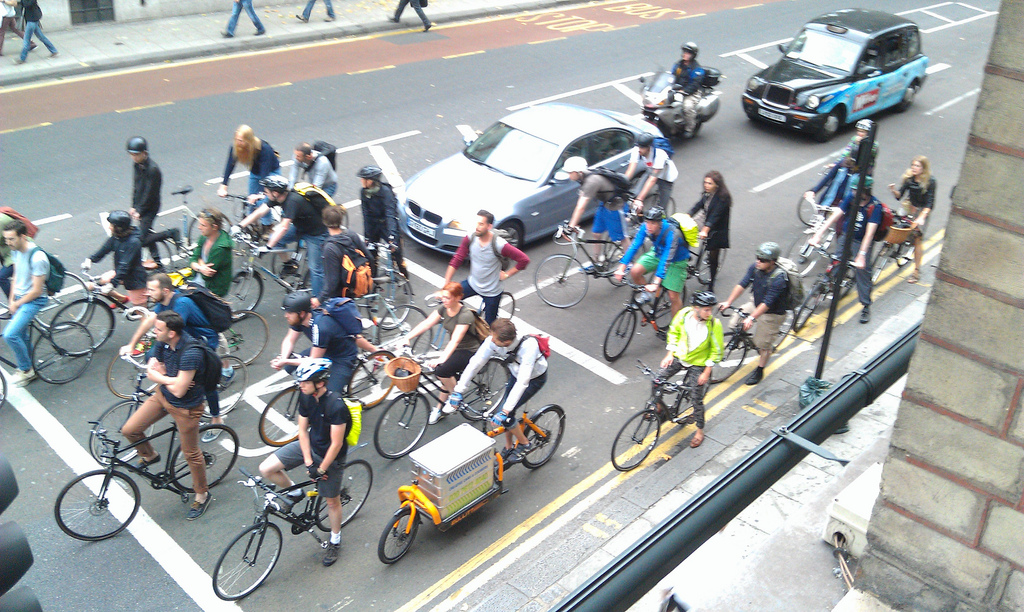
Jumping red lights is perhaps the classic complaint about cyclists. It’s an old favourite. This one at least gets off to a better start than most in that jumping red lights is against the law (some cyclists jump red lights because they feel safer moving into open space at signalised junctions rather than waiting for the following traffic to accelerate into that junction when the lights turn green – but the rights and wrongs or jumping red lights are a topic for another day).
How many cyclists jump red lights, then?
Back in 2007 (yes, we’re going back a bit here, but there’s not a lot of quantitative evidence out there), Transport for London’s Road Network Performance & Research Team looked at the proportion of cyclists who jumped red lights at five sites in the capital and said, “An average of 16% violated red lights, whilst the remaining 84% obeyed the traffic signals. Therefore it can be concluded that the majority of cyclists do not ride through red lights.”
More recently, in a 2013 YouGov survey 27% of London cyclists said they ignored red lights occasionally while another 8% said that they did so often. This survey relied on self-reporting and we couldn’t judge its accuracy.
Many road users will tell you that the figures are higher than this. You’ll sometimes hear claims of people seeing dozens – maybe hundreds – of cyclists jumping certain traffic lights every day. They might be right. How much of a safety concern is this? Let’s have a look at some more stats…
From 2007-16, no pedestrians in Britain were killed by red light jumping cyclists, while around five a year were killed by red light jumping drivers. For pedestrians hit by red light jumpers, just 7.6% of those slightly injured and 5.4% of those seriously injured involved cyclists. The other 92%-95% involved motor vehicles.
The percentages relating to cyclists are higher in London, where the concentration of pedestrians, cyclists and traffic lights is particularly heavy: 16% of pedestrians injured or seriously injured by red light jumpers were hit by cyclists, the other 84% involved drivers/riders of motor vehicles.
Judged purely on the number of casualties, red light jumping motorists are a far greater problem than red light jumping cyclists.
If it sounds like this is turning into an ‘Us versus Them’ thing, bear in mind that almost everyone on the road.cc staff is a motorist as well as a cyclist, the vast majority of you road.cc readers are both, and about 90% of British Cycling members also drive. However, if cyclists are singled out for breaking the law it makes sense to examine the degree to which other road users stick to it as a means of comparison.
According to the Department for Transport’s Vehicle Speed Compliance Statistics, 48% of car drivers exceeded the speed limit on motorways in 2017, 52% exceeded the speed limit on 30mph roads, and a massive 86% exceeded the speed limit on 20mph roads under free flow conditions.
How big a problem is exceeding the speed limit? Well, more figures from the Department for Transport say that in 2017 it was reported as a contributory factor in accidents that resulted in 220 deaths, 1,493 serious injuries and 5,855 slight injuries (travelling too fast for the conditions but within the speed limit was reported as a contributory factor in many, many more injuries and deaths). A massive problem, then.
The consequences of cyclists jumping red lights are small compared with the consequences of motorists jumping red lights, and they’re tiny compared with the consequences of motorists speeding. In fact, all of those usual gripes you hear about cyclists – riding on the pavement and the like – result in very few casualties.
Despite that, it’s cyclists who are routinely denounced as “a dangerous nuisance”, “a threat to safety” and the like on social media, and you’ll encounter headlines like “Cyclists kill or maim two pedestrians every week, according to statistics” in The Express… ignoring the fact that between 2007 and 2016 motor vehicles were involved in 98.5% of collisions where a pedestrian was seriously injured and 99.4% of collisions in which a pedestrian died. The biggest threat to pedestrians certainly doesn’t come from cyclists!
Mile for mile, pedestrians are more likely to be killed by a motor vehicle than by a bicycle. From 2012 to 2016 in Great Britain, for every one billion miles ridden overall, cycles were involved in 1.4 pedestrian fatalities. For every one billion miles they were driven, cars were involved in 1.9 pedestrian fatalities.
Cyclists breaking the law can sometimes have major – occasionally tragic – consequences, but why do so many people seem convinced that the problem is bigger than it actually is? There’s a huge disparity between perception and reality here.
We’d guess – and it is a guess – it’s partly because jumping a red light and riding on the pavement are so much more obvious than a motorist doing 35mph in a 30 zone. Plus, some people simply seem to believe that speeding at 85mph on a motorway in a two tonne vehicle is perfectly acceptable in a way that riding a push bike at night with a light out isn’t.
Research prepared for the Department for Transport also suggests that drivers can exaggerate the misbehaviour of cyclists because of a tendency to see us as an ‘out group’, and are prone to “overgeneralise from the behaviour of individual members of an ‘out group’ to the behaviour of members of the ‘out group’ as a whole.”
We’ll leave the final word to Sam Jones, Cycling UK’s senior campaigns officer.
“Sometimes it feels as though cyclists are represented in the national media as the ‘real danger’ of our roads,” he said. “The reality is that we cause negligible harm, but are disproportionately at risk of suffering serious injury. While that might seem to paint a grim picture for us cyclists, it’s worth bearing in mind Britain’s roads are relatively safe, and the benefits of cycling will always far outweigh any risks.
“Just because cyclists represent a smaller risk to other road users, that doesn’t justify inconsiderate or dangerous cycling. Cycling UK would encourage everyone to cycle considerately and within the boundaries of the law.
“The main problem is the shocking injustice that victims of road traffic incidents all too often face. It’s high time the Government took this problem seriously and ended the injustice suffered by far too many families who are being let down by the system.”
Cycling UK has compiled an excellent document to counter many of the accusations most commonly fired at cyclists, by the way. Check it out here.




















75 thoughts on “‘Cyclists are always breaking the law and are a menace on the roads’ – cycling myths debunked”
Thanks Mat, fine article.
Thanks Mat, fine article.
This is a well written
This is a well written article that makes a lot of good points but I feel it’s preaching to the converted, what I wonder is why do so many people believe cyclists are so dangerous? Putting stats aside as a pedestrian I’d fancy my chances far better being hit by a cyclist rather than a car and as a motorist, a car running a red light is a genuine concern to me whereas a cyclist is no threat at all just to themselves.
What I find particularly alarming is when well educated individuals such as Sir Robert Winston who you’d think would be someone who could understand statistics, criticises cyclists for the danger they cause. Is it as simple as people wanting ammunition to fuel their own anti-cycling beliefs?
I find it strange how many people just accept that cars will kill and seriously injure many people every year it’s just ignored. When Charlie Allison was in the headlines and last year when an e-bike rider tragically killed a pedestrian, I saw many people expressing their concern about the increasing threat cyclists posed and that new laws were urgently required to stop this problem. In a forum thread that had been open for over two weeks discussing the e-bike pedestrian death I pointed out to these people so gravely concerned about the threat cyclists pose that in the time the topic had been open it’s likely many people had been killed or seriously injured by motorists. That doesn’t seem to count though.
Unfortunately some cyclists
Unfortunately some cyclists don’t do any favours for other cyclists. The number of times I see red light jumpers when pedestrians or women with prams have been waiting to cross is alarming.
ShaunC wrote:
no it doesn’t give other people who ride bikes a bad rap or doesn’t not do them a favour, just like moron drivers doing far worse at red light, and on pavements/footways and pretty much everywhere else don’t for all drivers.
The facts as they stand prove peds do more harm to themselves than people on bikes when the two groups are in a collision, we know this from a government review last year.
In the grand scheme of things dangerous cycling is infinitsimally small, you’re 5x more likely to get killed by lighting in the UK than you are being killed by an at fault cyclist.
CyclingInBeastMode wrote:
no it doesn’t give other people who ride bikes a bad rap or doesn’t not do them a favour— ShaunC
Except it does. It shouldn’t, it isn’t fair, but it does.
mdavidford wrote:
No, it doesn’t. What’s your evidence that it does? Other than what motorists _say_ to justify their own bad behaviour. They tend to lie about such things, so that’s not evidence.
FluffyKittenofTindalos wrote:
Except it does. It shouldn’t, it isn’t fair, but it does.
— CyclingInBeastMode No, it doesn’t. What’s your evidence that it does? Other than what motorists _say_ to justify their own bad behaviour. They tend to lie about such things, so that’s not evidence.— ShaunC
To be fair, what other evidence do you expect anyone to be able to give? It’s necessarily going to be anecdotal experience of e.g. motorists tarring us all with the same brush. If “you lot all jump red lights” is their first line of defence, it does suggest the collective responsibility idea has gained some currency. By the same token, what’s your evidence that motorists tend to lie about such things? I can give you some first hand evidence though – one of my family got knocked over on a pedestrian crossing by a RLJing cyclist, suffering broken bones. I know that only one cyclist was responsible for that, but I still take a pretty dim view of other RLJers as a result. And I don’t tend to lie about such things.
Good article, whiich provides
Good article, whiich provides useful disinfectant when people throw the lycra lout dead cat on the table. As long as people are talking about lycra louts they’re not talking about or, more importantly, legislating against motorists.
Theres a weird rabid phobia
Theres a weird rabid phobia in this country. Trying to find a rational explanation is impossible because the behaviour is irrational. I think its a mixed form of racism, self loathing, hatred towards people doing something different that people cant comprehend themselves doing, and a god given sense of entitlement from car drivers. I also think it may be to do with the appearance thing, i.e the wearing of lycra.
thanks once again for another
thanks once again for another article that says much the same thing as has been stated foryears…, It would be good to have data, anecdotal or otherwise, for how many pedestrains ignore red lights..or put themselves in risky positions by not looking before stepping into the road or wearing headphones. I know it is different but ultimately it is about sharing space and being considerate to each other..
I’ll hold my hand up as a more than occasional red light transgressor, with the caveat that all my riding is based around being able to stop for the unexpected…so slow down, look once, look twice, proceed. if there is a pedestrian then stop until they have crossed…40 years riding in London makes you alert to everything but not infallible.
The cyclists I feel are dangerous (to others and themselves) are the ones who are unaware of how people and traffic move and put themsleves in high risk positions on the road….it makes me nervous to think they’ll end up in hospital for poor road craft.
The other major difference is
The other major difference is that red light jumping cyclists often do it when the lights have been red for a while and go through slowly, whereas most drivers going through red lights do it at speed to get through a light that has just changed. The cyclist is mainly putting themsleves in danger, whereas the driver is putting pedestrians and other road users into danger.
MarsFlyer wrote:
Yeah aye.. I don’t know about all but I tend to jump at the end of the red cycle. Been stationary, know lights routine, road is clear and (not putting myself in danger), a 2 metre jump allows me space while starting to build momentum again (not so much fore aft space, between the quarter islands space eg 2metres from side of passing cars).
Red light cameras down here are complimented with speed cameras. Originally lots were discouraged from running a red although encouraged to sprint intersections instead. Caution, smile, speed cameras nowadays too.
Naughty drivers 🙂
MarsFlyer wrote:
I think your point is mostly about the relative risks involved, but I think the different behaviours of RLJing cyclists and drivers is also why people seem so enraged by RLJing cyclists. Generally, drivers flouting red lights seem to be amber gamblers, squeezing through a light just before (or after) it turns red. Cyclists flouting reds may be (1) amber gamblers (who will sometimes do it because they’re not sure the car behind them will stop if they do…), (2) ‘marginal anticipators’ who are making a sharp start as or just before a light goes green to get away from vehicles behind, or (3) just sailing through a light which has been (and will be) solid red for some time.
In my experience, category 3 is very rare in drivers , and on the very few occasions I have seen it, it is truly shocking. This sort of RLJing is more common in cyclists, and I think it’s this type which is noticeable and pisses people off.
On your relative risk point, to play devil’s advocate, someone doing a category 1 or 2 RLJ may well be passing through the junction on a brief ‘neutral’ phase, when no other road user has a signal to proceed, and may therefore pose relatively little risk of incident. The category 3 cyclists I see though often (not always) show a complete disregard for other (more vulnerable) road users who actually have priority at that time. Some do proceed with caution, but I see many who blow through reds at speed.
Would be interesting to get a
Would be interesting to get a viewpoint from someone who knows a lot more about human psychology, but I was wondering whether there is a much more personal and therefore memorable element about a close miss with a cyclist where you get to see the person and possibly engage in verbal dialogue compared to the anonymity provided by a car?
Mungecrundle wrote:
I’ve no qualifications; I was once spoken to as a martial arts expert though. (I achieved a white belt. Lol. Sort of a budget in a sense. No point owning more than 1 belt. Limited language but never really learnt to branch few moves I learnt. Psychology? Used to jog 1.5km including a double crossing of highway with my eyes shut. At work a 2 tonne gantry toppled whilst suspending about 1 tonne of road train v8 block and part chassis rails. The ‘H’ beam hit my head as 3-5mm edge of beam found rest upon my stance. I was knocked out dude and when I found conscious, stars circled my eyes, my boss looked confused and was asking questions while I was too scared to move jaw as yaw balance was required to keep stance. (Didn’t even bleed nor bruise. Amazing aye)
Bicycles have superior primary safety, eg avoidance of collision. Secondary safety low. Eg gone if ya get hit.
Cars have excellent secondary safety as pilots are cocooned in a safety cell. Seems like a lot of drivers are complacent knowing that they can afford an accident without self harm.
Hence invading a drivers privacy of saftey cell might appear to be personal whereas invading requirements of a cyclist to maintain primary safety might not be as personally felt because machine was breaching space and an auto isn’t felt as personal as a persons directed voice.
Smile 🙂 ride a mile.
Alloys rule. Yeah
I have been musing recently
I have been musing recently that there might be an secondary perception issue in that it is well understood that getting hit by a motor vehicle could be fatal, as such it is considered and easy thing to do. However it is less well understood that you can have a fatal accident just falling over and hitting your head, and so less well understood that a collision with a cyclist cause such harm, as such viewed as more difficult to achieve so then viewed in someway that the cyclist must have been behaving in a way far more dangerous than a motorist who’s actions had the same result.
People seem to have a disconnect between probability and risk, in that you are far more likely to be killed in a car accident on the way to an airport than on a plane, yet many people still fear flying.
The point that has irked me more recently, the complete disconnect that 1/20 people die prematurely each year from air polution. Yet still “green” active transport is demonised. We are facing as a society many crisis which have a link to motorised personal transport, obesety, polution and road death on a scale that makes the most wars look pretty safe. Yet still soceity finds ways to demonise those looking for better solutions.
I get very angry with the vitrol I read on this subject, having been hit 3 times and more near misses than Fidel Castro. I am well aware when I leave for work in the morning, leave to come home in the evening, or go out for a leasure ride on the weekend – it might be my last, the persons responsible will be told “it’s alright these things happen” (if they actually stop or even have enough empathy to care at all). It is something that is on my mind a lot, might have stopped altogether by now if I wasn’t so stubborn.
I hope one day the situation improves, but the realist in me has only seen in get worse and I don’t yet see any light in this cave.
“The biggest threat to
“The biggest threat to pedestrians certainly doesn’t come from cyclists!”
No indeed, but you could say the same for the threat from cars over 500bhp. There simply are not that many of them. Which does not make it a worthwhile argument.
If it transpired that 16% of such cars jumped red lights, there would rightly be calls to curb these reckless high performace drivers, despite their paucity of numbers. Indeed, it is telling that you chose to truncate from the quote the final sentence. To help I have put the bit you edited out in bold:
“… an average of 16% violated red lights, whilst the remaining 84% obeyed the traffic signals. Therefore it can be concluded that the majority of cyclists do not ride through red lights. [b] However, the 16% that do must be discouraged from ignoring traffic signals. [/b]”
Sriracha wrote:
I agree so long as the traffic signals are fit for purpose – in both the places I have lived in the UK I have come across so called “smart” traffic lights that seem incapable on picking up cyclists. In early morning rides when cars aren’t about (the whole reason I leave early) to continue your journey you have no option but to cross a red light or wait in excess of 5 minutes for a car to turn up and trigger the lights – obviously you also must take responsibility for doing so safely.
kt26 wrote:
It’s legal to cross a non-functional traffic light. You treat it like a give way.
vonhelmet wrote:
I agree so long as the traffic signals are fit for purpose – in both the places I have lived in the UK I have come across so called “smart” traffic lights that seem incapable on picking up cyclists. In early morning rides when cars aren’t about (the whole reason I leave early) to continue your journey you have no option but to cross a red light or wait in excess of 5 minutes for a car to turn up and trigger the lights – obviously you also must take responsibility for doing so safely.— kt26 It’s legal to cross a non-functional traffic light. You treat it like a give way.— Sriracha
Thanks, I appreciate your point however there is an onus to prove the light is defective which I feel the plod will argue isn’t the case when they turn up with the their police car and the light turns green.
My bigger issue is that this is such a problem, many a time I have found myself having to try and role my bike repeatedly over a narrow unresponsive sensor, or pull forward and gesture to the car behind to pull forward over the sensor because I can’t set it off and you can’t see the way is clear.
Otherwise I obey traffic signals, and shake my head at those that don’t. But it isn’t hard to see how such experiences would drive some to lose respect for and ultimately disregard them.
Hi kt26 ,
Hi kt26 ,
After riding round my local area ,( Chester ) I’ve noticed two different types of ” smart ” traffic lights . The older type , which do not pick up a single cyclist and a newer type , recognisable by a small antenna attached which does pick up me on my Cannondale . See if you have any where you live
Sriracha wrote:
I’m pretty sure that given the opportunity, much more than 16% of motorists jump lights – and by “given the opportunity”, I mean when they are at a traffic, but a prevented from jumping the light due to the presence of another road user who has stop at the junction, denying them the opportunity.
There are junctions where I routinely see several cars driven through the junction after the light turns red, the vast majority of motorists will drive through on amber when they have the they could safely stop behind the stop line. Most drivers when they do stop for a red light will pass the stop line or advanced stop line (and often both) after the light has turned red. Even the ones who manage to stop behind the stop line, will then proceed to creep forward past the stop line whilst the light is still red. These are all technically the same offence – they might not generally be at all dangerous, but then neither are the vast majority of the times that a cyclist proceeds through a red light.
Well said Sriracha. Everyone
Well said Sriracha. Everyone needs to play by the rules. For me it all boils down to a need for better infrastructure backed up by better enforcement. Who’s gonna pay though? Until society sees the light and stumps up it’ll be the vulnerable road users…..
danhopgood wrote:
It could be funded if we decided to crack down on speeding motorists and use some of their fines. After all, everyone needs to play by the rules.
hawkinspeter wrote:
Or cancelled HS2, or Trident, or the road programme.
I find it odd that the 16% of
I find it odd that the 16% of cyclists who jump red lights rougly equates to the 14% of motorists who actually abide by the law in a 20mph speed limit.
From my own observations on
From my own observations on my regular lunchtime walk alongside a moderately busy small rural town A road, somewhere between 7% and 15% of drivers at any one time are doing something that could be enforceable by fine / points:
Active use of a mobile phone
Eating, drinking, smoking
Reading delivery notes or paperwork
Blatant speeding
Jumping red lights
Plus apparently there are a significant number driving whilst untaxed, unlicensed, un-insured, without a valid MOT or with vehicle defects. Not to mention those who are inebriated or unfit to drive through drugs – prescription or otherwise.
In my home town in the last 5 years there have been multiple pedestrian fatalities involving a motor vehicle, including a fire engine on an emergency callout.
I’m not saying that people using bicycles in an antisocial way should get a free pass on account of someone else is doing something worse, but when it comes to policing and allocation of limited resources to improve pedestrian safety, cyclists have to be a long way down any evidence based list of priorities.
I’m not excusing any bad
I’m not excusing any bad behaviour by car drivers but I think one reason cycling is so demonised and annoys so many is the anxiety (then expressed as anger) caused by sharing the road with such a vunerable user. I think this is also why the debate often becomes so polarised: a cyclist hit by a car is potentially dead or seriously injured and in 99% of cases this something neither wants, but its potential creates a lot of fear. Therefore, if people see something that regularly causes them stress, then rightly or wrongly, they are probably going to want to bemoan it.
Having said that, there are a lot of very angry / thoughtless / stupid people who really ought not be allowed behind the wheel of a car…or the bars of a bicycle.
McVittees wrote:
That’s not entirely logical as the majority of cycle related injuries are caused by poor driving of motor vehicles. If people were being triggered by that, they’d be demonising the drivers that jump red lights, speed, drive distracted etc.
hawkinspeter wrote:
…
— hawkinspeter That’s not entirely logical as the majority of cycle related injuries are caused by poor driving of motor vehicles. If people were being triggered by that, they’d be demonising the drivers that jump red lights, speed, drive distracted etc.— McVittees
I think there is a logical point here. If, as a motorist, you are stressed that you might injure someone, or might be blamed for injuring them, then you may act irrationally around them. Hence the driver who, on coming round a blind bend too fast towards me got aggressive and among other things said “But what if I’d hit you?”.
Though I’d ascribe more poor driving to unawareness, inattentiveness, bloody mindedness, and direct hostility.
McVittees wrote:
This falls down though in that the most vociferous complaints about cyclists come from the drivers who behave worst around them. This doesn’t seem to be the symptom of someone who is worried for the cyclists safety only upset about the perceievd loss of their own time.
Cycling’s biggest problem is
Cycling’s biggest problem is its biggest attraction. Anyone can get on one.
Even among those who cycle regularly I’d argue some shouldn’t be on the road. A guy at work who only rides and doesn’t drive because he was famously shit at it is also pretty shit at riding. Some people shouldn’t be allowed on the roads at all, they just have no natural balance or spacial awareness. They’re like drunks except they’re not.
Rick_Rude wrote:
I’d say the bit I bolded is more the point here – cars very weirdly are seen as a sign of wealth, of power. Those in a £500 Corsa still feel superior and more entitled to somebody on a £8k bike!
As for those incapable of riding well, I’d suggest that’s around 0.0001% and still a significantly lesser risk than those in cars. I’d suggest the majority of shit riders choose to ride that way…
1.8% of vehicles are untaxed.
1.8% of vehicles are untaxed.
https://assets.publishing.service.gov.uk/government/uploads/system/uploads/attachment_data/file/659918/vehicle-excise-duty-evasion-statistics-2017.pdf
In addition, there are vehicles that have no MOT and/or are uninsured. Those that are untaxed are likely to lack one if not both of these.
In addition, there are vehicles with a SORN that are on the road and are therefore unlikely to have insurance or an MOT.
On top of that, there are drivers without licences and those driving whilst disqualified or unfit.
Then there are vehicles with MOT’s that would fail if tested.
Add the frustrated red light jumpers who have to stop because the car in front does.
It makes it a joy to be out on the road :o)
nniff – I commute around 10
nniff – I commute around 10 miles morning and 10 in the evening probably being passed by around 100 killing machines each way. It beggars belief that statistically I’m maybe at risk by 10 drivers per day (not to count the ones with all the credentials but no idea) yet the general public think I need taxing, insuring and identifying!!!
For me, the ongoing
For me, the ongoing frustration/irony of drivers accusing cyclists of being a danger on the because we haven’t had to be trained and undergo a test is that even drivers only have to prove their competence once. Over a single 45 minute period.
I passed my test in 1987 (so no written test, no parallel parking etc.) and get to keep that licence for another 20 years without at any point having to prove my continued competence to take a vehicle on the road, in spite of vehicles in general being more powerful, and more numerous, than they were in the lat 1980s.
I also do not ever have to even look at the highway code no matter how many changes and updates are made.
I would have more sympathy with the argument for compulsory cycle training if it wasn’t so easy to get a driving licence and keep it for 50 years+.
Jetmans Dad wrote:
But if you look at the stats drivers who passed there tests 20-40 years ago are not high risk groups.
The cost of retraining drivers would be pretty massive simply because there are a lot of them and the evidence that it would have any impact on what are already pretty low numbers of deaths is not there.
If you were to look at what the highest risk group is by a mile, it is motorcycle riders, there are also pretty much the highest trained group of road users.
There are better ways to spend the money, e.g. cycle paths and road improvements, particulary on out of town A/B roads with blind bends and concealed entrances.
I had a browse through the stats after reading this, one of the most basic observations was that in 2018 26% of car occupant fatalities were not wearing their seatbelt! Hence why to get a 5 star NCAP you need an annoying bong if the seatbelt isn’t fastened which is a relatively cheap intervention.
Go into any big city near a
Go into any big city near a uni or college and you’ll see plenty of cyclists that look like they need stabilisers or something. Not saying you should be able to be doing nose manual tailwhips down the road but some people do look a liability on 2 wheels.
I remember when I did my CBT and the instructor told us you get some useless sods thinking they can ride motorbikes. This one lad turned up, started to ride off and dropped it…repeatedly. When asked if he could ride a bicycle, he couldn’t!
I think that there is an
I think that there is an institutionalised attitude that car = right/correct. At a recent inquest in East Yorkshire, a Coroner decided that it was a tragic accident that resulted in the death of a drunk, unqulified and therefore uninsured driver when his car left the road and hit a tree. He did not consider the facts that the deceased was unqualified to drive a car and had consumed seven pints of lager to be contributing factors in the drivers death. Until attitudes like this Coroners are corrected, cyclists will always be an outgroup. Personally I’m just grateful that this driver did not kill anyone else.
I know this article is far
I know this article is far from new and much had been commented, but the closeness of the fatalities per billion miles between cars and bikes is a surprise – 1.9 vs 1.4. Either being hit by a cyclist is more dangerous than I thought, or cyclists hit pedestrians more often per mile than I realised. Perhaps the stats are skewed by the masses of pedestrian-free miles done on motorways etc. In any case, we need to get that number down. I’d like to know if shared use paths might be part of that problem – I usually avoid them due to the unpredictable movement of some pedestrians (and broken glass, aimed fireworks, piano wire left by the local branch of the Great Escape Re-enactment Society, etc).
I was interested by the
I was interested by the proximity of the figures too- I think you are probably right- millions of miles on motorways and dual carriageways where there are no pedestrians at all, whereas the majority of cyclist miles will be in urban areas.
The closeness is interesting
The closeness is interesting but warrants more digging – with the caveat tha the “number of casualties I am likely to cause in a lifetime’s cycling” numbers are really tiny so “chance” may not be just a hand-waving excuse.
Cyclists travel some places cars don’t and vice versa. Also, aside from the motorways there’s a general effect of roads seeing less pedestrian motor vehicle casualties because there are fewer people outside cars on them. As was said back in the day (1920s?) – the child, the animal and the pedestrian have learned to get out of the way of the car. Or rather – we’ve depressed their road usage. We also put barriers to keep them off the roads.
I think the biggest issue for
I think the biggest issue for drivers is that cyclists cause them to move out of the line they were travelling in, slow down to do so, keep an eye on what cyclists are doing and having to be that much more attentive. That is seen as an irritation when infact it is forcing awareness. If better cycle lanes were available – without road debris, lampposts, overhanging bushes, etc – it would allow both to coexist better. Also, dedicated lanes for cycling only. So many are shared with walkers, why not clearly indicate where walkers and cyclists should try to travel? It works in other countries.
This whole piece is very much
This whole piece is very much like the Daily Mail articles it decrys, just in inverse. Deflect blame to the out group and then climb a hobby horse.
For them it is cyclists jumping red lights for this publication it is car drivers speeding. This is despite the fact that speeding is not even close to being the most common factor in road accidents/deaths. Where is the vitrol towards “looked didn’t see” and “failed to anticipate the path of another vehicle”.
Secondly the quantity of lies/damn lies/statistics most of which can be pulled apart pretty easily. E.g. 85mph on the motorway is the upper quartile speed of cars on a non congested motorway, there is around 100 deaths per year in 60 billion passenger miles of driving on these roads, ergo 85 on the motorway is pretty safe.
Rather than being anti car cycling groups should be pro road safety and road utility. Rather than pointing fingers at speeding and red light jumping it would be a lot more productive to ask why do people do these things and fix the infrastructure to accomodate human behaviour. (example green waves where cyclists don’t have to jump red lights, cycling infrastructure that simply doesn’t have red lights on it or improved A and B roads with less lethal features that allow motorised traffic to get where it wants to go)
This post needs more likes
This post needs more likes
“Rather than being anti car,
“Rather than being anti car, cycling groups should be pro road safety and road utility.”
Amen to that Brother.
But you have to admit, when some gammon starts spouting off about cyclists being a danger, directing them to their local news website which will undoubtedly carry several reports of deaths, injuries, traffic jams due to collisions and all manner of motor vehicle related mayhem is a good argument about where their own road safety concerns should really be prioritised.
Mungecrundle wrote:
This is one of Road.cc’s nods to the environment – the comment you’re replying to is a year old….
I only noticed after the fact
I only noticed after the fact. Reduce, re-use, recycle! And all that…
Quote:
I’m not about to dispute the numbers, but without some reference to a base rate they are all but meaningless. The best construction that can be put on them is that cyclists, in their current numbers, are too few to have much impact on KSI figures of others. And so long as their numbers remain low they are probably not much worth bothering about.
But that leaves the way wide open for others to argue that, in proportion to their far greater numbers, drivers cause less harm. And that therefore every motorist replaced by a cyclist acts only to increase the danger to others.
Now I don’t know if that is true, and it is difficult to find the appropriate base rate – is it per mile travelled, per hour travelled, or what. But certainly just comparing the raw numbers for the relatively few cyclists against the overwhelmingly greater number of drivers is not sensible.
Oh, and the last time I did have a stab at comparing the two relative to some base rate, it didn’t look so clever for cyclists.
But that is false comparison.
But that is false comparison. At any given set of traffic lights, only one vehicle per lane can go through the lights at a time (not including those instances where a chain of vehicles plays follow-my-leader through on red). So the greater volume of cars is managed down by the fact the opportunity to go through on red is limited to one vehicle per lane plus outlying data.
You’re saying that because
You’re saying that because the opportunities for cyclists to jump red lights are greater than for motorists they should get a pass on the consequences? I’m missing something in the logic.
Regardless, my argument is less about the specific offence of RLJ, more about the impact on KSI (of others) of cyclists as compared with motorists. If the relatively low impact of cyclists rests mainly on their low number then it’s not much incentive to increase their number.
Sriracha wrote:
Yes, you are missing something in the logic as far as it relates to the context of RLJs. It’s not about giving cyclists a ‘pass’, but about not pro rating the numbers because there are more cars on the road. There are more cars on the road, but they are not all at the stop line. In other words, you cannot give statistical credit for stopping at a red light to the car behind the one that stops at the red light. In that microexample, there is only one car that stopped for a red light.
OK, but you quoted specifically in the context of RLJs, so I concentrated on that. Nevertheless, fortunately we have other countries to look at where there are more cycles and more cycling, and we don’t see disproportionate serious injuries involving cyclists. Moreover, if we are not lookingat RLJs, we should be careful that we do not mistake KSIs involving cyclists with pedestrians as collisions caused by cyclists with pedestrians. Remove the RLJ and you remove a causative liability factor.
You seem to be appealing to
You seem to be appealing to some sense of fairness, that we ought to level the playing field before comparing cyclists against motorists. I don’t see why we should – I’m only looking at the trajectory of the figures if cars are replaced by bicycles as a mode of travel.
So to take your example, if ten cars queueing at a red light were replaced by ten bicycles you’re saying we have ten potential RLJs instead of just the one motorist at the head of the queue, and that distorts the figures. Whereas I’m saying, if that is how it is then that is how it is measured.
Sriracha wrote:
Nothing to do with fairness, it’s to do with understanding statistics and what base lane should be used.
That isn’t my example; I’m not saying that; it isn’t how it is and it isn’t how it’s measured. But there are too many presumptions to fix in the statement.
Sriracha wrote:
No – they’re saying that if you have 10 drivers and 1 cyclist approaching the lights you have 2 potential RLJs – one driver and one cyclist. And if you have 10 cyclists and one driver approaching the lights you have 2 potential RLJs – one driver and one cyclist.*
But in the latter case, an analysis based on modal share will dilute the danger from cycling because of the 9 irrelevant cyclists, and vice versa for the former case.
Or, to think of it another way, imagine that there are equal numbers of cars and bicycles on the roads, and you only ever get one of each approaching lights as they change. But there are then 10 times as many cars parked in a giant car park somewhere. It would make no sense to include those cars in the car park when calculating how likely a car is to be involved in killing or injuring someone due to jumping lights. The cars from number 2 in a queue backwards are similar to the cars in the car park.
[*Roughly speaking. There can of course be cases where the first car or cyclist jumps the lights, and the second follows them through, and in the case of cycling there’s more of an opportunity for the second cyclist to go around the first and jump the lights, which skews things even more in favour of driving.]
Sriracha wrote:
It’s always worth checking / computing rates but I think we’re safe on “any number factor times zero pedestrians killed isn’t a problem”. So your last about “not worth bothering about” applies.
Being cautious of course we should also check the “externalities” e.g. is this because – like cars / car infrastructure – the cyclists are suppressing walking / scaring the pedestrians off the roads? Unlikely. Maybe three cyclists in the UK are actually a homicidal maniacs – but the casualty numbers are low as they only go out once a year? (There are certainly some wronguns on bikes and cycling doesn’t make you a saint but this is likely still a no due to the much lesser potential for harm.) etc.
I take your general point – on-road cycling is still a minority activity in the UK and currently it’s likely that both the small numbers and “self-selecting” effects may skew what a “cyclist” looks like, relative to the averages of the wider population.
I’m not sure what the baseline should be either and it depends on the question. Given that car use and bike use is not “like-for-like” in several ways is it even worth starting? If so then maybe a “trip-based” count?
This is usually ignored by
Base rate is usually ignored by most of the cycling press.
If the above numbers are correct then on a national scale cyclists are over represented in terms of pedestrian KSIs caused by RLJ.
Which, unfortunately, partially justifies the continual complaints about cyclists jumping red lights.
Can you show your working?
Can you show your working?
The percentage of RLJ
The percentage of RLJ injuries caused by cyclists is greater than cyclists’ modal share of traffic on a national level.
Rich_cb wrote:
A modal share of traffic everywhere? Including all the car dominated rural highways and motorways that have either no traffic lights, no pedestrians or no combination of the two?
Can you explain why anyone would think that is an appropriate base rate to use?
Which is why I was careful to
Which is why I was careful to include the word “national”.
Do you have any better data?
Edit: According to 2019 DfT statistics cyclists travelled 2.5bn miles on urban roads. This compares to 132.4bn miles for all traffic. Cyclists therefore represent 1.9% of all urban miles travelled.
They are still significantly overrepresented in terms of injuries to pedestrians caused by RLJ.
Rich_cb wrote:
Base rate is usually ignored by most of the
cyclingpress.As for “justification” not really because the complaints have nothing to do with stats, numbers or indeed logic. Pretty sure that’s entirely about “someone who’s not in my group / a minority not following the rules” which we’re very sensitive to as humans. Will people cite the research in justification? Sure – but you’ll find most of the audience would be equally happy with “a cyclist nearly killed my friend the other day”.
Given the billion miles rate at the mileage I cycle I’ll need a lot of reincarnation before I see one of these. (Wonder if converting to “per time travelled” is any better though. Does a “trip based” measure make any sense?). Tiny numbers in absolute terms so is it worth digging deeper in the UK at all? Is it possible to learn anything more widely applicable from the number (zero killed, not many injured in some years)? Genuine question about the significance of these. If no-one died in the last x years, you make a change and one person dies over the next two can you say if this is success or failure from the stats?
Anyway I’m all for priorities and the low hanging fruit so let’s talk about fixing sponges, tea cosies, socks and trousers (yeah, 2000). Or if we want to keep to “infrastructure” then stairs.
Your last paragraph is just
Your last paragraph is just multiple examples of why the base rate is important.
The overall number of injuries in those examples is high but the rate of injury is incredibly low. As a consequence they represent the opposite of ‘low hanging fruit’.
“A cyclist nearly killed my friend the other day” or variations thereof is a common complaint. The statistics seem to suggest that the frequency of such events is not as exaggerated as we cyclists may have assumed.
Rich_cb wrote:
I’d assumed it was really very rare. And it is. But hey – it’s comparable in “per billion vehicle miles” to cars (assuming it’s statistically significant etc.). That is slightly surprising to me. Just wondering again if we can actually make much out of such small absolute casualty numbers. “Narrative” in this case may not be a distraction but give you a pointer to any issues. * Also, if you made an intervention you might have to wait several years to know if you’d made any meaningful difference…
I speculate that “A cyclist nearly killed my friend the other day” is likely a “common complaint” because:
a) it is actually an uncommon complaint – unlike “my friend almost got really wet on the way home” or “my friend had to dodge a couple of cars the other day”. We don’t tend to pass those stories on so much. Like the converse of Richard Feynman’s example “You know, the most amazing thing happened to me tonight… I saw a car with the license plate ARW 357. Can you imagine? Of all the millions of license plates in the state, what was the chance that I would see that particular one tonight? Amazing!”
b) it’s also likely to be reported by the victim to someone else in the first place because of its unusual nature.
c) There are certainly legitimate reasons why cyclists might be more “startling” / “aggrevating” than car close passes for pedestrians. There’s the startle effect – you may not be aware of the cyclist until they’re very close (because quiet). They may also be where you don’t expect anyone other than pedestrians (legally or not). They may be taller than you if sat up – we’re sensitive to things looming over us. So more like a larger human running at you – maybe that’s more alarming than a vehicle coming near. The distancing effect of being in a box on wheels working both ways. If you shout at them it may be you’re more likely to get a reaction than from the occupants of a car.
Finally people are almost certainly overestimating the likely consequences of any collision.
* We’re talking about such a small number of *incidents* so maybe a couple of councils put cycle routes down a hill next to the old folks home? (That could certainly be fixed). It’s possible the effects of a poorly organised / marshalled sportive or a few wronguns on bikes could take the leaderboard from a large fraction of the road.cc mile-eaters.
The discussion is about
The discussion is about injuries caused by Red Light Jumping.
Yes it’s a small number of injuries relative to WW2 etc but cyclists are still overrepresented.
Given that a pedestrian is far less likely to be injured in a collision with a bicycle than with a car that suggests an even greater over representation in terms of collisions.
Kinetic energy is directly
Kinetic energy is directly proportional to the mass of the object and to the square of its velocity: K.E. = 1/2 m v2. If the mass has units of kilograms and the velocity of meters per second, the kinetic energy has units of kilograms-meters squared per second squared.
This formula tells us that all other things being equal, cars will have a higher impact on a pedestrian they hit. At 20km/h a 1500kg car has 15 times the kinetic energy of a 100kg cyclist, at 40km/h it’s 60 times.
Sure, I did secondary school
Sure, I did secondary school physics too. But you can only kill a person so much, after that they are dead anyway, and the rest of the kinetic energy is just wasted, so to speak, even if it was transferred to the casualty in the first place, which is hardly a given.
All of which is besides the point – the stats stand on their own two feet.
Sriracha wrote:
Indeed – but the absolute numbers are very small. I’m not saying people on bikes do not collide with crossing pedestrians at lights and elsewhere. There’s at least one case everyone knows of – salient because this is apparently so rare. But with such small numbers an appropriate baseline may even be “compared with numbers of people who had a heart attack while crossing the road, or collided with another pedestrian / animal, or tripped over and injured themselves…”?
Not sure about the relevance
Not sure about the relevance of the heart attack thing, but anyway.
Yes, with cyclists the numbers are very small. And that is a valid point when the question is about which legislative levers to pull, which will save most lives, given the current numbers of cyclists and drivers? Legislation targeting motorists has a bigger effect than legislation targeting cyclists – because of their relative numbers.
However, when it comes to arguing for replacing motor traffic with bikes, you need some measures per unit of travel. You can’t advocate for “big cycling” by relying on the statistical insignificance of “small cycling”.
Articles such as this which say that cyclists account for so few casualties are really only saying that there are so few cyclists – it’s not a compelling reason to increase their number.
Sriracha wrote:
Well I think you *can* advocate for big cycling even in the face of some potential negatives. (It’s all negative to some…) Of course it’s the whole picture of costs and benefits as compared to those of the status quo (or where we’re likely to get to otherwise). You can make the roads safer by removing the remaining cyclists and pedestrians from getting about entirely – should we? Helmets for drivers and pedestrians? No driving until you’re 30 etc..
“However, when it comes to arguing for replacing motor traffic with bikes, you need some measures per unit of travel.”
Agree on the rate in general. However this would be correct *if* if the cycling accident rate were somehow fixed and / or you were doing a like-for-like. So turning today’s car users into today’s bike riders – and somehow maintaining the conditions which keep today’s bike riders riding as they do. (You could keep the car numbers static of course by “importing” cyclists via their being more riding without replacing car journeys or a modal switch from walking / the bus etc.)
I think for “big cycling” to occur (more than an extra % or two) conditions would have to change anyway so I doubt the cycling figures – and possibly the motoring ones – will stay constant. If achieved it will change other factors also.
Ah – the notes in the PACTS
Ah – the notes in the PACTS 2019 do a concise summary (albeit for rates in terms of injuries *experienced* by a particular mode):
Also some recent analysis by
Also some recent analysis by Aldred et al –
https://injuryprevention.bmj.com/content/27/1/71
Quite different figures for cycles relative to cars here (although same ballpark). Paper also looks at how that varies across different road environments.
Looks like the CUK ones are from Road traffic: Road Traffic Estimates Great Britain 2016. Tables TRA0402 (pedal cycle traffic) &
TRA0104 (motor traffic). (DfT, 2017)
Sriracha wrote:
It is very simplistic to think that increasing units of travel equates to an increase in incidents. In the first lock down, we saw a massive drop in motor traffic – however we didn’t see proportional drop in collisions, KSIs or motoring offences. Probably because a higher proportion of those still driving were people who take risks and don’t follows rules – coupled with emptier roads and therefore more opportunity to break rules (without all the safer drivers getting in their way).
In my opinion, adult cyclists largely fall into three categories:
1. Those who understand that actually with sensible precautions, the risks outweigh the dangers of cycling. Some of these may jump lights, they might ride on pavements, but only ever in a very safe manner.
2. Those who cycle rarely, and when they do rarely cycle on the road.
3. Those who think they are invincible and ride recklessly through red lights and recklessly.
If more people start driving less and cycling more – I would wager that most of their numbers would come from groups 1 and 2 – and many could move naturally or with the aid of cyclability from group 2 to group 1.
“It is amusing at this point
“It is amusing at this point in the controversy to look back at the abuse with which the poor bicyclist was received for his presumption in daring to use the roads at all seeing that he was usually “not even a ratepayer”; For his crime in being the cause of alarmed horses and too timid pedestrians; for the dust that he raised and the mud that he scattered; And for the recklessness of his excessive speed. It is as recent as the close of the 19th century but it is difficult, in the beginning of the 20th, to believe that it can ever have happened! Amid this storm of criticism and complaint, the cyclist found it far from easy to get accorded equal rights with horse drawn vehicles.” Sydney Webb, “The Story of the King’s Highway”, 1913.
None of this really matters,
None of this really matters, if all the deaths, incpacities, illnesses, destructions caused by motor traffic through it’s various consequences socially, environmentally etc. are factored in.
Motor traffic is orders of magnitude more dangerous than cycling. Full stop.