



Armchair experts, especially those on social media, will often tell you that cyclists should be positioned on the left side of the lane, never centrally, but what’s the truth? Here’s what you need to know to set the record straight.
We recently reported on road.cc that a Hove cyclist who suffered a close pass by a school bus was told that the driver thought she would have moved over – despite the fact that the space to her left was a parking bay. There’s clearly some misunderstanding of correct road positioning out there.
The first port of call on matters like this is usually the Highway Code (remember that not all of the rules in the Highway Code are legal requirements), and for a while, admittedly, it said nothing about how cyclists should position themselves within a lane apart from when dealing with junctions and parked vehicles.
However, with last year’s update came changes designed to better protect vulnerable users, plus some handy guidance on road positioning for cyclists.
As per Rule 72:
When riding on the roads, there are two basic road positions you should adopt, depending on the situation.
1) Ride in the centre of your lane, to make yourself as clearly visible as possible, in the following situations
- On quiet roads or streets – if a faster vehicle comes up behind you, move to the left to enable them to overtake, if you can do so safely.
- In slower-moving traffic – when the traffic around you starts to flow more freely, move over to the left if you can do so safely so that faster vehicles behind you can overtake.
- At the approach to junctions or road narrowings where it would be unsafe for drivers to overtake you.
2) When riding on busy roads, with vehicles moving faster than you, allow them to overtake where it is safe to do so whilst keeping at least 0.5 metres away, and further where it is safer, from the kerb edge. Remember that traffic on most dual carriageways moves quickly. Take extra care crossing slip roads.
Despite what some people would have you believe – spoiler alert: not everything written on social media is true – there’s no rule that says cyclists should always be on the left-hand side of the lane (we’ll talk about the related subject of riding two abreast in a separate feature, by the way).
One cause of confusion could be Rule 160, aimed at all riders and drivers rather than cyclists in particular: “Once moving you should keep to the left, unless road signs or markings indicate otherwise. The exceptions are when you want to overtake, turn right or pass parked vehicles or pedestrians in the road.”
This refers to the left hand-side of the road, though, not to the left hand-side of the lane. Plus, there’s a distinction in the Highway Code between ‘must/must not’ instructions which are legal requirements, and ‘should/should not’ and ‘do/do not’ rules which are advisory. Rule 160 is clearly among the latter.
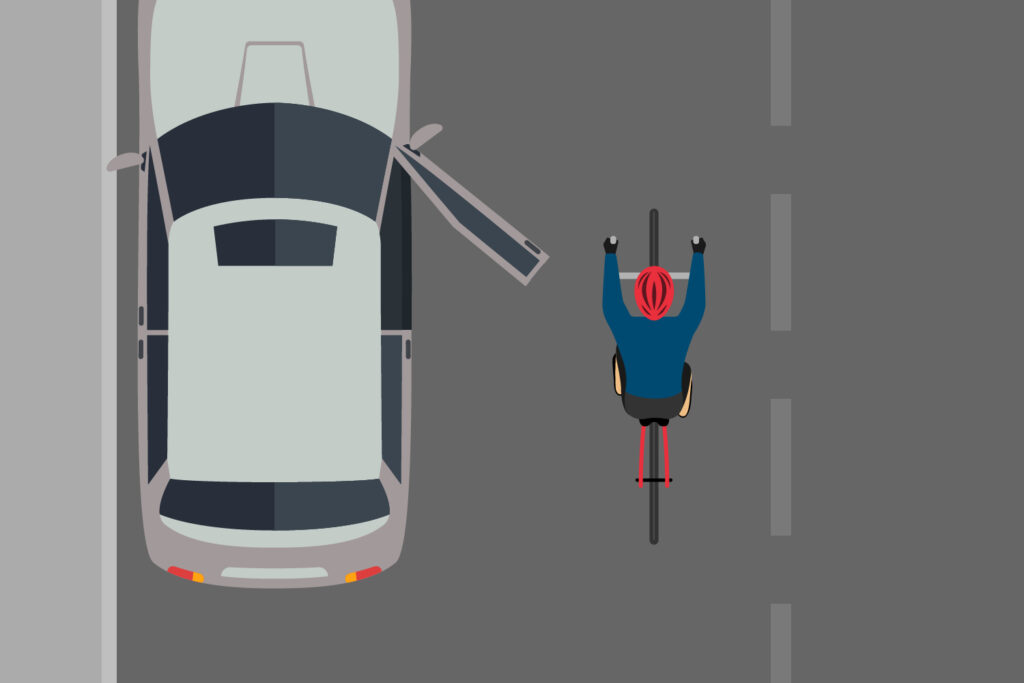
One other thing the Highway Code has to say about cyclists’ lane positioning is Rule 67: you should “take care when passing parked vehicles, leaving enough room (a door’s width or one metre) to avoid being hit if a car door is opened, and watch out for pedestrians stepping into your path”.
You need to be at least a door’s width out when passing parked vehicles, and 1.5 metres is often recommended.
What about at other times?
RoSPA (Royal Society for the Prevention of Accidents) says, “Don’t ride in the gutter; there may be debris and grid covers, and it will encourage drivers to squeeze past you even if there isn’t enough room.”
We all know that hugging the kerb means that when you do encounter a drain, broken glass or anything else lurking at the side of the road, your only means of avoiding it is to steer outwards – perhaps sharply – into traffic that’s potentially passing at a speed much faster than you. That’s clearly dangerous. Hugging the kerb also reduces your visibility to drivers coming out of side roads and drives.
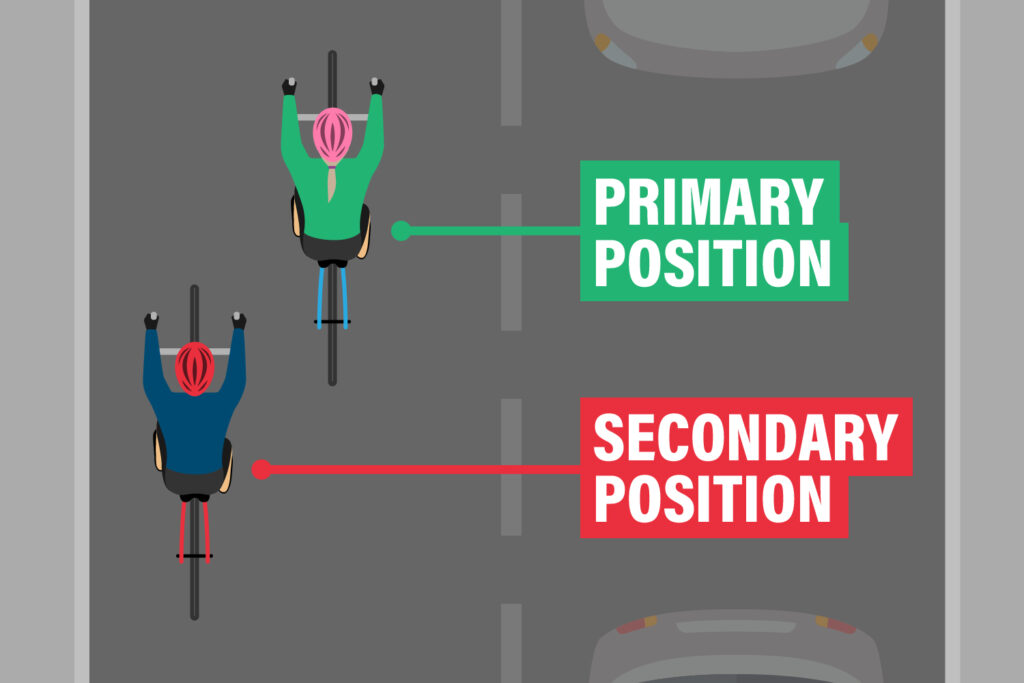
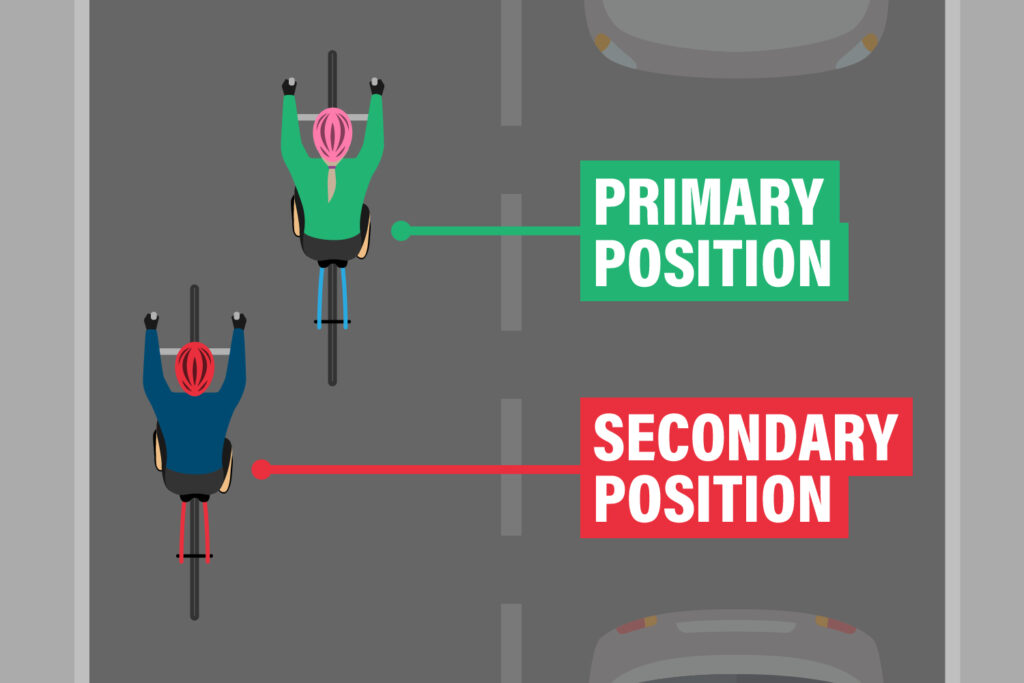
In his cycling skills manual Cyclecraft – which forms the foundation of Bikeability, the UK’s national standard for cycle training – John Franklin talks about two main riding positions: the primary riding position and the secondary riding position.
He defines the primary riding position as being “in the centre of the leftmost moving traffic lane for the direction in which you wish to travel”, and the secondary riding position as being “about 1 metre (3 feet) to the left of the moving traffic lane if the road is wide, but not closer than 0.5 metre (1.5 feet) to the edge of any road.”
Riding in the primary position, also known as ‘taking the lane’, is all about safety. John Franklin says that this is where you can best see and be seen, and are able to maintain the straightest and fastest course.
“The primary riding position should be your normal riding position when you can keep up with traffic, when you need to emphasise your presence to traffic ahead, or when you need to prevent following drivers from passing you unsafely,” he says.
‘Close pass’ initiatives by police around the country promote safety by telling motorists to leave at least 1.5m of space when overtaking a cyclist, but you’ve doubtless experienced many coming by far closer than that. Riding in the primary position discourages this by forcing traffic behind you either to stay put or to overtake only when the opposite/adjacent lane is free.
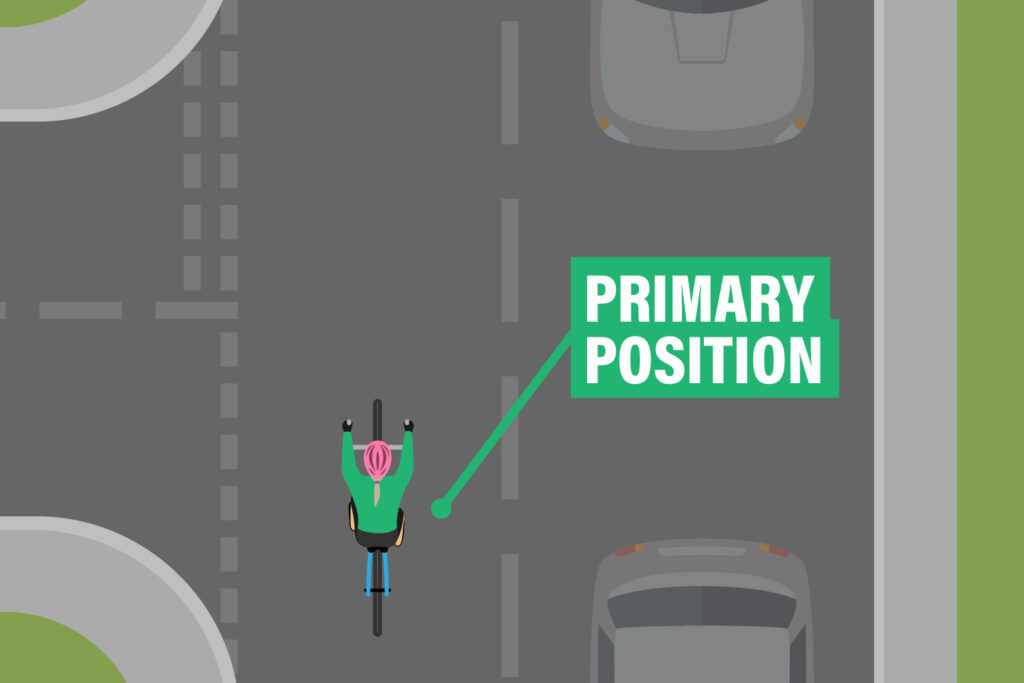
It’s often best to take the lane before passing a side road joining from the left, for example – after looking over your shoulder to make sure that it’s safe, of course, and signalling if you to need to communicate your intention to other road users.
Moving out increases your visibility to traffic at the junction, gives you more space to manoeuvre if the joining traffic edges out, and stops a vehicle squeezing by and turning left across your path at the last moment.
Similarly, the primary position can be best in slow and stationary traffic, when the road surface near the edge is poor, on narrow or winding roads, and through traffic calming schemes. You can also use it when approaching ‘give way’ signs, traffic lights, roundabouts, when turning at junctions, and in many other situations.
No one is suggesting that you ride in the primary position just to be awkward. Far from it.
“Because the primary riding position can result in some inconvenience to following drivers, it is reasonable to ride further to the left when this could help others, so long as your own safety is not thereby impaired,”says John Franklin (his emphasis).
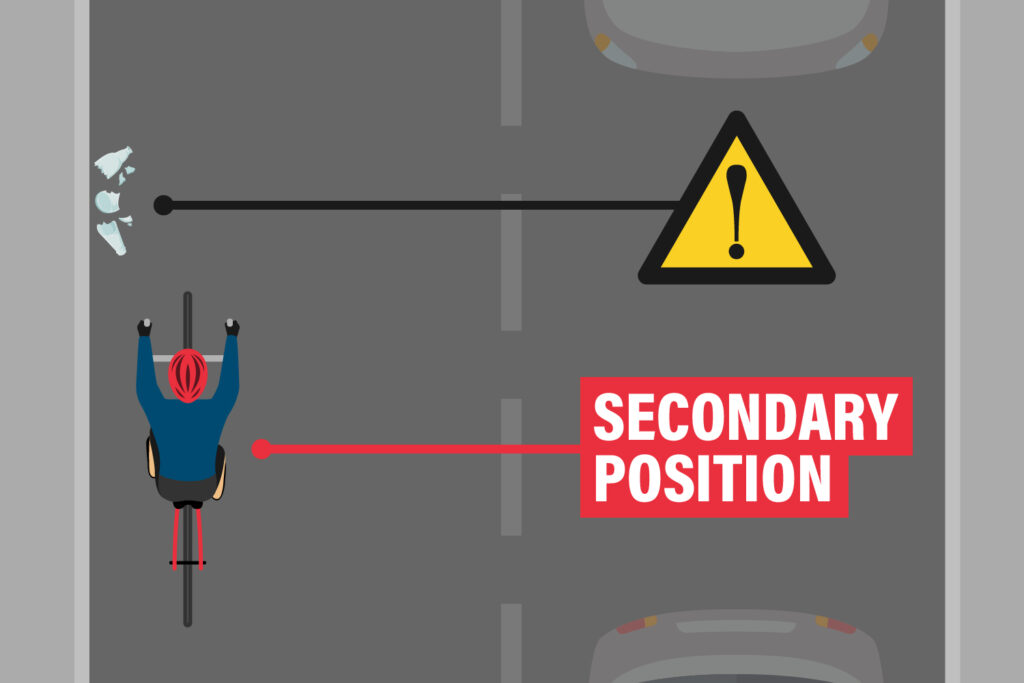
British Cycling says, “When riding in the primary position, [you] should travel at a reasonable speed, as part of the traffic flow. If, however, traffic is building up behind [you] and the road ahead is clear, [you] may wish to move to the secondary position to avoid obstructing other road-users unnecessarily.
“The secondary road position may be appropriate if the road is wide enough to allow safe overtaking, and the rider’s safety is not reduced by riding in this position.”
Why don’t cyclists always use cycle lanes?
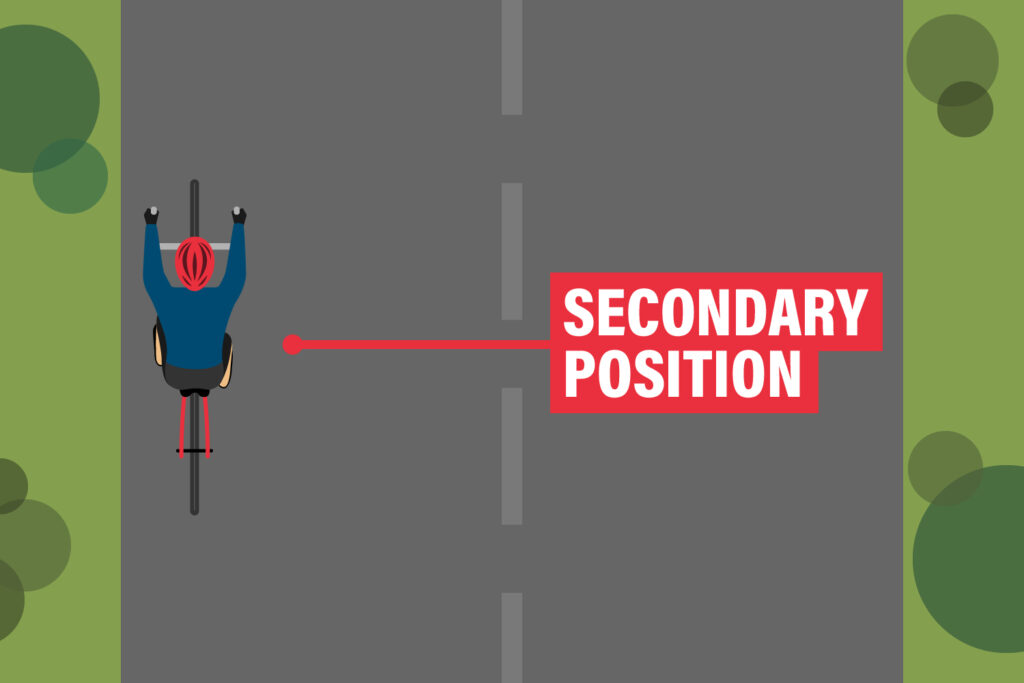
With that in mind, you might take up the secondary road position on minor roads where there are few parked vehicles, for example. However, the take-home points are that you’re not obliged to position yourself to the left of your lane, riding in the primary riding position is the best option in many circumstances, and your safety trumps another road user’s wish for you to shift to the side.
Matt Woodcock, Cycling UK Training Manager said, “Whether you’re new to cycling or an old hand, you’re hopefully familiar with the concept and importance of proper road positioning – and will probably have heard the terms ‘secondary’ or ‘primary position’ and will know that you shouldn’t hug the kerb.
“In the absence of decent cycling infrastructure across most British roads, proper road positioning is one of the most important things you can do to keep yourself safe while out cycling, but it can be a bit confusing to know where you should be at which point and sometimes counterintuitive, especially if you’re new to cycling.
“To help all road users understand cyclist road positioning, Cycling UK created two short films which show where and how cyclists should ride, especially in key areas like junctions, turnings and pinch points.”
The first one covers road positioning and junctions…
…while the second offers five tips to stay safe…










43 thoughts on “Monday moaning: Why don’t cyclists stick to the left of the lane?”
Now if someone could re-write
Now if someone could re-write this using shorter words, larger font and preferaby interspersed with females letting their mammory glands get some air, we could possibly encourage a few white van and taxi drivers to have a read.
StuInNorway wrote:
Asos Woman holding up all the pictures on boards, like women used to to tell you what round it was in boxing or wrestling on world of sport c.1974?
OMG!! What a terrible
OMG!! What a terrible sweeping statement…
In an early paragraph you
In an early paragraph you write that moving outwards into traffic is “clearly dangerous” and “reduces your visibility to drivers coming out of side roads and drives”. This is incorrect, which is the whole point of riding in primary position, and in fact throughout the story you contradict it, even explicitly stating “Moving out increases your visibility to traffic at the junction”.
The key thing to remember is to put yourself where drivers are looking, and in general they’re looking where they expect to see cars and other things that may threaten them.
This advice was formulated in the days before smartphones and in-car breakfasts. If you can get yourself onto every phonewatcher’s live stream or breakfast bowl you’ll be safe.
ConcordeCX wrote:
The explanation of why it’s dangerous is in the situation of being too close to the kerb and steering out further into the lane to avoid debris/gutter etc, that reactive sharp outward steering can have horrible consequences (into faster moving traffic) because they (motorists) aren’t giving you enough space as we know all too well.
This is not the same as moving out under control or already being in primary, so if you are already well positioned and have moved into that position in the first instance or having done shoulder check before pulling off you are less likely to need to move out at last second, move much less outward (so that might just mean a slight turn of the bars and the wheels deviate a couple of inches as opposed to two or three feet) than if you were closer to the kerb or can actually move inward to avoid the obstacle.
How can you know where any given driver is looking at from behind at any given point and how can you determine what they are focussing on where they are looking? you’re guessing, you shouldn’t need to be thinking like that most of the time. If you are vehicular riding then you position yourself almost as if you were driving, passing junctions where the exit is hidden, there’s parked or even stationary vehicles then you can move even further than primary to give you and any other party extra reaction time and distance.
Riding primary leading up to left turns is also useful/safer, you see more into the junction before you’ve committed, you’re keeping the same line into the lane thus preventing dangerous overtakes when the driver cannot see or is looking at that bin lorry coming up or a vehicle exiting their driveway that is right near the junction. There’s a petrol station near me with its exit back onto the estate road I turn into for home and it’s less than 20m from the junction, many a time vehicles have pulled out wide from there and any following vehicle behind me would if I were to be too close taking the corner have to brake very hard if they can react in time, drive extremely close or simply hit me to avoid collision. Me riding wide at that juncture gives them no opportunity to overtake right at the apex and therefore they have to hold back and rethink how to pass me.
I also don’t like BC wording re having to go at a reasonable speed otherwise you’re obstructing, why, motorists obstruct all the time on that basis, what is that speed anyway? if I need to be primary for my safety I will go at the speed I’m ordinarily going at, I am not ceding my safety so some other person can get to their destination a few seconds earlier. They need to stop with that nonsense and stop with the moton thinking, cyclists ARE traffic and motorists often go slow in ‘primary’ – or ‘middle of the road’ and obstruct people on bikes from making faster progress!
Typical of them to not get it, basically motorists who happen to ride bikes!
ConcordeCX wrote:
No, it’s hugging the kerb that we said reduces your visibility to drivers coming out of side roads and drives. We thought that was pretty clear but we’ve altered the wording now to prevent any further misinterpretation.
Mat Brett wrote:
In an early paragraph you write that moving outwards into traffic is “clearly dangerous” and “reduces your visibility to drivers coming out of side roads and drives”. This is incorrect, which is the whole point of riding in primary position, and in fact throughout the story you contradict it, even explicitly stating “Moving out increases your visibility to traffic at the junction”.
— Mat Brett No, it’s hugging the kerb that we said reduces your visibility to drivers coming out of side roads and drives. We thought that was pretty clear but we’ve altered the wording now to prevent any further misinterpretation.— ConcordeCX
thank you
Mat Brett wrote:
Exactly. Whether approaching a right or left turn, you need to move to primary in order to “look into” the junction. Given the number of twats who insist on parking on the corners of junctions, it is pretty much essential.
I always ride in primary
I always ride in primary position now. I get far less punishment passes.
I take the primary position
I take the primary position because most of the roads I ride, like a large proportion of the roads in this country, were laid, or last had their lane markings redrawn, back when cars weren’t nearly as wide as they are now. And a lot of drivers, especially the we-pay-road-tax/take-back-our-country kind, are loathed to cross the centre line to overtake a cyclist. If you give them a chance, they’ll squeeze through, at no risk to them but plenty to you. The trouble is, they learnt to drive in Minis in the 60s and 70s, but now own Range Rovers, and make no allowance for the extra 68cm of girth. I’m sure they reckon I’m hogging the road, given all the engine revving coming from behind, but my vehicle hasn’t increased in width from 46cm in decades.
handlebarcam wrote:
Is that extra girth of the vehicle or the driver?
Wheeliefine wrote:
Both, I presume. Both people and cars have gotten measurably wider over the last 20 or 30 years (by about a foot, in the case of the average car, I think, a bit less than that for people).
Oddly that has happened at the same time as population density has increased. You’d think everything would be getting thinner, in order for everyone to fit in.
FluffyKittenofTindalos wrote:
Is that extra girth of the vehicle or the driver?
— Wheeliefine Both, I presume. Both people and cars have gotten measurably wider over the last 20 or 30 years (by about a foot, in the case of the average car, I think, a bit less than that for people). Oddly that has happened at the same time as population density has increased. You’d think everything would be getting thinner, in order for everyone to fit in.— handlebarcam
the human form is evolving towards a sphere so that when all packed together they will fit perfectly, like soap bubbles.
https://brilliant.org/wiki/math-of-soap-bubbles-and-honeycombs/
I think after getting into
I think after getting into cycling a few years ago definitely became a better driver around cyclists and started to understand they ride in certain ways.
The other day I was stopped at a red light I could see there was a car parked in the (on road) cycle lane so I moved to the centre so that I could get past. This was met with a revving engine and a beep as the car raced around me once the light went green only to turn right about 50 metres later.
Hopefully, they felt a bit silly when they say there was a parked car causing me to move out and but probably not.
I’m not a frequent cyclist
I’m not a frequent cyclist but a driver and frequent pedestrian on rural roads. Yes, drivers are loathe to cross the centre line to pass – because they are obsessed with following rules rather than driving safely. The only occasion when a driver does cross the centre line is on a blind bend when they have spent more than three seconds behind a cyclist.
If only they were obsesed
If only they were obsesed with following rules. I’d love rule 163 to be adhered to…..
They’re obsessed with
They’re obsessed with following the rules – it’s just that they’ve made up what the rules are for themselves.
Cyclists on a narrow busy
Cyclists on a narrow busy road can create a convoy of vehicles behind them waiting for an opportunity to overtake. It may be helpful in these curcumstances for the cyclist to pull over and let these vehicles pass. Rule 169 of Highway Code refers to slow moving vehicles doing this, and what is a pushbike if not a slow moving vehicle? Also the cyclist may be holding up a bus and these vehicle should be given priority.
schlossmacher wrote:
I’m fine with that when the cyclist is the slower moving user.
Then when vehicles are crawling in traffic, I’d look to them to pull to the side and let faster moving users such as cyclists and motorbikes to overtake smoothly and safely?
Butty wrote:
You mean instead of waiting to see which side a cyclist or motorbiker is using to overtake and then moving to that side to stop them “jumping the queue”? (Or is that just in my experience?)
No, not just your experience
No, not just your experience – jump to 2:20
https://youtu.be/K183hSnBdeA
But looking on the bright
But looking on the bright side, they are not staring at a phone and are actually using their mirrors.
Butty wrote:
I was astonished last year to find on more than 1 occassion, cars and lorries indicating and moving to the nearside to let me past as I was going somewhat faster on a bicycle.
However, this was Mallorca and downhill.
I can create a convoy of
I can create a convoy of vehicles just by cycling?! Surely the convoy of vehicles is created by the occupants of those vehicles making the decision to use their vehicles?
Captain Badger wrote:
Including yourself.
Oh yes, because cars don’t
Oh yes, because cars don’t just pull / pull out in front of me and then force me to slow.
Stuck behind a tractor “my hard cheese”, behind a bike, or several bikes, it’s “€]#&+<_¥<]4_@9¥_{9 and pay your #### road tax!!!”
schlossmacher wrote:
I don’t know, my commute takes longer by car than by bike. But for approximately 500m of the 5km, cars can beat me to the next line of stationary cars. Overall in towns and cities I would not say cycles were slower. Many years ago in London I discovered cycling was far quicker than taking the bus. And this with bus lanes which allowed the bus to travel without being blocked by cars and vans.
I don’t often see slow
I don’t often see slow tractors, large trucks, or car/van drivers doing that when lost without their Sat Navs, plus the od milk float!
Slow moving vehicles are not
Slow moving vehicles are not cycles but vehicles that have their speed limited. Read what it actually says in the highway code. Rule 169 is for drivers.
An interesting piece but find
An interesting piece but find it strange that in the included safety video by Cycle UK for lane use doesn’t fully promote road safety as one of the riders isn’t wearing a helmet? I appreciate it is not law but in a safety video??
Jonty44 wrote:
Not one of the most important things for keeping cyclists safe
Jonty44 wrote:
A helmet doesn’t keep you safe. Some believe (and I happen to be one of them) that it offers some protection when things go wrong, but it doesn’t make you any less likely to suffer an incident, through your own fault or someone else’s. So its absence or otherwise isn’t really relevant to the purpose of the video.
Helmet debate!! And my usual
Helmet debate!! And my usual supply of popcorn is stuck in Calais!
Protection is mainly from over hanging branches and cold air, IME.
Helmets are also good for the
Helmets are also good for the attachment of rear lights and other high visibility accoutrement.
grOg wrote:
Michael Schumacher’s family might disagree with you about the wisdom of attaching things like lights to a proper helmet, let alone a cycle helmet.
And…. if I may be so bold
And…. if I may be so bold to add…. “Know nothing* judges who will reduce the compensation you are paid if hit by a car and your wife who will moan at you non stop if you don’t.”
*That doesn’t look right but I’ve not had my second cup of tea of the morning so please be gentle when you put me right!
And when cars are queueing in
And when cars are queueing in traffic do they move over to the left side of the lane, to leave the faster moving bikes space to overtake?
No, they sit to the right and then moan about undertaking.
They press their advantage
They press their advantage when traffic is flowing freely, we press ours when it’s not – seem fair?
David9694 wrote:
absolutely, stop start vehicle traffic queues shouldn’t be about ratcheting the cyclist to the back.
My point is they expect slower moving road users to move left, but they do not do it when they are the slower moving vehicles
Quote:
When an article’s updated, couldn’t it at least include a line about what was updated? I can’t for the life of me work out what might have changed here.
I mean it still says “We recently reported on road.cc…”, with a link to a story from Oct ’19 – I know 2020 has been a year a lot of people would like to forget had happened, but even so, I think that’s stretching the definition of ‘recently’.
Personally I always stick to
Personally I always stick to the left because I’m just not scared of a few close passes, and I have great balance. As long as they don’t actually hit me, I couldn’t care less.
But I absolutely 100% get any cyclist who wants to sit centrally.
Has this actually been
Has this actually been updated to take into account the new Highway Code?
I am a cycle Instructor and
I am a cycle Instructor and the Secondary and Primary positions are how we teach to our students. We also call the Secondary position the “Normal everyday riding position” which is far enough from the curb to avoid drains, broken bottles and the usual rubbish that the rain washes to the roadside. We always look behind first and then move into the Primary position for negotiating junctions etc. For overtaking parked vehicles we tell our students that the distance is “A car doors width and a little but more” and depending on the width of the road and size of the vehicle it may require riding on the other side of the road. If there is oncoming traffic they need to understand who has priorty and where to stop so they are still protected behind the parked car, but also able to clearly see past it so they will know when to proceed.