


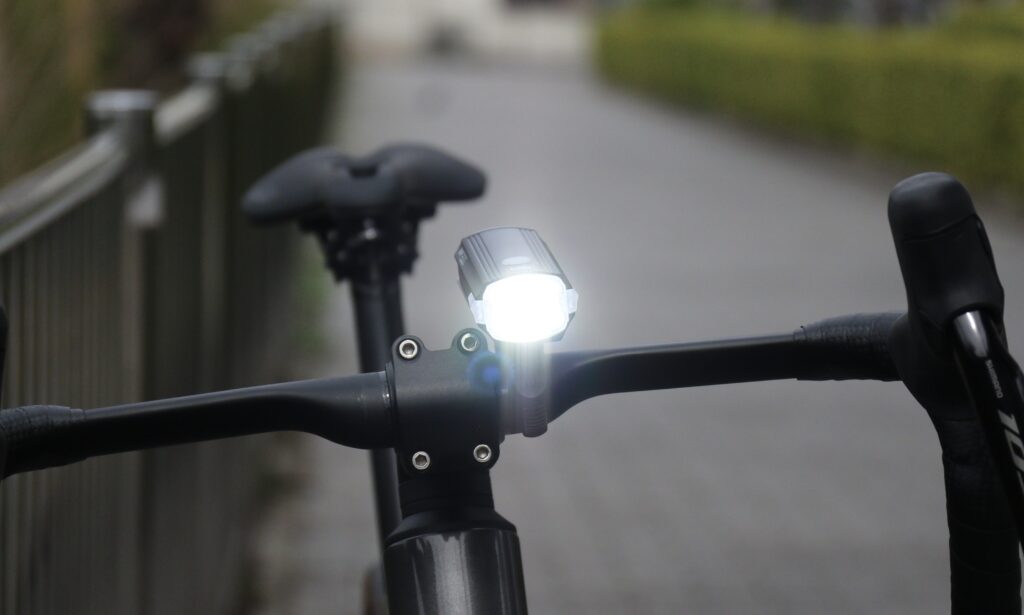

We’re willing to bet that every cyclist who has taken to the road or trail at night has, even if only for a moment, excitedly put their front light in full-power mode just to marvel at the sheer brightness of it. With modern bike lights capable of outputting multiple thousands of lumens, it’s a light show that can take the breath away.
However, a bike light’s maximum power shouldn’t really be the default mode for a typical ride. While you may need to crank the front-facing lamp up to full power in some select situations – such as new roads, tricky descents or particularly dark sections – for the vast majority of your cycling, you simply won’t need such illumination.
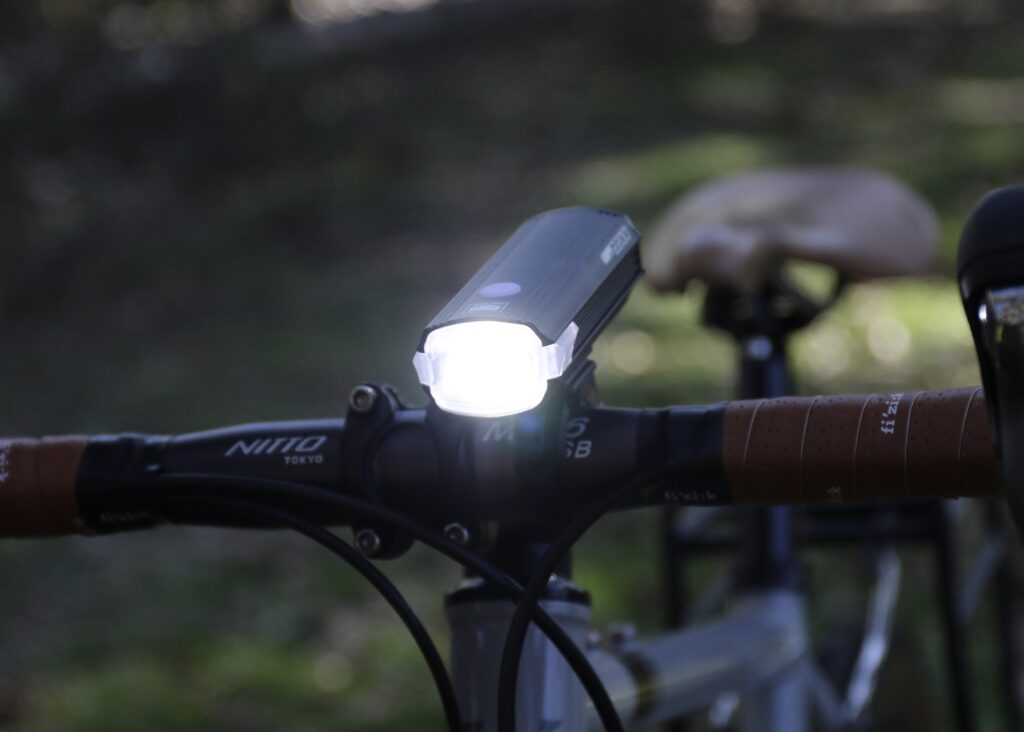
However, there is something that committed night-time riders really do benefit from: enhanced battery life and longer runtimes.
It is that concern – providing more useful runtimes while maintaining effective illumination – that sits at the heart of CatEye’s AMPP1300, AMPP1700 and AMPP2200 lights.
Rather than treating maximum brightness as the only measure of performance, each model gives riders a choice of carefully regulated output levels. The result is a product range that delivers immediate absolute power when needed, but combined with practical runtimes that are able to cover longer winter training rides, Audax events, extended evening commutes, or rides that simply go further than planned.
Power on (double) tap
Let’s talk about real-world performance, as this is what drives CatEye’s approach: what kind of practical runtime efficiencies can CatEye’s lights actually deliver?
If we take the flagship AMPP2200, it can produce 2,200 lumens of illumination for one hour in full-power Ultra Boost mode. Drop to its still-powerful 800-lumen Middle mode and the stated runtime increases 150% to 2.5 hours. At 400 lumens, it runs for five hours, or 400% longer than Ultra Boost. And its dedicated 200-lumen Enduro mode lasts for up to 12 hours, an 1,100% increase in runtime compared with maximum output.
It all means that Ultra Boost is a valuable resource to deploy when needed, but not a setting that has to be used continuously. Just double-click the AMPP2200’s operating button to bring all 2,200 lumens into play for fast descents, poor surfaces or dark roads. Then – once the road becomes less demanding – return to a lower output and conserve battery power.
The AMPP1700 applies the same principle. Its 1,700-lumen Ultra Boost runs for a stated 1.25 hours. Select the 1,300-lumen High mode for 1.75 hours or 40% longer runtime; 700 lumens extends this to three hours, or a 140% increase; and 400 lumens provides five hours, or a 300% increase in runtime.
And the AMPP1300 starts with a stated two-hour runtime at full 1,300-lumen output. Middle mode supplies 600 lumens for 3.5 hours, extending runtime by 75%. Low mode provides 300 lumens for 7.5 hours, a 275% increase over High.
The important point, CatEye says, is not that riders should choose the lowest setting. It is that the light can be adapted to the speed, conditions and character of the road. This turns battery capacity into something the rider can actively manage; not something they have to helplessly watch disappear.
Brightness management
Of course, the rider has the final say in how a front light is used, but inside each CatEye light is a range of technology designed to help maximise the rider’s choices.
CatEye’s approach is to optimise usable brightness through electronic power management, matching output to battery capacity and thermal conditions. Unlike some light manufacturers, CatEye looks to achieve regulated performance, allowing the light to deliver a dependable level of illumination through its stated mode, rather than relying solely on a brief initial peak.
For a road rider, regulated output means greater confidence when judging which mode will cover the planned ride. Clever battery management helps balance brightness, heat and remaining capacity, while the three-colour illuminated button provides a clear indication of charge: blue means above 50%, orange means between 50% and 20%, and red means below 20%.
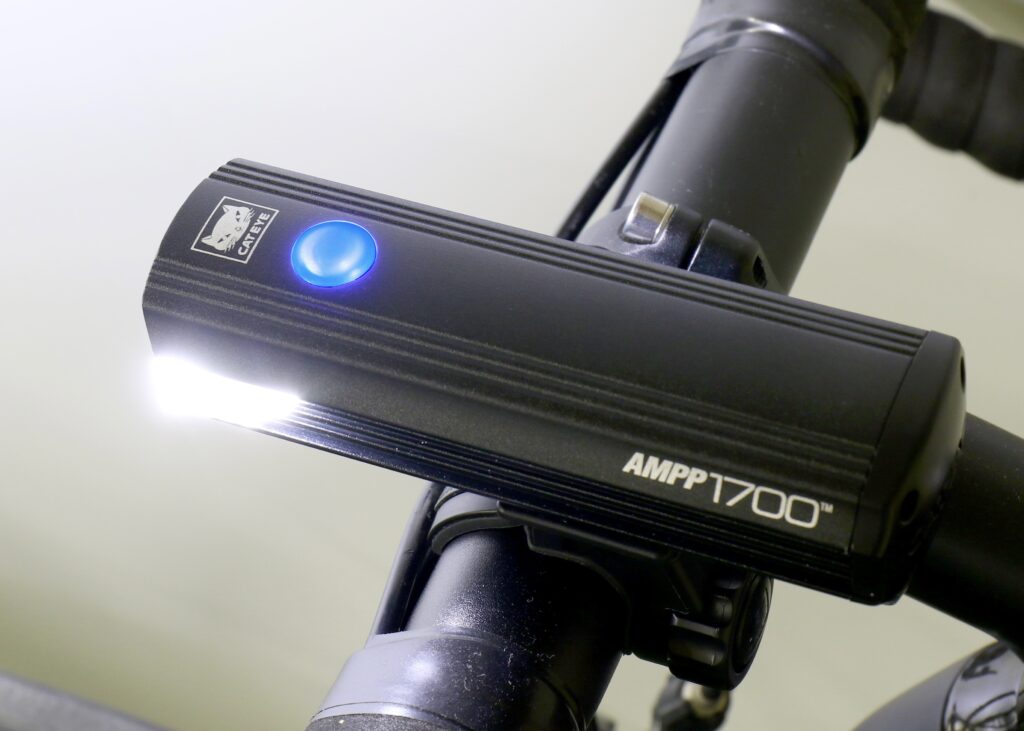
Mode memory adds another practical benefit. Switch the light off and it remembers the mode previously selected, so the rider can return to a familiar setting rather than having to cycle through every option again. A separate Lock mode helps prevent the light accidentally activating in a kit bag before the ride has even started.
Then there are the lens designs and optics, which matter just as much as power management. Each model combines a single high-intensity white LED with CatEye OptiCube lens technology. Rather than concentrating attention solely on the highest numerical output, the optics create a wide, evenly-spread beam. This results in a lower-power setting that is bright enough for most riding situations, meaning maximum output can be kept in reserve for moments when it genuinely makes a difference.
And it’s not only forward visibility that’s important, side visibility is key, too. This is particularly relevant for road riding, where a rider needs light projected ahead to read the surface, pick out potholes and judge corners, but also requires lateral visibility for junctions, roundabouts and side-road entrances. CatEye’s large side-lens sections allow some light to be seen beyond the direct forward-facing beam.
Extra details, easy performance
Beyond the intelligent power management and optics technology, CatEye ensures functionality and day-to-day performance is maximised with other key design details.
First of all, there is the control interface. All three lights use a large, raised and illuminated top button, giving riders a clear, tactile control point that is easy to locate without taking their eyes off the road. Small controls can become unexpectedly awkward once the temperature drops and winter gloves come out but a single large button is ideal for cold, dark and wet rides. Simply double-tab for max output.
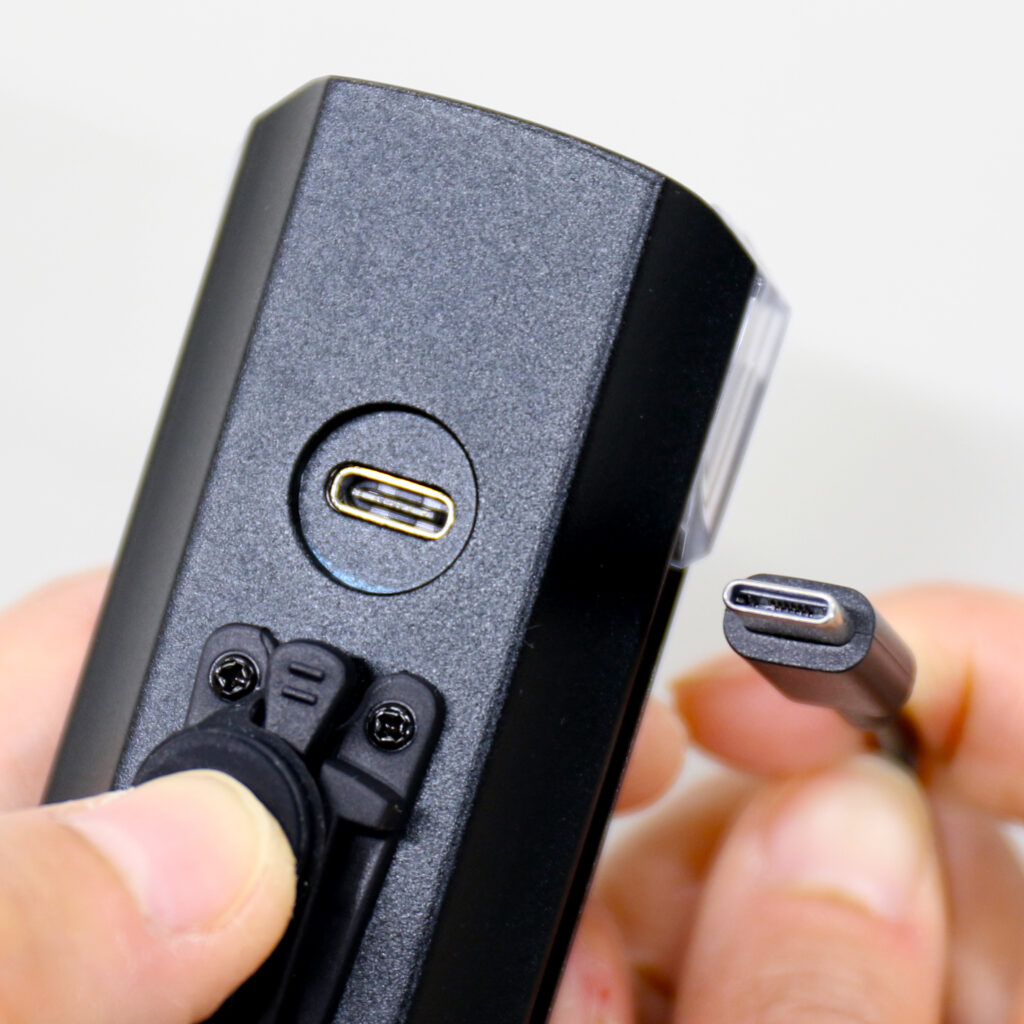
Then there is build quality and longevity. With bike lights most commonly needed for rides when the temperature has dropped and the weather has turned, they need to be sturdy. These CatEye lights are all based on a tough aluminium body, which has the added advantage of efficiently dissipating the heat that naturally occurs with high-powered LEDs and high-capacity batteries, helping to support the lights’ electronic and thermal management.
And what of those batteries? All three lights use a high capacity 5,000mAh lithium-ion rechargeable battery which has an approximate four-hour recharge time with a 2A supply. Meanwhile, USB-C charging makes it easier to integrate the lights into the type of charging routine many riders already use for phones, computers and other cycling electronics.
Finally, there’s CatEye’s FlexTight bracket, which is designed for handlebars up to 35mm in diameter. The bracket allows lights to be fitted or moved between bikes without tools, with optional helmet and centre-fork mounts also providing alternative positions. It’s a proven mounting system that road riders already trust.
So which light is right for me?
CatEye AMPP1300 £94.99
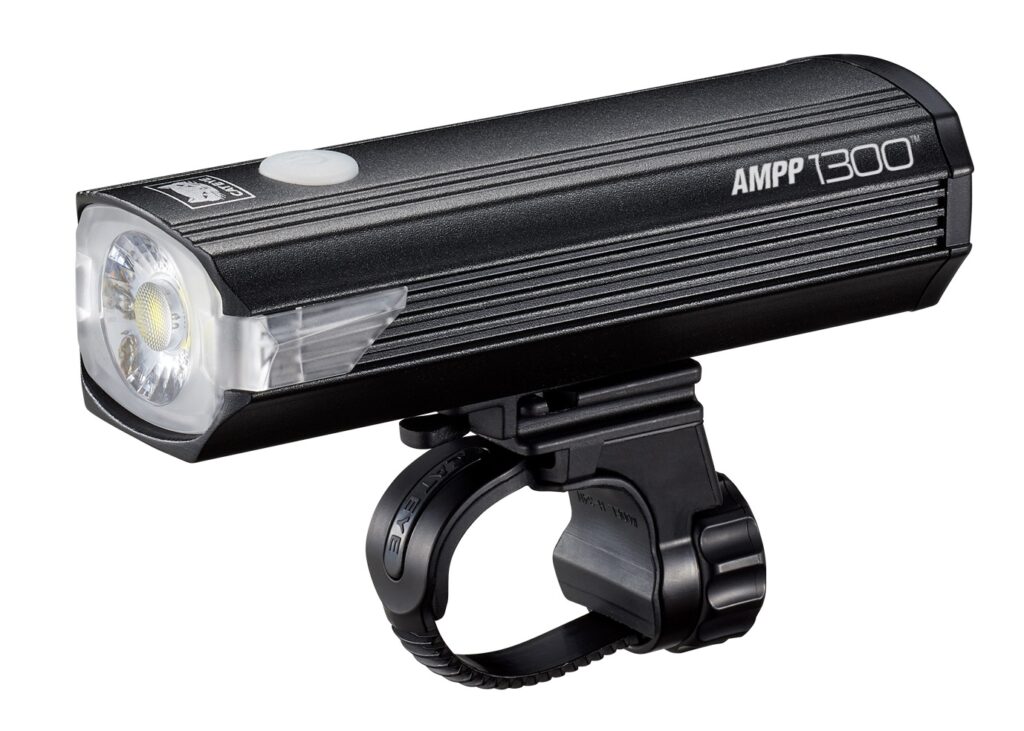
The AMPP1300 is the natural choice for riders who want a capable light for unlit lanes, winter training and everyday riding. Its 600-lumen Middle mode and 3.5-hour stated runtime provides a particularly attractive balance between outright power and efficient usage.
CatEye AMPP1700 £139.99
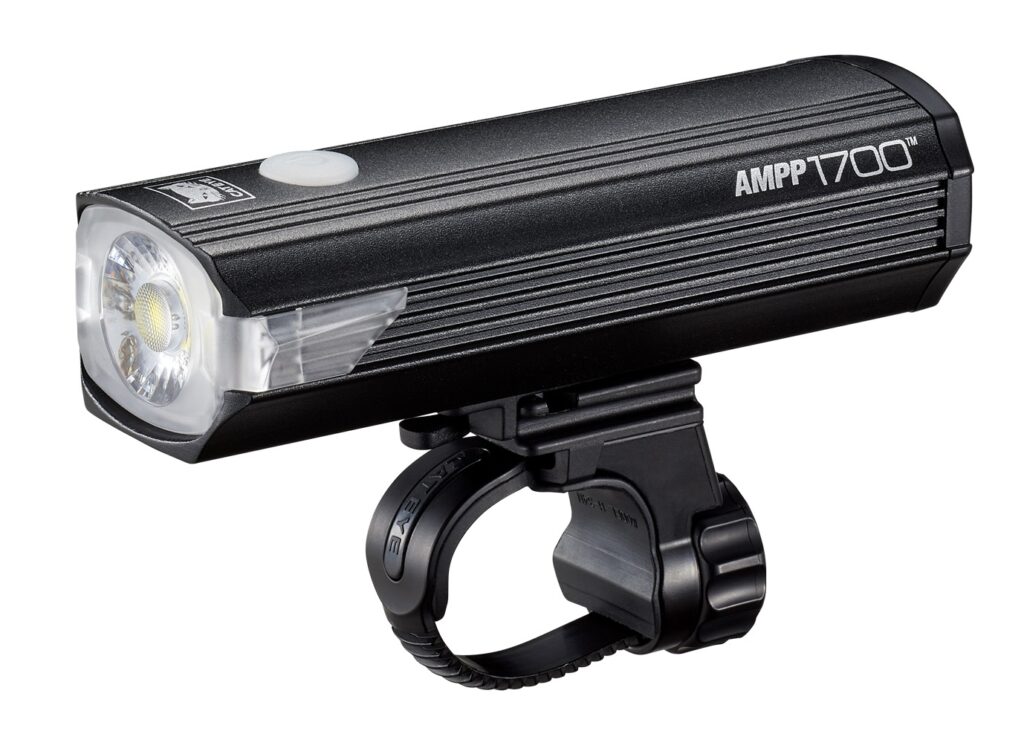
The AMPP1700 adds Ultra Boost to the mix and creates a useful middle ground for faster riders who want greater output in reserve. Its 700-lumen, three-hour Middle mode could cover a substantial evening road ride, while 1,700 lumens remains only a double-click away.
CatEye AMPP2200 £179.99
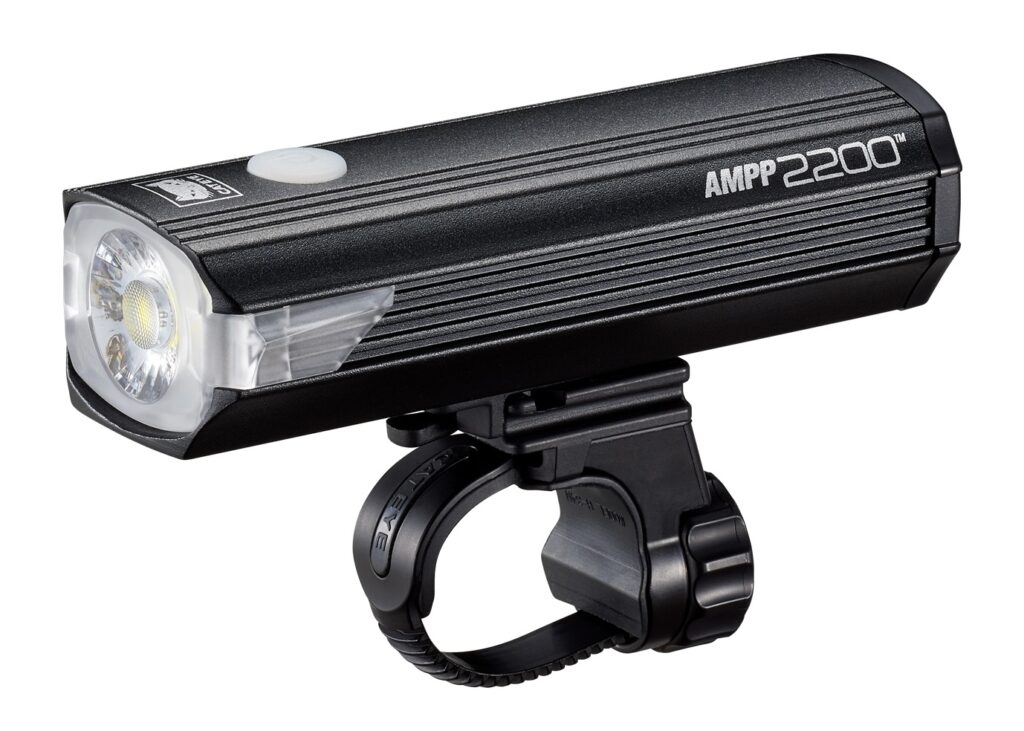
The AMPP2200 offers the widest choice of steady modes and also features the exclusive 12-hour Enduro setting. It is the perfect option for riders who want maximum headroom for very dark lanes, high-speed descents or mixed-surface adventures, but who also value the ability to stretch battery life considerably.
To find out more about CatEye’s range, visit cateyecycling.co.uk



32 thoughts on “How you can ride brighter for longer with CatEye’s cutting edge light and power management technology”
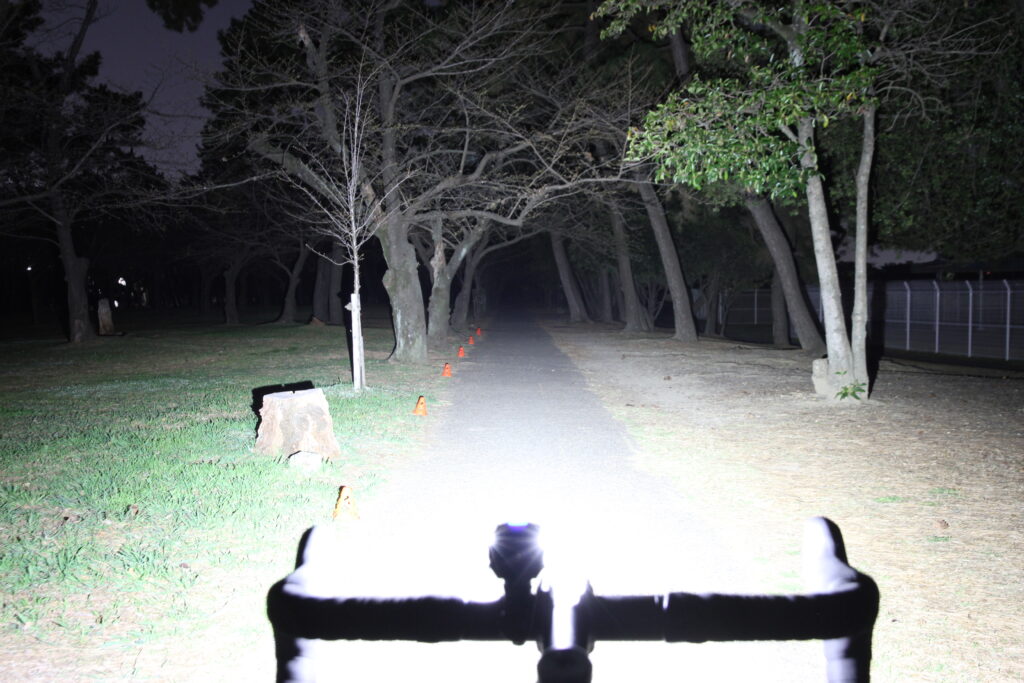
That photo in the park is tweaked so badly it’s ridiculous.
That’s what happens when you try too hard.
@tomlew What makes you think it’s been edited?
@Boopop The correct question is: What makes you think the world actually looks like in that photo?
Can’t you really see how distorted the contrast is, how badly unreal the colours are, how unbelievably white anything illuminated is etc.?
Either the photo was doctored or it was taken to present a VERY distorted picture. Either way, they knew exactly what was getting published and sorry, but with professional marketers and multi-million budgets I just don’t believe in innocent ignorance. And I do feel responsible to spot such obvious BS.
@tomlew I think Terry’s reply is a bit more sensible than yours. It’s easy to make any light look like that with the right camera settings and a long enough exposure time. Suggesting it has to be photoshopped to achieve that effect suggests a poor understanding of how cameras can be used.
As for the colours… the grass is green, the tree bark is brown… *shrug*. White balance setting on the camera can affect colours too, do you consider that “tweaking”? You have to choose a white balance, you can’t take a photo without the white balance set.
@Boopop Choosing a photo which obviously fakes the message does count as unfair tweaking in my book.
It would’ve been a different story if one was an amateur (or even a cycling blogger with no education in photography) and just took a random photo in the park.
Here we’re talking about professionals who must have taken hundreds of photos in that session and had all the equipment and knownledge necessary to take a good, realistic photo.
Instead, they chose a picture that does anything but showing reality. This way, even if the lamp itself is good, I personally just steer clear of it because of the ad.
And quite honestly, I don’t know which worries me more: that they did it or that there are people actually defending this obvious manipulation, who may one day fall victim of similar practices.
@tomlew You claimed you were certain the photo was edited, now you’re backtracking on that. It’s really quite difficult to get a photo of a torch’s performance without seeing it in person, as you have to balance for the darkness of the night and the brightness of the light. Obviously the two are really quite the opposite, so it’s hard to get the middle ground which would represent the in-person experience.
I know this article is an ad, which is a shame, but that’s how RoadCC stays afloat. I can appreciate that without assuming the whole article is a con.
Maybe have a bit more faith in people rather than assume the worst.
The picture comes from here – where you can see the light in all its modes for a comparison (though not clear if they kept the same camera settings): https://www.cateye.com/intl/products/headlights/HL-EL2200RC/
@Boopop I do have lots of faith people. I do not have faith in companies.
Especially when they hire experts and show obviously misleading materials in their ads.
And I NEVER accused Road.cc of any wrongdoing around this article.
@tomlew If that’s an accurate representation, then the rider is getting a worrying amount of glare. The road.cc Beam Comparison might be a more useful tool: https://road.cc/content/feature/roadcc-front-bike-lights-beam-test-310999
@tomlew That was my first thought but we don’t know the effective ISO, f-stop, or exposure time. It is a meaningless photo without that information.
The real test is how many drivers flash their brights at you 🙂
@Terry Hutt Sure, we don’t know the parameters. BUT. If you’re a professional and still publish a photo which is so badly unrealistic, it tells a lot.
I was really hoping to avoid this, but you provoked me 😉 Presenting a powerful lamp with no beam cutoff in an urban context just shows how badly the manufacturer does not understand urban cycling. Assuming the lamp needs to shine as much light on the tarmac as on the drivers’ retinas is just poor engineering IMHO.
@tomlew “we’re talking about professionals” lol.
“it tells a lot.” What does it tell? Are these photographer’s sneaky? or lackadaisical? Are you concerned many viewers don’t possess the technical to unpack a photo? Or is your concern wider in the possible sense millions may be affected by viewing an unrealistic photo and this renders detriment on the public square? If its the last one I’m in because its an inquiry not too far from cycling through a busy city.
@Terry Hutt ‘but we don’t know the effective ISO, f-stop, or exposure time’
EXIF info:
Camera = Canon EOS 7D
24th March 19:00
ISO = 800
f-stop = 7.1
Exposure = 2s
Focal L = 27mm
White balance = Auto
@I love my bike I just pulled the same info. We are underestimating the photographer’s skill. It’s a manual exposure of two seconds.
Two seconds is an appropriate exposure to replicate how it would look to a dark-adapted eye.
Kudos photographer. No post-processing needed.
@tomlew My first reaction to the park photo was wow, that does not look like a 2200lumen light. I have a Light & Motion Taz 2000 lumen light and it does not create that level of brightness … up to the tree stump, the pavement is washed out. I do not know, but it does seem that the camera settings are suspicious. There used to be sites like MTBR that did really good controlled images and comparative reviews of lights.
Personally, I think 2000 lumen is the minimum for road commuting and not really sufficient for MTB. So, likely this light is quite good for commuting.
@Motivated “2000 lumen is the minimum for road commuting” Really? Where are you commuting? I must be eating more carrots than I realised!
@TJCD Agreed- there’s a lot of bollocks, mostly in the form of allegations of cynical cheating by the manufacturers, in this topic- I think the beam comparison photos from Cateye are honest and believable. I commend road.cc for this type of ‘advertising’ which is a painless way of finding what’s available. I have used Cateye lights for decades, and they’ve always been very good with the available technology. The only reason I’m not using a Cateye front now is that the Aldi ones are so good, and I only use them on half power for most of my riding in the dark. What I need now is a deterrent for oncoming drivers who don’t bother to dip their thermonuclear headlights- I may get one of these Cateye latest for this purpose.
@wtjs “oncoming drivers who don’t bother to dip their thermonuclear headlights” – in a very half-hearted defence, I suspect that some drivers believe (rightly or wrongly) that their fancy matrix lights do this for them, so it’s not a conscious choice to blind us.
@quiff Which stokes the headlight war even further, because to trigger the automatic system and avoid being blinded yourself, your bike light now has to be bright enough for it to recognise it. 🙃
@wtjsa £15 – 500 lumen torch set on strobe usually does it when I’m walking the dog.
@TJCD to my 56 year old eyes, I have occasionally been surprised to pass pedestrians in dark clothes or I don’t see their dog on a leash unless my light is in the 2000lumen setting. The light is several years old, so probably not putting out 2000lumens any more. When I replace that light, 2000lumen will be the minimum. That’s why I read this article. I’ve also had good impression of CatEye products.
I have also tried commuting with my new Exposure Axis Mk10 (1300lumen) and it’s not sufficient. I only use it for road bikepacking in case of tunnels, etc. and because it’s sturdy and small.
For offroad, I think 4000lumen range is where you want to be.
@Motivated it’s strange how different riders ‘see’ things. My eyes are even older and I’ve done a series of all night road rides with my trusty Raveman 1200PR. Because a needed alight to last the full night, I ran it at 200 lumens, with the odd blast of full power in the trickier bits. I never thought I needed ‘more light’ and we weren’t hanging around.
Mind you I come from early 80’s mountain biking when our double Eveready Night Riders were given a massive boost with ‘Xenon bulbs’. To us youngsters it was revolutionary. These and a Petzl Zoom seemed to create almost daylight even though the combined light output was probably around 30 lumens. Luxury…
@Motivated First of all, lumen figure tells you how much light is produced, not how much actually falls on the road. Lumens give you potential, but do not guarantee the overall result.
It’s more or less like saying “I’m a fast rider because I produce lots of watts”. Which could go hand in hand with actual speed, but does not guarantee it.
And secondly, a lamp as powerful as that could be terribly glaring to other users of the road. It’s no coincidence that car headlights have a horizontal cutoff.
@tomlew The photos come from Cateye’s own beam comparison chart – see link posted by quiff. As far as I can tell from the embedded metadata (as reported by I love my bike; available for all the beam comparison images if you just view the file properties) they have kept the settings constant across all the images.
Keeping the settings constant is of course sensible in order to achieve a fair comparison. And the photographer had to choose settings which work across the range of lights and outputs. Some of the other lights/settings in the comparison database are much darker, and underexposed across much of the image. So the settings chosen seem like a reasonable middle ground.
Of course, the disadvantage of this “fair” approach is that it does not reflect the way the human eye works, as our eyes will naturally adjust to the amount of light available (not to mention all the processing that goes on in our brains that turns the signals from our eyes into our perception of the world).
2200 lumens. Jaysus… That’s going to seriously blind any oncoming cars.
Where does this lumens war end, when we have lights melting the tarmac as we go?
@Paul J Actually lumens aren’t really an important measurement here, as it measures the total output of light from the device in all directions. A dipped LED car headlight can produce 4000+ lumens and it won’t dazzle anyone. Far more important is lux, the concentration of light in a given square metre, that’s what tells you how blinding it will be (1 lux = 1 lumen per m²). A light may have high lumens but dissipate them in such a way that the lux is relatively low compared to a light with fewer lumens but a more tightly-focussed beam.
@Rendel Harris A good point.
That said, these bike lights have reflectors aiming those lumens generally in a forward cone-ish beam so most of lumens are going forward. And, given that generalisation, higher lumens == more blinding to other road users, and very very high lumens like that == very blinding.
I had a 1200 lumens “night rider”, but you couldn’t use it in full power mode on the road. I had cars coming to a near stop as they’d encounter me more than once when I did try it. Even on lower power settings, you have to angle it downward it a bit to avoid dazzling other road users.
@Rendel Harris
It *ought* not to. Whether it will or not is a whole other question in my experience.
@mdavidford I was driving my wife’s car the other day. Dipped beam has a very sharp cut off around 4ft above the ground. It only takes a small bump or roll in the road to make that 6 or 7ft above the ground.
@Rendel Harris A dipped car headlight, even on fewer lumens, does dazzle anyone whose eyeline is lower than the headlight. This typically includes small children, recumbentists and some wheelchair users. Obviously as cars get taller (SUVs) and their headlights get higher, it includes more people.
Look, this article is sponsored so that should tell you everything you need to know. Almost everything that you read or see on the Internet is a marketing ploy.
No mention of the battery life of these lights, so let me help the editors out.
Cateye makes a bunch of these lights but we’ll only discuss the 3 they discussed.
The 2200 will run for 1 hour at 2200, to 12 hours at 200.
The 1700 runs for 1.25 hours at 1700, to just 5 hours at 400, there is no 200.
The 1300 runs for 2 hours at 1300, and 7.5 hours at 300. This one has the longest battery run time of the 3.
You can go online to Cateye and get more details about other lumen settings and their run times.
The problem with most lights, including the Cateye, is that they do not have a replaceable battery; and according to Cateye the battery is only good for about 300 cycles which is the worse I’ve read in the industry, most are good for 500 cycles, the top of line ones like the Exposure are good for 1000 cycles AND the battery is replaceable; the NiteRider Lumina boost series also has a replaceable battery, but it will only cycle 500 times, but at least you can get the battery replaced for a nominal fee.
The reason I bring this battery thing up is because it is a waste of resources and our money to buy a light that can only be charged about 300 to even 1,000 times, which is about 1,000 to 2,000 hours of run time when the LED bulbs are good for at least 15,000 hours for the cheapest LED bulbs, most are good for 25,000 hours; so we’re throwing away perfectly good lights just because the battery cannot be replaced. I stopped buying lights that cannot have the battery replaced, even my taillight has a replaceable battery, it’s from Exposure; finding replaceable batteries in a taillight is very difficult to find because there are only 1 or 2 that can be replaced.