



People riding e-bikes or illegally modified bikes are 41 per cent more likely to suffer head or neck injuries in a crash than other cyclists on non-electric bikes, a new study examining cycling-related visits to a hospital emergency department has found.
According to the study, published this month in the Journal of Emergency Medicine, the increased likelihood of “significant injuries” among ‘electric bike’ riders stems from higher average alcohol consumption and lower reported use of helmets than their pedal cycle counterparts.
However, though described as a “wake up call” by one personal injury lawyer, the study’s findings were questioned by former West Midlands cycling and walking commissioner Adam Tranter, who pointed out that hospitals and emergency services “often use ‘e-bike’ as a catch-all term”, thereby conflating people riding illegal machines, and the injuries they suffer, with those on legal e-bikes.
Conducted by researchers from Queen Mary University of London and Homerton University Hospital, the study examined cycling-related visits to the emergency department of a hospital in northeast London between September 2022 and August 2025.
These visits were identified from the electronic patient record and categorised by the researchers as “e-bike” or “non-e-bike.”
Of the 5,529 cycling-related visits during the three-year period under assessment, 564 (almost 10 per cent) were categorised as involving e-bikes. The research also served as an unintended barometer of the rising popularity of e-bikes in recent years, revealing that only 3.8 per cent of cycling emergency department visits were e-bike related in 2022/23, compared to 16 per cent in the study’s third year.
Compared to “conventional” bike injuries, ‘e-bike’ riders were 41 per cent more likely to suffer a head or neck injury and 33 per cent more likely to sustain a lower limb injury. However, they were 36 per cent less likely to experience damage to their upper limbs.
Meanwhile, alcohol involvement was more common in ‘e-bike’ cases (eight per cent of all incidents compared to three per cent for non-electric bikes). Where documented, 81 per cent of ‘e-bike’ riders were also reported to not be wearing helmets at the time of their crash. Three per cent of injured ‘e-bike’ riders (a total of 17) required surgery.
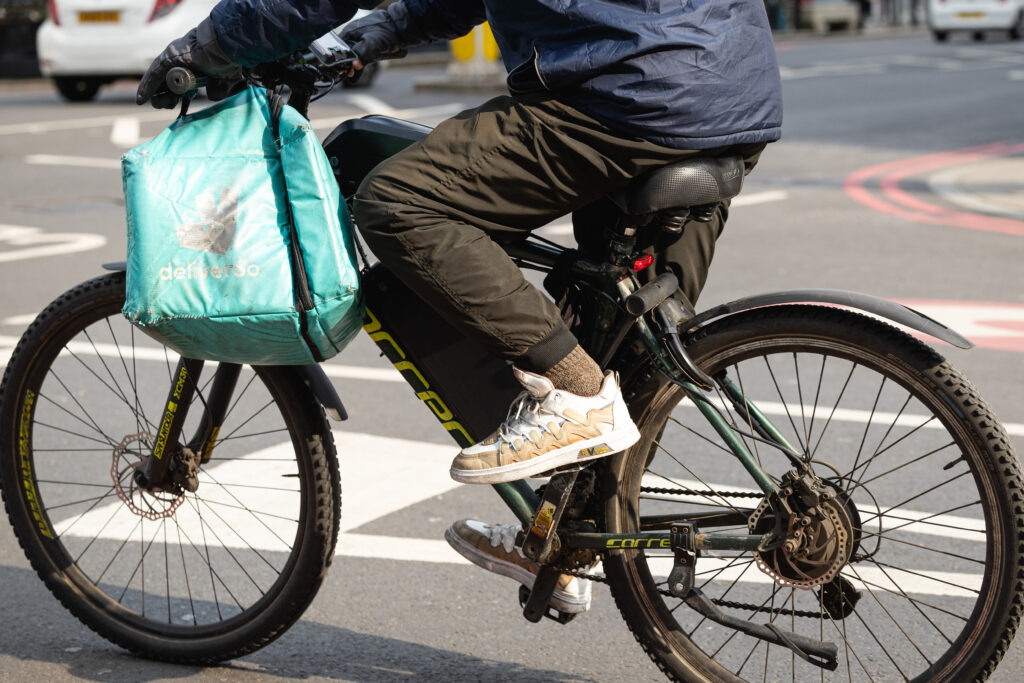
“These accidents were frequently associated with alcohol use and a lower reported use of helmets than in non-e-bike accidents and potentially resulted in more significant injuries,” the researchers said.
“These findings support targeted injury prevention and public health interventions as e-bike use continues to rise.”
Speaking to the Times, one of the study’s authors, Adam Stoneham, said: “What our study demonstrates is two things: that there is a greater number of patients presenting to A&E following e-bike accidents but also the severity of this trauma is greater than we were seeing with conventional bikes in the past.”
Stoneham, a consultant trauma surgeon and associate professor of social policy at Homerton University Hospital, continued: “E-bikes have been a total gamechanger; they make cycling much more accessible to people of all health and ages and they greatly increase the distance you can commute. But of course this comes at a cost.
“London infrastructure is not set up to deal with the volume of bikes we are currently seeing and it has already caused major problems in terms of parking as well as the health ramifications we are witnessing.”
Another co-author, James Siswick, a foundation doctor at Queen Mary University of London, said the study’s findings provided further evidence that authorities need to clamp down on fast, heavy, illegal bikes.
“Trauma is all about energy. E-bikes are normally much faster and heavier than conventional bikes so transmit greater magnitudes of force. The brakes and steering are normally not proportional to meet these demands, all of which is reflected in the pattern of injuries that are treated,” he said,
“Add into that the fact that riders are much less likely to wear a helmet [and] are much more likely to be intoxicated and you have a lethal combination.
“The popularity of self-modified, unregulated e-bikes which can travel in excess of the 15.5mph speed restriction is of particular concern, not least because they are difficult to apprehend and completely untraceable.
“Collaborative working by the government, local authorities and bike hire companies could improve safety measures, resulting in a positive impact on public safety as well as reducing the consumption of NHS resources on e-bike related accidents.”

Adam Tranter, the former West Midlands commissioner for walking and cycling, urged caution, however, when it comes to using the study’s findings for policy or policing purposes, noting that hospitals tend to conflate legal e-bikes with their illegal counterparts, muddying the road safety picture.
In the UK, legal electric bikes, classified as electrically assisted pedal cycles (EAPCs), must have pedals that can propel the bicycle, have an electric motor with a maximum continuous rated power not exceeding 250 watts, and cut off electrical assistance when it reaches 15.5mph.
However, the use of modified bikes, which do not cut off assistance at 15.5mph and can reach high speeds without pedalling, has become an increasing issue on the UK’s streets, leading to widespread confusion with their legal counterparts.
These machines are instead classified as motorbikes and mopeds and do require a licence, registration, Vehicle Excise Duty, and the rider to wear an approved motorcycle helmet to be used on a public highway.
Tranter also noted that the rise in e-bike injuries is to be expected given the increasing popularity of electric-powered vehicles, illegal or otherwise.
“It is unremarkable that e-bike injuries appear to have risen as a share of cycling injuries, given how e-bike use has grown in the capital,” he said.
“The bigger issue is that hospitals and emergency services often use ‘e-bike’ as a catch-all term, including illegally modified machines that are electric motorbikes in law.
“Better data collection, including in police STATS19 records, would give the full picture. We shouldn’t conflate heavy, fast, illegal bikes with the legal, regulated e-bikes that sustainable transport depends on.”
Nevertheless, Lucie Clinch, senior associate in the personal injury team at Stewarts Law, described the research as a “wake up call”.
“E-bikes are not simply bicycles that happen to have a motor – they can be heavier, faster and capable of generating considerably more force in a collision than a standard pedal bike. When things go wrong, the consequences can be catastrophic,” she said,
“The data is of no surprise – that traumatic injury from e-bike accidents often arise where alcohol has been consumed and where the riders were not wearing helmets. Use of e-bikes across London is growing and the risks of e-bikes should not be underestimated. Public education is still required to protect users.
“Accidents frequently result in concussions, skull fractures and broken bones, but some victims can sustain life changing injury. More regulation is needed, to include micromobility generally, to ensure that the ever-changing landscape of transport the UK, does not result in reduced road safety for all.”
















36 thoughts on “‘E-bike’ riders 41% more likely to suffer head injuries than other cyclists due to “lethal combination” of lack of helmets and alcohol – but cycling campaigners say hospital stats include fast illegal bikes”
I came to make a lot of points about the validity of this study, but Adam Tranter has made them all, except perhaps for one: many of the people riding these bikes haven’t ridden a bike for fifty years, and lack knowledge and experience.
The implied conclusion, that e-bikes are significantly more hazardous than normal bikes, is not supported by the data.
“Nevertheless, Lucie Clinch, senior associate in the personal injury team at Stewarts Law, described the research as a “wake up call”.”
‘Wake up! There’s money in this.’
it would appear that even people carrying out research aren’t capable of critical thinking. 🙄
“E-bike’ riders 41% more likely to suffer head injuries than other cyclists due to lack of helmets and alcohol…”
Lack of alcohol causes head injuries? That explains a lot!
They don’t have any helmets, so they have nothing to drink the alcohol out of.
@mdavidford It’s a well-known fact that any Viking who lost his helmet in battle was not permitted to partake in the post-pillaging quaffing and wassailing due to the absence of a drinking vessel; he had to sit in the corner being mocked by his mates and drinking ginger ale and then had to steer the longship home.
@Rendel Harris – ginger ale can be alcoholic when it’s traditionally brewed. Not nearly as strong as mead, though.
@arowland Just imagine how fast you ride to the shop when your booze has run out!
@arowland Reality is an illusion caused by lack of alcohol.
@eburtthebike Reality is for people who cant handle drugs
What is being criticized here was not even part of the study!
The paper states clearly: “The primary objective of the study was to quantitatively assess the changing pattern of e-bike–related visits at a London District General Hospital ED by measuring the total number of visits for cycling-related injuries and the ratio of e-bikes to non-e-bikes.”
There is not even a word in the study about the general safety of (e-)bike use or frequency of injuries while riding. That part is a far-fetched and invalid conclusion by other parties mentioned in the Road.cc article.
A doctor taking the first look at a patient must quickly recognize what kind of trauma they should look for and identifying patterns in this area helps a lot. And THAT is the practical conclusion from the study, not judging how safe cycling is.
BTW it is not even a doctor’s job to decide whether the e-bike was street-legal or not. That’s a task of the police. And by the time that is actually determined, the doctor’s job is often done, so from a clinician’s perspective they often don’t really care about that.
Except that the paper’s conclusions are all about policy interventions to reduce or modify ebike use, and nothing at all about changes to practices of clinical assessment. So the ‘far-fetched and invalid conclusion’, which doesn’t relate to the stated objective, is the authors’.
@mdavidford Not true.
“Therefore, policymakers should take a balanced view on the benefits vs. drawbacks of e-bikes.”
“studies such as this could support future public policy interventions, especially around the issues of helmet wearing, illicit drug and alcohol use, availability of e-bikes to those aged under 18 years *** and regulatory enforcement to curb the use of illegally overpowered e-bikes.*** “
Um, yes – as I said – all about policy interventions to modify the usage of ebikes, and nothing at all about changes to practices of clinical assessment. 🤷♂️
Also, they repeatedly talk about the study showing the ‘risk’ of traumas, rather than observations or occurrence, as your comment suggests. Since the study doesn’t look at rates of usage, etc., the risk of those activities is outside of its scope, and it doesn’t justify that discussion.
@mdavidford It’s useful to know that epidemiological studies are not the place to present recommendations for actual medical procedures. A scientific paper is not a medical handbook.
And secondly
“Study Objectives
To quantify trends in e-bike–related ED visits in a 3-year period and compare demographics, injury patterns, alcohol involvement, helmet use, and markers of clinical severity with non-e-bike cycling injuries.”
It was never the goal of the study to provide any advice, only to analyse the data and possibly suggest what areas may need new recommendations (not what those recommendations would or should be).
So then what were you on about with this?:
…and yet they chose to do so anyway.
@mdavidford Again. Knowing THAT you must introduce practical changes does not mean telling one WHAT kind of changes those should be.
But an epidemiological study absolutely can provide insights for others to follow up on – that’s how modern science generally works.
It can’t provide any insights about things to follow up on as regards policy in the area of ebike usage, though, since it didn’t study that. And yet it claims to do so.
It might, as you suggested, provide insight that helps guide trauma response in a clinical setting, but it doesn’t mention that at all.
Generally, the way science works is you use a study to inform the thing that was actually studied.
@mdavidford @tomlew Nope, that’s not what I said.
I said the study provides information for others to follow up on, specifically within the realm of epidemiology. But it does not provide any actual advice on what actions should be taken, that will probably be the subject of another paper (by the same or another group).
Anything beyond that are your projections, not my words.
What exactly do you think I said you said that wasn’t what you said? Because you appear to be saying that you did say what i said you said – that it may provide useful information to inform the way that clinical cases should be assessed and handled when they present. Or as you put it:
The issue is that they themselves didn’t conclude this – they claimed that it provides information about the risks of ebiking and related behaviours, and that it could inform policy in those areas. It doesn’t and it shouldn’t.
@tomlew Good point and even if it was how would they find out? In my experience most people seriously enough injured to require A&E treatment don’t bring their bicycles in with them, and the police don’t attend bike crashes as a matter of course. Scandalously academically unrigorous assumptions.
How on earth a study of this nature can be published without any reference to the number of riders wearing a safety balaclava is beyond me
As every hoodlum knows a balaclava – or just a “neck gaiter” pulled up over your nose – is essential street safety gear.
So effective that even special forces types and the hard men of the US ICE have taken to wearing them.
That’s why you never hear of young twockers (does that still exist?) bothering the NHS!
@chrisonabike To which list you can add hiding-in-mummy’s-basement-behind-the-keyboard hard men who seem to have misunderstood the meaning of “stop the boats” and so block people from getting on the channel ferry.
@Rendel Harris The local neighbourhood webpage has a petition about having a government enquiry into illegal immigration. I’ve just asked why they didn’t do that when it was 40% higher.
Where were they when the Dutch were in the Medway? Or the Armarda appeared off the coast? Behind their keyboards * or out bowling, that’s where!
And what about in 1066? Or when Claudius turned up? Or the beaker folk arrived…
* Harpsichord? Virginals? Or just pumping their organs?
@chrisonabike Or, alternatively, they’ve had the experience of swallowing a bug at 15.5mph and don’t want to repeat it.
Mostly pootling about doing urban transport-type cycling I swear by my safety beanie in winter (possibly combined with some neck-sock affair for draft-exclusion).
And I’m rarely without a cap in summer, being a bit pasty.
Can’t tell you they’ve saved my life, but they’ve possibly helped me keep my concentration on the job.
(Apart from one time where a gust caught my cap and in putting my hand up to grab it I went down. Cap tethers/chinstraps, folks…)
@chrisonabike While riding over the Severn Bridge, a gust from an HGV swept my cap off, into the army camp below. The ride to the camp entrance was about five miles, but I had to get the cap back, it was a present from SWMBO.
Good effort!
– “London infrastructure is not set up to deal with the volume of bikes we are currently seeing,” said one of the new study’s authors –
Presumably we can also state:
” London infrastructure is not set up to deal with the volume of cars we are currently seeing,” …
What doesn’t seem to be mentioned is now, casual cyclists that would just cruise along at 10 to 15 kph, have a throttle and can go 25 kph (or more if it’s illegal). The difference in speed from 15 to 25 is only about 1.6 times. BUT the kinetic energy from 15 to 25 kph is 2.7 times …. similar to the difference between being hit be a car doing 40 kph and a car going 60 kph.
Another confounding factor is that your average e-bike user is more likely to be a novice rider. There are so many other variables that go along with e-bikes vs standard bikes that it’s impossible to draw any conclusions from the correlational (uncontrolled) study.
@Chris RideFar ….. and the first thing they do is crank that throttle all the way! WHOO HOO!!! Look at me go!!!
We keep hearing about how much damage a heavy eapc can do but surely the rider’s weight has more influence. The weight of the bike has little additional impact if the rider is 100kg…. A 20kg eapc and a 70kg rider is less!
@mikewood I can’t speak for everybody and their arguments, but physics says the problem is more about velocity, not weight.
A 10% increase in speed equals a 21% difference in kinetic energy. 20% more speed = 44% more energy, and so on.
@tomlew Don’t disagree. That makes me at a system weight of 85kg more dangerous at 20mph than a 100kg rider on a 20kg eapc at 15.5mph! Except that I’m in control and only do that sort of speed on the road, not shared used paths etc