


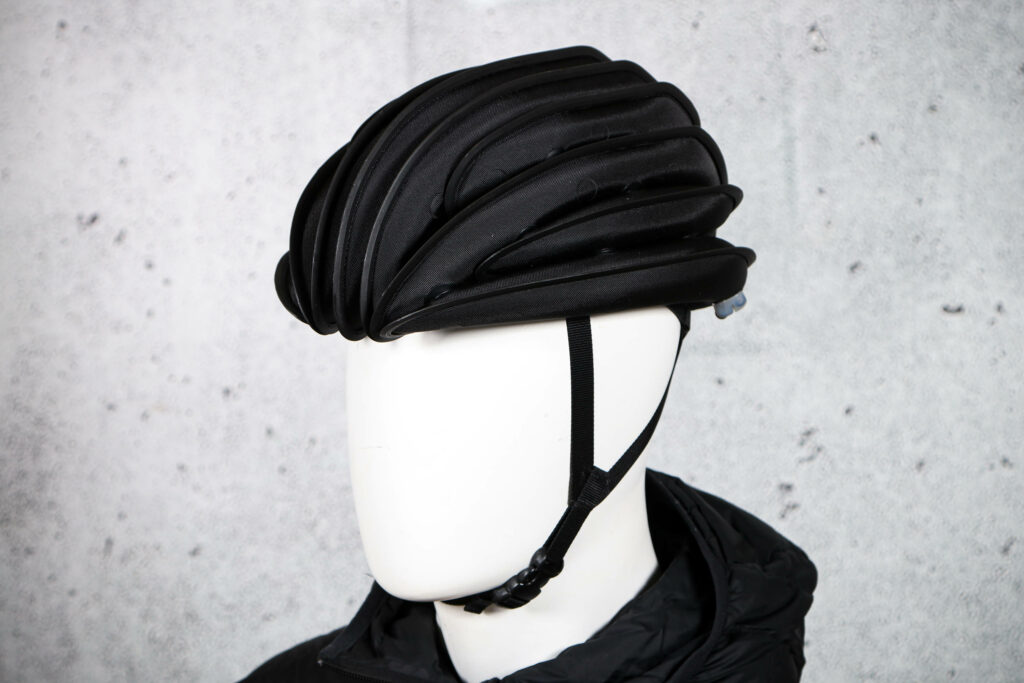

There’s a new inflatable bike helmet and the brand behind it has some pretty big claims about its safety performance, including that it “outperformed 30 of the UK’s leading helmets” during independent testing.
The Ventete aH-1 (pronounced von-tet, like Ventoux) is, of course, not the first inflatable cycling helmet to hit the market; numerous similar ideas having come and, in most cases, gone over the years, none ever really managing to break through with their design.
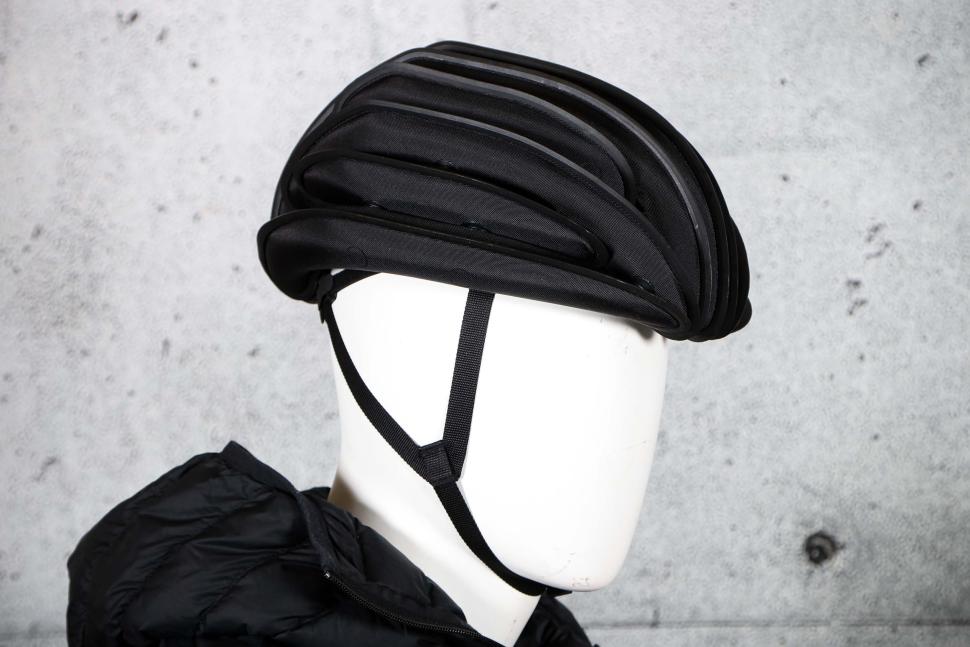
Perhaps most famous was Swedish firm Hövding’s £249 airbag cycle helmet. Although not technically a helmet, it made headlines when it received independent tester Certimoov’s protection rating of 4.5 stars, beating all other cycling helmets that had been tested by the independent French testing institute at the University of Strasbourg.
> Best cycling helmets 2025 — choose a bike lid that’s right for your riding
However, in 2023 the company filed for bankruptcy after a consumer watchdog ordered a product recall and banned sales. Hövding won its appeal against Sweden’s Consumer Agency – but said the damage done left it with no option other than closing down. Elsewhere in the inflatable/airbag helmet marketplace, POC and automotive safety system specialists Autoliv were recently successful in patenting an airbag design, while there is also an inflatable helmet from German company Inflabi (although it has been at the pre-order stage since 2023). So what is this latest design?
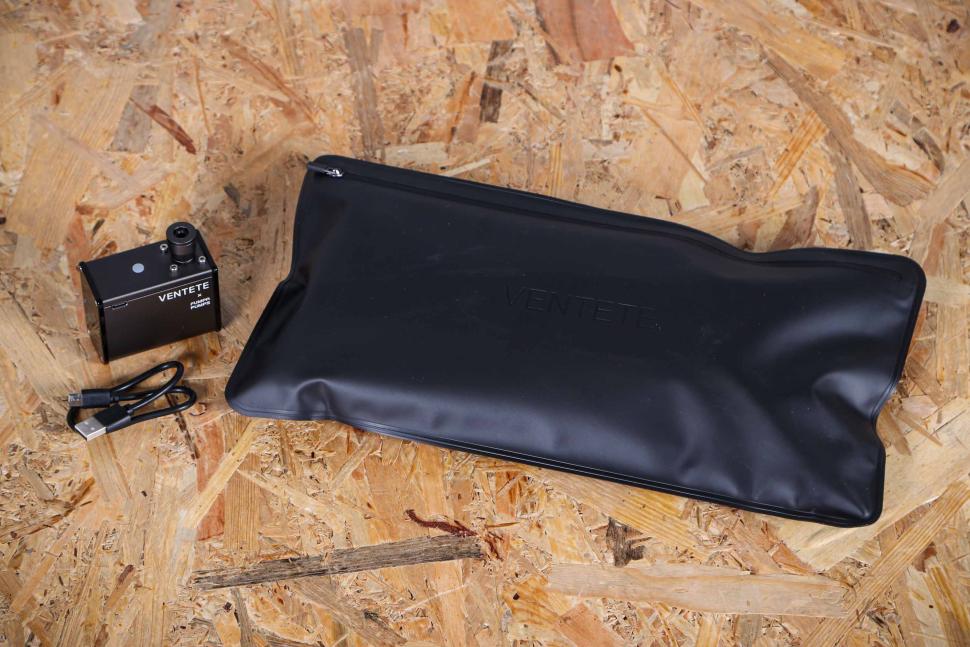
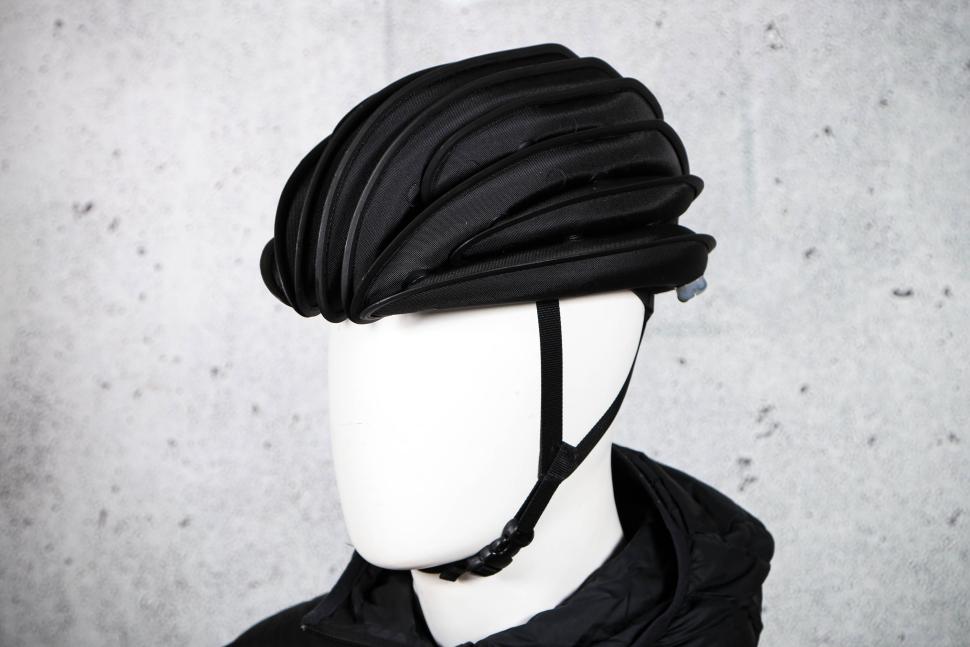
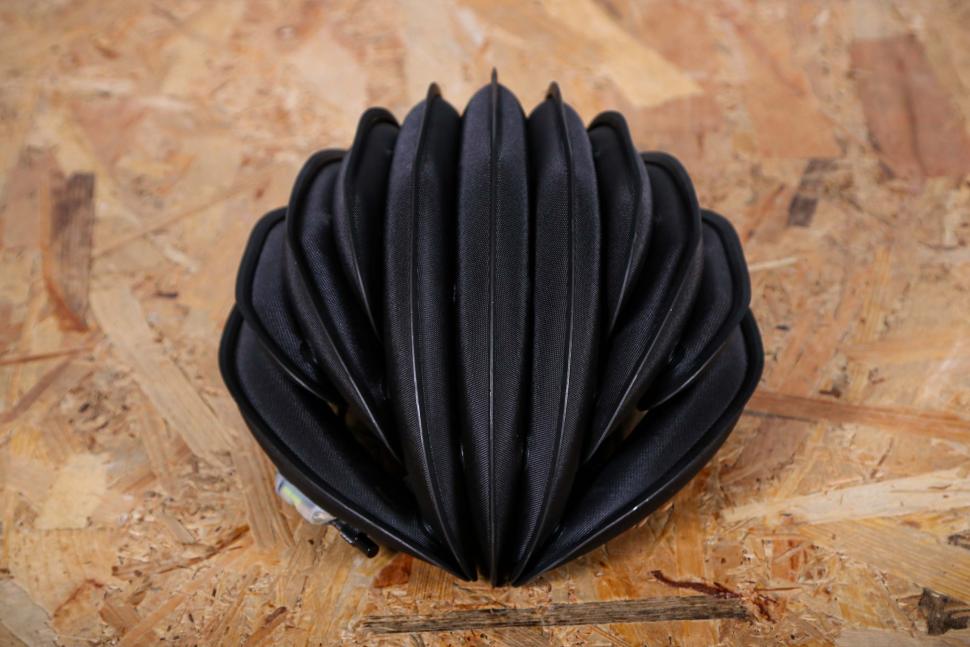
The Ventete aH-1 is certified to UK and EU safety standards, packs down to a size of just a few centimetres wide and inflates in around 30 seconds via a Presta valve and Fumpa mini pump (included in the £350 price). A visible line on the side of the helmet denotes when it has been inflated to the correct pressure.
Ventete says the triple-laminated, high-tenacity nylon means users don’t need to worry about getting a helmet puncture. The brand’s CEO Colin Herpenger even suggested a fellow co-founder had successfully “driven his car on top” of one to prove a point about its durability.
The aH-1 is now available in white as well as black and weighs 465g for a size medium. It is very much aimed at commuters and people riding about town who don’t want to lug a helmet about all day, Herpenger highlighting the importance of convenience for the “future of how we use the bike to get around”, especially in cities like London where cycling and hire bike schemes have boomed.
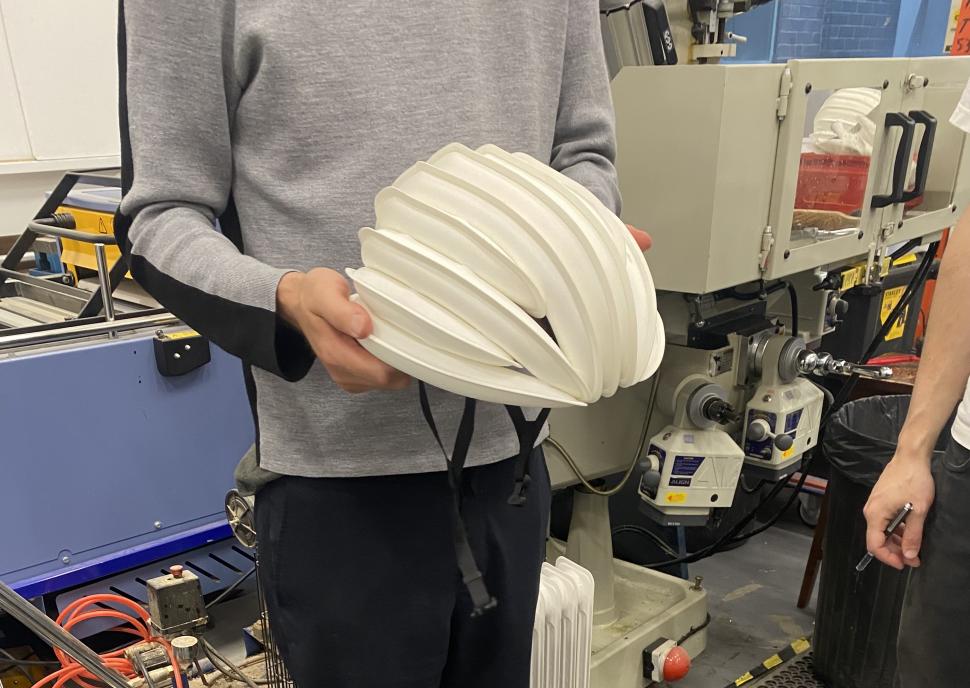
Commuters with plenty of disposable income perhaps, there is no escaping the fact £350 is a lot of money, even if part of that cost is taken up by the mini pump. Other than elite-level time trial lids, the aH-1’s price far exceeds just about every helmet on the market. For comparison, Hexr’s custom-made, head scan-fitted lids used to cost £349 but are now down to £299, while most brands’ most expensive top-of-the-range road helmets are still closer to £200-£250 than the £300-£350 mark.
Anticipating another possible issue that readers might raise in the comments, the practicality boost of having a helmet you can deflate and pack away might be tempered for some by also having to remember to charge and pack a mini pump.
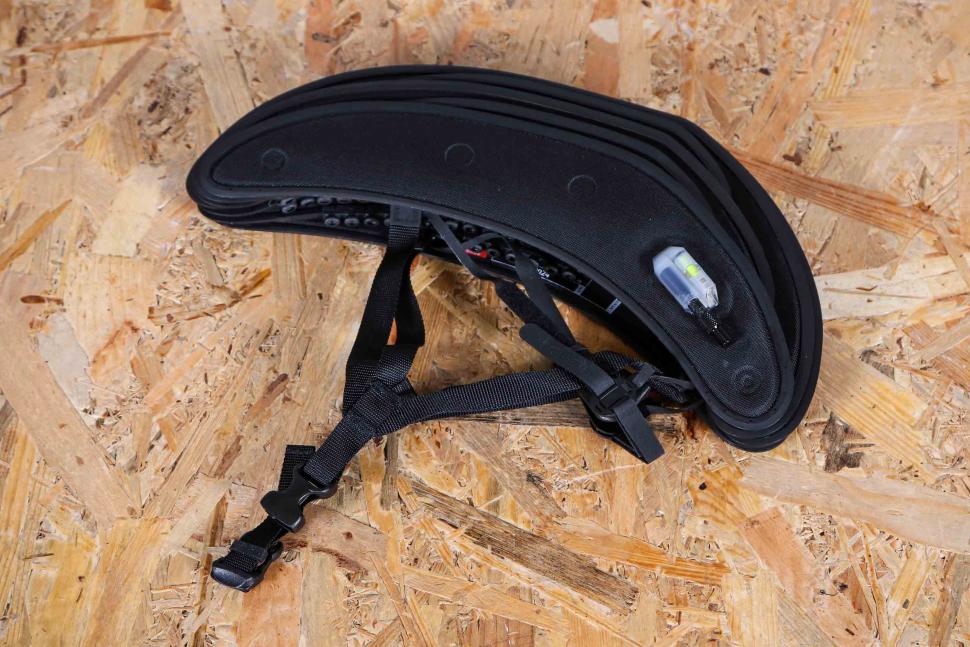
However, Ventete is convinced it has created, after a decade of development and impact testing, a “major advancement in helmet technology” that offers enhanced impact protection over conventional EPS foam helmets.
The brand claims in “independently testing by HEAD Lab at Imperial College London, the Ventete aH-1 outperformed 30 of the UK’s leading helmets”.
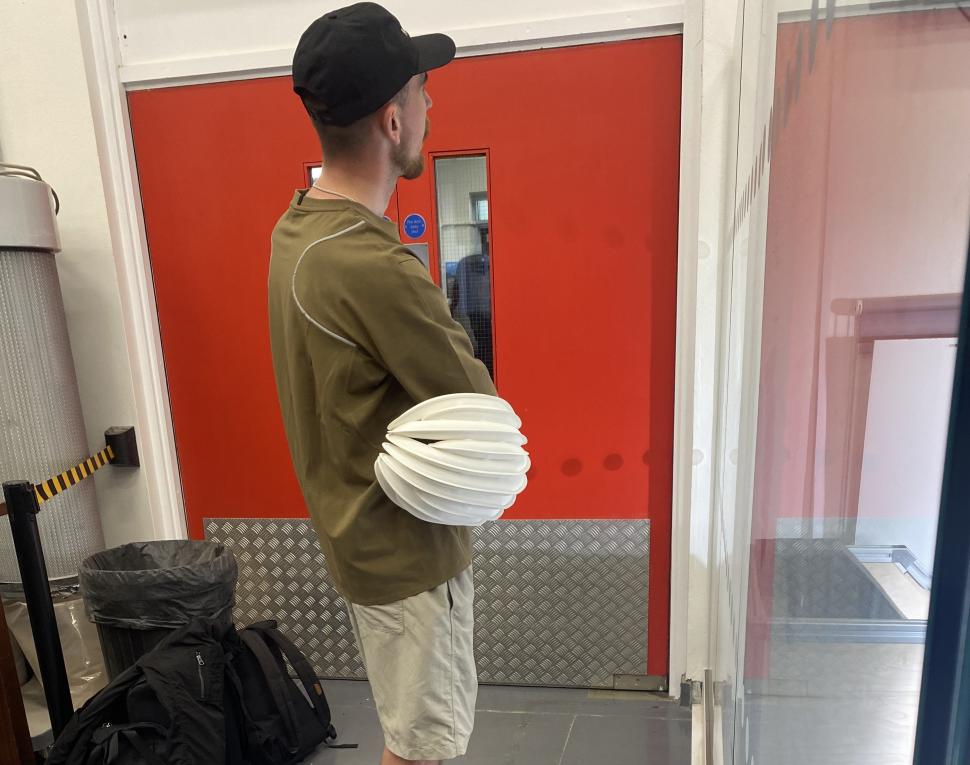
“It reduces linear brain injury risk by 44.1 per cent compared to the best-performing conventional helmet in the study”, the claims continue, Ventete saying this is achieved by “significantly lowering peak linear acceleration across all impact zones while providing rotational protection comparable to MIPS”.
This is all “made possible by its air-filled structure and RHEON-engineered padding”, Ventete saying the aH-1 “also doubles impact duration compared to traditional helmets, minimising the force transferred to the brain”.
Its performance was documented in the study (which is not yet peer reviewed), ‘Linear and Rotational Brain Injury Protection of Air-Filled and Foam-Liner Bicycle Helmets Under Oblique Impacts’, published by Imperial College researchers in January, comparisons with high, medium and low-performing (based on HEAD Lab testing) helmets shown below.
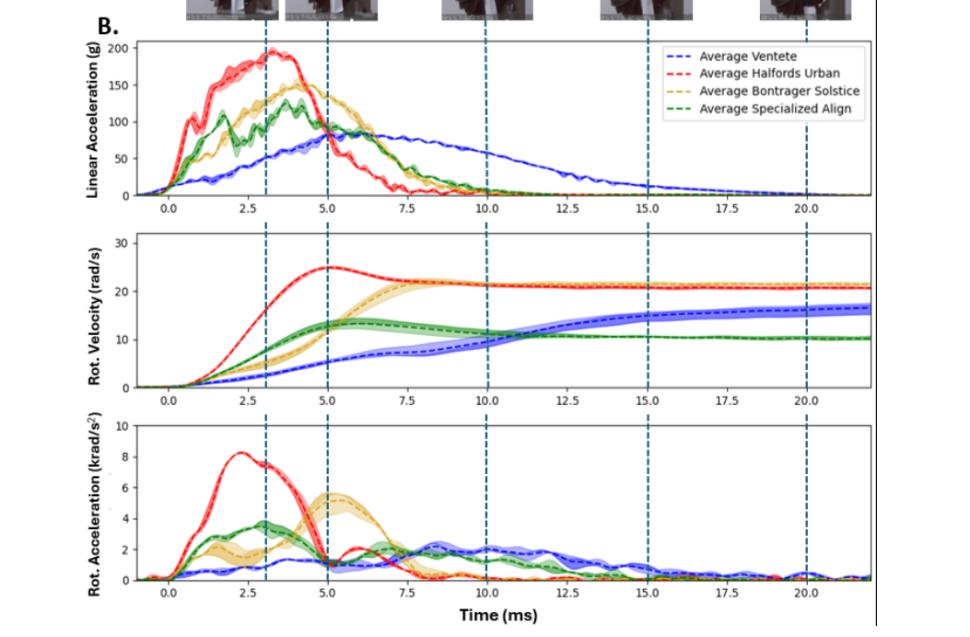
Highlighting his brand’s performance in HEAD Lab’s testing, Ventete head of design Sam Davies said “the really interesting thing” is “how much longer the impact is spread over” compared with foam helmets, the graphs showing rotational acceleration, rotational velocity and linear acceleration during an impact, over a 22.5-millisecond period.
He also proposed a hypothesis for why this might be the case: “The reason this is, I think, that conventional foam is compressible and it crushes under impact. There’s typically a sort of maximum amount that the foam can compress before it can have a substantial force to the head.
“So it’s all about the thickness of foam that you’ve got, whereas the [Ventete] helmet, essentially the whole cavity depth, so the whole of the helmet depth, is compressible. So you’ve got a much greater distance that the helmet can absorb impact over before it starts to translate towards the head.”
The testing was carried out by HEAD Lab, based at the London university, who publish all their helmet safety rankings online, with 30 currently ranked (far less than other established testing labs such as Virginia Tech) but more coming this summer thanks to funding by the Road Safety Trust. Of course, the results in the study, online rankings and claims in Ventete’s marketing come solely from HEAD Lab’s testing and there are numerous other labs with their own testing processes and results.
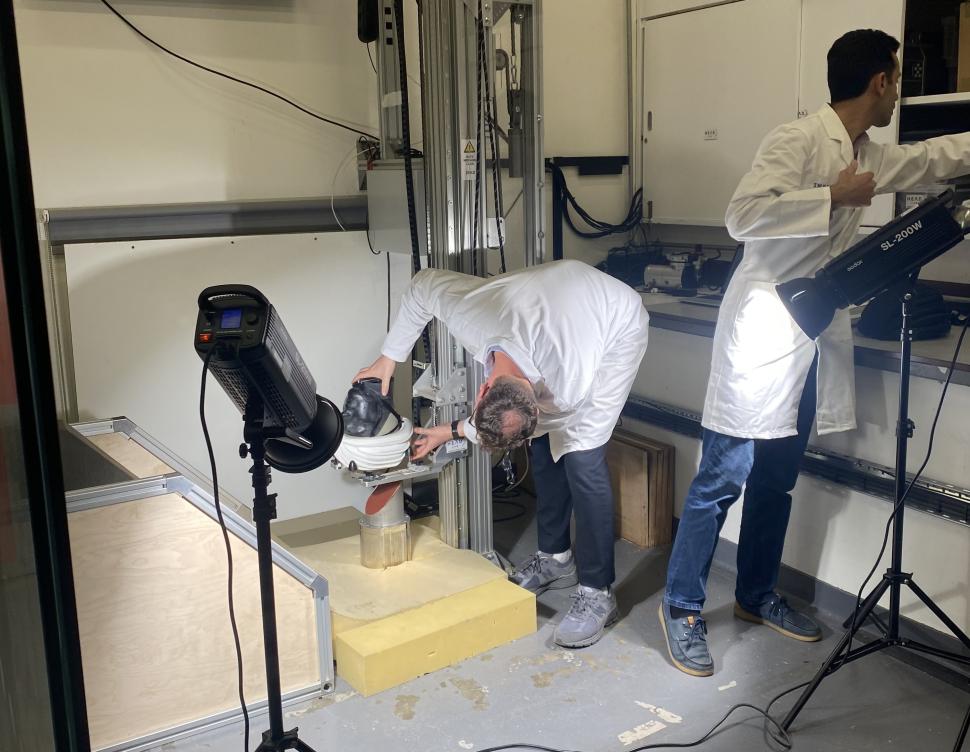
However, the head of group, Dr. Mazdak Ghajari said HEAD Lab’s aim is to provide more comprehensive independent testing of helmets and to better inform consumers and manufacturers. At the heart of this is their belief that existing safety standards are outdated, helmets only required to pass a minimum safety standard when more could potentially be done to test a helmet’s real-world effectiveness.
Working with neuroscientists from Imperial and further afield, the testing uses a drop tower to simulate what a cyclist might be exposed to in a collision. Helmets are dropped onto an oblique anvil which Dr. Ghajari says better simulates what a rider might experience in a crash, rather than a flat or kerbstone anvil.
Ultimately, across multiple tests and impact locations, a final risk value is used to rank helmets.
Of the 30 models tested so far, Specialized’s Tactic MIPS, Echelon II MIPS, Align MIPS, Lazer Tonic MIPS and Bontrager Velocis MIPS are the best-scoring. The Ventete inflatable model’s performance compared with the Align, also documented in the study.
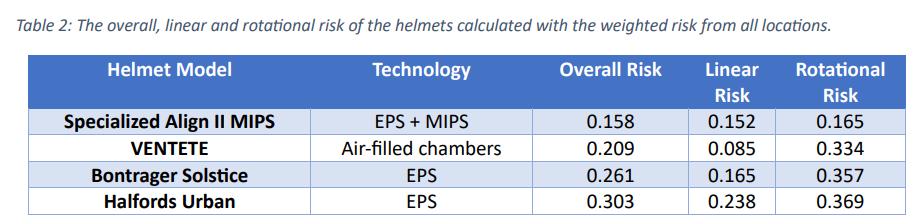
When we visited Imperial to see the HEAD Lab testing in action, research associate Will Dawber explained how all helmets tested are exclusively bought from retailers, never provided by the brands, making cost the restricting factor, but they intend to test and add as many popular helmet models as possible in the future.
The lab has collaborated with MIPS and numerous brands such as Scott and Kask, Dr. Ghajari concluding that the aH-1’s results are “exciting” and “shows that air has so much potential in making improvements, and in reducing injuries in general”.
At £350, it seems unlikely we’ll be seeing Ventete aH-1-wearing riders dominating the streets, but what about future developments of inflatable helmet tech? What about if the packable nature meant a cheaper future design could be easily stowed as a standard part of a bike hire, such as being provided on Santander Cycles or Lime Bikes?
Dr. Ghajari didn’t want to get into any helmet debating. The researcher accepts that the discussion around mandatory helmet use and other road safety factors remains controversial, but simply concluded his team wants to build a safety scoring system that is useful to those who do want to wear a helmet.
“I think there’s quite a bit of tension,” he said. “We try to really stay away from that debate. So we are not advocating the use of helmets. Where we position ourselves is that there are around 50 per cent of cyclists who choose to wear a helmet and we are here to help them to choose the best helmet.”
Ventete co-founder and CEO Herpenger admits for now one of the main challenges remains getting people to buy into the idea of an inflatable safety product.
“By nature, if you think about an inflatable product you’re like ‘oh I don’t know if I’d use that to protect my head’ but that’s what our technology and innovation has built,” he said. “It’s always the challenging thing and people fight against it until they’ve tried it and then they swear by it and then they tell their friends.”
We’ve got an aH-1 in for test at the minute so expect a full review up on the website at some point in the near future, but what do you reckon? Is this the inflatable helmet design that finally breaks through? Would you wear one? What about the £350 price tag? Let us know in the comments and you can find full details about the aH-1 on Ventete’s website…

-300x199.jpg "“He wants bikes in traffic lanes. Give him what he wants”: Cyclists urged to “slow every street down to bicycle speed” and ride in middle of lane amid premier’s war on cycle paths + more on the live blog")








15 thoughts on “Would you buy a £350 inflatable bike helmet? Latest air-filled lid hopes to tempt commuters”
Looks nice in white. Could be
Looks nice in white. Could be a bit warm. One thing that spending on a good hat is good ventilation, if you want it.
That cost has to reduce
That cost has to reduce BIGTIME… I’m sure China could produce this way cheaper? – I’m sure they’ll be on it already lol – a vented version is crucial imo
Ironically, you would need to
Ironically, you would need to have taken a knock to the head to want one of these
It’s probably not overly
It’s probably not overly surprising that an “air-bag” can perform extremely well.
I do wonder about the rotational risk on loose ground (i.e. gravel), where I suspect the helmet might perform far better than most conventional (non-MIPS) helmets…
Seems pretty heavy (465g) for
Seems pretty heavy (465g) for a device where the protection comes from air. I’ve just bought a new helmet, necessitated as the previous one broke when I carelessly bashed my head off the ground while wearing it, and the new one weighs not much more than half that.
As to why buy an inflatable helmet, presumably that’s in the expectation it will deflate to something much smaller for convenience. Does the minipump also help with deflation?
Think I’ll stick to my onld
Think I’ll stick to my onld-fashioned skid lid for now.
This is a great answer to the
This is a great answer to the question “how can we sell something with electronics / a computer in it that previously we didn’t need them for?”
Not that plastic foam helmets don’t come with a built-in “lifetime” … but actually I’ve one from (probably far too many years ago) for which the batteries haven’t run out. It would probably still give some kind of protection.
OTOH when I used other safety gear I did get into the habit of retiring it after it reached its “lifetime” even if “not damaged” – so perhaps not so different?
But I’m not the target market here – I’ve got out of the habit of helmet wearing almost entirely…
I don’t think it has any
I don’t think it has any electronics or a computer in it. If it protects better than a normal helmet then surely any helmet advocate would support it.
The helmet itself doesn’t, it
The helmet itself doesn’t, it comes with a electronic pump that does, but I guess you could just go manual so there’s that.
There are electronics in the
There are electronics in the pump, which is part of the product.
When I commute I want to
When I commute I want to leave the office quickly and quietly. That ticks none of the boxes and is a month late for April’s Fool Day!
What happens when someone
What happens when someone uses a CO2 cartridge to inflate it?
You know *someone* will.
Costs the price of a decent
Costs the price of a decent bicycle, dubious if it can stand hitting something pointy, overweight, needs additional tools that require effort, energy or cartridge to use.
Seriously now who put his money on this idea? Or maybe just people are willing to throw any amount of money on cycling kit.
I breifly considered the
I breifly considered the Hövding, but decided agaisnt something that would need recharging if I tripped. It wasn’t jsut too expensive at £249, there was likely to be an ongoing cost too.
Instead I spent £100 on a Hedkayse ONE – as well as folding, it isn’t damaged by being dropped (or bashed about in a bag) which – as far asI’m concerned – makes it more suitable for daily commuting/transport cycling than a polystyrene lid that’s supposed to be replaced if you drop it, dent it, etc. It’s real appeal isn’t the fold, it’s the robustness.
The major downside to the Hedkayse is its weight (496g). This is barely lighter (465g) despite being full of air.
Sure, if can survive having a car driven over it – but that’s not really how punctures occur, is it? At some point I’m gonna fish it out of my bag and find something sharp has damaged it.
“Would you buy a £350 inflatable bike helmet? Latest air-filled lid hopes to tempt commuters” No, I’m not even considering it. Make it for £50 and there MIGHT be a market for it as a spare helmet for travelling with.
They happens regular as
They happens regular as clockwork don’t they. It’s been a folding helmet, an air bag hoodie collar thingy, gloves with indicators on, lights with line lazers, leather wine bottle / banana holder and what was it a few weeks ago, a body worn tail fairing. All things we never asked for, don’t want and certainly would never pay for.