


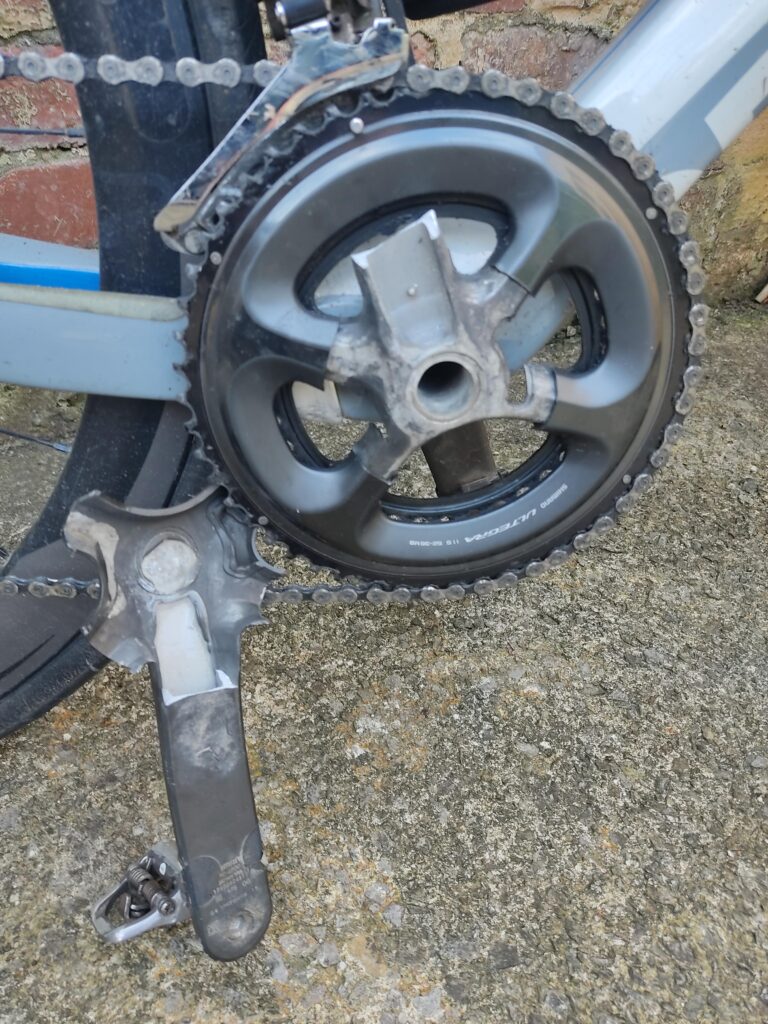

Shimano says that there isn’t a design problem with its Hollowtech cranks despite reports of a pattern of failures – although its engineers are continuing to investigate other factors or causes.
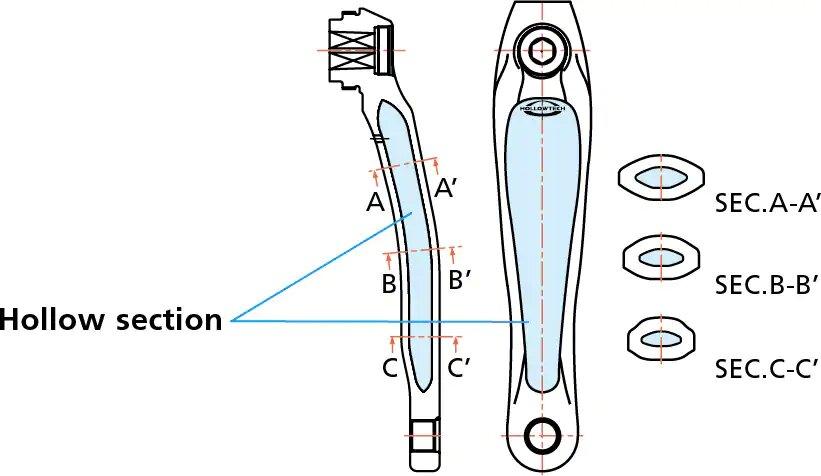
The hollow design of Shimano’s Hollowtech crank arms makes them light; decreasing the rotating mass helps with acceleration. A lot is to be gained and Shimano says on its website, “The challenge is to reduce the weight of the crank without reducing its strength and rigidity.”
So, is the balance right?
road.cc reader hawkinspeter shared with us all in a forum post last month the result of an uninvestigated creaking noise. The photo shows the Hollowtech crank arm cracked completely and split in two. This failure resulted in the rider hitting the deck.

He explained that the noise repeatedly occurred when accelerating from a standstill, but that he was unable to get to the bottom of the issue until the crash when it became clear Shimano’s Hollowtech crank arms had been the source.
This is one reader’s incident, but there are more. When we shared the photo on our Instagram page we got countless replies detailing similar incidents, so much that it spawned a whole road.cc Podcast episode on scary cycling incidents. An Instagram account with 11.1k followers, @thanksshimano, shares photos documenting similar issues, with new posts every day or so.
@thanksshimano reckons the issue is that “none have properly treated internal surfaces and all rely on ‘perfect’ bonding which we know to be sometimes imperfect”.
It’s clear hawkinspeter’s failure isn’t a one-off, but we have no way of putting a definitive figure on it.
Shimano sells a vast number of these cranks – there are far more out there than cranks of a similar level from SRAM or Campagnolo, for example – so it’s almost inevitable that there will be more reported failures. It would be interesting to see the number of incidents versus the number sold, but we have no way of getting these figures. Nor can we tell you about the history of any particular product that has failed.
What we do have, though, is a response from Shimano on the issue.
We brought the reported failures of cranks to the company’s attention and in a nutshell, Shimano says there is no design problem, but that it is still looking to find out if there is a specific cause.
Here’s the full response we received:
“Thank you for bringing the reported failures of cranks to our attention. We take customer complaints seriously and, as a result, we initiated an investigation.
“Crank failures do occur, even though our cranks do not have any design problems or if there are no other easily identifiable issues.
“During our examination of usage cases, and through our own internal testing, we have not identified a design problem with the cranks, and we are continuing our investigation to discover other factors or causes.
“We would like to be able to give further details, but we cannot at this point because our investigation has not resulted in the identification of a cause of the crank failures your readers reported.
“We would like you to know that your readers’ complaints are not being ignored, and Shimano’s engineers are trying to find out if there is a specific cause.”
Have you had a Shimano crank fail? info@road.cc?subject=Shimano crank failure&body=Please tell us the circumstances in which your crank failed - what your bike shop or Shimano did about it and whether you still have the crank. Feel free to attach pictures.">Please get in touch and tell us what happened.













125 thoughts on “Shimano denies design problem with Hollowtech cranks despite reports of cracked arms”
“We’ve never seen it before..
“We’ve never seen it before…” is a standard reply in a bike trade from suppliers and manufacturers when you rise a warranty claim or express concerns about design/manufacturing/assembly issues…
“We’ve never seen it before..
“We’ve never seen it before…”
To which the standard retort should be…
“Well, you have now!”
BBB wrote:
We had that with BMW – “We’ve never seen that happen before, so it must be your fault”. Sold the car and went to another manufacturer, and won’t be back.
PS, and never miss an opportunity to say how utterly awful BMW’s customer service was. BMW bot – you’re welcome.
BBB wrote:
Right up there with “We take [xyz] very seriously…”
Didn’t Shimano (in fact, don
Didn’t Shimano (in fact, don’t they still…) deny all knowledge of leaking disc brake piston seals as well?
I have had that failure on
I have had that failure on items on calipers not long out of warranty.
https://www.youtube.com/watch
Note the video date.
Yes my slightly under three
Yes my slightly under three year old Ultegra crank failed in the same way (funny Shimano only give them a two year warranty) . Luckily mine wasn’t a full detachment so I didn’t crash. Shimano UK didn’t want to hear about it telling me I should take it to a Shimano dealer who would return it via the dealer network. It is almost impossible to contact Shimano now. Shaming them on social media is about the only approach. Granted the crank was out of warranty but I would want every failure back to investigate.
Rigobear wrote:
Hmm, it may be out of warranty, but an item must be fit for purpose. Wearing out a chainring is one thing but having a major chainset structural failure after 3 years suggests not fit for purpose.
Two years warranty is a very
Two years warranty is a very short time for something like cranks that you’d expect to last ten years or so. Shimano must know of the issue, but presumably they’re happy with the failure rate (4%?).
Shimano can say whatever they
Shimano can say whatever they like about their warranty, none of which impacts your statutory rights – against the retailer. My undertsanding is broadly that these rights last six years, although the available remedies taper off with time. How long an item can be expected to last does matter, so the retailer can not simply point to Shimano’s 2 year warranty and send you on your way.
Sriracha wrote:
Unfortunately, my bike retailer closed shop a few months after I bought my bike, so that wasn’t an option.
You may still pursue a claim
You may still pursue a claim with whoever you have the contract with probably the shop or Shimano direct via the small claims court under a fit for purpose clause under the consumers act or against the manufacturer for latent defects which is where the 6 years derives from mentioned by sriracha (I should google them for proper references / titles etc). If a common design defect is known which this seems to show then in simple terms it makes it easier to demostarte the manufacture knows about a fault and has a duty to replace or correct. The warrenty period is merely to enable a quick and easy means of getting goods replaced or monies returned by making them part of the contract.
still try to go fo warranty.
still try to go fo warranty. I had my failed just within two years and had it replaced no questions asked. Shimano knows, but doesn’t communicate about it. I think they probably replace most people even if out of warranty to make it not become a huge media circus.
Another one here! A 5 year
Another one here! A 5 year old Ultegra with around 25,000 km on it. I honestly expected a crank arm would last the life of a bike. (With 62 years under my belt, I am hardly putting a steady 500W through it ). My failure was due to progressive failure of the bond line. I knew something was wrong but couldn’t pin it down, until I noticed flexing of the crank arm under power, at which point failure progressed more rapidly. I shudder to think what a catastrophic failure under power, out of the saddle, would be like, and commiserations to those who have suffered such. My next bike will be carbon cranks!
time to file a class action.
time to file a class action.
Yep. I’ve had exactly this on
Yep. I’ve had exactly this on a 6800 crankset after about 3 years use. Luckily, I felt it going for several miles before it failed. It felt like the pedal spindle was bent. As others have said, the pursuit of minimum component weight means this is all too common in the industry. I had a DT Swiss PRC wheel start to fail because in a moment of genius, they decided that the best material to make the inverted and totally invisible spoke nipples from was aluminium. Less than two years in, the nipples were crumbling away and spokes popping out the rim. DT Swiss response was along the lines of “Oh yeah – you shouldn’t use them if you might sweat on them. Or if it rains. Or if you leave near the sea. And you must always position the drip hole at the bottom of the rim to let liquid run out. Blah, Blah, Blah. I’d been descending the Stelvio on those wheels at 85kph only 3 or 4 months earlier! From talking to various bike shop mechanics, this is a stock response from DT Swiss, Mavic and most of the others.
I had an Ultegra 6800 drive
I had an Ultegra 6800 drive side fail, thankfully it didn’t seperate so I managed to stay on the bike. Also a non drive side Dura Ace 9000 stages crank arm, started showing over 1000w on only relativly minor efforts. I guessed at the problem and removed it before it went completely.
If Shimano would like them for examination, I’ll hapily swap for new ones.
My Ultegra 6800 cranks failed
My Ultegra 6800 cranks failed recently as well. The 2 halves of the arm came unstuck at the axle end. It had been creaking for a while, and luckily I was able to get home before it failed completely.
It did have a lot of miles on the clock. Worth checking if you have an old ultegra/dura ace crankset. In my case I could see (and feel) the outer shell flexing away from the chainrings when I weighted the pedal. The inner shell of the arm is cracked down by the pedal.
Almost impossible to find spares at the moment too…
nopants wrote:
I had the same problem, it looked exactly like yours. I was about 6 months outside the warranty but persued it with the UK distributor rather than Shimano, and got a replacement. Ultegra 6800. I also knew there was something wrong but couldn’t find it, until it got to the stage where it was flexing as I pedalled. I was on my way to Rosedale Chimney, luckily I spotted it before the climb ?? I still had about 25 miles to roll home gently though, expecting it to let go any minute.
Probikekit have 105 chainsets
Probikekit have 105 chainsets at £116. Different construction and should work nicely.
Thanks for that. I have 6800
Thanks for that. I have 6800 groupset and had experienced squeaking, have oiled and changed everything except the flipping cranks – though i did check the bolts. Will have ot check it’s integrity. Still have old 105 crankset kicking around so will swap out check to see if the creak/squeak has gone.
This problem has been known
This problem has been known and discussed for a long time. It seems to affect mainly the pen-ultimate generation of 11x DuraAce and Ultegra (6800).
By comparision to Ultegra 6800, the successor Ultegra 8000 (and respective 105 and Dura-Ace) crank arm have already been “beefed” up very visibly – probably to address this mode of failure — and I’d assume that the latest (12x) generation has been improved even further.
Nevertheless: Cudos to Shimano for their elegant and cost-effective designs! Having the same strength and weight as (non-recyclable) carbon-fibre cranks arms from other brands is an impressive achievement – and the number of failures (even in the old 6800 generation) is very small. Let’s hope they’ll handle them more gracefully in the near future…
Also a lot of Ultegra r8000.
Also a lot of Ultegra r8000. Actually didn’t see it with models before r8000 yet, but it might be from the moment the hollow tech technique was introduced.
Dura Ace R9150 crank weight
Dura Ace R9150 crank weight 614g, SRAM Red AXS crank weight 561g, so bang goes that argument.
As for recycling? Bearing in mind the heavy steel axle through the middle plus steel inserts for pedal attachment, how much of that 561g of the SRAM crank do you suppose is carbon fibre, compared to the weight of Lycra (non recyclable) the average cyclist goes through during the life of a carbon crank? Back to merino wool it is then!
No, I’m not being flippant. In the UK, household waste amounts to 400kg per person per year, of which only 44% gets recycled. If you really want to reduce landfill, say 100g of carbon crank per cyclist every 10 years (10g per cyclist per year) is hardly the place to start.
Reduce, Reuse, Recycle in
Reduce, Reuse, Recycle in that order. Needing to buy replacement cranks is hardly reducing comsumption.
rct wrote:
Absolutely, and I would expect cranks to last pretty much the life of a bike. My Ultegra crank failed after 5 years.
“Dura Ace R9150 crank weight
“Dura Ace R9150 crank weight 614g, SRAM Red AXS crank weight 561g”
Theres still lighter and better : https://www.renehersecycles.com/shop/components/cranks/rh-11-speed-double-cranks/
Reneherse is only lighter
Reneherse is only lighter without the shaft (in the bottom bracket), no?
Is kudos really an
Is kudos really an appropriate response to a product that endangers users like this?? You should perhaps ask instead why such fragile thin-walled aluminium is still being used in a premium groupset (9100 and 9200).
Flagship bike products (framesets, groupsets, wheelsets) are carbon for good reason. Carbon is stiffer, lighter, and stronger than alloy. Your frame and wheels are probably carbon.
The failure modes on the insta page are all the same, not random, showing a common design fault in a thin-walled aluminium design pushed just too far in its struggle to match the low weight of carbon.
With the new 9200 DA shimano have finally given-up pretending aluminium painted black is even comparable with carbon, making the c/set heavier (690g vs 624g before) due to 9100 breakages. Zero surprise, the campag SR carbon c/set is 11% lighter and 6% stiffer.
Using relatively low-cost aluminium and some black paint for manufacture may generate great DA profits for shimano, but it’s hardly the pursuit of marginal gains (and safety) expected in a flagship groupset.
HiFi wrote:
Flagship bike products (framesets, groupsets, wheelsets) are carbon for good reason. Carbon is stiffer, lighter, and stronger than alloy. Your frame and wheels are probably carbon.
— HiFi
I snapped a pair of Specialized s-works carbon cranks so I’m not sure it’s all down to material choice.
anke wrote:
Is this a joke, I can’t tell if you’re trying to be funny or not. I hope you are.
Look, the design for
Look, the design for manufacture, mass-production, weight, and affordability, based on cheap materials, as mastered by Shimano, is most impressive. — Just producing an expensive clunk from the most expensive material available is child’s play compared to this (but can be done by smaller companies without the production and engineering resources, if these companies can demand high prices).
But as I wrote before, I totally agree that Shimano did not seem to handle this problem (cracked crank arms) in a graceful way.
anke wrote:
This post has no more fact than your previous post. Shimano have “mastered” nothing here, the cranks break, people get hurt, have you not been listening? As for the nonsense about affordability and cheap materials versus “the most expensive material available” if you had actually checked you would find that SRAM Red 22 (carbon) are cheaper (by msrp) than Dura Ace R9100. The company “demanding high prices” as you put it, is the one using cheap pieces of cast aluminium badly glued together.
I think you’re exagerating a
I think you’re exagerating a little, my dear Griff500. It also seems you didn’t read my post properly, did you?
anke wrote:
In defence of Shimano you have so far said they are light as the opposition, (they aren’t in all cases eg DA versus Red), lauded them for use of cheap material, despite the end product in some cases being more expensive (eg Dura Ace versus Red), and described them as masters of DfM, despite a clear pattern defect in use. Now which bit do you think I got wrong?
Right. So Mr ex black belt
Right. So Mr ex black belt would design bike-parts to a six sigma level of reliability, so there might be just shy of 4 failures in one million parts, over many, many years, in possible highly corrosive environments? What’s the weight penaltiy? Pro-level bicycle parts (or at least very high-level ones) – not the stuff for the daily commute?!
anke wrote:
You clearly don’t understand DSSM, you are way over your head. Despite the name it’s not about meeting an absolute figure, it is about meeting a set of key requirements which you define yourself for your product and market, and covering much more than reliability. So no nothing whatever to do with meeting 4 failures per million, unless you think that 4 is the right number for a specific parameter on your product. Being an authority on DfM, I thought you’d know that.
Right. But you didn’t even
Right. But you didn’t even attempt to provide an estimate of what level of reliability, failure frequency, weight, … are acceptable for components for this market (Amateur racing, pro racing, keen / wealthy riders) – but just attack me for appreciating Shimano’s innovative crank design.
You know, people can appreciate a cool, elegant, light and clever design – even if it shows problems, in particular problems that seem to occur after a longer time or in corrosive environments – for which these “fair weather products” might not have been designed.
These Shimano-Cranks are cool, because they provide a high stiffnes at low weight, by achieving large, hollow cross-sections from the pedal through to the four arms holding the chain-wheel. Yes, this could also be made from carbon fibre or perhaps, somehow, by welding. But making it from aluminum, with thin walls, cheap enough for hundreds of thousands of bikes is cool. I also believe that Shimano were the first to question the three-arm or five-arm designs – replacing it with a much more logical four arm design that can be tuned for the way a rider will provide the greatest torque during the down-stroke. And finally, I believe that these designs are cheap to manufacture for Shimano – so again, cool engineering for production — even if the sales people might have added a huge premium.
But instead of appreciating these clever design points, you can just continue attacking me personally and boast about your credentials if that’s what you’re here for.
Where do you get 4 from –
Where do you get 4 from – there are about 30 fails mentioned in a self selecting thread on the problem.
hirsute wrote:
Looking at the number of riders that have experienced crank failures, I’d say the failure rate would be much closer to 4% than 4 in a million. Otherwise, riders like Bubba Tex would be incredibly unlucky to have broken three of them and that doesn’t seem that unusual.
Ask Grif500, who introduced
Ask Grif500, who introduced his six-sigma credentials, and that he used to be a black belt …
(Six sigma, originally, means that a production step should be managed so tightly that its standard deviation (in a critical outcome) is so small that a single part will only be a failure if it deviates from the specification by six standard deviations (sigma) – which corresponds to approx. four failures in a million parts, assuming a Gaussian distribution.)
Why would I ask anyone other
Why would I ask anyone other you who wrote
“so there might be just shy of 4 failures in one million parts, over many, many years, in possible highly corrosive environments?”
Given the number of posts and photos of the problem prior to you writing it does seem a rather odd thing to claim.
“Why would I ask anyone other
“Why would I ask anyone other” (than) “you who wrote…”
…you would ask Griff500 because my post is a response to Griff500 (as clearly indicated above the post). And it was Griff500 who argued based on “six sigma” (which, originally, means four in one million). Why he did so? I do not know.
Edit: The black belt and six sigma stuff have disappeared now from the posts of Griff500. That’s fair enough – in that case, please ignore my comments on black belts and six sigma…
anke wrote:
Indeed, note that word “originally” in your definition? Good, nothing to do with the Design For Six Sigma Design Methodology then, just a snippet of ancient history you decided to throw in. “Six Sigma Methodology is a proven tool set for driving and achieving transformational change within an organization. Six Sigma is a continuous improvement process focusing and organization on: Customer Requirements, Process Alignment, Analytical Rigor, Timely Execution”
Apart from which, you will note that your hastily Googled 4ppm definition refers to reliability of a process step, which is very different to reliability of a completed component, made potentially from hundreds of process steps.
You say you don’t know why I raised this? You were the first to mention Design for Manufacture, so I gave you the credit of understanding the subject. Because that is what Design for Manufacture is, the control of many process steps used in the manufacture of a component such as a crank, and the summation of small, possibly 4ppm errors and failures at each step to result in an overall figure. It was you who after a quick Google, applied 4ppm to a complete crank, not me!
Interesting: “Because that is
Interesting: “Because that is what Design for Manufacture is, the control of many process steps used in the manufacture of a component such as a crank, and the summation of small, possibly 4ppm errors and failures at each step to result in an overall figure.”
You better go and correct wikipedia then, their definition must be as wrong as my understanding of the term: “Design for manufacturability (also sometimes known as design for manufacturing or DFM) is the general engineering practice of designing products in such a way that they are easy to manufacture.”
anke wrote:
Nothing wrong with the wikipedia deinition as a supeficial intro, but totally ignores fundamentals like how to achieve ease of manufacture, and equally important, minimisation of waste. Fundamentally, it is all about control of processes from supply chain through to in service, so that when components come together they fit, and work, as designed, for the period of their design life, as a result of which there is minimal rework and waste and high reliability . Design for Six Sigma is just one way to achieve that, there are others, but the principle is the same
anke wrote:
Just for the record, NOWHERE did I state that bike parts should meet a reliability of 4 parts per million. Absolutely nowhere!
Anke, seriously? You accuse me of attacking you? Take a look at my posts and you will see that all I set out to do was correct your suggestion that Shimano was “as light” (it isn’t) and cheaper (it isn’t), than the opposition and enumerate your exaggerated non recyclable concerns as a mere 10g per year in 240kg of average non recyclable waste per person. No personal attacks whatsoever (until now!). Read your own posts and see who is attacking who, and misquoting me is really scraping the bottom of the barrel. I am sure you knew that coming onto a thread populated predominantly by people with broken shimano cranks in their garage, with talks of elegant design would not gain you much support (just take a read through the other responses). Don’t take that out on me for merely introducing some real examples in place of your anecdotes. Or maybe you are just here to me constrovercial?
This is a much more positive
This is a much more positive tone now, thank you, and I’m happy to respond in detail.
You wrote the following:
To me, these statements do read like a fairly aggressive attack.
Also, did you not write about the six sigma black belt – text that was removed by now?
You also claim that I was just giving anecdotes – can you provide any evidence, please?
Finally, you ask whether I’m just here to be controversial. No, I’m not. But when writing about a likely flaw in an otherwise successful product, it’s not fair to keep bashing that product, entirely ignoring its strengthes. This is why I combined my observations and criticism with an appreciation of the crank arm design.
anke wrote:
Thank you very much for not
Thank you very much for not responding to my summary of your aggressive statements. It seems you like to attack, rather than to respond to a discussion…
Personally, I find it peculiar that you mention Lotus as a positive example – the very company that has become (in-)famous for it’s super-light, dangerously frail and frequently failing Colin Chapman designed F1-cars…
anke wrote:
Colin Chapman designed F1cars never used bonded aluminium in stressed components. Chapman died in 1982. Lotus didn’t introduce bonded aluminium into road chassis construction until 1996., a technology which they largely pioneered, and for which they have become world renowned, transferring in to other manufacturers from Aston and Jaguar at home, to Hyundai, Isuzu in the East, and Chevrolet and Dodge in the West. Not to mention a shedload of awards, such as “The European Aluminium Awards jury recognised that Lotus used its knowledge in lightweight materials, such as aluminium, to its advantage to build the APX, and that Lotus satisfied the jury’s key criteria of originality, functionality, design, durability and recyclability.” So yes, I’d say they are pretty good at bonding aluminium. Nothing peculiar there at all.
Why did you remove the final
Why did you remove the final sentence from the quote:
“But as I wrote before, I totally agree that Shimano did not seem to handle this problem (cracked crank arms) in a graceful way. “
To spin my statement in the direction that you like?
For all interested: @peake
For all interested: @peake torque (on YouTube) made a brilliant in depth analysis of the problem.
I had my crank broken like this two years ago, and it was just inside 2 years warranty and op of more then 30.000 km’s in. It’s not a new issue by any means and Only introduced when they converted to the four arm spindle design.
the things is, Shimano not addressing it is plainly stupid: it’s by no means clear the new cranks of the new group sets use a new methodology for construction. This will make me think twice or 3 times about buying a new groupset, although I overall like Shimano and especially it’s shoes and wheels.
I like Shimano too, but not
I like Shimano too, but not their cranks. That’s why my builds all have Rotor cranks. Think their old 5 arm design with NoQ rings look classy too.
This isn’t exclusive to
This isn’t exclusive to Shimano cranks, I had some Cannondale Hollowgram ones fail in exactly the same way. Bond went and then sheered off the crank arm. I think @thanksshimano nail the problem when they said the bond needs to be perfect. In this type of design the error rate for an imperfect bond seems too high. It’s a shame really as it’s a nice idea, but I now avoid cranks based on this type of technology.
This, and I’d add is this
This, and I’d add is this really where you want to be testing the design limits? I have older Dura-Ace 7600’s, 177.5 which I think are solid. But they’re on a 2015 Trek Domane that originally came with 6800’s (I needed the length, not available in 6800s). They’re going into the box with the custom steel fork rusting out around the crown.
I was 2mile from home on a
I was 2mile from home on a slight incline, stepped out of the saddle and ended up on the floor in front of a bus. Had no idea what went wrong until I saw the crank arm still fastened to my shoe.
Walked back. Bike shop never seen it, Shimano Europe not interested as I was out of warranty but if I send the parts in at my expense they would have a look. So I bought a new crank and went on. It’s a shame I didn’t know others experienced the same
Is there a weight limit for
Is there a weight limit for Shimano cranks? Might be interesting to see if there is a correlation between these failures and rider weight.
70kg here! Must be a low
70kg here! Must be a low weight limit!
it wouldnt be the riders
it wouldnt be the riders weight per se, it would be the torque forces or the twisting force being applied by the rider on the pedal to get the bike moving,and the metal is just suffering from fatigue cracks which grow over time till the component fails completely.
This has happened to Hambini
This has happened to Hambini’s crank as well. He’s taken it up with Shimano and had the door slammed in his face.
I await his video of this and the ensuing lawsuit from the big S suing him ?
My 6800 Ultegra suffered this
My 6800 Ultegra suffered this cracking in April 2020. Unexplained creaking for a while before I spotted the fracture as per photo. Luckily replaced before it failed totally. 4.5 years old at that point. So out of warranty. Found a few references to the problem on the web and that Shimano’s response was “that there are very many cranks of this type out there and failure numbers are minimal”. Problem is a failure can be catastrophic!
So let me get this straight;
So let me get this straight; Shimano are saying that just because yours failed, there is actually nothing wrong with it because others didn’t. Genius!
I know 2 people in my club
I know 2 people in my club where their top end Shimano cranks have failed alone. It’s clearly a very serious global problem. Do more digging, get them to do something about it!
6800 failed in Spring this
6800 failed in Spring this year on my 2017 Defy.
Good mileage but I am neither heavy (78kg) nor strong (15mph averages on 65ish mile rides in Warwickshire, no not many severe hills). I also tend to spin rather than grind up hills – what sane cyclist would stand when they can laze around on a seat?
At least 6 Ultegra 6800
At least 6 Ultegra 6800 cranks have failed this way in our club … I would suggest failure of these cranks is an inevitably. I have a spare set from a written-off bike and am waiting for that tell-tale creak to start… Looking at Rotor as replacement.
Curious as to where the ‘cut
Curious as to where the ‘cut-off’ is for failure prone vs. not.
I’ve got some 7000km old Ultegra (6800 I guess, 4 arm) with Absolute black chainrings on them. I’m approx 3W/kg on a good day.
Bike sees virtually no rain though, is on turbo duties 6 months of the year and sunny rides only the rest of the time.
Maybe this is the justification I need to buy those Cane Creek ee-Wings in my local shop window. Big welded titanium tubes, what could possibly go wrong!
“Secret_squirrel wrote: I don
“Secret_squirrel wrote: I don’t blame Shimy with sticking with what works.”
Feeling a bit sheepish this morning?
What would really help is an
What would really help is an in-depth look by Road CC at the new 12-speed versions of Dura Ace and Ultegra to see if the issues could persist – perhaps talk to some materials experts about why the failures are happening now and whether Shimano has addressed them (it appears the new cranksets are heavier so that may be a pointer)?
I’ve had it happen to 3
I’ve had it happen to 3 ultegra cranksets over 3 years with two different bikes. All Ultegra 6800 (52×36 crankset on a road bike, and 46×36 CX style crankset on a CX bike). On one bike, the warranty replacement failed with 1 year after covering only about 2000 miles.
Only one of those was covered under 2yr warranty, the others were refused as out of warranty period … so 105 was used to replace them, as that doesn’t have the cranks manufacturered as two separate pieces and bonded together.
Some reports online suggest it’s to do with salt water due to coastal riding (uk) and winter riding (uk) and that it’s somehow getting into the void of the crankset and causing a corrosion like reaction with the back face of the crank arm while ultimately weakens the bonding agent for the two parts. Starts off with a minor amount of play which due to constant flexing from the pedalling motion builds into a fatigue crack forming and ultimately full crank failure as it shears off. Usually get a bit of warning with a bit of creaking, or if your frame tolerances are tight (as in my case) then the crank arm will flex enough to hit the chainstay (!!!).
These failures happened about 4 years ago and it was a known problem then, but Shimano were failing to acknlowledge there was a problem and buried it. It also happens to Dura-Ace of the same time period as 6800, and I believe R8000 etc are also affected due to a similar two-piece bonded design.
dee4life2005 wrote:
I have had an Ultegra 6800 failure, I am not a UK rider, l live in the South of France, 50 miles inland (no salt, even on winter roads), I rarely ride in the rain, and although we get winter temperatures down to zero, that is hardly extreme.
Here’s mine : 6800, in 2018.
Here’s mine : 6800, in 2018. I am certainly no powerhouse, but this happened (just) inside the warranty. Planet-X did replace it under warranty, with an r8000, which I sold.
I totally distrust this design, and will never use this “hollowbond” type again. I will stick to 105/R7000, which use a different manufacturing technique – basically a forged hollow tube closed off at the pedal end.
I think, as others have said, any imperfection in the bonding allows moisture (and salt in our UK climate) in to cause havoc. Once the bond is weakened, the whole thing is inherently too weak and WILL fail.
How many of these will have
How many of these will have been washed with non ph neutral cleaner? If you want to avoid corrosion and early failure of alloy and steel components on your bike, specifically spoke nipples, cranks, bearings etc then make sure the wash is ‘PH Neutral’ . Fancy spray cleaners, foaming degreasers and fairy liquid in a bucket tend to be non ph neutral – choose the products you use to clean your bikes with care!
hmsgenoa wrote:
I wouldn’t expect bike parts to be especially sensitive to non ph neutral cleaners considering that they should be designed to cope with the general muck that gets thrown up from the road including winter salt. Cosmetic, surface damage would be fine and expected after a few years, but not catastrophic failure.
The Shimano instructions didn’t contain a specific warning about cleaning that I saw, though it did warn about checking for any signs of cracks before each ride.
Mine lasted about 25,000km including winter riding in the UK and it’s been cleaned with a variety of cleaners, though mostly car shampoo. I think it’s a design fault rather than which cleaner you use. You’d also expect other components to start having problems before a crank – bearings and spokes/nipples typically get a rough time from any dirt and/or aggressive cleaners.
Well you should expect it,
Well you should expect it, the bikes are getting a double and even triple whammy from salt of the road in winter, salt from sweat when the bike is used on an indoor turbo trainer as well as most car washes and fairy liquid in a bucket, not to mention fancy coloured spray cleaning liquids (most of which are not ph neutral and actually have corrosives in)will instigate corrosion that will ultimately lead to failure. It is just a question of when. And for those living near and riding on coastal roads it can be a quadruple whammy if all those factors apply. Anybody who has an old hack on a turbo will know what sweat alone can do to their handlebar stem for instance. All it needs is for corrosion to be instigated, from that point forward it is just a matter of time. Granted the cranks appear to be bonded, which is a weak point any corrosives will expose, and they I think will need to redesign them. But as for the weakness starting, no doubt in my mind it’s winter riding, non-ph neutral wash and for those turbo bikes and ones ridden on coast they are at high risk of failures on all alloy parts in the long term, Shorter if a combination of these things apply.
I wouldn’t expect bike parts to be especially sensitive to non ph neutral cleaners considering that they should be designed to cope with the general muck that gets thrown up from the road including winter salt. Cosmetic, surface damage would be fine and expected after a few years, but not catastrophic failure.
The Shimano instructions didn’t contain a specific warning about cleaning that I saw, though it did warn about checking for any signs of cracks before each ride.
Mine lasted about 25,000km including winter riding in the UK and it’s been cleaned with a variety of cleaners, though mostly car shampoo. I think it’s a design fault rather than which cleaner you use. You’d also expect other components to start having problems before a crank – bearings and spokes/nipples typically get a rough time from any dirt and/or aggressive cleaners.— hmsgenoa
I think you’re missing hp’s
I think you’re missing hp’s point – given that all that is going to be thrown at it, they should be designed to withstand it. Otherwise they’re not fit for purpose.
hmsgenoa wrote:
I don’t doubt that corrosion happens, but that doesn’t look to be the issue with the problem cranks. Looking at pictures of them (and my own example), there’s not clearly signs of corrosion. Also, why would 105 cranks be not susceptible to the same corrosion?
No – it’s a manufacturing/design fault with the hollow-bonding in my opinion. When my crank snaps again, I’ll go for 105 to replace it.
Exact same issue for me,
Exact same issue for me, though thankfully I checked out the creaking noise before it caused an accident. Shimano wouldn’t cover it under any sort of warranty/guarantee though, so the replacement came out of my own pocket
Nick Johnston wrote:
I’m amazed they can claim that isn’t a warranty replacement job, over two years old?
So they’re not only ugly as
So they’re not only ugly as hell, they’re also shite…
So mine is only six months
So mine is only six months old. I’ve sent these pictures to Dolan, who say there’s nothing wrong even though the joints were perfectly aligned a few weeks ago and now they’re very clearly not.
My tweet to @ShimanoROAD is unanswered.
And I don’t know if I want to ride my bike any more.
What am I supposed to do now?
Crossword Getting Harder
Get that replaced under warranty.
As well as checking for cracks, any non-alignment with the chainwheel (as in your photo) indicates broken bonding and it won’t be safe to use.
Consumer rights act applies
Consumer rights act applies if bought in heh UK. The goods aren’t fit for purpose so either Dolan replaces them or they refuse in which case you buy a suitable alternative and take them to the small claims court.
Crossword Getting Harder
judging fromt he reports I would expect that to fail. I would try again with the retailer, because even if it hasn’t broken, it clearly has deformed and is not as sold.
I would point out to Dolan, that this looks like te begining of a known common failure, which has the potential to cause injury, and that by denying they are potentially liable for any injuries sustained.
Does the chainset creak in use?
I got a new 9100 Dura ace
I got a new 9100 Dura ace group set in 2016. Within three months I broke the drive side cranks catastrophically as depicted in so many of these posts. It unequivocally has nothing to do with the soap you are using to wash the bike. There is a structural flaw to some of these sets. Not being a metallurgist or engineer I won’t guess what but something is so wrong.
Luckily I did not crash as I eventually pulled over and inspected it , at first thinking the loud screeching- creaking noise was coming from the pedal.
With all of Shimano’s talent, resources, and technical expertise, one would think they could get this right.
Whether they admit it or not
Whether they admit it or not this looks/feels like a design fault. Mine failed after around 5000 miles and that was without huge amounts of wet weather or high humidity. Fortunately I found out what the “clicking” was before it actually snapped and could cause a crash – but not until I swapped out pedals, repalced the BB, changed my cleats. Did not expect a crank failure but afterwards found some comments on forums showing that this is not an uncommon occurance. Seems like the QA or the bonding is better on DA. Meanwhile my 6700 crank is still going strong!
This topic has certainly
This topic has certainly worked on me! I’m an (almost) lifelong Shimano devotee, and I don’t think I’ve ever had a Shimano component fail unreasonably, but I wouldn’t buy one of these ‘bonded’ efforts.
OEMs tell shimano keep it
OEMs tell shimano keep it light, keep it cheap, and this is what you get.
Shame on shimano, putting riders at risk like this.
Don’t tolerate it; switch to stronger/lighter/stiffer carbon. Campagnolo carbon is highly reliable in rim/disk and mech/elec. 12x chorus £1160, SR £2160 (eg wiggle).
I’ve done nearly 12,000km on
I’ve done nearly 12,000km on my Vaaru with ultegra cranks. Just over two years old.
maybe full length mudguards helped, maybe I’ve just been lucky. I will pay more attention to any creaking noises and inspect the chainset for any sign of misalignment.
I sold a set of R9000 Dura
I sold a set of R9000 Dura Ace cranks on, the guy who bought them told me a few months later that they’d failed in that way and he’d had quite a bad accident as a result. Then about six months later the same thing happened to mine – three year old R6800 cranks, realised gradually over a couple of hundred miles what the weird feeling was in the pedal stroke, by the time I realised what it was they were coming apart quite badly. Supposedly they’re being replaced under warranty, but that’s been over a year now and nothing back to replace them yet (the shop handling it for me is doing me a favour as they were originally bought from a different shop as OEM, and that shop no longer exists)…!
Oh yeah, and looking at Hope
Oh yeah, and looking at Hope or Rotor to replace the Shimanos on both my road bikes at the mo to avoid likelihood of it happening again…
I’ve had 2 goes this week at
I’ve had 2 goes this week at sorting out a creak. I hope it was from not getting the cassette tight enough (isn’t it in the region of 50 Nm?) rather than the first signs of danger from a 6800.
I had a creak, more of a
I had a creak, more of a click really, on the left pedal stroke. I suspected the pedal, bearings were stiff that side, but the click remained with new pedals. The click was progressively getting more noticeable. So I took it to LBS to check out the BB. Nothing.
As I was putting it in the car I saw it – cracked seat stay (alloy frame) on the other side. Bugger.
cracked seat stay (alloy
cracked seat stay (alloy frame) on the other side
I had a noise which I took too long to identify because it was a crack in the mid seat-tube on a reputable steel frame. You don’t expect it! It was sorted out by the shop and is fine 10 years later
The ultegra cassette lockring
The ultegra cassette lockring that I took off and cleaned yesterday says 40nm.
Solution to these problems.
Solution to these problems. Superbly engineered carbon 12x chorus groupset £1160, SR £2160 (eg chain reaction).
I’ll endorse that. I’ve had
I’ll endorse that. I’ve had campag record on my road bikes for the last 22 years and never had a problem. I’ve been using SR EPS since 2016 and wouldn’t dream of using anything else.
I’d love to try a Campagnolo
I’d love to try a Campagnolo groupset, to see whether there is any real difference. But £1160 is £400 more than I’ve ever paid for a complete bike!
My (much cheaper) solution would be a 105 groupset. Good enough for everyone, even for racing. Unlike Ultecrack and Dura-break, the crankarms aren’t stuck together with Airfix glue.
Of course you don’t need the
Of course you don’t need the whole groupset. I successfully ran a Campag Ultra Torque crank with Shimano for a while until I got the other bits to go fully Italian. You will need new BB but other than that they are interchangeable.
I would recommend avoiding the Power Torque chainsets but any model of Ultra Torque, alloy or carbon seem bullet proof.
SimoninSpalding wrote:
Mixing Shimano and Campag?
I setup an account here just
I setup an account here just to post to this. I am on my 4th R8000 crank since April, 2018 – 2 have been warranty replaced but I bought the 4th because I needed a quick replacement (and I have a spare now). All of mine have cracked on the drive side arm joining seam to the left (when looking at the bike as the picture above). This would be the seam that catches most of the sweat as well as all of the pdeal stroke power. Shimano did ask me if I lived in Flordia or on the coast (I don’t) on my last warranty exchange – so salt related erosion is a concern of theirs (and I sweat ALOT). Until they make a change to this design, I am not buying Shimano any longer (35+ year customer) – or at least not the crank.
This is an “impressive”
This is an “impressive” experience (glad you’re fine!). May I ask if there is anything special about yourself, your environment or your riding style? (Strong sprinter, overweight, using Ultegra for Gravel, extra-long pedal shafts…?)
Bubba Tex wrote:
I can’t see how the drive side crank would be subjected to more sweat or greater forces than the non drive side crank.
It does seem strange that the drive side is normally the one that fails, but I would suspect a difference in fabrication.
The drive-side is very
The drive-side is very complex and glued together, the non-drive side is (I’m fairly sure) a single piece…
anke wrote:
I think both cranks are hollow bonded, but drive side is a more complex shape.
hawkinspeter wrote:
The non drive side is hollow, but does not appear to use the bonded structure of the drive side. I just sectioned mine, and no sign of a bond line. Looks to me like a single piece casting or extrusion, though I’m no expert. This is very different to the drive side, which has overlapping lips which act as the bond surfaces, rather like an airfix model.
Well, that definitely looks
Well, that definitely looks like it’s hollow-forged. That raises the question of why they used different techniques for the left and right sides.
Because one is attached to a
Because one is attached to a ring, and the other is only attached via a bolt?
Even for the non-drive side,
Even for the non-drive side, the hollow-forging is quite an achievement. Doing this on the drive side, and with hollow crank-arms, seems almost impossible…
anke wrote:
Well, they find it easy enough on their 105 series which doesn’t suffer from the issues that the hollow-bonded Ultegra and Dura-Ace have.
hawkinspeter wrote:
They don’t. With 105, the crank arm is hollow – but not the small arms connecting to the chain-ring. Making the 105 less stiff and/or more heavy, compared to Ultegra / DA. (Whereas the non-drive-side crank arms are the same between Ultegra and 105, possibly DA too.)
But then, 105 has always been a reliable “workhorse”, probably better suited for sporty commuters, winter cycling or just long term use than the lighter Ultegra / DA.
anke wrote:
Yes, that’s what I would expect, I wonder about making both cranks the same, and only attaching the chainrings to the axle directly. probably make the driv side crank heavier, taking it all the way to the axle, instead of bonding (unrelaibly) to the chainrings.
The non drive side is also a
I think it depends on the model, doesn’t it? Pretty sure my DA 9000 left crank is also two-part bonded but would have to have a close look to be sure.
My Ultegra R8000 crank went
My Ultegra R8000 crank went on my 2017 Canyon Endurace CF SL, it was replaced by Shimano (through Madison their distributor) after I complained to Shimano, this was despite the bike being 4 years old. It had been well cared for and serviced by my LBS. I thought that the pedal had gone as it felt like it had broken and the pedal was moving and slightly oblong shaped feeling as I pedalled, at first couldn’t see anything but whilst climbing a fairly sharp but short hill looked down and saw that the crank was split and coming away from the arm. It has left my slightly apprehensive about this type of design as a result of this failure.
I have 2 cranksets break in
I have 2 cranksets break in this manner. Both 6800 ultegra.
I had 8000 ultegra cranks,
I had 8000 ultegra cranks, then about two months ago I felt this flex on the drive side. I thought it was my cleats, but after about 2 more rides i took the bike in to my LBS and sure enough there was a crack in the arm about 5 cm long. I contacted the LBS i ordered them from and Shimano warrantied the cranks. They were about 1.5 years old. Now i just have to wait for the news ones which also may crack.
This happened to a guy in our
This happened to a guy in our club this week.
Shimano’s engineers are
Shimano’s engineers are trying to find out if there is a specific cause
There is! It’s people pushing too hard on the pedals. I’m pleased to announce that as a result of delicate pushing I have never broken a crank- on the other hand, I only have the boring old non-glued Hollowtech or ordinary alloy spider types
Peak Torque has a vlog on
Peak Torque has a vlog on this
It happened to me today on my
It happened to me today on my gravel. 1,5 years old 8000. Disappointed..
I am the latest to suffer
I am the latest to suffer this failure. An Ultegra R8000 crankset.
New creak last week when I was out of the saddle. Felt the drive side pedal leaning away from the bike, but wasn’t sure if this was real or not.
Small, but definite crack. Bit relieved that I didn’t ride it to failure.
Bike bought in 2018 and only covered 3,350 miles on it.
A bit unimpressed. I have already replaced the brake calipers that were leaking fluid last year. These failures shouldn’t really happen.
Sniffer wrote:
Glad to hear you didn’t experience it failing, but a failure after 3,350 miles is unlucky.
Yes this week had same
Yes this week had same problem. Feel like it must be design and or manufacturing problem. 10000 miles 4 years old is surely not a reasonable lifetime for a premium product
I know this thread is a bit
I know this thread is a bit old, buy my Ultegra 6800 failed about two weeks ago. I was going up a hill at the time, but fortunately I was in the saddle and managed to stay upright.
Unfortunately, I’m having serious difficulties getting in touch with Shimano for some sort of remedy. Canyon has not been great at helping me out in this matter, but perhaps that’s what I get for not buying a bike at my LBS.
My bike is just over four years old – so outside of the parts warranty – and I’m rather put out at the thought of having to purchase a new crankset for a bike that I’m probably only going to use for another year or two.