


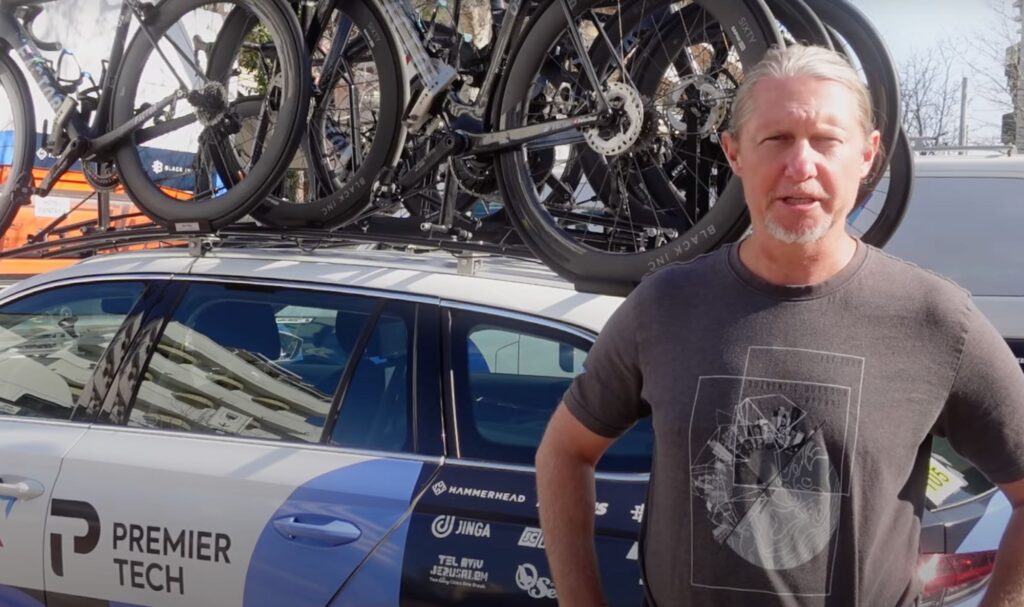

Chris Froome’s mechanic Gary Blem says that disc brake technology isn’t yet at the level required for professional road racing and that in time Froome will again be “unstoppable” – and, before anyone makes the joke, that’s not a reference to his brakes.
Gary Blem is a mechanic for Team Israel Premier Tech and has had an association with Chris Froome for many years.
Chris Froome STILL has disc brake problems
In a video posted on Froome’s YouTube channel, Blem says, “I’m not a huge fan of disc brakes. The whole theory for road cycling is that you can brake last minute and, yes, the peloton is doing that. But sometimes the tyres are not adequate to go inside into the corner and you see a lot of crashes in the peloton and most definitely the speeds of racing have gone up a hell of a lot as well.
“The workload with disc brakes is insane. You can get a brake to work absolutely perfect for a normal cyclotourist but for a professional that will hit a 20-30km descent, who’s really heavy on his brakes, by the bottom the rotor is noisy, the pistons are frozen – they’re stuck. Hopefully, with the new 12-speed from Shimano, those problems have been resolved.
“Chris is not a huge fan. There’s the noise factor, it’s not super-reliable, wheel changes are way slower – so I think those are aspects that can improve.
“In mountain biking racing is different. I know they’ve been using them for years, but racing is completely different in mountain biking. It’s not the same type of elements that these guys face daily.
“The biggest thing is the weight factor because now you add 300-400 grams to the bike, so where are you going to lose that weight? Ultimately, you need to lose it on the frame or the wheels. That’s it, which means you need to get super light, once again pushing the boundaries there.
“I think it was more forced by the manufacturers than anything else, and not so much by the riders. This was coming from manufacturers at end of the day.”
Froome himself has made many well-documented comments on disc brakes. Most recently, he complained on YouTube about warped rotors rubbing and described disc brakes as a “work in progress”.
Blem holds similar views and believes that many of the problems would be solved if hydraulic disc brakes featured adjustable pistons.
He says, “If you can have an adjustable piston, already you solve some of the issues because if that piston gets blocked… you should be able to move it enough so that you got some clearance. It’s easy to say it but to do it is a different story.”
Blem likens the introduction of disc brakes to the adoption of electronic shifting.
“Initially we had a lot of problems with electronic,” he says. “It’s just a matter of time, I guess when disc brakes get to that level – but we’ve got to give it time. The hard part is these guys’ careers are continuing so they don’t really have much time. It’s something new and I think people tend to shy away from something new or reject it initially, so we just need to keep an open mind and go from there.”
Blem also reveals that Froome takes a huge interest in equipment and alters his riding position frequently. He says, “I’ve done many tours with him where we’ve changed the position every single day.”
Blem also says that Froome was thinking about dropper posts long before Matej Mohorič used one to help win this year’s, Milan-San Remo.
Matej Mohorič deploys dropper post to win stunning Milan–San Remo victory
“What I like about Chris is that he is innovative,” Blem says. “This dropper seatpost that Mohorič was riding – Chris spoke about this ages ago. It’s just about working closely with the manufacturers and getting things like that sorted, but it’s something that he came up with a while back. I think there’s a lot of elements that guys are using today in racing that came from Chris.”
Blem reports that Froome has also been very particular about his saddle in the past.
“The Giro he won in 2018, he had a saddle sore issue and I think we tried seven or eight saddles for him and it was crazy,” says Blem. “He kept me busy. Even after he won the Giro, that evening he said to me – I think it was 11 o’clock at night – Gary, I want to try this saddle when I take my bike with me.”
Blem believes that despite not challenging at the highest level since sustaining multiple fractures while warming up at the Criterium du Dauphiné in 2019, Froome will again reach the top of the sport.
He says, “Many people tend to lose faith but they forget he’s been down and out before and he’s come back and he will do so again, so I’m looking forward to that. I think it’s not over yet. I think Chris is just finding himself again and once he does he’ll be unstoppable again. It’s just a matter of time.”












21 thoughts on “Chris Froome’s mechanic agrees with his boss: “I’m not a huge fan of disc brakes””
Hmmm. This may be unkind but
Hmmm. This may be unkind but perhaps the problem with Chris’s disc brakes are linked to said Mechanic????
I have to wonder whether I am
I have to wonder whether I am reading too much into the editorial decision to juxtapose his views on disc brakes and his belief in Chris Froome’s return to glory.
(No subject)
I wonder that too. I think a
I wonder that too. I think a lot of the road mechanics are ‘old school’ and anything new is to be viewed with suspicion.
Nothing wrong with disc brakes.
Well they are right, disc
Well they are right, disc brakes are bloody awful. Even off road they’re terrible, just that off road the alternative is even worse. Clearance is the only mitigation. You don’t need clearance on road, so I can understand their frustration.
Oh god really. At least
Oh god really. At least acknowledge the fact that many people get on with them far better than rim brakes.
And off road – as someone whose run them since the 90’s – you’re talking cobblers. They were a quantum leap forward over V’s particularly on MTB’s with non-diamond frame layouts – pretty much every full susser.
I’m here to listen to an
I’m here to listen to an opinion rather than challenge it, but how are disc brakes ‘bloody awful’?
As someone who suffers from bad Raynaud’s syndrome and has very poor hand strength (numerous fractures, familial arthritis etc etc) I can see numerous benefits to them, but even I wouldn’t go about saying they are the Holy Grail. Humans are varied and changeing beings with unique needs.
Really?? Go and ride a
Really?? Go and ride a Downhill/Enduro course on V-Brakes……You’re talking utter twaddle…..
” just that off road the
“just that off road the alternative is even worse”
There weren’t too many words in my post, it’s quite clear.
A bit of confirmation bias,
A bit of confirmation bias, but this seems to support my general view that disc brakes make sense for the amateur/casual rider (I certainly wouldn’t go back) but not really in the pro peloton.
As a pro, you’ve gotta
As a pro, you’ve gotta respect Froome’s opinion on the subject. If he doesn’t feel that discs are right for him specifically, it’s because they probably aren’t. We live in an era where tennis professionals still use animal gut strings (last I remember) because they have superior feel, despite their high wear rate and overall unsustainability.
However, it’s inaccurate to decry discs in general because, as we are all aware, they have numerous benefits for day-to-day use.
I often feel watching wheel
I often feel watching wheel changes in races theyd be a lot quicker if the teams actually routinely practiced them, so that it became just second nature. Instead they seem to bundle out of a team car in a blind panic, start fumbling around for wheels, dont always have the right tools with them, and it all gets to be just a big mess. I think it was the TdF last year neutral service replaced a disc brake wheel and it took ages to sort and everyone said aha disc brake wheels rubbish, not hold on the tool the guy was using to torque the thru axle looked about as powerful as a rubber band and that was the hold up.
It’s the kind marginal gain I’m surprised Ineos havent been seen focussing on with their F1 buddies.
Not watched any recent pro
Not watched any recent pro road races, are they really using thru-axles in the pro peleton?! That’s utter madness in a sport where a quick wheel change can be the difference between winning or losing race. No amount of practice will make up for the additional time a thru-axle wheel change will take compared to a quick-release wheel, the clues in the name!
The mechanic has highlighted
The mechanic has highlighted an interesting point on the shortcomings of disc brakes.
Discs do not dissipate the heat quickly enough when used on very long or very steep descents. The disc ultimately warps and ‘ping’ against the pads until they cool down. I experienced this phenomenon when road bikes were fitted with 140mm size discs and I rode them in the Alps. (My weight was 85kgs and I wasn’t dragging the brakes). I thought the switch to 160 mm discs had solved this but clearly not for the fast descending pros.
However, I wonder whether instead of looking for adjustable pistons, larger discs or same sized one with better heat management is the simpler answer?
I used to think the disc
I used to think the disc brakes were noisy until I learned to bed them in. Not a problem. Chris needs a new mechanic.
.
.
Laugh my four ken ass off!
.
Four times TDF winner.
.
Or cbmdc.
.
Who ya gona call?!!!
.
Sheeeesh let it go already.
Sheeeesh let it go already. Some people like disc brakes and others prefer rim brakes, each to their own I say. Amazing how some folk get so protective about their chosen braking system.
Chris n Gary are right. There
Chris n Gary are right. There was no need to replace rim brakes. Discs are a bloody dangerous (and noisy) mistake. We will go full circle.
Fignon’s ghost wrote:
Cool, you don’t like them. I find them a massive improvement on the rim brakes on my previous bike and have no intention of going back.
Why must we always default to “I don’t like these therefore they are rubbish”.
Have rim brakes on my road
Have rim brakes on my road bikes and discs on my MTB. All fine. Happy days …
Serious question but I dont
Serious question but I dont understnd the weight penalty arguments. The last time I checked pro bikes were regulrly below the UCI weight limit and mechanics were adding ballast to meet the limit, I have read about chains being put in the seat tube and lead weights being used. Surely the added weight of disc brakes just means that they need less ballast to meet the limit. Have I missed out something since I last noticed? Are bikes still being artificially weighted to meet the UCI limit?