



The Cateye Tight Kinetic Rear Light is relatively powerful, highly weather resistant and inexpensive, with three sensible modes and a ‘braking’ function. Run-times are reasonable, and replaceable AAA cells very convenient, though the inability to switch the braking function off is a little disappointing in my opinion.
> Buy now: Cateye Tight Kinetic Rear Light for £22.99 from Cateye
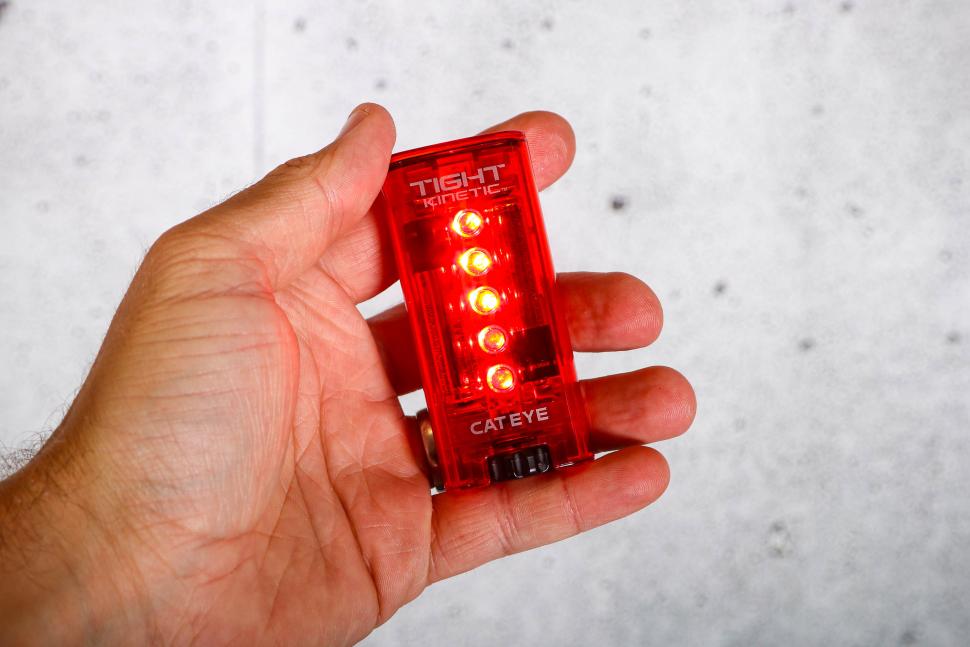
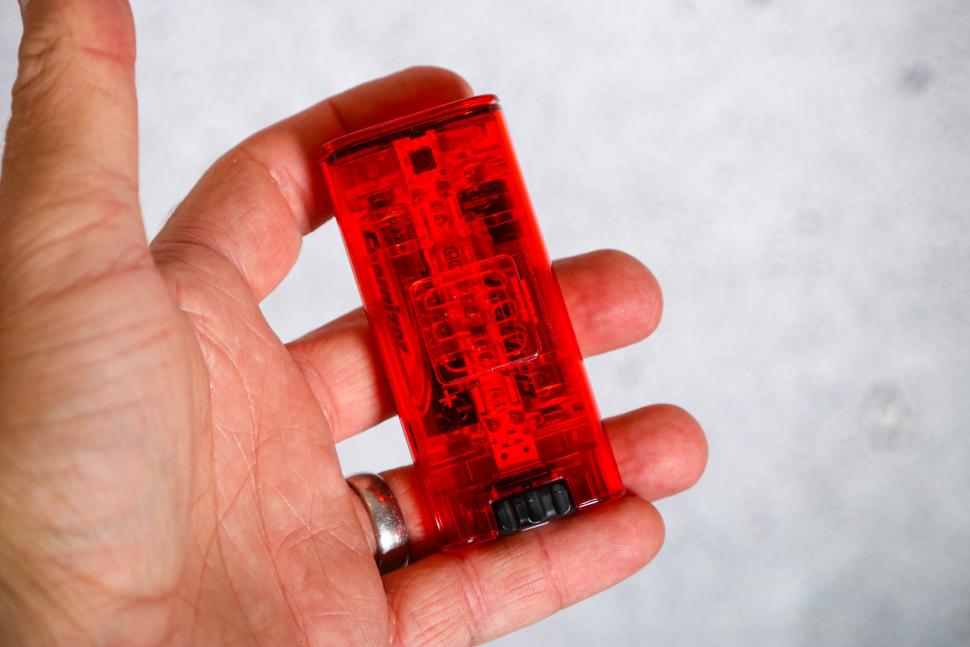
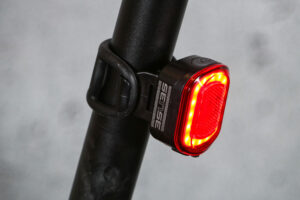
The light is an interesting blend of old and new. Inside the polycarbonate body-cum-lens, which is designed to project 360 degrees, we have five traditional diodes – notable, given the prevalence of COB (Chip on Board) technology, where legions of tiny diodes are crammed together for maximum intensity – but I’ve been pleasantly surprised by their punch. Although Cateye doesn’t cite the light’s lumen output, in the real world there’s sufficient punch for remaining conspicuous along dark, rainy rural roads.
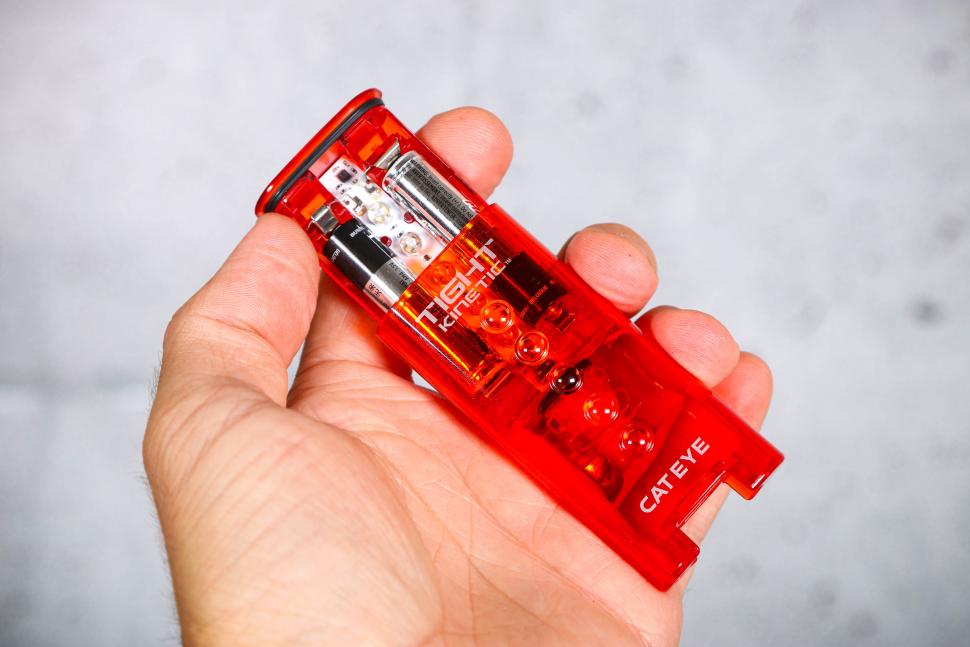
It’s fuelled by two AAA batteries, which may be rather a culture shock, given the dominance of rechargeable batteries, but replacements are readily available pretty much anywhere. Unlike rechargeable designs there’s no battery life indicator, which isn’t overly problematic but something to bear in mind, especially ahead of a longer ride. It does offer quite generous run-times, though, so they won’t need replacing too regularly.
The light’s build quality is reassuringly solid, especially given the price, and you get a two-year warranty (covering the light but not the mount).
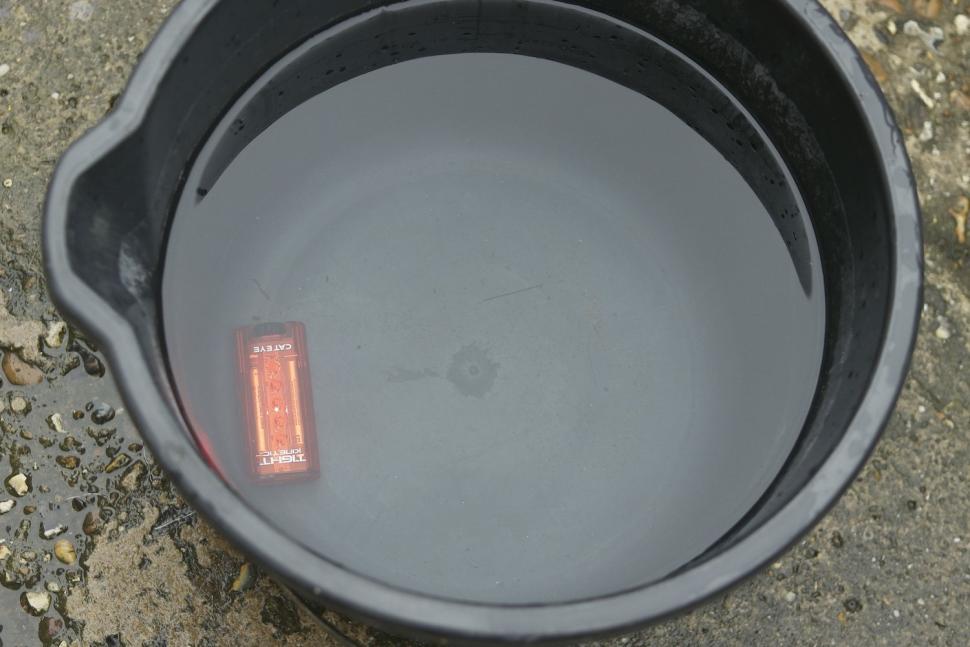
Its IPX7 standard for weatherproofing is reassuringly high, especially at this end of the market. I popped it into a full bucket of cold water for 30 minutes to check, and it passed with flying colours, with no signs of water ingress.
Despite this, accessing the battery compartment is straightforward: simply remove the threaded top cap and slide the sections apart, then slot everything together, refit the top cap and you’re ready to go.
It’s also been exposed to wet roads and wet trails and has taken direct hits from stones with no damage or obvious signs of weakness to date. Cateye cites a temperature range between minus 10 and plus 40 degrees, which should cater for most rides!
Modes & run-times
The light has just three modes: constant, flashing and rapid flash. A little basic perhaps, but there’s something to be said for simplicity, and some would argue we only need two – steady and flashing. There’s also a memory function, so it’ll turn back on in the last-used mode, which to me is a welcome convenience.
The on/off switch is fairly small but user friendly, and the right side of positive: no unwanted engagements.
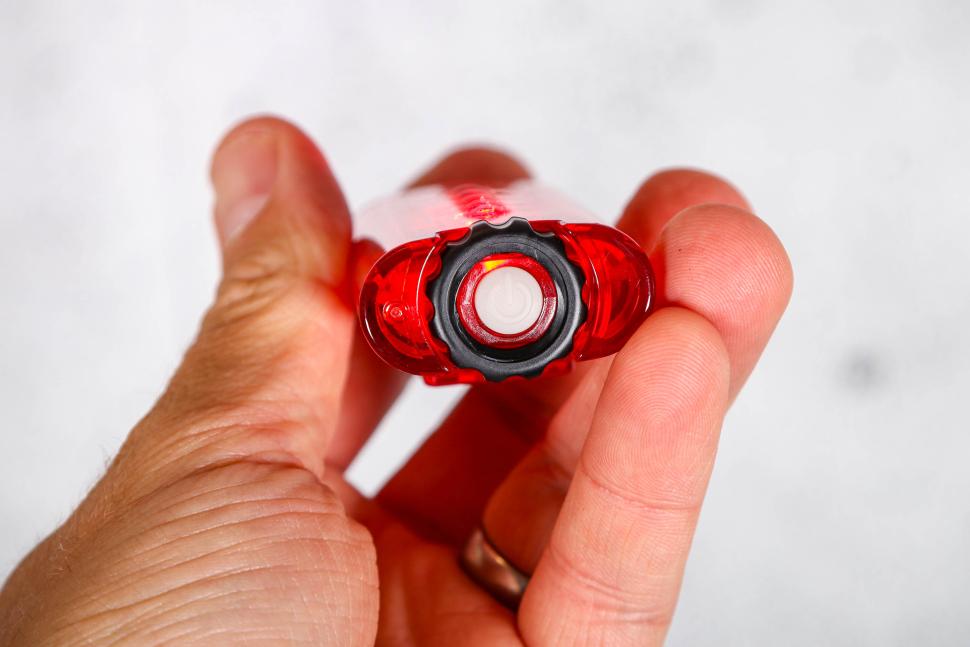
The braking function works to the same principle as others I’ve tested in recent years. It’s not a braking light like those found on cars and motorcycles, rather a sensor that detects a change in speed, engaging the highest output for 2.5 seconds when the tempo drops, and disengaging when it senses acceleration.
It seemed to engage more predictably, dare I say reliably, than others I’ve used in the last four or five years, but – as with those others – there’s a bit of lag, some slight pause, before it disengages. Obviously, the braking function has an impact on run-times, and it cannot be switched off.
Official run-times are 70 hours (constant), 160 hours (flashing), and 140 hours (rapid flash), but this drops to 55, 65 and 60hrs on the basis of the braking light engaging 60 times over the course of an hour. I managed to get 55 hours from the steady mode, and am well into 70+ in rapid flash, with no hint of waning.
Though not sufficiently potent to be considered a daylight running light in very bright conditions, the Tight Kinetic has a surprising amount of clout on cloudy and overcast days, due in part to the braking function’s intensity.
The arc of light is probably closer to 180 than 360 degrees, though still generous enough that it seemed to boost my presence when tackling bigger roundabouts and entering the flow of traffic.
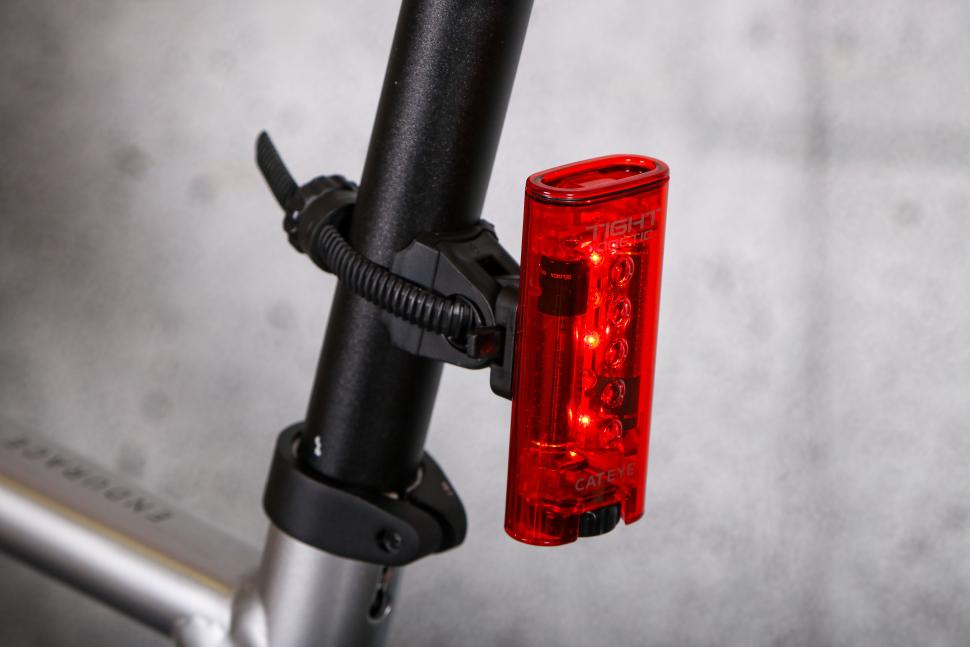
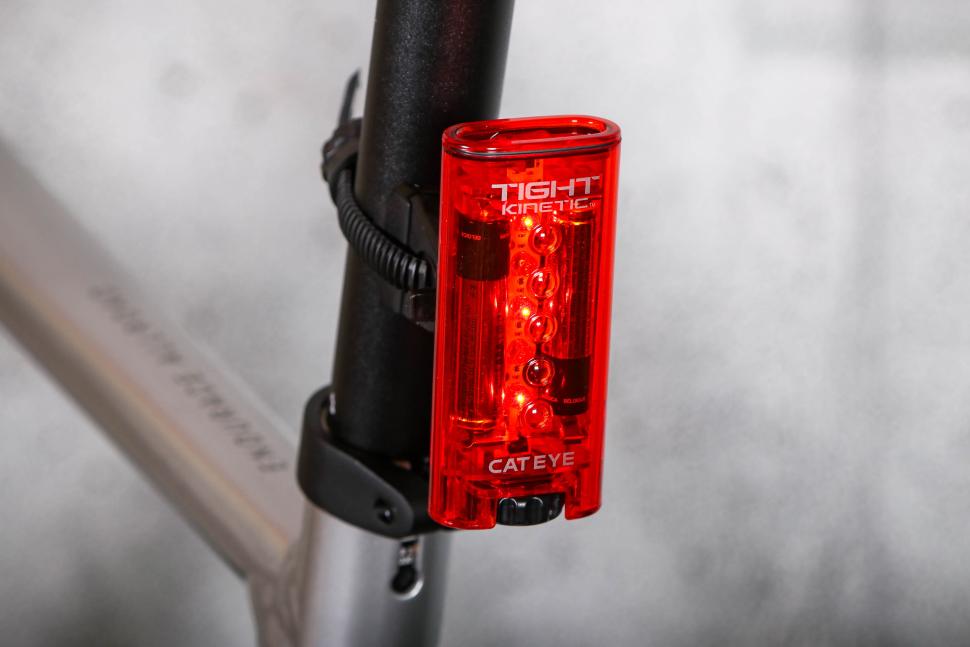
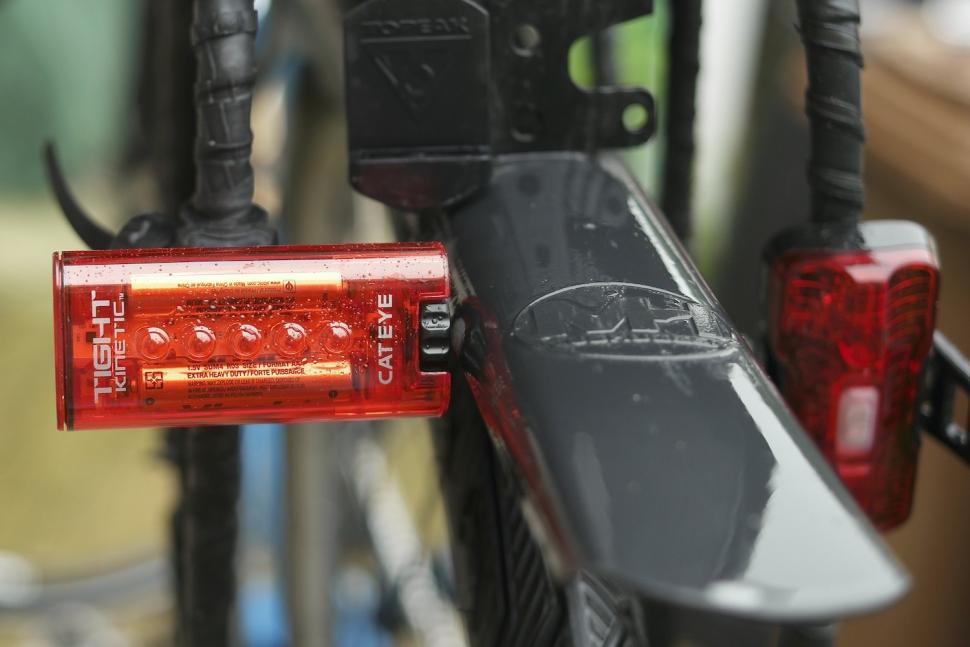
Predictably, the flashing modes are the most extrovert. Along unlit backroads, other riders suggested they could pick the rapid flash out at 300 metres, and wouldn’t want to be following it at close quarters, while friends in cars suggested they could pick the light out at a similar distance, with flashing reckoned visible at 225-250 metres, a little further on inclines or other scenarios when the braking function kicked in.
Constant is what you’d choose on a group ride, although it’s a little fierce at close quarters – especially when the braking function kicks in. Consensus seemed to be around 125 metres along unlit roads, 90-110m through built-up areas.
As a side note, this also seemed unaffected by vertical or horizontal mounting.
Mount
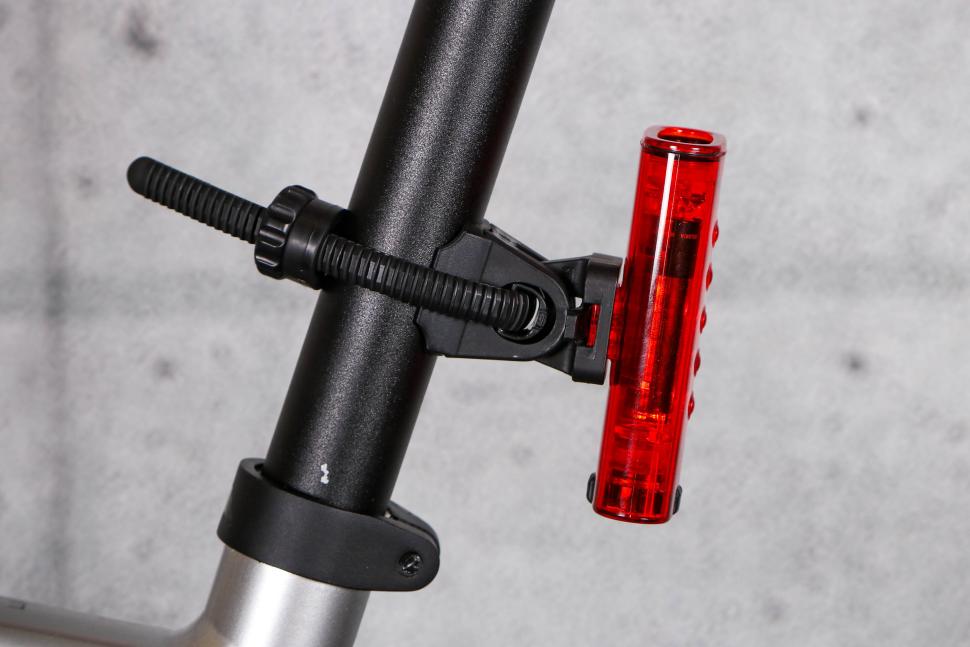
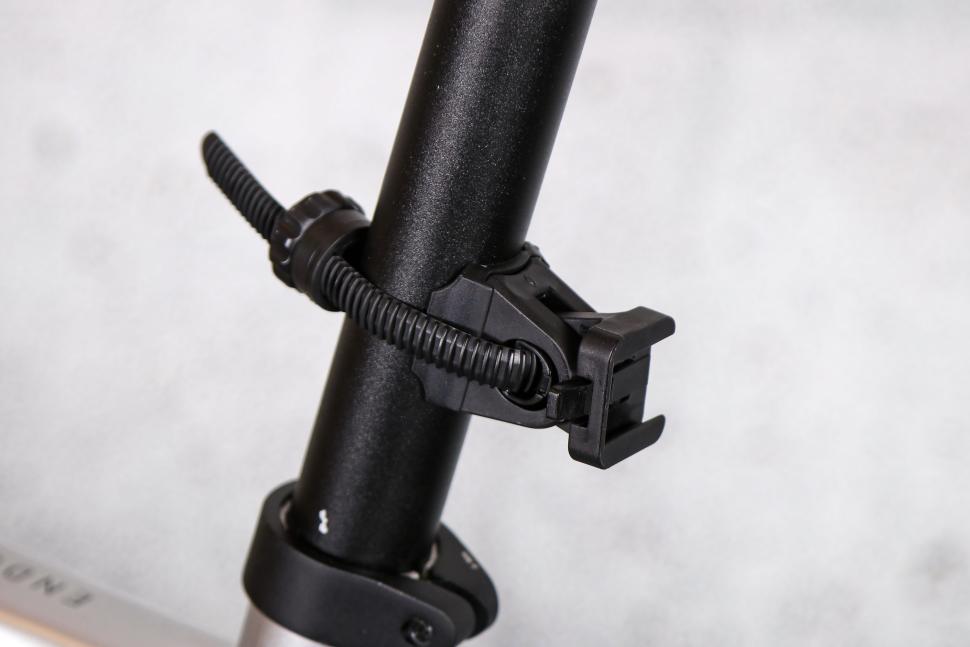
The FlexTight SP11 bracket is a tool-free design that works with tubing diameters between 12 and 32mm, catering for everything from pencil-thin seatstays to oversized seatposts. The thinner end of this range requires the rubber shim but ensures a slip-free fit. Note, I have needed to snug it tight typically weekly when doing a mix of road and gravel riding.
If you’re unfamiliar with the design, it employs a serrated strap and a threaded bolt. Feed the strap around your chosen host and secure by turning the threaded bolt snug. Slot the light into the bracket head until it clicks, slacken the bolt, align the light as required, then nip it tight again.
Spares are readily available, should you wish to switch between bikes without porting the mounts over. It can be removed in around 10-20 seconds, so might be worth removing mount and light when locking in the street.
Note, I have needed to snug it tight typically weekly when doing a mix of road and gravel riding.
Value
Its RRP of £22.99 is very reasonable for a model employing a braking function.
Magicshine’s Seemee 100 V2 has, surprise surprise, a max output of 100 lumens and a braking function, and costs £26.99. I tested a previous version in 2020 and found it powerful and practical, though the braking function was a bit sensitive.
Another option is the Sigma Blaze Rear Brake Light at £27.99. There’s no flashing mode on this model – that’ll cost you another £2 – but Iwein was pleased by the relatively long run-times, though he noted the braking light function was easily (read accidentally) engaged in a bag.
And Charlotte thought the Sigma Buster RL 150 Rear Brake Light was very good, with a rechargeable battery and 150-lumen day flash setting, but at £29.99 it’s over a fiver more.
Ravemen’s CL05 USB Rechargeable Lightweight Sensored Rear Light is also £29.99, and offers a max 30 lumens, so not the brightest, but Steve thought it was well made, and was particularly impressed by the clamp and adjustable mount. It doesn’t have a braking function – rather, the headlamp sensor sees it flash at its full, 30-lumen brightness as cars loom near “in the whimsical hope of making drivers look up from their phones” as Steve put it.
If you’re happy to go without the brake light function, there are cheaper options: Nick was very impressed with the Knog Plus rear light at £18.99, though it has a maximum output of 20 lumens, and he noted it wasn’t the most secure on aero posts.
For more options, check out our guide to the best rear bike lights.
Conclusion
The Cateye Tight Kinetic is a quirky little rear light. It’s relatively bright for a unit employing old school diodes, and the ability to change batteries in the middle of nowhere will suit many. Its weather resistance is also impressive, especially for this end of the market. But I have mixed feelings about braking functions – here it does its job, with the same limitations as others I’ve tested, putting a dent in run-times.
Overall, if you weren’t needing a daylight running mode, can tolerate a permanently engaged braking function, and wanted a simple, weatherproof light, it’s worth a closer look.
> Buy now: Cateye Tight Kinetic Rear Light for £22.99 from Cateye
Verdict
Simple, relatively bright light with decent weatherproofing but braking function cannot be switched off
All the deals displayed on our review pages are pulled from a constantly updating database feed of the best affiliate deals available. The criteria for deciding on what are the best deals is who is offering the lowest, delivered price. In most cases we will be showing the very best deal available online, but sometimes you may be able to find an item cheaper. If you can please feel free to post a link in the comments box below. To find out more about affiliate links on road.cc click here.
road.cc test report
Make and model: Cateye Tight Kinetic Rear Light
Size tested: One Size
Tell us what the light is for, and who it’s aimed at. What do the manufacturers say about it? How does that compare to your own feelings about it?
Cateye says “The TIGHT KINETIC rear light combines 360 degree visibility, 5 LEDs, and 3 operating modes with a powerful waterproof rating of IPX7 to provide cyclists with optimal safety on the road. The built-in acceleration sensor for “Brake Mode” increases rider safety by alerting those behind you when slowing down. The FlexTight SP-11 bracket and Snap System make for the perfect installation and removal. Long runtimes ensure a reliable and safe ride.”
My feelings are it’s a slightly quaint light by modern standards but reassuringly bright, with sensible modes and AAA batteries making it convenient for touring and commuting.
Tell us some more about the technical aspects of the light?
Cateye lists:
* Built-in acceleration sensor for Kinetic mode (Brake mode)
Automatically turns on Hi for 2.5 sec when bike deceleration is detected
* Waterproof IPX7: Operates even after 30 minutes of submersion in a depth of 1 meter
* Long runtimes
* 360 degree visibility
* 5 LEDs
* 3 modes
* Mode memory function
* FlexTight™ SP-11 bracket (Ø12-32mm)
* Snap System™
* 6 X 77.5 X 23.5mm
* Weight:
* 49 grams (light unit and battery)
* Light source:
* Red LED X5
* Battery:
* AAA alkaline battery X2
* Runtime:
* Constant mode: 70 hrs
Flashing mode:160 hrs
Rapid mode:140 hrs
* The stated runtime of each mode excludes the Kinetic function.
When the Kinetic function is enabled 60 times / hour, the runtime will be approx. 55 hours in Constant mode, approx. 65 hours in Flashing mode and approx. 60 hours in Rapid mode.
* Mount size:
* φ12.0~32.0mm (FlexTight SP-11)
* Water resistant:
* IPX7
Reasonably solid and no issues during testing.
Generally very user friendly. The kinetic (braking) function cannot be turned off, which wasn’t unexpected given the asking price, but could put some off.
Plastics feel less solid than some, but it’s offered reliable tenure on seatposts, racks and box section tubing. The light can also be mounted horizontally or vertically.
Passed my 30-minute submersion test with flying colours and has also been subjected to sustained heavy rain without missing a beat.
Good in the main but in common with others with a braking function, factors such as long climbs, stop-go traffic and so on will also put a dent in things.
Brighter than I was expecting, and surprisingly effective along unlit roads, but look elsewhere if you’re seeking a light with a potent daylight running function. Run-times are also reasonable and seemingly accurate, and though AA or AAA batteries have fallen out of fashion, they can be picked up at petrol stations, off licences, supermarkets and the like, which is useful for touring, or wherever USB recharging isn’t so easy.
Light body and mount feel less sturdy than some, but no issues in the real world and it hasn’t missed a beat in heavy rain.
Its RRP of £23 is very reasonable for a model employing a braking function. A decent specification and performance for the money, although rechargeable batteries are a more cost-effective option.
Tell us how the light performed overall when used for its designed purpose
Overall, it’s pleasantly simple to use, with three sensible modes that cater well for urban and unlit contexts. In common with most designs employing a braking light, it does put a dent in run-times, and I was disappointed to discover this function cannot be disengaged.
Tell us what you particularly liked about the light
Simple, relatively bright and well sealed from the elements.
Tell us what you particularly disliked about the light
Braking function cannot be disengaged.
How does the price compare to that of similar products in the market, including ones recently tested on road.cc?
Its RRP of £23 is very reasonable for a model employing a braking function.
Magicshine’s Seemee 100 V2 has a max output of 100 lumens and a braking function, and costs £26.99. I tested a previous version in 2020 and found it powerful and practical, though the braking function was a bit sensitive.
Another option is the Sigma Blaze Rear Brake Light at £27.99. There’s no flashing mode on this model – that’ll cost you another £2 – but Iwein was pleased by the relatively long run-times, though he noted the braking light function was easily (read accidentally) engaged in a bag.
And Charlotte thought the Sigma Buster RL 150 Rear Brake Light was very good, with a rechargeable battery and 150-lumen day flash setting, but at £29.99 it’s over a fiver more.
Ravemen’s CL05 USB Rechargeable Lightweight Sensored Rear Light is also £29.99, and offers a max 30 lumens, so not the brightest, but Steve thought it was well made, and was particularly impressed by the clamp and adjustable mount. It doesn’t have a braking function – rather, the headlamp sensor sees it flash at its full, 30-lumen brightness as cars loom near “in the whimsical hope of making drivers look up from their phones” as Steve put it.
If you’re happy to go without the brake light function, there are cheaper options: Nick was very impressed with the Knog Plus rear light at £18.99, though it has a maximum output of 20 lumens, and he noted it wasn’t the most secure on aero posts.
Did you enjoy using the light? Yes
Would you consider buying the light? Yes
Would you recommend the light to a friend? Minor niggles aside, yes – if they were seeking an inexpensive, simple, relatively bright light and weren’t set on a daylight running mode.
Use this box to explain your overall score
Quirky but generally user-friendly light with impressive water resistance, good output and reasonable run-times. The option to disengage the braking function would add appeal.
About the tester
Age: 51 Height: 1m 81cm Weight: 70kg
I usually ride: Rough Stuff Tourer Based around 4130 Univega mtb Frameset My best bike is: 1955 Holdsworth Road Path and several others including cross & traditional road
I’ve been riding for: Over 20 years I ride: Most days I would class myself as: Experienced
I regularly do the following types of riding: cyclo cross, commuting, touring, fixed/singlespeed, mtb,

8 thoughts on “Cateye Tight Kinetic Rear Light”
Disposable batteries? What is
Disposable batteries? What is this? 1995?
SAVE THE PLANET!
Renewable whale-oil for the
Renewable whale-oil for the win?
Whale-oil IS renewable.
Whale-oil IS renewable.
YAY PLANET!
I read somewhere that NASA
I read somewhere that NASA still use it to lubricate on spacecraft, maybe even spemaceti, the good stuff…
Could only be better if they
Could only be better if they used ambergris – giant sea-monster beaks from high-pressure darkness, carried Jonah-like in a whale, then used for safe transport to very low-pressure regions…
But in space no one would be
But in space no one would be able to smell the evocative aroma of whale poop.
Terry Hutt wrote:
The extraction, processing and use of Li-Ion batteries, which are also in a sense disposable, will not save even one tiny fraction of the planet. They are expensive and when they eventually fail they are invariably not removable.
Ni-MH rechargeable AAAs are cheap and will take many charge cycles before the capacity deteriorates, at which point you can swap them for a fresh pair.
This model looks like an update of their bottom-of-the-range TL LD150 that I used to run. I’d recommend something with brighter output, especially in urban areas with so many competing light sources, though this would be good as a backup or secondary light.
I have dynamo lights on two
I have dynamo lights on two of my bikes. They are my prefered lighting solution. Single use batteries are the absolute worst.