


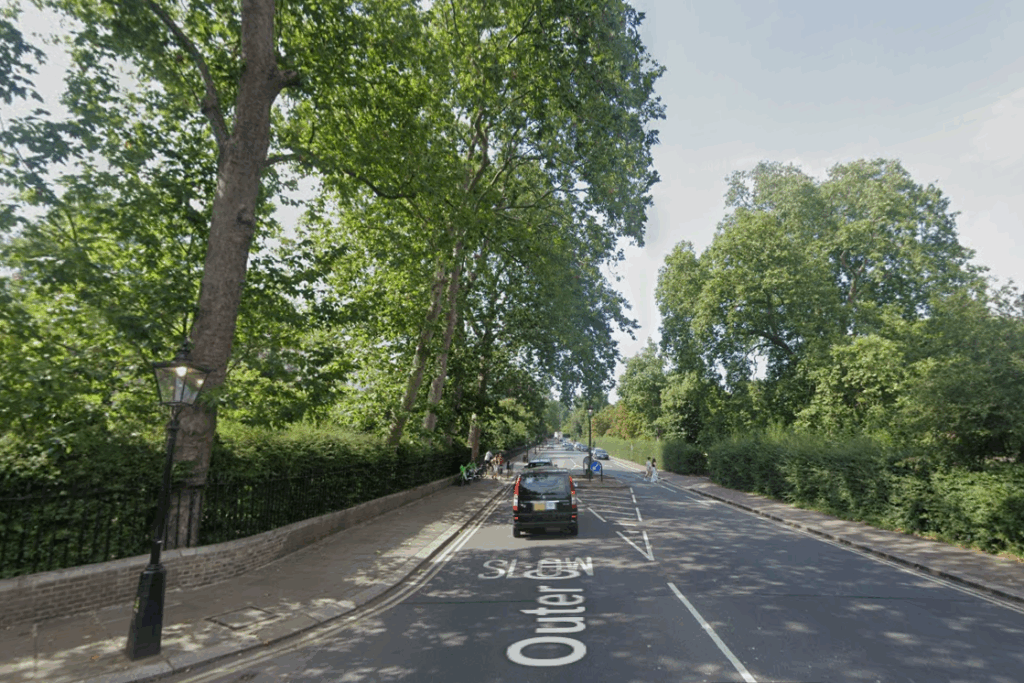

A cyclist who rode on the wrong side of a pedestrian crossing during a group ride in Regent’s Park — hitting a woman and fracturing her skull — has been fined £500 and ordered to pay £2,500 compensation after admitting riding without due care and attention.
Matthew Thornley was riding laps of the London park, a popular destination for many cyclists in the city, when he hit 53-year-old Paola Dos Santos as she used a pedestrian crossing, knocking her unconscious and inflicting multiple fractures to her eye socket, jawbone and cheekbone, as well as musculoskeletal injuries.
The Telegraph reported Thornley was riding laps as part of a Club Peloton group ride when the collision happened on Hanover Terrace at 7.30am in May last year.
Lawyers representing the cyclist said there was a “build up of traffic” which led to him taking “evasive action” and riding on the wrong side of the road and a pedestrian island, where he hit Ms Dos Santos. Thornley added that he was not riding faster than the park’s 20mph speed limit and called the riding an “evasive manoeuvre”.
“Our client is very, very sorry for what has happened and always has been,” Mark Bowen from Shearman Bowen solicitors said. “He made concerted efforts at the beginning; he remained at the scene and he later contacted the hospital.”
Last week, Thornley was sentenced and fined £500 and ordered to pay £2,500 compensation. He was due to stand trial this week having denied riding without due care and attention, but pleaded guilty on September 3 and was sentenced at Westminster Magistrates’ Court.
The group ride Thornley was part of was organised by Club Peloton, who confirmed he is a member who was taking part in one of its “informal” rides that is “open to members and organised by volunteers within our community”.
A spokesperson told The Telegraph the club has “reviewed member communications and reinforced guidance around safe and respectful riding” following the incident.
However, Ms Dos Santos told the newspaper the sentence was “paltry and insulting”, claiming she had not been informed of the change to Thornley’s plea and never submitted an impact statement.
She commented: “What annoys me is that the judge has sentenced this cyclist without any input from me about how this collision has affected me. The cyclist was on the wrong side of the road. If a motorist was driving on the wrong side of the road and caused these injuries he or she would have been punished far more severely.
“I have little doubt his bike cost way more than the £500 fine he has received for the offence. But, the fact this man is a cyclist without insurance means he has got away with it. Solicitors are not prepared to fight such cases for victims because cyclists do not have insurance.
“Many nerves in my face are totally messed up and some muscles permanently damaged. I feel that justice has not been done, let alone be seen to be done, and I seem not to matter in this court process.”
The collision which injured Ms Dos Santos happened the day before an inquest into the death of Hilda Griffiths, an 81-year-old who died in hospital two months after being hit by a cyclist riding laps of Regent’s Park.
Brian Fitzgerald was riding at a speed of between 25 and 29mph when he hit Ms Griffiths at the same spot as Thornley’s incident two years later. The inquest into Ms Griffiths’ death saw the Metropolitan Police confirm that the 20mph speed limit does not apply to people riding bicycles and that the case was closed because there was “insufficient evidence for a real prospect of conviction”.
The case involving Ms Griffiths played a significant role in the campaign for stricter dangerous cycling laws, promoted by sections of the press including The Telegraph, and fast-tracked by the Conservative government then in power and former leader Iain Duncan Smith. The Labour government is expected to introduce the legislation in question, believed to be part of a wider review of road laws.
Commenting on Ms Dos Santos’s case, a Crown Prosecution Service spokesperson said: “We are striving to improve the experience of victims as it is vital for them to achieve justice in their cases. We recognise the criminal justice system did not reach expected standards on this occasion and, together with the police, we continue to look at ways to jointly enhance our victim communications.”














29 thoughts on “Cyclist who fractured pedestrian’s skull while riding laps of Regent’s Park fined £500 over group ride collision on wrong side of crossing”
“. If a motorist was driving
“. If a motorist was driving on the wrong side of the road and caused these injuries he or she would have been punished far more severely.”
I mean, I’m sorry for the injuries suffered here, but that is absolute nonsense.
Driving or cycling the wrong
Driving or cycling the wrong side of a pedestrian island is dangerous in the extreme, likely to be harshly punished and rightly so. Doing it when pedestrians are crossing is even worse. This guy was extremely lucky to get away with a £500 fine when the maximum for the offence he was charged with is substantially more and he was lucky that he didn’t cause more serious injuries.
We are right to call out inadequate sentences for drivers who kill and injure cyclists through their bad driving but we need to be consistent and call out inadequate sentences for cyclists who carelessly or recklessly injure other road users and this seems a prime example.
LeadenSkies wrote:
I agree up to the “likely to be … punished” – I see this sometimes and AFAICS none of those drivers worry about any punishment at all. (I don’t run cameras – partly because living in Scotland there’s little point, because Polis Scotland). I doubt it was the first time…
And hasn’t CM stopped reporting these as police informed him they weren’t interested?
Yes, poor wording on my part,
Yes, poor wording on my part, should have read “likely to be MORE harshly punished IF it results in an injury to others”. Unfortunately we no longer punish adequately for driving offences or cycling offences that don’t result in injury. You could (and I would) argue we have never punished adequately but we have punished more harshly than we do now.
The point I was trying to make was that cycling or driving the wrong side of what sounds like a keep left sign protected pedestrian island is dangerous. Collisions resulting from that behaviour should be harshly punished to give a bit of deterrent effect and we should be consistent in calling out inadequate sentences for dangerous road use regardless of the mode of transport.
LeadenSkies wrote:
This I believe is part of the problem, we punish based on the consequences of the action and not on the action itself.
I reported such an event to
I reported such an event to Surrey Rozzers a few weeks back (with video footage) – no response at all. So, you know….do what you want on the roads I guess
Agree. It’s highly unlikely a
Agree. It’s highly unlikely a motorist driving in a similar manner would have caused these injuries – it would likely have been much worse, possibly fatal.
I always want to ask motorist
I always want to ask motorists who say “if I did x they’d throw the book at me!”
a) to meditate on their own breaking the law / punishment ratio and
b) if they could stand doing that (honestly) to have a quick look through the large collection of “killed someone while using a motor vehicle but not punished / no prison” cases.
Of course that’s usually a waste of time because many people would not consider their driving “criminal” despite speeding etc. And there’s the reality of people making mistakes both inside and outside of motor vehicles: “innocently killed” etc. Problem is that it’s the ones outside who die in both cases – the witness is usually the one who did the driving…
Mick Mason being the ultimate
Mick Mason being the ultimate case that proves your point. https://www.cyclinguk.org/blog/duncandollimore/mason-verdict
the little onion wrote:
Yep.
I agree that the penalty is light.
But you then get ‘what do you have to do to get the maximum given this only got half’.
To which I will point at Death by dangerous driving charges. Where prior to increasing maximum penalty to life, the longest ever sentence was 10 years IIRC. So basically 2/3rds of maximum sentence… And we still don’t have anything remotely close to a life sentence per current rules…
And I am pretty sure there are an awful lot of worse offences than going wrong side of a traffic island for bad cyclists…
I have sympathy for the
I have sympathy for the victim but do we know that the defendent didn’t have insurance (victim stated “But, the fact this man is a cyclist without insurance means he has got away with it.”)?
I’m not aware that any English/Welsh court would take consideration of the defendant’s insured status in any judgement.
I think that they were
I think that they were talking about a private claim for compensation for injuries in that bit and the article just didn’t make that clear. Without an insurance policy to foot the bill, you risk incurring the substantial expense of making a claim through the courts and after winning your case finding it was a pirrhic victory as the defendant has no assets and so no way of paying your costs or any compensation leaving you out of pocket.
I’d be very surprised if the
I’d be very surprised if the cyclist is not covered for third party claims on his home insurance.
Or via Club peloton, unless
Or via Club peloton, unless they’re claiming the informal nature of the ride meant they werent covering their members, who happened to informally ride together.
Which feels rocky ground as a position especially if they issued extra guidance for members taking part in such rides.
Would you be surprised enough
Would you be surprised enough to risk tens of thousands of your own money on bringing a legal case only to find out he wasn’t?
But anyway, somewhat beside the main point, that the original victim in this case was unlikely to be talking about insurance in the context of criminal prosecution but much more likely to be talking about being unable to afford to bring a claim for damages and not finding a no win no fee solicitor willing to take on such a case with no surety that the other party had insurance or assets available to pay any damages / costs.
My presumption though would be that a simple solicitors letter before action would be enough to elicit whether or not any insurance was in place that may cover him and at minimal cost so I would have thought that would have been done.
In a small claims court, the
In a small claims court, the fee is £115 for that value of compensation.
We are straying way off topic
We are straying way off topic here but ….For the £2500 awarded by the criminal court, yes, you could have sued in the small claims court but my suspicion is had it been taken to court the civil claim for the injuries mentioned which apparently included fractures and permanent nerve damage plus no doubt some time off work would have added another zero and more. A small claims court has a max of £5k for personal injury claims. Not commenting at all on the rights or wrongs of civil damage amounts or small claims court limits. Are you honestly saying if that had been you wiped out by a car in those circumstances and ended up with those injuries you would have sued in the small claims court and asked for £2,500 as true compensation for your injuries, pain and suffering?
Just did a bit of research and a criminal compensation order is almost always substantially less than the equivalent civil damages award because a CCO takes account of the defendants ability to pay and doesn’t look to cover full costs incurred by the victim. The upside is failing to get a CCO award doesn’t leave you potentially liable for your own costs or the defence costs since you didn’t bring the case, the crown did. Oh and CCOs are not given if the defendant is jailed.
If it had been a car, then I
If it had been a car, then I would have recourse to the motor insurance bureau.
LeadenSkies wrote:
According to The Torygraph, the cyclist is “a 45-year-old director of an architecture company”. If he isn’t insured it seems likely that he would have the means to pay a compensation claim himself.
Possibly, possibly not. In
Possibly, possibly not. In theory I am lucky enough to be asset rich as a homeowner but very little of them would be available to courts in such a situation due to the nature of the assets and the fact that many of them aren’t in my name. That’s not me trying to do anything shady, it’s just the fact that the law as it stands won’t make my wife and children homeless for something that I might have done wrong and most of my remaining family assets are in my wife’s name.
LeadenSkies wrote:
Just as big an issue (if not more) is limits on legal fees for RTC claims: https://www.justice.gov.uk/courts/procedure-rules/civil/rules/part45-fixed-costs/practice-direction-45-fixed-costs
Solicitors decide its more work than the fixed payment is worth vs other stuff they can negotiate charges for.
Note that a similar issue applies to comparable claims by pedestrians or cyclists against drivers. A chunk of your car insurance cost (also legal cover on home insurance etc) is hiring experts to handle claims.
Would the victim have not
Would the victim have not been able to use their own insurance to claim against the cyclists household insurance?
Or did the victim not have legal cover and thus was – herself – uninsured?
Is not the victim able to use a ‘no-win, no-fee’ group?
Oldfatgit wrote:
Getting a NWNF firm to take on your claim is harder than people imagine. In the popular imagination they are ambulance-chasing chancers who’ll take on anything however frivolous, in reality their eyes are firmly fixed on the bottom line and they need to be almost positive of a win before they’ll take a case (I once tried to get NWNF firms to represent me after breaking my wrist in a motorcycle accident caused by a large pothole, none of them would and one representative said to me, “I think your chances are about 70/30 in your favour and that’s not the sort of odds we’re looking for”). I suspect that if the plaintiff doesn’t have insurance (and fewer household policies offer TPI for events outside the home than people imagine) the amount of work needed (in the event of victory) to pursue their assets and secure a lien against them is generally just too big a hit to the profit margin to make it worth their while.
Here’s another one of my
Here’s another one of my rambling comments! It’s likely there is liability insurance somewhere, either in relation to the club membership, or his household insurance. What the injured person is referring to is the reluctance of a “no-win, no-fee” solicitor to take the case up because there is no motor insurer to handle the defendant’s case, An insurer’s involvement makes everything more procedural and predictable, including rating the compensation based on medical reports. At the end of the day there is a chance that the cyclist has no means to pay the compensation which in the case of a fractured skull and facial nerve damage is going to run probably more than the equity in his house. There is nothing stopping this lady paying a solicitor to bring a claim. But she would be taking on the risk of incurring legal costs if the defendant is a man of straw. By the same token, cyclists have the same problem if a pedestrian walks out in front of them when they are properly cycling along. We could say, well the problem is that pedestrians don’t have insurance. Well they probably do in the same way that cyclists probably do. In any event, this person could have purchased legal expenses cover which would have paid for making this civil claim. It doesn’t seem terribly clear what happened as the focus is that he was on the wrong side of an island over a crossing point. She may have walked straight out in front of him, but being on the wrong side of the road she probably didn’t look in his direction. Awful as these cases are, let’s remember they are only news because it’s very rare compared with being hit by a car when crossing the road.
The uncontrolled crossing
The uncontrolled crossing pictured in the article is the one that is often referenced when talking about this case and that of Hilda Griffiths. But the official collision data puts the location of the Hilda Griffiths collision at the traffic light controlled crossing further down the road:
https://www.cyclestreets.net/collisions/reports/2022010384589/
It’s possible the official data is wrong though.
If it is the uncontrolled crossing that has been the scene in both cases, then perhaps it needs upgrading to a zebra or pelican crossing.
Put in a raised crossing,
Put in a raised crossing, slows everyone down then
HoarseMann wrote:
All of those island only crossings in Regent’s Park should be either removed or upgraded. Some pedestrians think they have the same status as zebra crossings and just walk out onto them no matter what’s coming, some drivers think they have to stop and then arseholes behind who know you don’t have to overtake on the wrong side of the island (seen this multiple times from cars and bikes), tourists with young children try to cross and then end up stranded in the middle and trying to stop the kids stepping in the road…they’re a mess. There aren’t that many, making them all zebras, or a combination of zebras and pelicans, wouldn’t harm traffic flow. Whether some of the Rapha-clad chaingangs from Islington would observe them is a different matter…
Rendel Harris wrote:
This is true and it would seem the cyclist in this case ignored a ‘keep left’ arrow in order to pass the traffic island on the wrong side. However, I would think it less likely a zebra/pelican crossing would be abused in this way.
If the collision data is wrong and it is these uncontrolled crossings that are the common factor, then there is some change that could be made to the infrastructure to reduce the likelihood of such a collision occurring again. Certainly will have more effect than a change in legislation.
That’s not a crossing. It’s a
That’s not a crossing. It’s a traffic island. It’s put there so vehicles don’t have to stop for a pedestrian who is in the middle of crossing the road.
Strangely, drivers are more likely to stop for a pedestrian standing on the island, when they’re not required to do so, than they are for a pedestrian in the middle of the road, when they are required to do so.