


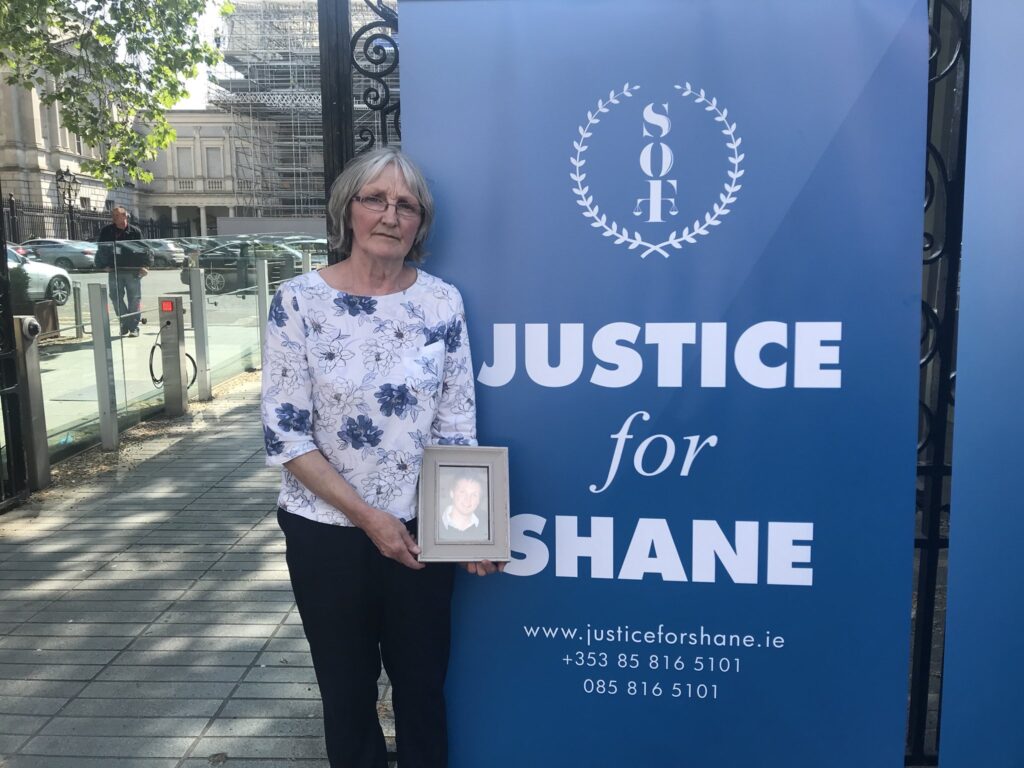

The family of a cyclist killed by a hit-and-run driver, who should have been in prison at the time of the fatal crash, have hit out at a judge’s report into the incident, which claimed that the rider was at least “partly responsible” for his own death.
The as-yet-unpublished Department of Justice report, obtained by Irish state broadcaster RTÉ, argued that 23-year-old Shane O’Farrell exhibited “highly negligent behaviour” by cycling on a main road while wearing dark clothes and without lights, and that he was partly responsible for being struck by the driver “unless, for some reason… the rules of the road did not apply to him”.
O’Farrell’s family have heavily criticised the report, which they had hoped would help pave the way for a public inquiry into his death, saying its findings have “retraumatised” them and that they regret having co-operated with it.
Triathlete O’Farrell was killed in August 2011 while training near his home in Carrickmacross, Co Monaghan, when he was struck by motorist Zigimantas Gridziuska, who fled the scene and hid his car. The 23-year-old was killed instantly and his bike was found 60 metres away.
Gridziuska had 49 previous convictions including aggravated burglary, drugs, and road traffic offences. On the day of the incident he was on bail from at least five different court houses, and had been arrested two weeks earlier in Newry for three counts of theft.
In the year before the crash, Gridziuska received a six-month prison sentence, which he never served due to a Courts Service administration error.
He was found not guilty of dangerous driving in relation to the fatal collison, but was found guilty of failing to stop at the scene of a crash, and handed a suspended eight month sentence. He did not serve any prison time for the hit-and-run.
In January 2012 the O’Farrell family submitted a formal complaint about the case to the Garda Síochána Ombudsman Commission (GSOC). They believed that the motorist should have been in custody for breach of his bail conditions at the time of the law graduate’s death, and have campaigned throughout the last decade for reforms to the justice system.
In 2018, after the Dáil voted for a public inquiry into the case, the Department of Justice instead appointed a retired judge, Gerard Haughton, to report on whether further inquiries were necessary.
In the Scoping Exercise report, which has yet to be published, Judge Haughton recommends against an inquiry, with parts of the report emphasising that O’Farrell was partly to blame for the fatal collision.
After noting that Shane was struck from behind and that the motorist “failed to stop and remain at the scene and subsequently that night hid his vehicle”, paragraph two of the 416-page report states that “there were neither front nor rear lights on Shane O Farrell’s bicycle which at the time was being ridden approximately [15 inches] out on the main carriageway of a major road with a speed limit of 100kmph.”
Quoting evidence given at the trial by the Forensic Collision Investigator, the report continues: “The cyclist was wearing dark clothes. He had a small red rear reflector, one yellow reflector on each pedal, and a yellow armband.”
On the first page, the judge also quotes a court judgement which stated that “Failure to have such lighting is highly negligent behaviour on the part of a cyclist.”
The O’Farrell family, who withdrew their support before the report was finished, strongly disagree with the report’s findings, and told RTÉ that the focus should remain on Zigimantas Gridziuska, who – as well as the debate concerning whether he should have been in custody – did not have car insurance or a valid MOT at the time of the crash.
Shane’s mother Lucia told the broadcaster that Shane was “legally entitled to be on the road”, and “that man [Gridziuska] was not legally entitled to be on the road. And that’s the core issue here.”
She continued: “Why was that man at liberty to kill in circumstances when he should have been in jail? He had committed 30 offences while on bail… He had unpaid fines to the court. He had received a prison sentence for four counts of heroin, which he hadn’t served… where did the system break down that allowed this?”
While Judge Haughton refused to provide a comment to RTÉ, the final report includes a response from him to a letter from the family’s solicitors which complained about the judge’s references to O’Farrell.
In the response, Haughton stated that Shane was “partly responsible” for the collision, “unless, for some reason which you have not explained, the rules of the road and the recommendations of the RSA [Road Safety Authority]… did not apply to him or that you contend that there is no rational basis for the law requiring a cyclist to have lights on a bike at night”.
The judge also referenced a “near miss” involving Shane and two other motorists shortly before the fatal collision.
“The introduction of the report essentially blames Shane for his own death. And as a family member, I think that’s so shocking,” Shane’s sister Hannah said.
She also said that the family feel they are now “worse off” than when they initially began to campaign for justice for Shane’s death.
“We’re now left with a report that blames Shane for his own death,” she says. “There’s no doubt that we are now worse off, and Shane’s memory is worse off for us having participated in this process, which is shocking.
“If we had done nothing on the 2nd of August and we hadn’t asked any of those difficult questions, we wouldn’t have a report like this that will sit on a shelf… Shane is completely innocent in this.
“He wasn’t killed by a normal average person who had no previous convictions. He was killed by a criminal who should have been in prison and had multiple previous convictions.”
“It’s cruel. It’s cruel to Shane’s memory,” his mother Lucia said. “I’m sorry I ever took part in anything to do with it. It has retraumatised us, revictimised us.”
Last year, two police officers who were accused of negligence in their handling of Shane’s case had their disciplinary sanctions revoked by Garda commissioner Drew Harris.
In February 2019 the then-Justice minister Charlie Flanagan announced that the Garda Commission’s initial report into the case “found there were no grounds for criminal proceedings against any member of the Gardai. However, the report identified conduct that might lead to disciplinary proceedings and commenced an investigation into that conduct.
“Tragically, the actions of the Gardai fell short of what should have happened where a person on bail or remand is subsequently arrested for other offences.”
However, following the internal investigation into the incident, the Garda commissioner Harris agreed in January 2022 to quash the fines and findings of negligence against two of the three officers who faced sanctions.
The previous July, Shane’s sister Hannah accused the Irish government of a lack of transparency in its handling of the case, and said that the family felt “like we’re the enemy because we’re asking these questions.”












28 thoughts on “Cyclist killed by hit-and-run driver, who should have been in prison, was “highly negligent” and “partly responsible” for fatal crash, says judge”
The poor family, my heart
The poor family, my heart goes out to them.
The judge is getting some quite nasty comments, which may not be entirely deserved either. While the driver shouldn’t have been on the road really, the unfortunate rider shouldn’t have been either without lights, at 1015 at night. The evidence is other motorists had close calls with the unfortunate deceased.
I don’t know for sure, but the photo of the scene available doesn’t show any lamp posts, suggesting the road is unlit.
Not sure it is really “night”
Not sure it is really “night” at 10:15 pm on August 2nd in Ireland.
According to this Sunrise and
According to this Sunrise and sunset times in Timeanddate.com, civil twilight would have ended at 22.07, thus there would still have been some light available.
It does seem quite a shocking comment by the Judge.
I beg to differ. Sunset at
I beg to differ. Sunset at 21:26 and Dusk at 22:10 according to
http://suncalc.net/#/53.9705,-6.7128,10/2023.08.02/19:20
That would have been pretty murky.
Dusk is the point when the sun is at 18 degrees below the horizon and there is no longer any sunlight in the sky
According to the calculator
According to the calculator here – https://www.timeanddate.com/sun/ireland/carrickmacross – “night” at the location on the date at question doesn’t legally start until “midnight.” Civil twilight runs to 21:27 and nautical twilight to 24:00.
You’d think a judge would at least want to get the legal part right.
It would have been dim. How dim or murky would be highly dependent on the surroundings. If there was thick vegetation turning the road into something of a tunnel, it would have been very murky. If the road was surrounded by open fields, pretty much the opposite, especially if the cyclist was silhouetted against an open field.
But judging solely from what is reported here, it would appear how easy or how hard it was to spot the cyclist is largely irrelevant given the judge decided a bicycle shouldn’t be taking up 15 inches of the pavement.
Wonder what the ruling would have been if the dead man had been a farmer knocked off farm equipment taking up even more of the road and moving even slower than the cyclist.
cmedred wrote:
Unfortunately that’s the astronomical definition – it’s also a bit ludicrous for riding a bike. It’s likely Irish law follows UK law – as they were pretty much identical before 1920.
“Night in the UK is defined as the time from half an hour after sunset until half an hour before sunrise, sunset and sunrise being determined at surface level.
It should be noted that this is different from the ICAO definition.
ICAO Definition of night: The hours between the end of evening civil twilight and the beginning of morning civil twilight or such other period between sunset and sunrise, as may be prescribed by the appropriate authority.”
He obviously should have had
He obviously should have had lights on but If he had they would have said it was because he had no hi-viz jacket, or if he had hi-viz he should have had a helmet, or brighter lights, or been on the pavement or whatever BS they could come up with to cover up the fact that drivers killing cyclists is just one of the things we have to accept and stop complaining about.
He obviously should have had
He obviously should have had lights on but If he had they would have said it was because he had no hi-viz jacket, or if he had hi-viz…
Yep, that’s the way they work- hence the way the police (they claimed it was the CPS, but that’s just a standard dodge) claimed to be prosecuting a case but then binned it at the last minute because there was no rear camera as well as a front one
We’ll see how they deal with
We’ll see how they deal with the report I’m just about to make about a driver attacking me today with a golf club after nearly hitting me with his car! My insistence on standing my ground against bullies finally caught up with me I guess. He saw I wasn’t backing down when I parked my bike instead of running away and he went in the back of his car for a weapon. I cycled off and he threw it and nearly ended up on his arse like the famous pratfall road-rage driver. He missed obviously.
EDIT; Was just preparing the video for submission and it hit me that I should have called 999 at the time as for all I know he’s driving round attacking people. I’ve just called 101 and made a report but I’m still reporting it through the Nextbase portal anyway.
I think we need to know what
I think we need to know what sort of club it was.
I hope you were wearing a helmet otherwise it will be ruled as negligence.
Hirsute wrote:
I was, and hi-viz!
I’m not a golfist so you’d have to tell me;
Looks like a driver or a 1 or
Looks like a driver or a 1 or 2 wood
Hirsute wrote:
A driver? How ironic.
Had they just reversed off
Had they just reversed off and almost hit you? (just looking at the angle of the wheels). I think it is rather telling that the house they might have come out of on streetview is blurred, almost like they might have something to hide.
They were parked on the other
They were parked on the other side of the road facing the same way as me so their u-turn was directly into oncoming traffic, i.e. me.
(OP adds emoji)
(OP adds emoji)
I think you’ve done them too many favours there. They look far better than before…
???
???
Reminds me of the giant squirrels attacking a cyclist in Trigger Happy TV.
1m25s in.
Careful what you say.
Careful what you say.
He’ll never be let on a
He’ll never be let on a proper golf course in shorts.
Wouldn’y hold your breath. I
Wouldn’y hold your breath. I’m still waiting for a call from Greater Manchester Police regarding a 999 call about a car driving in a park at 9.15am on a Saturday morning. During parkrun. They declined any immediate response at the time. I had to stand in front of the car to stop the driver and let the runners past safely.
I know the police have been shafted by funding cuts but bloody hell.
Thanks for reporting – I know
Thanks for reporting – I know that just getting out of the situation is priority and then you can think – not worth the bother now.
Thanks because it’s a public service. This pair are gonna hit someone else if they didn’t already.
Thanks. All I was thinking of
Thanks. All I was thinking of as I rode away was the famous pratfall video which probably took my mind off what the club could have done to my head if it connected. Can’t believe I didn’t stop around the corner and dial 999. I guess potentially killer drivers are such an everyday occurrence it just didn’t enter my head and I just thought report it as a bad driving incident when I get home as usual.
I actually disagree in this
I actually disagree in this case. The judge is required to examine the legal facts of the case and I’m presuming that like UK law – Irish law requires lights at night but HiViz is just a recommendation.
I do take issue with the fact its irrelevant to whether the tea leaf should have been out – so its out of line with purported purpose of the report BUT importantly not the full facts of the case. If you want to blame anyone you need to blame the department of justice for not drawing up the scope of the review correctly.
You may be right, I guess the
You may be right, I guess the only way to know is if he’d had lights. I’m just going on past experience and how surprised I am when a judge doesn’t victim blame a dead cyclist.
Writing that down it occurs to me what a terrible situation we are in when I consider that a win. My ex colleagues funeral is tomorrow in Romania and his best friend was telling me today he’s gutted he can’t go. The police have told him it could be 12 months before the investigation is complete even though they have witnesses, CCTV and the hit and run driver handed themselves in and confessed.
Some pretty harsh wording
Some pretty harsh wording from the judge towards the cyclist. I can’t begin to imagine how distraught the family of the victim feel to have to hear those words.
Hopefully he had some significantly harsher words for the killer, who had so many outstanding court appearances, they couldn’t keep up.
One thing I like about the
One thing I like about the Irish “Rules of the Road” is Rule #1 is “You should always be able to stop within a distance you can see to be clear.” This really ought to be one of the most fundamental principles of driving safely.
The same rule (more or less) is in the Highway Code but it’s buried down in Rule 126.
Cyclist should have had
Cyclist should have had lights but any competent driver would have seen them.
Judge’s language is unhelpful.
How very sad and upsetting
How very sad and upsetting for the family.
I’m not going to comment on the rest of the statement, but the additional snark from the judge to say “the rules of the road do not apply to him” sounds like it could have come from a tabloid playbook or cyclist-hating bingo. How anyone could think it appropriate to say something sarcastic like that in such a serious case is a shocking to me.