


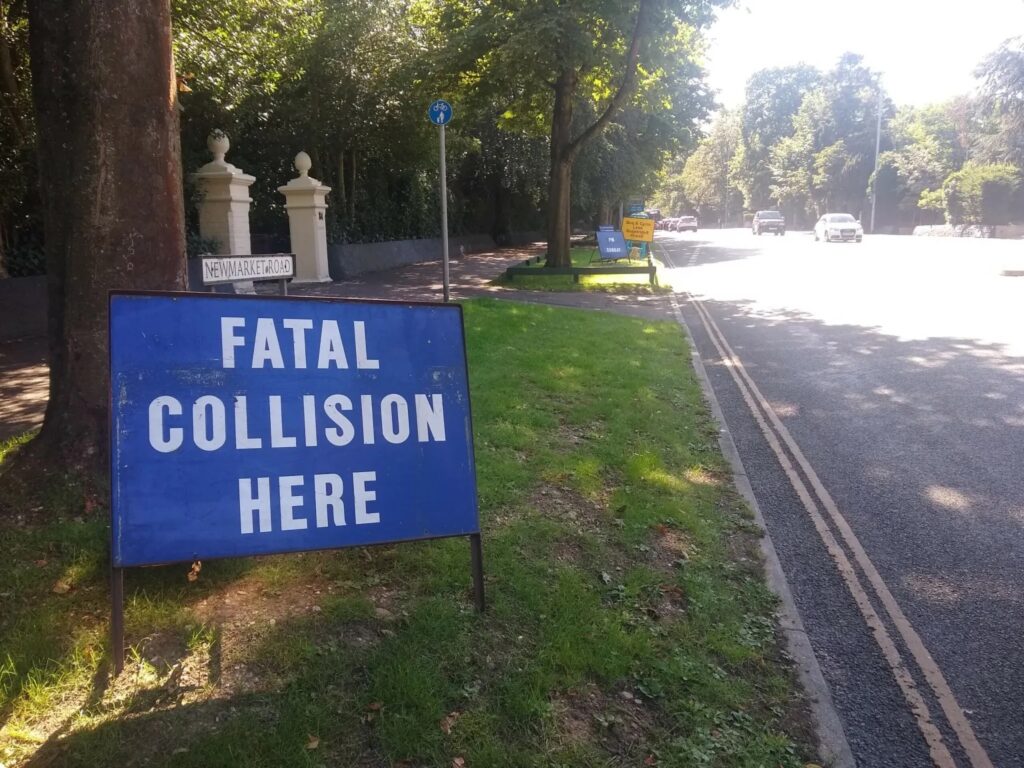

The number of cyclists being killed on the UK’s roads has fallen once again from 91 fatalities in 2022 to 87 in 2023, the latest reported road casualty statistics published by the Department for Transport have shown.
However, this continued drop in cyclist fatalities, the lowest number since records began 45 years ago, is counterbalanced by a significant decline in cycling traffic in 2023, as the number of miles travelled by bike fell by seven per cent, a marked trend of the post-pandemic period.
The number of cyclists seriously injured on the road also dropped slightly between 2022 and 2023, from 4,045 to 3,942, though this number remains significantly higher (18 per cent) than the 3,329 cyclists seriously injured in 2004.
According to the Department for Transport’s ‘Reported road casualties Great Britain’ annual report for 2023, which outlines and analyses the casualty statistics of a range of road users, 87 cyclists were killed in Great Britain last year, while 3,942 were reported to be seriously injured, and 10,970 slightly injured.

Those figures mean that cyclist deaths have fallen by four compared to 2022, when 91 cyclists were killed, and comprise the lowest annual death toll for cyclists since records began in 1979 (when, incidentally, 320 cyclists were killed on Britain’s roads).
It is also only the third time on record that cyclist fatalities were below 100, with 2018 (when 99 cyclists were killed) the only other year before 2022 to not reach that unfortunate milestone.
By comparison, cycle traffic has also increased by 39 per cent in the two decades since 2004, when 134 cyclists were killed.
However, the number of people on bikes seriously injured in 2023 is 18 per cent higher than the equivalent number in 2004, though the overall number of collisions involving injured cyclists has dropped by over 1,600 to 14,999 (a figure that, as the Department for Transport notes, must take into account the reality that many lesser incidents involving cyclists on the roads go unreported).
But while the DfT’s graphs show a welcome and steady drop in the number of cyclists being killed or injured (with the exception of the outlier year of 2020), when you zoom in more closely, the picture looks somewhat less promising.

In fact, with the number of overall miles travelled by people on bikes in 2023 (3.6 billion) dropping by seven per cent compared to 2022, the number of cyclist casualties of all severities actually increased last year, accounting for 4,152 injuries or deaths per billion vehicle miles travelled.
Along with this drop in cycling miles outweighing the fall in casualties, the DfT’s National Travel Survey also revealed last month that distances cycled annually in England have fallen to their lowest levels in a decade, while car journeys continue to rise.
According to the DfT’s figures, the average person in England cycled 47 miles during 2023, just over half of the high-water mark of 2020, which saw 88 miles travelled on average by bike. However, 2023’s average distance was also 17 per cent down on the previous year’s figure of 57 miles per person, and below the pre-pandemic average of 54 miles in 2019.
Nevertheless, compared to 2004, the overall casualty rates per billion miles travelled has fallen by 35 per cent, with fatalities decreasing by 53 per cent.
Taking into account the period between 2019 and 2023, an average of two cyclists were reported to have been killed and 80 seriously injured each week. 82 per cent of these casualties were male, while 15 per cent were under the age of 20.
Meanwhile, 46 per cent of cyclist fatalities were in two-vehicle collisions involving the driver of a car. However, the highest proportion of casualties that are fatal occurred in two-vehicle collisions involving an HGV, with 5.9 per cent of collisions between a cyclist and a lorry resulting in the cyclist’s death.
Collisions in which cyclists are killed or seriously injured are also most likely to occur from 7am to 10am and from 4pm to 7pm on weekdays, while weekends see a ‘peak’ around mid-morning between 10am and 12pm.

Between 2019 and 2023, 58 per cent of cyclists’ deaths also took place on rural roads, which account for just 31 per cent of traffic, while 57 per cent of fatalities did not occur at or within 20 metres of a junction.
The three most common contributory factors for fatal or serious collisions involving cyclists were the motorist failing to look properly, failing to judge other road user’s speed, and driving in a reckless or careless manner, or in a hurry.
In the overall road casualty picture for 2023, cyclist casualties of all severities saw the biggest percentage decline of all road users in the UK.
72,826 car drivers and passengers were killed or seriously injured last year (with 725 fatalities), 315 motorcyclists were killed (and 16,663 injured), and there were 19,263 KSI collisions involving pedestrians, leading to 405 deaths.




















24 thoughts on “Cyclist fatalities fall by 4% to lowest ever recorded level, but cycle traffic down 7% and serious injuries higher than 20 years ago, new government figures reveal”
Nearly 73,000 KSIs (car
Nearly 73,000 KSIs (car drivers & passengers) just last year??
Yet the prevailing narrative about roads in the meeja is whingeing about LTNs & 20mph speed limits, or stoking division and calling for new laws for dangerous cycling etc etc…..
I assume cyclists (especially the ones wot arrived by boat) are responsible for this massacre of motorists?
Clem Fandango wrote:
Edited comment, the way the data is presented is quite confusing in the report and confused me as well as obviously road.cc. The total number of KSI for 2023 (all transport types including cyclists and pedestrians) was 29,711, still an absolute bloodbath but not quite as bad as stated above. The 73,000 figure for car drivers and passengers is all casualties, not just killed and seriously injured, so includes everyone who might have just picked up a bruise or two, accident investigators have to write down any injury sustained in the report, however minor.
Which just goes to show that
Which just goes to show that you can prove anything with stastics; even the truth.
So this means that cyclist
So this means that cyclists are being subjected to increasing fatalities, and serious injuries, per mile cycled. No surprise then that fewer cyclists are prepared to take the risk.
That’s what I thought: if
That’s what I thought: if cycling numbers are down 7% then everything else being equal then you’d expect cycling fatalities to be down 7% too… If they’re only down 4% then hasn’t the rate of fatalities almost doubled (or something)?
brooksby wrote:
The key may be “everything else being equal”, one imagines. Maybe the numbers of those who cycle commute in cities – the most likely to be KSI – have remained constant or even risen (cost of living crisis etc?) whilst the numbers of those who took to riding round parks, off road trails etc during the pandemic have fallen away now the full panoply of other amusements are available? So possibly fewer of the type of miles where KSIs are least likely to happen are being ridden whilst the amount of the type of miles where they are most likely to happen has remained constant?
I thought they always claimed
I thought they always claimed statistically you were more likely to be KSI’d on a bicycle on country roads, commutes in cities weren’t as risky because infra, lower traffic speeds and access to quicker medical care is better
Looking into it I see you’re
Looking into it I see you’re right, I didn’t know that and assumed cities are more dangerous, in fact 56% of cycling fatalities last year were on rural roads and 44% in urban environments. Every day is a school day! I think my general assumption probably still stands that within the cities those who commute by bike (who will generally have to ride on some of the most dangerous roads) are still commuting whereas those who took up leisure cycling (who will generally ride on safer roads or off-road) during the pandemic are less likely to be still cycling, which could be a contributor to the fact that deaths have not dropped at the same rate as mileage.
brooksby wrote:
Almost. 1.03 times much, so if you round up to the next integer then it’s doubled.
mdavidford wrote:
Isn’t 1.03 x 4 = 4.12?
Yes, but that’s not how you’d
Yes, but that’s not how you’d calculate it.
If cycling numbers before were X, and fatalities Y, then the rate was Y/X.
If cycling numbers now are down 7%, then they are (93/100)X; likewise fatalities down 4% makes this (96/100)Y.
So the rate now is ((96/100)Y) / ((93/100)X).
We can rewrite that as ((96/100) / (93/100)) x (Y/X).
And then simplify the first part of that by multiplying numerator and denominator by 100: (96/93) x (Y/X)
Which comes to 1.03 x (Y/X)
To make it a bit more concrete, imagine in year 1 you have 100 cyclists who have 100 incidents* – the rate is 1 incident per cyclist
In year 2, you have 94 cyclists who have 97 incidents*. The rate is now 1 and a tiny bit per cyclist (94 incidents would be 1 per cyclist, but you’ve had 3 more than that, which, divided across your 94 cyclists is roughly 0.03 each – so 1.03 total).
[*in this case, not fatalities, unless some of them are being resuscitated and then run over again.]
Thank you!
Thank you!
That’s quite a shocking
That’s quite a shocking number of pedestrian deaths (405). Walking isn’t supposed to be risky.
There may be other people
There may be other people involved in those deaths.
Indeed. However
Indeed. However understandably we consider motoring a given – background events, like night or weather. But perhaps we shouldn’t so often as in fact it’s not fixed e.g. see here.
Looking at this from perspectives of others who could do something though:
… But it was an accident / but they didn’t mean to – so the police and courts won’t be interested.
… But some individual made a mistake, so a case of “nothing we could have done” with the infra (“a random, unpreventable occurrence”) so the council / road authorities won’t be interested. We’re probably biased against the pedestrian in this regard so we give the motorist the benefit of doubt. BUT … if we have enough of these in one place eventually a campaign may ensure “something is done” – which is normally to impose further inconvenience on pedestrians “to protect them” *.
… But some people will always get hit and mass motoring is a “good” but regardless if we “punish drivers” we’ll in turn get punished at the polls (and lose some very powerful backers…) – so politicians aren’t so interested.
* Sometimes we simply ban crossing by putting railings up. Or we make a pedestrian crossing of some kind – either “hope that the vehicles see you and stop”, or “press a button and wait here”. Or we grade-separate (which is actually sometimes a good solution) BUT we “move the vulnerable road users out of the motorists’ way” – making them climb stairs to cross or descend into a pit while motorists stay on the same level.
That’s quite a shocking
That’s quite a shocking number of pedestrian deaths (405). Walking isn’t supposed to be risky
It may be shocking but not surprising when you see a BMW nutter charging off the road, through a load of cycle racks and hitting someone locking up her bike (if I remember correctly) and whio is only ‘spoken to’ by the police.
Walking is slightly more
Walking is slightly more risky per mile than cycling according to the stats. The numbers are shocking, it’s also broken down into other party in the collision. Where recorded, the other party in a pedestrian fatality is a car driver in 68% of the cases.
anotherflat wrote:
How many of the pedestrian bothered to wear a walking helmet?
I’m sure someone else can
I’m sure someone else can explain it better than I can, but 405 fatalities is probably not that high considering how many people walk. The point that two people die cycling a week – when cycling has the lowest modal share is frustrating. That anyone dies on the road is wrong.
Rome73 wrote:
Actually in terms of fatalities per billion miles travelled pedestrians come off slightly worse than cyclists, with 27 deaths per billion miles compared to 24 for cyclists. Astonishing numbers for both really, over 500 people killed each year walking or cycling. That’s the equivalent of a Manchester arena bombing every fortnight; if that was happening there would be national outrage and the government would do everything in its power to prevent it, but when it’s happening on the roads it’s just seen as a normal part of everyday life.
I want to click ‘Like’ for
I want to click ‘Like’ for this (Rendel’s reply) but the underlying message is too depressing
Rome73 wrote:
I guess the explanation is that most of the time pedestrians are not on the road, ie safe from cars, trucks, etc. as long as they don’t cross a street, that’s why the number of fatalities is so much lower than cyclists. I would not compare the number of fatalities by miles travelled as they are doing here, the difference in speed is too high (why not by hours travelled, then).
S.E. wrote:
Well, they *feel* safe there – in fact a number of those fatalities are indeed on the pavement, because that’s where the pedestrians mostly are and motor vehicles end up also…
This one is also debated but seems to have stuck. I wondered about time as a measure of “exposure” to threat. Presumably distance used because it doesn’t make much difference for pedestrians (low speed) but for motor vehicles a wide range of speeds is possible – so it’s easier to compare journeys using a per mile measure? Of course we’d want to subdivide this by e.g road type e.g. street, urban distributor, country road, motorway…
They need helmets and hi vis.
They need helmets and hi vis. They have a responsibility to ‘be seen’ by drivers.