



A local politician in Exeter has urged residents to be patient with year-long roadworks while a cycle lane is built, the “missing link” route connecting with other parts of the city’s infrastructure network in what will be a “fantastic bit of road”.
The situation mirrors episodes seen across the country, a council looking to invest in active travel facing criticism from outspoken locals who have branded the £1.7 million project an “utter waste of time and money”, a Conservative councillor going against the Tory-run council that approved the project to claim all it will achieve is “making it impossible for motorists to move around freely”.
Alison Sheridan told the BBC that “they want us out of our cars and on our bikes or walking which is simply impractical for most people”, and added: “We don’t live in California or the Costa Del Sol we live in Exeter and love it as we do, it is often very rainy and wet.”
“There’s a fine line between coercing, encouraging and forcing and what they’re actually doing here is making it impossible for motorists to move around freely,” she claimed.
A fellow councillor, Marina Asvachin of the Labour Party, disagreed and made the point the route on Rifford Road, for which works began this week and are expected to last a year, will provide a “missing link” that will join up other infrastructure.
“At the end of the year we will have a fantastic bit of road that will join up Burnthouse Lane to Sweetbrier Lane,” she argued, reassuring those concerned about potential impact to the width of the road by explaining that the route will still be wide enough for two HGVs to pass each other.
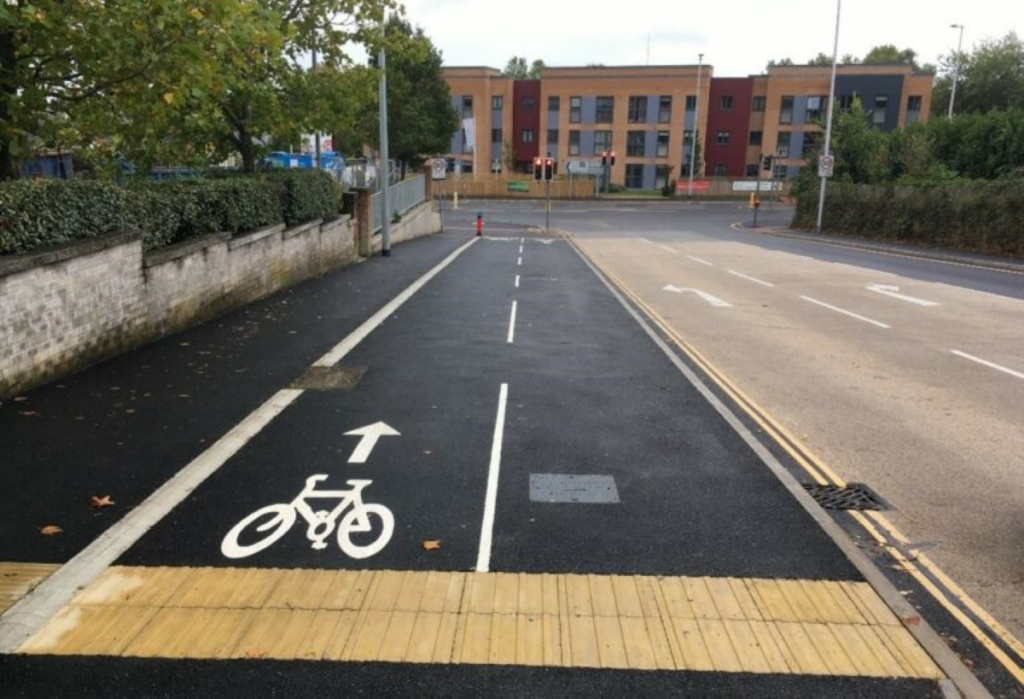
The 700m-long route will, the council says, mean “people walking and cycling will have their own dedicated space and will have priority when crossing the side roads”, and should look similar to the photo illustrating this article of another bike lane recently built in Exeter.
“In order to deliver the new cycle track, it will be necessary to remove the central hatched area of the road. Traffic lanes and on-street parking bays will then be moved across to provide the space for the new off-road cycle track,” the council said.
“It will also be necessary to remove 16 on-street car parking spaces, four of these lost spaces are due to the provision of new driveways which were requested by residents during the informal consultation. This will of course enable off-street parking for these properties. It is proposed to carry out the necessary driveway works at the same time as delivering the new cycle track as it provides better value for money to all parties and removes the need for future disruption.”
However, the BBC also heard from a local resident, and cyclist, Angela Martin who said the plan is an “utter waste of time and money”.
“I think it’s an utter waste of time and money that could be better spent on maintaining pavements and cycle paths,” she said. “We’ve got too many potholes, we’ve got cycle paths that are unusable, you could cut back vegetation and make the paths twice as wide in some places. There are a lot of simple, easy, cost-effective things they could do.”
It comes as the latest active travel dispute in Exeter, the scene of low-traffic neighbourhood (LTN) controversy in recent times.
> Exeter LTNs vs dodgy data on the road.cc Podcast
Devon & Cornwall Police warned vandals that removing or damaging road closures is a criminal offence – and say they are monitoring anti-LTN groups on social media after masked youths ripped out bollards last summer, before fleeing by bicycle.
By the autumn the situation had become so toxic Exeter’s Labour MP Sir Ben Bradshaw reported anti-LTN protestors had resorted to filling councillors’ letterboxes with faeces and sending death threats.
More recently, “human bollards” stepped in to enforce a road closure after a “child was knocked off a bike” by a motorist and a cyclist was reversed into. As a result, last week, police said they would be clamping down on “unacceptable” drivers flouting bus gates and putting vulnerable road users at risk.















13 thoughts on ““At the end of the year we’ll have a fantastic bit of road”: Councillor cools criticism of “utter waste of time and money” cycle lane “making it impossible for motorists to move around freely””
Alison Sheridan “making it
Alison Sheridan “making it impossible for motorists to move around freely”. She says that as if it’s a bad thing.
Yet another tory who is firmly on the pro-car bus (confusing reference deliberate).
I find that when I’m driving,
I find that when I’m driving, the biggest barrier to motorists (including me) moving freely are all the other motorists on the road. It doesn’t matter if it’s one lane or 6 lanes, I can’t ever remember (in over 40 years of driving) having my freedom to move restricted by anything other than motorists.
Why can’t some people see what the problem is even when it’s smacking them in the face.
I’ve been impeded by rivers,
I’ve been impeded by rivers, buildings and we still don’t have flying cars! Bloomin’ cyclists to blame.
eburtthebike wrote:
Yet, they have no problem making it Impossible for cyclists/pedestrians to move around freely.
When will people understand that this all about providing balance and choices.
I’ve just returned from a
I’ve just returned from a very rainy Antwerp in Belgium where every road and pedestrianised area has high quality cycling and pedestrain infrastructure, where cars, walkers and cyclist all seem to have mutual respect and understandign of how to move around each other in a shared space….I’m sure there are confrontations and incidents but the starting position seems much better. And that means everyone cycles.
Global Nomad wrote:
There does seem to be a certain amount reliance on the correct attitudes, doesn’t there – I feel that this is the biggest hurdle, in the UK.
local resident, and cyclist,
local resident, and cyclist, Angela Martin who said the plan is an “utter waste of time and money”
I thought, initially, that this was GI Tory ‘I’m a cyclist myself’ stuff. However, if she’s a genuine cyclist, as opposed to somebody who has sat on a bike ever, then her comments do make sense although they’re obviously far too late
However, I think Angela doesn
However, I think Angela doesn’t understand how local authority finances work. Building cycle infrastruture is usually financed from a government or Combined Authority (if there is one) dedicated pot allocated to active travel / local improvement schemes (such as TCF or CRSTS). Potholes and the like are maintenance and need to be paid for out of the Councils own budget. Remove the new cycle scheme and it doesn’t mean theres money to be spent on other things – it just means there won’t be a new cycle scheme.
Under Boris the consequences
Under Boris the consequences were even greater. Page 21 of the 2021 Conservative policy document “Department of Transport: Gear Change One – Year On” reads: “We will reduce funding to councils which do not take active travel seriously, particularly in urban areas….an authority’s performance on active travel will help determine the wider funding allocations it receives, not just on active travel.”
That’s a pretty clear instruction to local gvt.: if you don’t build active travel infrastructure we will reduce your budget for social services and education.
“We don’t live in California
“We don’t live in California or the Costa Del Sol we live in Exeter and love it as we do, it is often very rainy and wet.” The infamously harsh and brutal climate of Exeter, navigable only by car!
bikes wrote:
Life was terrible before the car when people were trapped in their homes for 4 months of the year, unable to go anywhere.
Or maybe we need to rediscover the clothing secrets of the ancients, long forgotten, that allowed people outisde in inclement weather.
wycombewheeler wrote:
See you at the next solstice at Stonehenge. We might need a virgin.
I just looked at the forecast
I just looked at the forecast for Exeter. It’s survivable for now but there is some chance of light rain on Wednesday afternoon. And only around 13 C! Arghhh!!!