


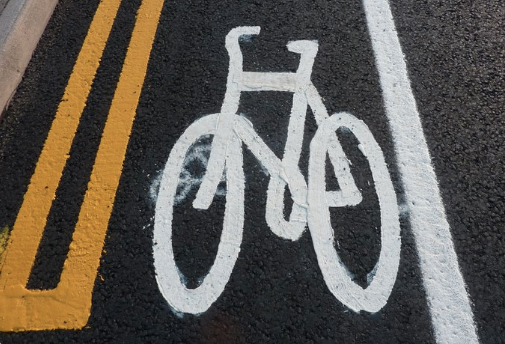

A council officer, responding to criticism and concerns from drivers about the quality of local roads at a time when the local authority is progressing with a project to build five new cycle lanes, has told councillors and constituents that “the new hierarchy is pedestrians first, cyclists, buses and everything else” and “cars are last”.
Invercycle Council officer Gordon Leitch responded to questions about the perceived disparity between the number, and quality, of cycle lanes being built in the area compared with the quality of roads in the district by insisting “cars are last in the list unfortunately”.
The Greenock Telegraph has reported discontent at the latest active travel project which will see Sustrans work alongside the council, led by a Labour minority administration, to deliver cycling infrastructure, in this case five new bike lanes.
Last week, local councillor David Wilson accused the Scottish Government of prioritising “cycling and walking over cars”, before it was today reported that Conservative councillor Graeme Brooks had told the local authority’s environment and regeneration committee about concerns from constituents who did not believe the same efforts were being made to improve the area’s roads as were being made to introduce active travel infrastructure.
In reply, council officer Gordon Leitch explained that full plans would be shared shortly, but: “The only thing I’d point out about the road and the cycle network is that the new hierarchy is pedestrians first, cyclists, buses and everything else and I think that cars are last in the list unfortunately. That’s the route we’re going down now.”
Council leader Stephen McCabe added that the funding for such projects is “ring-fenced” as “part of a national strategy where the government is keen to improve cycling and walking routes and safer streets”, and so “the money that we’re getting for this cannot be spent on renewing our pavements and our carriageways” anyway.
“We either take this funding and we design these schemes in line with the national strategy to make our streets safer for pedestrians and for cyclists, or we turn the money down and say we’re not going to do that,” he attempted to clarify. “We’re not going to get the money to spend on resurfacing our roads and pavements.”
However, McCabe did express a desire to see a council debate on the cycle lanes, despite agreeing to the project “in principle”, as he also suggested it could “impact on the efficiency of the bus service”.
“I think SPT’s (Strathclyde Partnership for Transport) view is we’re spending too much money on cycling routes and not enough money supporting bus services and bus routes,” he said.
Last week, councillor Wilson argued: “I don’t think these things should be a priority. That money could be better used on road building to improve the road system in Inverclyde. We have enough cycle tracks, and I don’t think the ones we have are getting used.
“This SNP government budget on roads in Scotland is being cut, due to the influence of the Greens, who are completely against cars and road expenditure. It means there is not going to be money for major road improvements such as the signals on the A8 to help with the general flow of traffic. It is a question of priorities, and seems to be cycling and walking over cars.”
Defending talk of a hierarchy on the roads, and in planning for how people use the roads, SNP councillor for Inverclyde Chris Curley said proper design means the “top of the pyramid of the hierarchy flows freely” and “that includes people walking, cycling and taking public transport”.
“I’ve seen stuff that’s been designed in other areas – public transport is ingrained within that streetscape and moves freely,” he said, raising doubt about whether active travel infrastructure necessitates negatively impacting bus services.









25 thoughts on ““Cars are last in the list,” says council officer defending plan to build five new cycle lanes amid concerns from motorists about road quality”
Illustration is that of a
Illustration is that of a shit cycle lane, far too narrow!
Looks like an improvement on
Looks like an improvement on the tiny one you can still see
Oh the irony – after all the
Oh the irony – after all the years of cars being the priority to the detriment of every other road user.
Corporal Jones and his “They don’t like it up ’em” springs to mind.
I think a modern equivalent
I think a modern equivalent might be the Russians very publicly complaining every time the Ukrainians fight back…
Over 100 years of building
Over 100 years of building roads for motorists and hardly anything for people cycling, and still they’re not happy.
Cry harder Mr Wilson. You’ve had your chance, you screwed it up. Make way for more forward-thinking people.
It’s always going to be
It’s always going to be difficult to follow the arguments of right wingers, they have no respect for facts and you’ll run out of breath before they run out of ever changing reasons for NOT doing something.
Nearly every council has a
Nearly every council has a transport hierarchy in its Local Transport Plan.
It’s good to see one council actually implement it.
Personally I’d put
Personally I’d put motorcycles above shared vehicles, possibly equal standing with public transport, on the basis of their vulnerability on the road
I particularly like how the
I particularly like how the council have changed their name to Invercycle council, just to really rub it into them drivists faces
Every day we see videos of
Every day we see videos of cyclists who refuse to use bike lanes so why waste money creating them to just be there unused . The money would be better spent on resurfacing roads for all users
Wheelywheelygood wrote:
FTFY
Wheelywheelygood wrote:
Saying something doesn’t make it true
Wheelywheelygood wrote:
They look like a waste of space, don’t they?
I reckon you should be campaigning for the money – and some space – to be taken away from “roads for motor vehicle users” and spent on a network of proper wheelchair infra!
Wheelywheelygood wrote:
Every day we get road.cc trolls creating multiple accounts and wheeling out the same old bullshit arguments that have no substance, simply to baiting people. Why do you do it, Nige?
You even know the answers to this question as it has been discussed repeatedly on here and elsewhere. Perhaps you’d be better asking councils why they build the kind of pathetic, disjointed infrastructure that means people find it difficult/unpleasant/a waste of time to try to use it.
Wheelywheelygood wrote:
Every day we see videos of cyclists who refuse to use bike lanes that are obviously so poorly designed they are unsuited to use as they are dangerous so why waste money creating them to just be there unused? The money would be better spent on providing cycle lanes that are fit for purpose.
There, I fixed it for you.
Reallyreallycrap
Reallyreallycrap
Wheelywheelygood wrote:
There are very very few cyclists who “refuse” to use cycle lanes. Most of the people who aren’t using cycle lanes are doing so either because the cycle lane is very poor (surface/layout) or because it isn’t actually going where they want to go (so is very inconvenient).
The A road on my commute is jam packed during the morning “rush hour” with motorists who are refusing to use the motorway, because they feel that it is quicker or more convenient for them to use the local road instead. Should we therefore remove funding for the motorway network?
Where are these videos? Are
Where are these videos? Are they on Sky? We can’t get Sky, we are with BT.
I believe they’re available
I believe they’re available from
all goodsome Accountants, and also some “foreigners” / Dutch bike shop owners with extremely rapid language acquisition skills. If you’re quick you might even find a mention of them on a Wikipedia page, before the information is removed by the impolite / discourteous.Even a child knows this.
Are they all filmed in Essex?
Are they all filmed in Essex?
Dutch bike shop owners with
Dutch bike shop owners with extremely rapid language acquisition skills
You forgot to mention the multiple personality disorder, trolling variant
“…..Conservative councillor
“…..Conservative councillor Graeme Brooks had told the local authority’s environment and regeneration committee about concerns from constituents who did not believe the same efforts were being made to improve the area’s roads as were being made to introduce active travel infrastructure.”
Yet another tory who doesn’t seem to understand anything. So he kindly goes on to prove it:
“That money could be better used on road building to improve the road system in Inverclyde. We have enough cycle tracks, and I don’t think the ones we have are getting used.”
It’s like the tories have a death wish or something. Normally, I’m morally opposed to anything the tories want to do, but in this case, I’ll happily make an exception.
As a user of Sustran Route 75
As a user of Sustran Route 75 through Inverclyde for the last 30+ years, the recent expansions have been great for improving getting about to shops etc. There is also a 20 mile flat costal route from Marina (Greenock) to Marina (Inverkip) with only about 300m on the road. It is worth noting not until Covid times has it ever been questioned as a bad idea to have a cycle route through Inverclyde.
I do follow the council meeting and watched as Councilor Brookes adding his usual sarcasm when questioning the recent route additions, in build and future plans. He has history in this department and even been pictured sitting in the middle of the cycle lane on a 300/400 m section that causes the most local car user comments. Following lasts weeks meeting (can be viewed on YouTube) I emailed several councilors asking why we always question something that should be good environmentally plus health and wellbeing. I pointed out that a 300/400m section should not be used as a stick against all the good additions and expansions. Councilor Curley wrote back with a comprehensive positive reply and mentioned he has put forward a solution for users in the questioned 300/400m stretch.
All it really comes down to is the Tory Councilors Brookes and Wilson simply question everything the SNP and Labor members put forward and agree on. The Greenock Telegraph actually fuels the problem by always questioning Active Travel projects as it generates the most comments from the online Trolls etc.
Marina (Greenock) to Marina
Marina (Greenock) to Marina (Inverkip) – I must try this someday!
I’ve done an interesting day trip on the other side (mostly route 1 / 75) from Helensburgh to Edinburgh. The 75 especially east of Glasgow is one for the most hard-core fans of frustrating navigation, wiggly routes, diversions and muddy / glass-strewn alleys round the back of blasted estates!
To be completely fair I was a bit weary on the latter half (had diverted for some business in Glasgow) and there is a nice section in the middle (Caldercruix to Armadale). Still… this had the “Sustrans feel” of “we must somehow string together a route between A and B even if it’s several times the distance as the car drives”.
On the map it does look like once you’re out the West of Glasgow it would be attractive.
Chris, yes the route through
Chris, yes the route through Paisley and on East is pretty grueling at times but good if completing in sections. Close to me there are nice sections along the coast and across the old train line between Kilmalcom & Paisley and they are currently building a section running in parallel to Gourock Train Station where you can get the ferrys etc. Should be a good connection to Trains and Ferries once completed – fingers crossed