


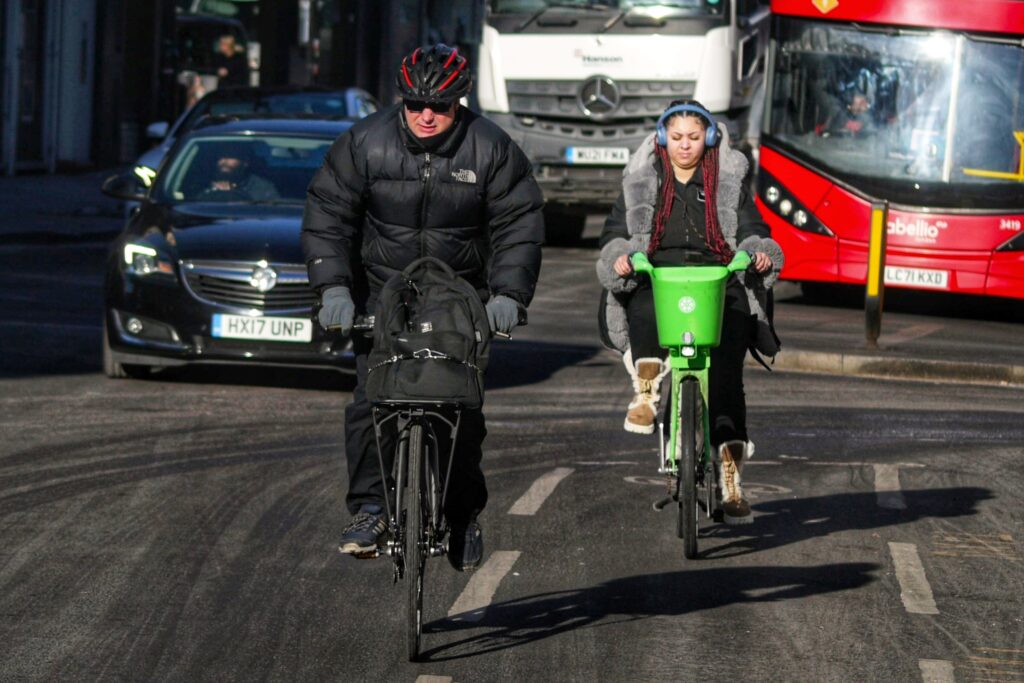

A new survey has put the percentage of Brits who are scared of urban cycling at 90 per cent, with fears over being hit by a driver, experiencing road rage and the threat of theft topping the list of factors contributing to the concern.
The figures come from research by bike subscription service Swapfiets, published by City AM, with the survey finding that fears about cycling in cities are more noticeable in older age groups as younger respondents were more likely to feel confident making urban journeys by bike.
However, overall the survey suggested that 90 per cent are scared of cycling in UK cities, with the risk of being hit by a driver (68 per cent), experiencing road rage (54 per cent) and theft concerns (47 per cent) being the most commonly cited reasons behind the fear.

Inability to stop safely (34 per cent) and getting lost (27 per cent) were also mentioned, but less frequently. Swapfiets noted concerns about urban cycling were less prominent in the ‘under 24’ age category, with fewer than a quarter reporting any major concerns.
It was also suggested that men are likely to be more confident than women, 90 per cent of women stating that they find urban cycling “terrifying”, compared to 40 per cent of male respondents.
> Cycling infrastructure needs to be built with women in mind, study suggests
Swapfiets has urged the government to enable more people to access bicycle journeys in UK cities by increasing active travel funding in the upcoming budget to fund protected infrastructure projects that will make city cycling less daunting.
“The findings of our study are a wake-up call,” UK country manager at Swapfiets, Rory MacPhee said. “With over 90 per cent of the nation fearing urban cycling and the UK potentially falling short of its 2030 net zero targets, it’s clear that current efforts aren’t enough.
“We’re urging the government to not only reinstate but increase the active travel budget this October. Improving cycling infrastructure and offering better education are essential if we’re going to break down the barriers stopping people from choosing sustainable transport. Prioritising these investments will not only address our climate goals but also improve public health and create more liveable cities for everyone.”

Last year, the previous government slashed the budget for active travel schemes in England outside London by £380m in what was described as “a backward move” by the Walking & Cycling Alliance (WACA).
Having won this summer’s general election, the newly elected Labour government said it would invest “unprecedented levels of funding” in cycling, as well as develop a new road safety strategy.
New Transport Secretary Louise Haigh said access to safe cycle routes is “essential” for tackling carbon footprint and pointed to the “hundreds of thousands, if not millions” of GP appointments that could be reduced each year through active travel investment.
> Build safe cycling routes to help people ditch cars for local journeys, urges senior doctor
Haigh’s comments came in the same month it was revealed that average cycling distances in England had fallen to the lowest levels in a decade. According to the Department for Transport’s National Travel Survey, people in England averaged 47 miles by bike in 2023, a 17 per cent drop on the previous year and just over half the distance recorded in 2020, while car trips continued to climb.
Swapfiets also said it would be relaunching its programme of guided city cycling tours to build confidence with nervous cyclists.














57 thoughts on “90% scared of cycling in UK cities — new research suggests fear of collisions, road rage and theft putting people off”
Few solutions:
Few solutions:
1. Infrastructure.
2. Unmarked police cycling; Issue section 59 notices to any driver/vehicle that endangers them. When cars start getting siezed over it driving standards will improve.
3. Marked police cycling – similar awareness to surroundings to foot patrol, while able to move around an area significantly faster.
Cycling competence should be
Cycling competence should be part of the driving test.
And it should be compulsory
And it should be compulsory for anyone renewing a licence. Anyone unable to ride a bicycle would have the option of a tricycle, e-bike or e-assisted hand cycle.
Agree. It’s those “barriers”
Agree. It’s those “barriers” overcoming which is necessary (but not sufficient) for people to switch modes *.
Policing is a “necessary” for road safety but I’m just not sure how important. I certainly don’t think that has much to do with people’s feeling of safety or the lack of it on the roads. Plenty people die in car crashes but I’m not seeing people saying “I would drive, but feel the police just won’t protect me…”. And it has zero to do with convenience of cycling and also zero to do with the relative appeal of driving a given journey over cycling it.
People won’t necessarily know good solutions themselves ** and they also might simply assume some things are given if you cycle (e.g. getting sweaty, “but how will I carry anything” etc.)
Ultimately I doubt how much this is about “personal choice” (unless that is people choosing to pressure their MP / councillor / other people). Personal choice gets our current 1% of journeys cycled (and falling, without further work). The people with the power to actually change things (councils, and ultimately the government for allocating funding / setting direction of travel / amending laws) have to feel this is worth not just having (otherwise we get ineffectual “encouraging cycling”) but worth the long-term, contentious hard work of selling and making a major change to our transport systems (and indeed philosophy).
FWIW Cycling Embassy of GB have a comprehensive page on people’s reported barriers to cycling.
* While it’s possible for e.g. extra road capacity to create new driven journeys in general this is about switching from using one mode to another. Another complication is that for journeys previously driven it may be these are replaced by multi-modal transport, or by “substitution” e.g. used to drive to the out of town shopping centre for a big weekly shop, now realise that I can do this e.g. using the bike on the way home from work at more local shops but split over a couple of shops over the week.
** A bit like asking “why do you drive to the shops?” – it’s unlikely that people would identify “you can buy cars which have lights, storage space, locks and weather protection, right from the dealer. Then there are well-maintained roads for me to drive on between here and there where I don’t feel I’ll get killed and parking both by my house and the shop, oh, and everyone else does this” – but without those conditions there probably wouldn’t be much motorised shopping.
It’s not just urban cycling,
It’s not just urban cycling, it’s any road in the UK! And it isn’t just the risk of being hit, the risk of being nearly-hit is off the scale.
Solutions? Make the driving test harder. Make people re-do it every 10 years, if not 5. Make cycling part of the driving test, make it a road user test. Have some actual traffic police, not just cameras on every corner. Have a justice system that actually punishes people, when they actually get as far as court. Link car ignitions to the DVLA, so your bloody car won’t start if you haven’t passed your test, or currently banned.
But no-one else gives a shit. Which is why we have ended up with 85 deaths and serious injuries every day.
You don’t need to retest
You don’t need to retest people frequently, if you regularly hold & keep people to the tested standard, it involves more road coppers though, and a willingness to prosecute for road offences.
And fwiw despite the fact a collision is more likely to be fatal, I don’t encounter a tenth of the hassle or safety concerns on rural roads that I get from urban areas riding.
We barely have enough
We barely have enough capacity to handle existing demand for tests…
But courts should be able to mandate ongoing testing as a penalty for driving offences (i.e. after ban is spent offender is required to repass test every 5 years); For offences above a given severity retesting should be part of court investigation (i.e. you have to do a driving test BEFORE it goes to court and the result + examiner review is submitted as evidence)
Courts should also be able to time limit existing licences (i.e. we aren’t banning you immediately, but you have 3 months to pass a test if you want to keep licence)
This focuses limited test resources on problematic drivers.
OF course all of these penalties need to be in addition not instead of current penalties.
Not being able to cover
Not being able to cover demand is not a good enough reason to re-test. Increase the capacity. Grade tests as beginner, refresher etc. Fail a refresher one and you’re back to the start. Increase the cost of the test to cover the cost of the extra infrastructure.
These are all possible solutions rather than just saying “too hard, give up”.
The standards of driving in this country are atrocious. I suspect a lot of this is due to laziness or main character syndrome, but some of it is due to people not realising that they’re not doing things well. When I’ve tried to educate drivers about what they could do better it usually results in a threat of a fight, when I’ve tried to get the police to educate them I get ignored, so who is going to correct their behaviour? Regular meetings with a trained and impartial examiner could help a lot here.
At work I have to be re-trained and tested regularly on everything from lifting boxes to cyber security. Why should it be any different when I streets?
Another solution: Make
Another solution: Make Dashcams compulsory. In the event of a collision, the Police can then use that in evidence. We have seen this a few times, such as the case of driver Tomasz Kroker.
Anyone familiar with the
Anyone familiar with the history of cycling in this country will be wondering why the company wasted its money on yet another survey to find out exactly what all the other surveys have said. Why people don’t cycle has had the same reasons for decades, the problem is that successive governments haven’t given a flying flamingo, quite happy to announce massive spending on cycling, and having got the headlines, withdraw the funding.
It is to be hoped that Louise Haigh’s promise of unprecedented funding will break the mould and actually be realised: it’s certainly way, way overdue.
As Chris Boardman has (I
Completely agree. However as Chris Boardman has (I think correctly identified) money is in some ways not the issue. Or rather it’s one of the last issues to address when trying to get change at the political level. If our lords and masters really get it they’ll almost certainly be able to do *something* useful – even before substantial moneys were available given the (relatively) vast funds available for “road transport” and other things which sorting our streets could be filed under.
Apparently it works in the opposite direction! (e.g. IIRC councils have managed to get “active travel” funding to pay for improvements for drivers and bus companies…)
The solutions are either:
The solutions are either:
-build high quality infrastructure,
-build infrastructure that is of high quality
-build infrastructure, and make sure the quality is high.
the little onion wrote:
Out of curiosity, why do you believe this when all evidence is to the contrary?
Infrastructure construction has not yet once, in the history available to us, decreased the fatality rate of cyclists. Each time it has been attempted, the municipality in question has watched it fail, at the unnecessary cost of time, money, and lives, and then been forced to pivot to the strategies that do work to improve cyclist safety — specifically, reducing the volume and lawlessness of traffic, particularly motor vehicles.
We can see this most-obviously right now in the Netherlands, which has been investing in cycling infrastructure since approximately WWII, and yet has a shockingly-high rate of cyclist fatalities ( averaging 280 annually, from a quite-small population that cycles very slowly and over very short distances, per their official statistics ). So, despite all that infrastructure, the Dutch are pivoting to the strategies I just mentioned, and implementing 20kph limits __for cyclists__ , never mind what they’re forced to do with motor vehicles.
It profoundly does not matter how much concrete and paint you pour. Without enforced traffic laws, roads will remain dangerous — for everyone. But the catch is, if you can enforce traffic laws, you don’t need infrastructure dedicated to specific vehicle types — which does not work, due largely to intersections, and doesn’t scale at all, and is sufficiently environmentally-unfriendly as to undo any benefit resulting from a mode-share change. So why not skip wasting time, money, lives, concrete, and paint and just enforce existing laws? We already know this works, since Japan has done it. Why not try the strategy that works, and skip the ones that we know don’t? It is already quite illegal to kill or injure pedestrians and cyclists with a vehicle, but those laws remain effectively un-enforced and that is the entire problem.
I’m not sure you are correct.
I’m not sure you are correct. Pavements are specific infrastructure for a specific group. Would you suggest doing away with those? If you have contiguous, safe cycle routes that avoid busy roads then of course people will use them and feel safer doing so. The KSI rate in the Netherlands may be high but how many people, as a percentage of population and journeys, cycle in the Netherlands? Surely more than the 2% in the UK
Some stats on who cycles,
Some stats on who cycles in NL, when, how far and some crash and casualty data by eg. cause and age, in English (there’s a ton of this available online).
https://english.kimnet.nl/publications/publications/2024/01/10/cycling-facts-2023
Turns out that if you have tons of people cycling there are plenty of “no other vehicle involved” cycle crashes, and if lots of those people cycling are young or quite old those are the people you mostly see in A&E. Who’d have thought it!
chrisonabike wrote:
For extremely widely varying definitions of “tons”. The number of cyclists in the United States is roughly 13 times the number of Dutch cyclists.
And yet, the Netherlands racks up about 1/3rd of the cycling fatalities that the US sees.
dh700 wrote:
Note for those who have missed our American cousin’s interpretation of statistics previously: he works off data which includes anyone in the USA who has cycled a bike once in the past 12 months as a cyclist.
Rendel Harris wrote:
Fine — cut the number to regular cyclists. The rate is still lower than the Netherlands’, and by a significant margin. And that’s without counting most of the “invisible cyclists” ( cf https://www.bicycling.com/news/a20049826/how-low-income-cyclists-go-unnoticed/ )
And, just for the record, what magic prevents occasional cyclists from being killed?
How many regular cyclists are
How many regular cyclists are you claiming for the USA? With a data source please: here’s mine, 54 million cyclists even if you include people who only take a bike ride once a year. You claim that the USA has “roughly 13 times the number of cyclists than the Netherlands”, which would mean about 200 million cyclists in the USA. Do you have the data to match your assertions?
Rendel Harris wrote:
Fairly sure we’ve been over this — you are quoting adult cyclists. There are an additional 80M or so children, and the enormous majority of them bike ( or scooter, these days, but that’s an irrelevant distinction from a road safety standpoint).
You are using an erroneously high count — about 15M — for the Netherlands. There are barely even that many Dutch. The actual number is around 10M.
Meanwhile, every study done in the US — from well before the Pandemic bike boom or the advent of most micro mobility sharing systems — found that around 1 in 3 Americans bikes at least annually.
“Within the preceding 30 days, 21% of the 4170 adult respondents reported riding a bicycle. Of the 863 adult bicycle riders, 5% rode a bicycle every day, 25% rode several times per week, 15% rode once a week, 27% rode a few times per month, and 27% rode once per month.”
https://www.ncbi.nlm.nih.gov/pmc/articles/PMC5189688/
“Nearly three-fourths of those age 16 or older (72.1%) never rode a bicycle or had
not done so during a 30-day period over the summer of 2002.”
https://www.bts.gov/sites/bts.dot.gov/files/docs/browse-statistical-products-and-data/bts-publications/archive/203331/entire-1.pdf
So yeah, as a matter of fact, I do have the data.
As an aside, the US scores
As an aside, the US scores very poorly for road safety in comparison to other developed nations. It has about 4x the number of road related fatalities/head of population that the UK has and about 3x that of the Netherlands. And some states in the US perform particularly poorly for road deaths and serious injuries. Texas has the worst record for DUI although Florida is bad too and the rule of thumb is that southern states are worse than those in the north. There were more road deaths in NC in 2021 than in the whole of the UK.
OldRidgeback wrote:
Really Bob Woodward? That’s some investigation right there.
Now compare the geography of those countries, and miles-traveled. It turns out that no country in the world has a road system that compares to the US’ for a variety of very good reasons. Should US roads be safer than they are? Absolutely — but that is entirely the fault of our indolent entity that we euphemistically call “law enforcement”.
dh700 wrote:
I’m not sure why you chose to be sarcastic. Yes, I’m a journalist. Yes, my job involves reporting on road safety and I’ve spoken with a lot of experts in the field over the years. I see a lot of road crash data from the likes of the DfT here in the UK and the FHWA in the US.
In most developed nations (and most developing nations too), the rate of road fatalities dropped during the COVID 19 pandemic when travel restrictions were imposed. The US bucked this trend, with an increase in road deaths. According to the FHWA, speeding and DUI offences became significantly more common.
The US has a serious problem with road safety and as I pointed out, some states are particularly bad. I travel to the US very regularly (i’ve been to 27 states, more than most US citizens probably) and have done for years. I often drive there, as well as cycling and motorcycling.
There are solvable road safety problems in the US and other nations have shown the way. France has halved its annual rate of road deaths over the last 10 years by getting tough on speeding and drink driving offences and ensuring that drivers can’t wriggle out of charges. Yes, the French could teach the Americans some pretty simple lessons on how to cut road deaths.
Driving education and standards aren’t good in many US states and I’ve heard that directly from US police officers as well as from officials at the FHWA. Only a few states allow police officers to use breath testing equipment to detect DUI for example, despite this having been proven over many decades elsewhere around the world. The same applies to drug testing kits, also proven elsewhere in the world.
OldRidgeback wrote:
Isn’t this a glaringly obvious answer to carmageddon? If a pack of mad dogs were running loose and biting all & sundry, sometimes to death, we’d remove that pack toot-sweet, would we not? Just because its mad humans doesn’t, at bottom, change that obvious solution, even if the removal process would be dialled down from “shoot the mad blighters” to “take them from their cars”.
I confess that it annoys me – cyclists bleating for a seprate infrastructure with its vast costs & environmental damage (paving over yet more of the paradise the same cyclists claim to value riding their bikes in). They’d be happy to ignore the continuing carmageddon if riding with an inadeqaute protection strip “protecting” them from the roaring car-dogs. As long as they have their own very expensive strips of protected road they’re content to see the carnage amongst others continue – perhaps whilst running down a ped-in-my-way on the laughably-named “shared” infrastructure sections.
We humans invented laws for a reason. The reason was to prevent a war of all against all by stopping of acts damaging others, making such acts punishable to do so. We already have traffic laws that in theory extract and prevent mad car-dogs from murdering & maiming. All a society has to do, really, is apply the already extant laws. ……..
Although I’d make traffic laws even tougher, myself, with punishments making miscreants pay-back a recompence rather than putting them into very expensive gaols wherein they become even more anti-social as they drain the tax coffers.
The infrastructuraists will add another bleat agin’ this apply-the-law solution to carmageddon. “The cost”. But effective policing and subsequent punishments can pay for themselves, not just from the fines and car-confiscations but from vast savings in other effects, from less NHS expense in mending the maimed to the many good effects of a greater well-being amongst the millions affected over a lifetime by the murder or maiming of their loved ones.
PS And don’t forget the vast savings of not having to build hugely expensive cycling infrastructure.
The problem is – the dogs
The problem is – the dogs here vote. (Or rather dog-owners – in fact in this land it’s mostly dogs and dog-fanciers). The mad dogs (or those with irresponsible owners) look the same as the well-trained ones; the former are rather rare and the latter sometimes also bite and kill unpredictably – “but they couldn’t do anything to prevent it – it was a tragic accident” / “he is just terrified of cyclists”.
There is little interest in dog-safety in this land, because deaths are not that frequent and we all accept that some will die from being bitten because obviously we need dogs. Most can’t imagine how they’d cope without their own useful, well-behaved dog.
It is a mark of adulthood to own a dog. People try to make themselves look more consequential with expensive pedigree pooches. Parents take big dogs on the school run “to protect the children”.
Oh and the incredibly wealthy dog breeders and dog-food manufacturers have turned the politicians and police into poodles. (And obviously *they* are all dog-owners!)
In this context feel free to bring forward your bill for shooting dogs (or restricting where they can be walked, or removing some kennel-spaces)…
chrisonabike wrote:
You’ve taken (that analogy) too far!
Whislt its true that loudmouth anti-LTNers and similar will rant loudly about their rights to risk murdering and maiming others by vrooming, they are in fact a very small minority. Endless surveys reveal that a large majority don’t want to be run over by a car loon. And were such surveys ever really needed to know this?
A serious policing of motorists according to the already extant law is going to offend no one other than the car loons who are caught and denied further access to their “weapon of choice”. Well, no one other than the gutter press and various proto-fascists who need something-anything to employ as a means to recruit others of their ilk to their paradoxically unpopular populist cause.
*******
How much longer must we peasants cater to the unholy wants of the various tiny but powerful (or just loud, courtesy of that gutter press) elements demanding that they be allowed to do what they want no matter how damaging?
And lets not have that false dichotomy that brands every one who wants or needs to drive as identical to the murdering & maiming carloons or the seriously incompetant. As any cyclist who uses the roads rather than running down peds on a footpath knows, the great majority of British drivers in most places are considerate, with no desire to murder or maim. They too would like rid of the car loons. After all, they’re probably in more danger from vroomers than even we cyclists.
Well I hope it was ridiculous
Well I hope it was ridiculous… still haven’t found a good source to gauge the ratio of the relative damage done by a few “murdering and maiming carloons” to that caused by “once in a lifetime tragic accidents” by careful and considerate drivers.
Going back to the article though – people are saying “we won’t cycle (so we’ll probably end up driving more short trips) because of car-fear”. Now I’m sure that is not the only reason (indeed I wonder just how important it is) BUT that is what period consistently say.
I just don’t believe nicking done drivers then pointing to the same busy road (you appear to suggest the bad drivers are a small minority – I’d generally agree) with cars, buses and lorries going at 30mph or more and saying “send your kids out in complete safety now! ” is going to make anyone cycle who doesn’t do so already.
Whereas in the places that have moved from total motor dominance and no cycling to mass cycling (even at just 10% of trips, say) like those in Europe as far as I’m aware they still have bad and careless drivers (though they may have a slightly more observant average driver). They’ve just reduced the number of places where vulnerable road users have to interact with lots of fast motor vehicles, and reduced speeds and volumes of motor traffic where people do mix (eg. residential areas – by blocking through-traffic) . (In fact they’ve even reduced the places where *drivers* interact with other drivers going in a different direction – see their “turbo-roundabouts” and the national ban on overtaking on some single lane roads! )
chrisonabike wrote:
— chrisonabike
How do novices come to take up anything that has a potential for injury? If the attraction is large enough, they consider the actual injuries suffered by those already doing it then decide if they’ll take the risk.
But perhaps what they mostly do is listen to or read the scuttlebutt put about concerning the activity. Personally I think this scuttlebutt is the main inhibitor arround safety fears and cycling, not the actual injury rate. The scuttlebutt is part of the gutter press campaign agin’ cycling. And part of the schtick here to get clicks.
So, two factors that need improving; injury rates to cyclists from cars (persecute the carloons and prevent the incompetant from driving); quality of info concerning the injury rates.
The latter is the hard part, as it would need some serious limitations on the freedumbs of the gutter press to LIE AND LIE AND LIE. But this website could do a better job too, eh?
If we extend your argument for a seprated cycling infrastructure to all other matters in which dangerous and aggresive loons murder and maim others, we’ll need to restrict or canalise all sort of activities and the folk doing them. An oft-quoted example concerns women and rape. Should we have a seprate infrastructure dedicated to women going about that’s closed off to men? Or should we deal with those certain types of men?
DItto endless other groups who are highly predated upon, such as children; and LGBTQIA+ folk; and Muslims in areas frequented by the islamophobic; and ….. All, according to your argument when generalised, must have their own separate infrastructure for their exclusive goings-about, banned to other in case those others are incompetant humans filled with a violent intolerance or lust.
***********
I’m not suggesting its easy to deal with carloons, incompetant drivers, rapists or the lustful and violent. But I am suggesting that its necessary to attempt to do so if we’re to claim we live in a civilised society.
Or are you going to give me another, “It’s just the way the world works” excuse for building more barriers between us all?
Well Ghandi – sometimes it’s
Well Gandhi – sometimes it’s just better to keep the bull in a field with a fence round, not in the playground. I’m all for barriers round the race course (horse, motorbike or F1). I am not at all troubled by barriers separating me from people in high speed trains, or on motorways. (Although if they’ve built a motorway *though* the city I’ll know the reason why, and it better not impede people crossing that direction – but that is old-style motornormativity!)
And it’s probably an idea – sadly – to keep the road further from the school to reduce the chance of parents with their SUVs from driving them into the school because occasionally one has a “moment of madness” or “medical episode”, as has happened).
I’m just interested in how eg. we practically give the kids a way to cycle to school that doesn’t involve sharing with cars doing 30 (plus). Making it so parents let them cycle to school doesn’t stop us having police and arresting the (thankfully rare) nutcases doing 60 through there (and it’s not a one-and-done – seems the UK is quite capable of generating a stream of people who’ll drive while high, or won’t give a stuff about careful driving because they’re already a gangster etc.)
So it’s really simple – let’s fix it so more of the next generation of kids can cycle to school, or old people get about without always needing a car. There’s a way to do it (using multiple tools including but not limited to “separate cycle infra”) which has worked in multiple places. It’s cost-efficient – nay excellent value for money and relatively cheap and opens up tons of other benefits. Why wouldn’t anyone want to do that?
I don’t think the press is helpful but (apart from a recent “culture war”, some poor rags as you mention and the BBC for some reason) they tend to reflect the prevailing mood (plus of course their sometimes bonkers proprietors). Nobody apart from a few current self-identifying cyclists is influenced by what appears on road.cc
Finally (for some reason I feel I should add) the Netherlands (and indeed Belgium) is still rather noted for tough, fearless cyclists. Safer cycling isn’t stopping those who want to push it. Just making it safer and more convenient for them AND everyone else.
Tbf most quoted & published
Tbf most quoted & published UK cycling stats about trips and miles, use the same metric. So it’s consistent.
stonojnr wrote:
That’s as maybe, the point is that he is claiming that the US has 13 times the cyclists of the Netherlands, which would mean about 200 million minimum; as per the statistics I’ve illustrated below, only 54 million Americans cycle even once per year.
Rendel Harris wrote:
So you’re going to leave this up, even after I corrected you?
Well the “widely varying
Well the “widely varying definitions” aren’t mine… Could the US population be larger than that of NL? Let’s have a look – the internet says:
345,426,571 vs. 18,228,742
I reckon that’s about 19 times bigger? So that alone would supply an answer to your query, but wait, there’s more!
I’m not sure where you’re getting your US cycling stats but another case of comparing apples and oranges most likely.
In NL most people – of all ages = cycle at some point for any journey type (shopping, commuting, going to school, going to leisure activities – and some “just cycling”). In the UK and the US most people don’t.
Those that do in the UK tend to be cycling in specific circumstances (food delivery cyclists which is a very recent development and its own somewhat depressing rabbit hole, “sports cyclists” and small amounts of “because we can’t afford a car / got banned” and recreation (often “drive to the ride” or at a holiday park)). The demographic doesn’t reflect wider society either (by age, gender etc.) The exceptions with greater numbers are places which have already reduced motor traffic and … places with motor-vehicle free cycle infra.
Returning to the original story – on “fear” I think the picture that Chris Boardman put up at one of his recent talks conveys where we should be aiming (and how to actually achieve change – after all why not do something that’s been shown in practice to address exactly that concern, in many places [1] [2] [3] [4] …?).
chrisonabike wrote:
If you had to look that up, you’re probably beyond your depth here.
I didn’t have a query, I explained the relevant statistics.
The former is far less true than you think — a reference to which has already been posted here. Basically, the Dutch ride down the block, but beyond that, they drive. ( Cf https://www.peopleforbikes.org/news/best-kept-secret-dutch-biking-dutch-hardly-bike once again)
And you will find in all those examples you cited, it was not construction that was effective, it was the decimation of traffic and increase in enforcement — as I previously explained.
Well hello again. Hope you
Well hello again. Hope you’re still enjoying the ride. What’s got you excited again after all this time?
I thought you also previously explained that you were above personal sniping and only posted on stuff you knew etc?
I’m surprised you’re using the US as an example. You could point to Antarctica – zero cycling fatalities and they needed no infra at all!
Seems as last time you see a triumph of theory over practice (or reality). Or maybe you actually got to visit some of these places and are here to tell us it’s a lie (turned out wrong since the last time e.g. I visited) – all the videos were filmed in a lot in Los Angeles?
You’re quite right that reducing the speed and volume of motor traffic definitely helped in NL but “decimation” is an odd word to use – particularly when motor traffic distance driven has increased (at a greater rate than population increase from e.g. 2022-2017). Some of that is “through traffic” no doubt. What has been reduced is local traffic. But how on earth could that happen? Could those bikes (and of course improvements in public transport and the growth of local amenties – that people don’t need to drive to) have had something to do with it? I wonder why more people chose to ride rather than drive – perhaps it was made easier and more pleasant in some way?
No idea on the policing assertion (I would hope it was a bit better also) but I’m sure you’ll have the numbers…?
chrisonabike wrote:
I’m wondering if his Mrs ran off with a Dutch cyclist? There must be some explanation for this monomaniacal desire desperately to try to prove the utterly risible assertion that the USA is actually more of a cycling nation than the Netherlands.
Rendel Harris wrote:
If pathetic ad hominem attempts are all you can muster in reply, then I am very obviously correct.
That said, I never claimed anything remotely like the US status as a “cycling nation”. I merely explained to y’all that Dutch cyclists die at a rate approximately triple that of the US — which is not renowned for its cycling infrastructure. No one except Belgium and theoretically France can compare to the Dutch love of cycling — which is partly why some of the statistics quoted here are, as I explained, made excessively rosy by Dutch officials.
I only talk about the Netherlands because the topic is cycling infrastructure and they’ve been conducting that failed experiment longer and more vociferously than anyone — with, by now, predictably terrible results.
dh700 wrote:
Glass houses, etc.
dh700 wrote:
Well, having visited both Holland and USA, I’m pretty sure about where I’d rather be cycling.
But did you go to The
But did you go to The Netherlands though?
https://en.wikipedia.org/wiki/South_Holland,_Illinois
https://en.wikipedia.org/wiki/Parts_of_Holland
On a serious note if I went back now I guess I’d be more interested in less sexy stuff like how utilities and highways works are done and coordinated. Or how local government is measured and held accountable on their responsibilities for safety and environmental criteria. Or the intricacies of politics, planning and funding.
In all of which I would be well out of my depth! But these places are probably where the actual (boring, grubby, political) magic happens which ensures that the entire country offers incredible places with real transport choice, Dutch adults and adolescents are more physically active than those in most other EU countries etc.
As I said earlier, I travel
As I said earlier, I travel to the US a lot for work (and vacations too sometimes). I also travel to European countries a lot. I’ve been to many major cities in the US and have cycled in a few of them too. In no US city have I ever seen anything like the numbers of cyclists on the road as I have in Amsterdam or Copenhagen, not even close. We get more regular cyclists commuting here in London than in any US city, and even more in Paris or Munich where I go regularly too. To try and claim the percentage of regular cyclists is high in the US in comparison to the Netherlands is ridiculous. You just need to stand on a street corner in Amsterdam to see that.
Hear hear, I don’t know why
Hear hear! I don’t know why he’s so desperate to prove the opposite of what is blindingly obvious, but he can only do it by a) saying other countries lie about their numbers and b) counting every American who rides a bike once a year as a regular cyclist, then throwing in every kid who rides a pushalong scooter on the sidewalk as a cyclist too. Surprised he hasn’t thrown in every under-three who pushes a tricycle round their yard as well.
That’s a bit silly. Never
That’s a bit silly. Never really got to the bottom of it though (I did try previously).
Most people have reasons for why they put energy into something. I believe it’s worth knowing “where they’re coming from” though I might still disagree on where they then take that (or how they argue it). At least you then know the things that it’s likely not worth discussing. As it won’t be an argument because they “know” – we all are set up for motivated reasoning. And on this topic they’re defending the truth. (Even if it involves shifting the goalposts and/or bringing in stuff which just ain’t factually true – details).
OTOH internet forum so some people just like “being right” and engaging is just volunteering to be made wrong.
chrisonabike wrote:
Twas apparently road.cc’s turn to pop up in my feed. There are many dens of disinformation on the Internet, and I’m sure you’ll be disappointed to learn that road.cc doesn’t get all my attention.
No actual idea to what you are attempting to reference. Seems I made a bigger impression on you than vice versa.
If you think videos are an effective means of study compared to data, again I have to suggest this pool may be a bit deep for you.
Again as previously observed, Dutch cyclists die at an excessively high rate. You appear to be missing that premise, and suggesting that their environment is far safer than it actually is. Which is why, again, around 70% of Dutch cyclists feel road safety is a major problem.
So tell me again how all that construction was so effective.
Rome73 wrote:
Thanks, but I am, since I’ve been studying this for many years.
I would not tear up pavements, but neither should we build more, since they also do not work — pedestrian fatalities are vastly more than cyclists everywhere — and do not scale.
No construction will work to improve safety without law enforcement. The only reason pavements are even mildly useful is because a driver who drives on one might actually face prosecution.
As I already said, the Netherlands fatality rate per cyclist is exceedingly high. It is roughly triple that of the US’ rate — a country not exactly known for its cycling infrastructure. I don’t have the UK number handy. The Dutch rate per km cycled is not great, either, since they only ride about 14 city blocks per day, on average, at 12 km/h.
All that said, pavements are often shared, and not dedicated to just one group.
dh700 wrote:
And what evidence is this of which you speak? The absolute number of cycling deaths in a given country isn’t a very useful metric since it tells you nothing about exposure. Whilst the average cycling journey in the Netherlands might be fairly slow and fairly short, that is the result of the fact that a lot of people cycle for the majority of their journeys. When you properly account for exposure, you’ll see that the Netherlands is actually one of the safest places to cycle (image below; source). Followed closely by countries such as Denmark, Germany and Norway – all countries that have invested heavily in segregated cycling infrastructure.
OnYerBike wrote:
I already explained that the Netherlands has been forced to resort to other strategies, since their decades of construction completely failed to achieve a safety improvement. The same pattern has been followed everywhere else.
That said, your chart is inaccurate. For political and cultural reasons, the Netherlands grossly undercount their cycling injuries and over count their cyclists and mileage. https://www.dutchnews.nl/2021/09/cycling-injuries-three-times-more-than-official-figures/ Official Dutch statistics claim roughly 80% of the population rides, but when polled, the actual number is half that. https://www.peopleforbikes.org/news/best-kept-secret-dutch-biking-dutch-hardly-bike
Cf preceding — the alleged Dutch exposure is wildly overstated, and they are killed at an extremely high rate. Which is precisely why the Dutch are implementing lower speed limits, even for cyclists, and 70-ish percent of them report feeling unsafe when cycling.
Which has proven completely ineffectual, resulting in all of those countries pivoting to the strategies I previously mentioned.
Have you read the pages you
Have you read the pages you linked to?
The Peoplesforbike.org page doesn’t support your assertion at all. All it says is that the Dutch do a lot of short journeys by bike. This can lead to some slightly counter-intuitve statistics (such as the average length of a cycled journey in the Netherlands being short), but does nothing to detract from the fact that the total amount cycled in the Netherlands by the average person is high.
The dutchnews.nl site makes a valid argument that injuries may well be underreported in national statistics (that’s not a problem that would just affect the Netherlands I would add). However, I would expect fatalities – which is what the report I showed focuses on – are far more likely to be accurately captured. Indeed, that very page notes “fatalities are very low per km cycled”. It also notes that “Cycling levels in the Netherlands are the highest in the world, with more than a quarter of all journeys taking place and up to half of travel within cities.” – so that would seem to undermine your previous point too.
I’m not saying that the Netherlands is perfect – yes there is a problem with infrastructure designed for cyclists being used by faster/heavier vehicles than it was designed for (some legally, many illegally) – this is nothing new (https://bicycledutch.wordpress.com/2013/02/23/the-moped-menace-in-the-netherlands/) although the rise of e-scooters and high powered “ebike” electric motorbikes is probably making this worse.
How exactly has it “proven completely ineffectual” if those countries (with the best infrastructure) are objectively the safest for cyclists? The official statistics might not be perfect, and infrastructure alone isn’t a complete panacea, but you’re yet to present a shred of evidence that actually supports your argument.
OnYerBike wrote:
Yes, and many others.
Yes, it does, because until the Dutch add more days to their year, riding extremely short daily distances means they ride few miles per year. That, coupled with the fact that their number of cyclists is quite small compared to many countries means their shockingly high fatalities indicate a severe problem.
And this is reinforced by polling which reveals the huge majority of Dutch recognize a cycling safety problem, and by the Dutch slashing speed limits even for cyclists.
And yet fatalities are not particularly low per km when we use accurate statistics, even if we trust that they are only lying about injuries. Why, exactly, would they only misstate injuries and not fatalities?
I’m not sure what point you think this undermines, but this statement depends entirely on the definition of “levels”. If one is referring to percentage of population that cycles, the Netherlands is very high. If one is referring to number of cyclists, they are not at all. If one is referring to km per cyclist, that is almost impossible to know, since hardly any countries track that with useful precision.
Precisely one of the reasons that infrastructure dedicated to a single vehicle type does not work, and does not scale, and is a fool’s errand. By the time you build even a fraction of it, it is obsolete because vehicles change faster than construction can happen.
We should have learned this lesson a long time ago. Let’s consider not repeating the same mistake over and over again.
This is simply a misstatement of the situation, first of all. Among other reasons, the safest country for cyclists is Japan, which has no dedicated infrastructure to speak of, and frankly a rather terrible road system for geographic reasons, but does have strict enforcement of traffic law.
Stop spewing nonsense if you wish to argue with me.
Furthermore, as discussed ad nauseum above, the Netherlands is not nearly as safe for cyclists as you are attempting to claim — despite half a century or so of infrastructure construction.
Finally, in none of the countries you are using as examples did construction-based solutions effect their desired result. In every case, failed construction strategies were followed by traffic reduction and increased enforcement — which, again, do work.
dh700]
Really?
…and from the PeopleForBikes website from which you quote so approvingly:
Do explain how 49% is an “enormous majority”…no actually don’t bother, I think people can judge the validity of your data and your interpretation of it for themselves…
Rendel Harris wrote:
Because — as I already explained — they distinguish between bicycles and scooters and one-wheels and such — which is irrelevant from a road safety perspective. The enormous majority of children use one or more of those devices.
I’m still waiting for some
I’m still waiting for some actual evidence to back up any of your assertions.
Nothing in the Peoplesforbike.org page provides the slightest evidence that the Dutch statistics on cycling rates is incorrect. Individual journeys might be short, but when a significant proportion of the population cycles a significant proportion of their journeys it adds up. The graph I included previously indicates that the average distance cycled per person per year is highest in the Netherlands of all European countries with good data, and the rate of fatalities per km cycled is the lowest. If you’ve got evidence to the contrary, then do please share.
Where are these “accurate statistics” of which you speak? Again, do share.
No-one (other than you) has claimed that the Dutch are deliberately manipulating statistics. The dutchnews.nl article you link says that injuries may be underreported because statistics in the Netherlands (as in other countries, including the UK) are based on Police reports, and not all incidents (especially minor injuries) will require police attendance. It is reasonable to assume that fatalities are far more likely to involve a police officer attending and so be captured in the statistics.
Oh, the irony.
Hats off to those 10%! What
Hats off to those 10%! What percentage of people aren’t scared by base jumping, diving with sharks, free climbing, etc?
Actually, while I can’t
Actually, while I can’t comment about base jumping – not gonna get me doing anything relying on equipment that has a potential single point of failure – in my personal experience both diving with sharks & free climbing *feel* a great deal safer than anything involving motorised vehicles in a large city.
Did the report make any
Did the report make any mention of the pope defecating in the woods?
The problem is the continued
The problem is the continued use of large motor vehicles in towns and the way roads are designed to suit them. Instead of expensive schemes designed for pedal power , which can easily be scrapped due to cost, start by giving roads to pedal powered vehicles and then only allowing motor powered ones when safe and properly costed. Look at way road traffic is controlled benefitting motor powered vehicles over both pedal powered ones and pedestrians. Replace all traffic lights with simple mini roundabouts. Add thes to all road junctions as well as simple zebra crossings on all junction, without expensive traffic lights or bolisha beacons.
This woll not be popular with traditioal motorists(I used to be one), but as has been found in Wales when reducing speed limit the number of road accidents was reduced and even the insurance companies agrees .
I think the problem is in the
I think the problem is in the last sentence e.g. it would be far less than “not popular” with traditional motorists in the form you’ve suggested.
As often recently I can only recommend listening to Chris Boardman on the reality and practical ways we can start to change our streets. He actually doesn’t mention cycling very much – quite sensible because most people aren’t cycling in the UK and most currently don’t consider it. So just saying “you have to cycle / give up most of your roadspace right now” will just get you a “No” from most people and you’ll fail.
The vision of “just remove all the cars” / “just make all the drivers perfect” is a tempting illusion, but just that. There isn’t a “single hop” path to there from here.
There is a way to start changing things though – but it’s slower and messier and more complicated AND probably boring to most. It involves multiple different changes (including addressing public transport and indeed where amenities are). But it’s the only way that has actually worked in practice (in several places, some which started “from nothing”) – barring war, revolution (also tends to be bloody) or the fuel running out of course. It’s not just bikes – but unless you fix it for people to use bikes (where they just won’t currently) the whole isn’t achievable.