



Public Health England yesterday launched 'Everybody active, every day', an initiative to improve the nation's health through physical activity — and getting people cycling is a major part of the organisation's recommendations.
An arm of the Department of Health, Public Health England's mission is to improve the nation's health, and what better way to do that than to encourage people to be active.
PHE says the country is suffering from a physical inactivity epidemic that's responsible for 1 in 6 deaths and costs an estimated £7.4 billion a year. A staggering 45 percent of women and 33 percent of men are not active enough to maintain good health, it says. Over one in four women and one in five men do less than 30 minutes of physical activity a week, so are classified as ‘inactive’.
Lack of physical activity can help guard against cancer and diabetes, and conditions like obesity, hypertension and depression.
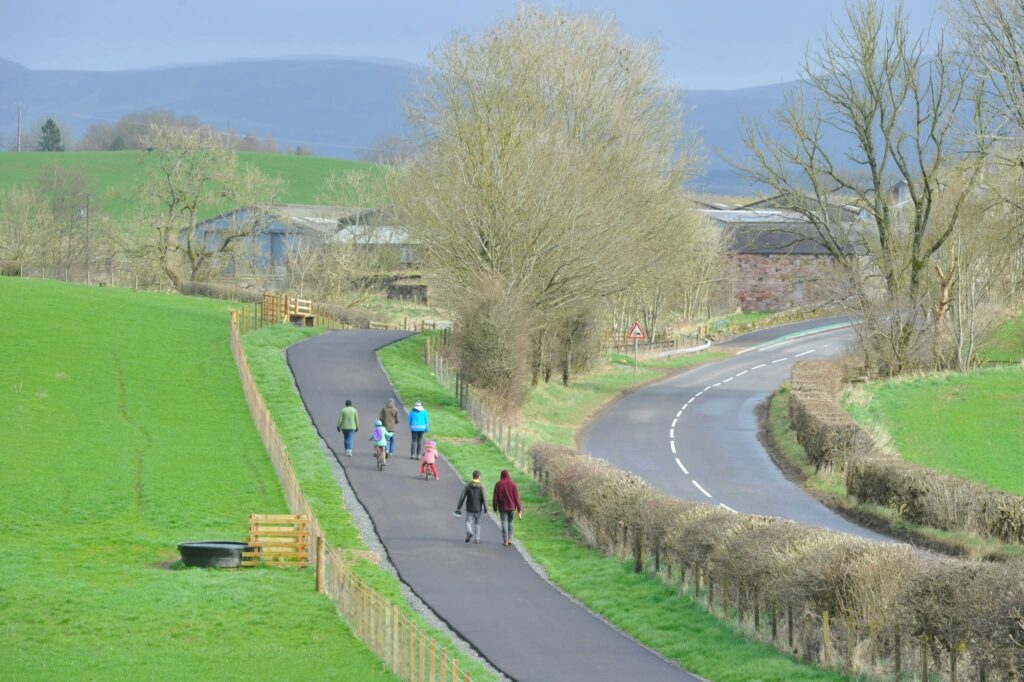
Creating attractive environments for cycling is high on PHE's list of five steps local areas should take to support change.
The organisation has looked at what works to keep people active in other countries. The variation in activity levels across is striking:

International comparison of physical inactivity
It's no coincidence that the two countries with the best activity levels also have high rates of cycling, facilitated by cycling-friendly infrastructure.
Everybody active, every day recognises this, taking what PHE terms an evidence-based approach, that is, making recommendations on what has been shown to work elsewhere. That includes making it easier to walk and cycle as everyday transport.
The report says:
Pedestrians, cyclists, and users of other modes of transport that involve physical activity need the highest priority when developing or maintaining streets and roads. This can mean re-allocation of road space to support walking and cycling; restricting motor vehicle access; introducing road-user charging and traffic-calming schemes; and creating create safe routes to schools.
Such changes have prompted substantial shifts from car transport to walking and cycling.
Increasing active travel will require inout and cooperation from many areas. One group NHE identifies as key are transport planners whose training it recommends should be reviewed "to ensure a consistently high standard of provision of walking and cycling infrastructure on the strategic and local road network".
Cycling charity CTC has expressed enthusiastic support for the PHE recommendations. Sam Jones, CTC's campaigns coordinator, said: “PHE’s latest framework reinforces what CTC has long campaigned for: joined up thinking on cycling provision and encouragement, across both national and local government, is absolutely crucial for getting people of all ages, backgrounds and abilities cycling.
“With health costs rising due to increasingly sedentary life styles, getting more people cycling is an easy win. If we increased cycling to German levels by 2025, as recommended by the Get Britain Cycling report, CTC led research calculates the NHS could benefit by £6bn annually. PHE recognises these benefits – and it is our hope that the Chancellor will too and make funding for cycling part of his Autumn Statement on December 3.”
The two parts of the report can be downloaded from Public Health England.








13 thoughts on “Get people cycling for better health, says Public Health England”
This is great news….but then
This is great news….but then as per my latest debate with my colleagues in the office ( a bunch of decent educated people aged 30-60 years old) the average cyclist consistently does the following:
1) Passes with red lights
2) Uses the mobile phone while riding (~#!~!!)
3) Doesn’t respect speed limits
4) Squeeze in between cars slowing down traffic
5) It is a cost for the society because when a cyclist gets involved in an accident (which is obviously always their fault) NHS has to spend money.
The most shocking bit was that although everybody recognised that using the phone where driving or cycling is not acceptable, equally everybody strongly believed that doing it while cycling is soooooo much more dangerous for other road users!!!
I felt there is no hope, and wondered whether all the cycling related charities (which are doing a great job) should retune the overall message to capture the non cycling community in order to educate people so the rubbish unsubstantiated arguments like the ones listed above are erased by people mind forever!!!
Apart from number 4 is that
Apart from number 4 is that not what large numbers of car users do? As for number 4, on my ride to work this morning I was held up at two consecutive junctions by cars waiting to turn right despite the fact that at both spots there are signs indicating no turning right between certain hours (morning and afternoon).
Well, I assume they are aware
Well, I assume they are aware that if they gave cycling a try, they wouldn’t personally have to do any of those things?
And they missed “weaving”.
Riccardo_M wrote:
3) Doesn’t
Really? Never heard that levelled at cyclists. I suppose a decent cyclist can easily break a 20 mph speed limit. But we aren’t required to have a speedometer, and it isn’t an offence. And most cars break speed limits.
Riccardo_M wrote:
5) It is a
Recent study in Copenhagen concluded that cyclists benefit society by 21p per mile ridden (converted from DKK/km), and cars cost society 12p per mile driven.
Sadly, when people want to be
Sadly, when people want to be ignorant, they will be.
I can’t think of any reason why so many apparently intelligent people appear to believe so much ill-informed anti-cycliing propaganda… quite what people are so scared about I can’t quite imagine.
Bingo!
Bingo!
Just a “crazy
Just a “crazy idea”..
‘Department of Energy & Climate Change’, chip in since getting everyone on bikes will save energy and help with climate change and CO2 emissions targets.
‘Department for Environment Food & Rural Affairs’, chip in for a cleaner environment.
‘Department for Education’, chip in since you will get happier children at schools like in Denmark and Netherlands.
‘Department for Culture Media & Sport’, chip in since everyone on bike must definitively be good for sports.
‘Department of Health’, chip in for the obvious reasons shown here. ‘Department of Transport’… well, you can’t expect everybody else to pay for what it should be mainly your job no? Chip in big.
Maybe not so crazy idea. Get people on bikes an everyone wins. How can a minimum of £10 per person be so difficult to achieve then??
I assume that those are just
I assume that those are just the savings to the NHS from the effects of a sedentary life style. On top of that are the saving to the NHS from not having to treat so many car crash victims which is not inconsiderable. And since most car accidents are within 5 miles of home, those are journeys that are eminently replacable by cycling.
As depressing as it is
As depressing as it is dealing with ignorance Riccardo, you’ll break down their prejudices over time. If I had a penny for every time I’ve heard every one of those trotted out…..
Anyway, gentle reminders of the money you save commuting, save on gym membership, how you miraculously avoid all those bouts of flu and colds that ravage the office etc all tend to win them over after a period
People will always look for
People will always look for excuses for their laziness. The “bikes sneaking between cars slowing up traffic”‘is a classic. Why is there traffic in the first place? I think you should have brought up the “cars spewing absolutely disgusting fumes all over the place” because that is starting to annoy me more with every passing week. I’ve got an EV now partly due to realising how foul diesels are from the saddle (and it’s awesome). We need to change. Sure there are lots of reasons why we need ICE transportation for goods and long journeys but people need a mindset shift away from “speeding around in cars is the norm and anything that even slightly inconveniences that is against the natural order”
Not surprised but genuinely
Not surprised but genuinely stunned. I always thought the U.S. was the world’s recognised slob nation and having visited a few times I’ve seen the kind of sizes people reach but we’re far worse.
What annoys me intensely is David Cameron’s rant about the bill from the E.U. and that was a piffling 1.7 billion euros. The nation faces a bill of nearly 8 billion and that gets yet another useless poster campaign?
No leadership, coupled with crack cocaine levels of car addiction means the nation really is screwed. Blind leading the blind doesn’t even begin to describe the mass cock up of the nation’s health.
Heard an advert on the radio
Heard an advert on the radio that the government is cutting the cost of a provisional driving licence “to help out with the cost of driving for young people”. Give. Me. Strength.
This government doesn’t know its arse from its elbow when it comes to joined up policy.