


- This topic has 60 replies, 35 voices, and was last updated 4 years, 8 months ago by
Surreyrider.
-
CreatorTopic
-
December 16, 2021 at 5:27 pm #31893
 steve@mycrocamuk.co.uk
Hi All
My name is Steve from Techalogic safety cameras.. we focus on road safety cameras for motorcyclists, horse riders and of course CYCLISTS. Camera tech is our passion.
I am keen cyclist myself and have set myself a goal in 2022 to develop the perfect front and rear cameras for cycling. Its probably even more important to have a camera on your bike than in your car in my opinion. There are very few dedicated cycling cameras.
This really is a blank sheet of paper and the goal is to design, build and launch the prefect camera for cyclists needs.. So I thought that Roadcc forum members would be the best place to get some great ideas on what features and benefits cyclists really need..
I don’t want to lead in with questions but would really appreciate it if you can feedback your ideas on the design, look and feel, mountings and all the features (like battery life, stability, Video Quality) that is important to you..
We would really appreciate you help and when the camera is launched will make a great half price offer for all Roadcc forum members that helped with the development.
Kind Regards
Steve
-
CreatorTopic
-
AuthorReplies
-
Here are my main points:
Here are my main points:
* Battery life – 5-plus hours (including for light if rear camera included) in all temperatures
* Preferably able to change batteries – ie removable
* Good, secure mounts that don’t interfere with riding – some rub on legs
* Small and lightweight – made from decent materials
* Good image quality able to pick up registration plates clearly in (nearly) all situations/conditions
* Reliable – so waterproof and drop proof (probably too much to ask to be crash proof)
* Charges quickly
* Companion app easy to use
* Simple way of uploading footage
* Buttons that are easy to use with winter gloves
* Some sort of way to automatically record – ie crash mode and maybe close pass – so that footage is easy to find
* Doesn’t cost the earth – some front and rear systems cost an arm and a leg – so I’m thinking sensibly priced as all these requests don’t come cheap
Achieve all (or most being truthful) of those and I’ll buy without hesitation
HoarseMann
Sriracha wrote:
Sriracha wrote:However the same approach could be used to improve the video – effectively it is passive OIS.I’ve been mulling over the passive stabilisation idea. I think you could be onto something here. I’m a bit sceptical about damped phone mounts, as the phone/camera is quite light and you do need a bit of mass in your sprung object. So I got onto thinking about passive gimbals like this…
The downside to these is the extra weight added to a camera system. But what if you designed your camera to be shaped like a passive gimbal, with the heavy batteries low down and the lighter camera up top, the mounting point providing the articulation? It’s a bit of a wacky idea and might not work too well on a platform that’s moving a lot. It could just end up flapping all over the place, but maybe worth a look.
Spot on. Your example 1 is
Spot on. Your example 1 is digital stabilisation. Example 2 optical stabilistation.
Optical can be done by moving just the lens/sensor (better for small amplitude and fast vibrations, as the lens has low mass/inertia so can react fast), and/or by moving the entire camera on a gimbal (better for larger amplitude and slower movements).
OIS can remove vibration blur from a longer exposure. The problem is when the object you wish to image is also moving, you need an exposure time that is short enough to capture that moving object without blur too.
Some testing is needed, but it’s possible that an exposure time short enough to capture a car numberplate passing at 60mph without blur, is fast enough to deal with any vibration blur from mounting directly to a bike. With active illumination at night, my hunch is OIS will not be needed to get a clear image.
Sriracha
Maybe we are talking about
Maybe we are talking about two different degrees of image stabilisation:1) “anti-vomit”; stabilising the horizon, smoothing out the general sway and tilt of the camera (ie low frequency, high amplitude), can be done in software but crops the frame edges. Generally this is what is meant by video image stabilisation.
2) “anti-blur”; still-image stabilisation, counteracting movement of the camera during the frame capture (shutter open time), so that the individual frame is sharp. This can’t be done in software, the movement has to be physically counteracted by moving either or both the lens and sensor – or minimised by using a shorter shutter time (needs a bigger aperture and/or more sensitive sensor). Shutter speed is also the only way to contend with subject (as opposed to camera) movement blur.
The second is the important one if you want to read a number plate. The individual frame has to be sharp, regardless of any nauseous movement between frames. Active OIS obviously eats battery. It’s also a potential weakness in the face of heavy vibration.
Quadlock have made a vibration damping phone mount for motorcycles. There is some discussion on their site about reported vulnerability of phones’ OIS mechanisms when subjected to vibration on motorcycles, and their aim is to protect the OIS (rather than to enable clearer video). However the same approach could be used to improve the video – effectively it is passive OIS.
@siracha Yes, you could embed
@siracha Yes, you could embed the accelerometer data in the video file to enable post-processing digital image stabilisation. Capturing this data is very low power and an accelerometer/gyro would be running anyway to do the crash detection function. This approach would also retain the entire captured image data from the sensor.
I think a shock absorbing mount is a good idea. But if your
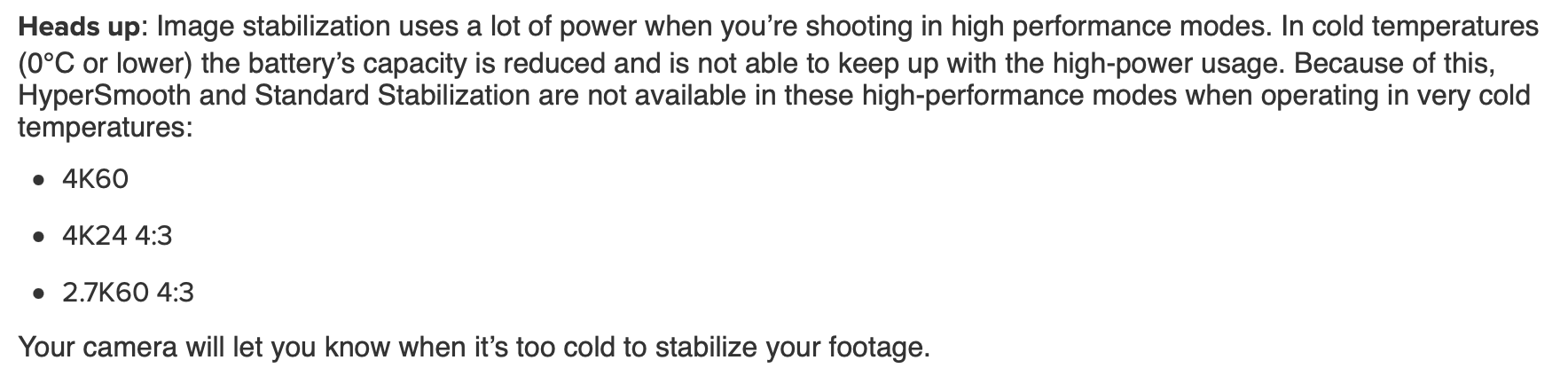
frame rateexposure is fast enough and you are using a global shutter image sensor, then it should not be needed for clear imaging – just to make viewing less vomit inducing!lonpfrb I’ve not done any testing, but image stabilisation does consume quite a lot of power. So much so, that GoPro’s won’t do it when the battery is cold! The only benefit of digital stabilisation is to make the footage nicer to watch. For a camera that’s focused on evidence capture, that is a lower priority.
Presumably if the
Presumably if the accelerometer data is recorded then digital image stabilisation could be carried out in post processing just as effectively. Which is to say that it still won’t be able to fix subject movement, which can only be ameliorated by shorter shutter times.Also, I don’t see any effort to design the camera mount to damp vibrations before they can impact the image.
Oldfatgit
Image quality by frame rate.
Image quality by frame rate.While 60fps gives a better quality image, it leads to significantly longer processing times.
This might not be an issue of you are adding telemetry to a 5 minute clip, but when you are adding it to a 2 hour ride it becomes quite serious.My i7 laptop, using Dashware, will normally take around 3 hours to add telemetry to a 2 hour 30fps video.
As an experiment, I’ve changed from 30fps to 60fps and it took over 15 hours to add the telemetry on a 2 hour recording.I would suggest a user selectable variable frame rate (30 / 60 fps) to accommodate different end video usage.
lonpfrb
HoarseMann wrote:
HoarseMann wrote:This takes quite a bit of power consumption to do on the device. The reduction in image data and battery life is not worth it to me.
Please let us know what difference in image data and battery life you got, with or without digital stability, on which device?That would be a great help…
Back again with a thought on
Back again with a thought on image stabilisation: don’t bother with it.
Only optical image stabilisation is capable of improving the clarity of the image, but it requires moving parts and is quite complicated to implement in a way that will survive the vibrations when mounted to a bicycle.
Digital stabilisation that uses an accelerometer to compensate for motion, is done to make the footage more pleasant to watch. It does this by using a wide angle lens, but then throwing away imaging data in the extremities in order to smooth out motion. This takes quite a bit of power consumption to do on the device. The reduction in image data and battery life is not worth it to me.
XQJ-37
Hello Steve and forum members
Hello Steve and forum members.
I have been using your DC-1 camera for over a year now and I am generally very pleased with it. I submitted a sample of my experience of a bad driver to you which is up on your YouTube page (https://www.youtube.com/watch?v=6UJk1sirRww). The view of the car’s number plate was quite visible in many of the frames and my own file is less compressed that the YouTube footage so a bit better still. My memory is that the light level of the footage is brighter than the light level as perceived by my eyes!
What I really like about the camera is that I have two cameras but only 1 battery/charging point, one on/off switch and one memory card. This is the kind of convenience I’d like to see in a bike mounted two camera setup as the thing I don’t really enjoy about the DC-1 is that I have to wear it on my head. If my camera was split into two parts with the front lens, battery, controls and mem card mounted to my bars, then a single wire going to the little rear camera attached to my rack or seatpost, that would be great.
The other thing I’d like to see is a way to change settings via my PC rather than a phone app. I have a smartphone, but I am very wary of the apps that I install on it due to privacy concerns. I did look at the VF Cam app that is used with the DC-1 but found that it came with a bundle of Facebook trackers that I am uncomfortable with. I know that puts me out of step with most of humanity but I don’t have a FB account, I haven’t ticked the box to accept their terms and conditions, and I don’t see why they should be able to track my location, contacts, media files etc, etc. This is not a problem for the most part as I can download and view my files on my PC and I was able to position my camera with a little trial and error by the same method. It would be nice to be able to view the settings though, and I guess that my time-stamp is only correct for 6 months of the year.
Anyway, I like the camera, appreciate the cutomer service response time (my experience is counted in minutes rather then days/weeks!) and would buy again from you.
Best wishes.
Back here with an imaging
Back here with an imaging sensor suggestion:
This looks to be perfect for a bicycle camera:
– Global Shutter: no wibbly, wobbly, jellyvision artefacts
– B&W, supports IR at 850 & 940nm, with strobe sync: crisp licence plate capture in the dark with active infrared led illumination.Available as a board camera for RaspberryPi, useful for prototyping.
dabba
Waterproof; image
Waterproof; image stabilisation; at least 1080p quality image @ 60 fps; day and night capability; 2 hour battery life with ability to connect external battery via USB; small size (about matchbox size) and no screen; handle large capacity micro SD cards; user determines file size and looping or not; not a GoPro; use standard mounting fittings that can be purchased at reasonable prices from any photographic equipment supplier.
I am currently using this https://m.youtube.com/watch?v=uooaSBe7sxc Its only deficiency for me is that it’s not waterproof. Price is right. Images could be slightly improved but still quite good.
hawkinspeter wrote:
hawkinspeter wrote:It’s a shame that Cycliq seem happy to just push out incremental changes with their products and not be a bit more innovative. Their cameras do seem to be the best for cyclists but they’ve got faults too.
Yes, agreed. Innovation is expensive so to be applauded from a small company like Cycliq. Garmin, a huge company, has abandoned quite recent products as soon as a successor is released. So Edge 1000 is abandoned due to 1030. Not what you expect from the top end device..The more value add by software, the more we slide towards the smartphone 18 month innovation / obsolescence cycle. Sustainable it is not, though Right to Repair is slowly getting some traction..
ooblyboo
I have to carry four
I have to carry four batteries around for my current (admittedly cheap) camera because none lasts more than an hour before running empty. It’s affixed to the bike and is very bulky. As a result of the bulk (and I am slightly ashamed to admit this), I don’t use it on the summer bike or TT bikes. Decent image clarity, good battery life, and a compact/aero design all key for me. I’m sure that’s really easy to achieve! andystow
Yes, if there was the option
Yes, if there was the option to wire it into my dyno hub and still have it weatherproof, I’d be sold!
-
AuthorReplies
- You must be logged in to reply to this topic.