



Cycling and innovation? They go hand in hand (until the UCI interjects, of course)… but some slip through the restrictive net of cycling’s world governing body, like deep-rim carbon wheels, electronic shifters and teardrop-style time trial helmets.
A lot of these innovations are created to make you go faster with a whacking great smirk on your face, or simply make the rider more comfortable. Some very much don’t, however, even though they may have had potential. Here, we chart a sextet of cycling inventions that sadly never took off…
The plastic bicycle

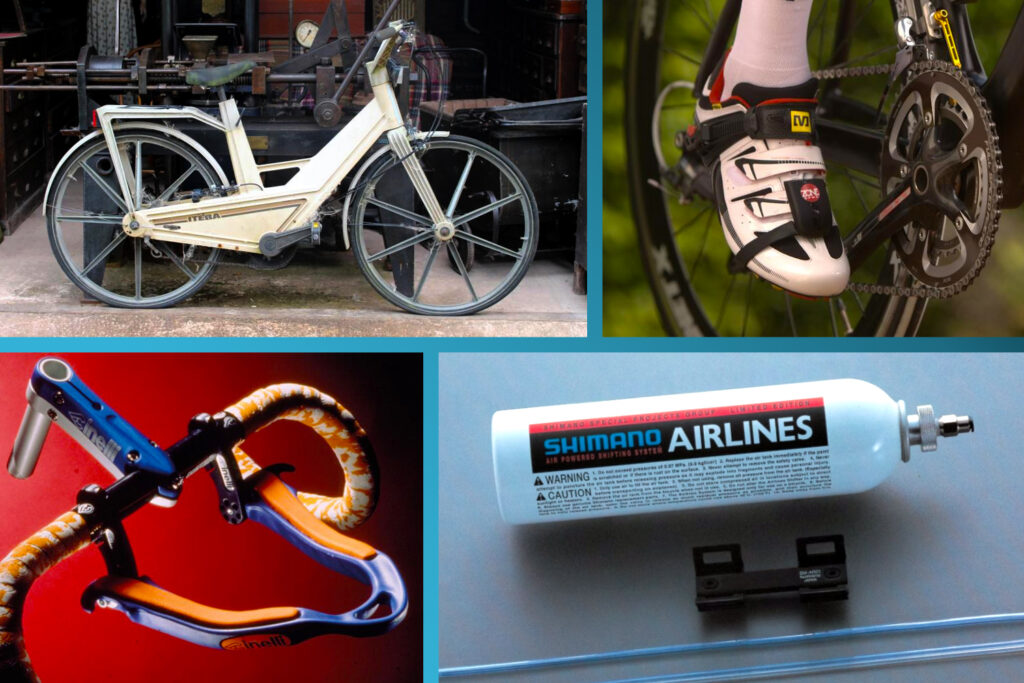
This is the stuff of dreams for petrochemical king and Ineos Grenadiers owner Sir Jim Ratcliffe: a bike made entirely of plastic, including the chain and hubs. The idea for a plastic bike was originally conceived by cycling enthusiasts Charles Cadorette and Joseph Dorrity, who founded the prosaically titled company “Original Plastic Bike Inc” in 1971.
Did it take off? Nope… in fact, we dug deeper than we’d rather admit into the research but questions arose over whether the bike ever existed, with some suspecting it was an investment scam. They did, however, produce a catalogue, featuring the aforementioned and rather hyperbolic advert:
“Some of the things we do to our bikes would kill you.
“We would venture a wild guess that if you were shot with a 45-calibre bullet at 25 paces the result would be quite damaging. Unless you were an Original Plastic Bike, of course. Little things like bullets don’t bother it much.
“And if we were to drive 11,000lbs of weight over you, beat you brutally with sledgehammers, pour sulphuric acid all over you and submerge you in salt water for a few months, to say the least, it would probably hurt you. Sometimes it just pays to be a plastic bicycle.
“Our bike will withstand temperatures of 30° below 0 up to 500°F, which is probably more than any human being can withstand.
“But there is one thing you can be thankful for as a human being. You won’t ever have to go through the torture we out our plastic bike through.”
About as subtle as being ridden over by a plastic bike…

Still, the idea didn’t die. Production started on Sweden’s Itera Plastic Bicycle in 1982, after more than 100,000 Swedes showed interest in purchasing one. Unfortunately for Itera, that interest didn’t manifest in sales and, after a sluggish start, assembly issues and media disinterest, production ended in 1985.
Reportedly, 30,000 Itera plastic bikes were produced with leftover stock shipped to the Caribbean, where rust was a problem for metallic bikes.
The Castelli Thermosuit

Okay, so the inclusion of this garment may be quite harsh as cycling apparel specialist Castelli still sells the Thermosuit; but we’d encourage the Italian brand to take it as a compliment towards the success of its other products. The latest incarnation of the Thermosuit is the SanRemo RS, currently €209.97 down from €349.95, which is arguably quite telling with regards to how popular it is (or isn’t).
On paper the Thermosuit certainly has merits, combining two of Castelli’s best-performing products, the Perfetto RoS Long Sleeve with the Sorpasso RoS Bib Tight. That combination aimed to add comfort while (and this is the big sell) doing away with any cooling drafts that might penetrate your midriff.
The idea’s sound enough and road.cc reviews have always been mostly positive, scoring an 8/10 in 2013 and in 2016, with our reviewer of the latter concluding that the Sanremo 2 Thermosuit was “a comfortable, aerodynamic take on combining winter tights and a jersey into a single bit of kit”.

So, why hasn’t this one-piece wonder become a winter wardrobe staple for cyclists? Well, some feedback suggests that its cold-beating attributes are simply too strong. A cycling onesie simply lacks the vents and breathability that you might need on hard efforts during the coldest of rides; although, that might not be an issue for riders who feel the cold more. If that’s you, it might still be a well-spent couple of hundred euros. Feel free to maul us in the comments if you still swear by yours…
Shimano Airlines

Nope, that wasn’t the world’s biggest manufacturer of bicycle components having a stab at planes (though they do sell a lot of fishing reels)… Airlines was Shimano’s bright idea to bring pneumatic shifting to cycling. Who needs cabled actuation when you can arm your bike with a jetpack in something that wouldn’t look out of place in Wacky Races, mused a (probably now ex-)Shimano engineer in the late 1990s.

The idea arose from the downhill discipline of mountain biking, which was booming in the latter half of the ’90s. With time of the essence, swift shifting was seen as the difference between victory and defeat. And what quicker vessel for delivering lightning-fast shifts than a canister of compressed gas attached to your frame, either on the top tube or downtube?
> 8 bygone bike technologies we’re now well rid of
Apparently, each shift sounded like a gun going off. And you really didn’t want to face an undulating parcours, as the canister was good for around 400 gear changes before needing a refill via some hardcore pump action.

It’s now a bit of a collectable, partly because of that unique shifting sound, and we even found one on eBay, complete with Team Edition Rapid Fire Shifter, for the princely sum of £2,214.66 at the time of writing.
Shimano obviously learnt from its failures, and in 2009 brought the first full groupset with electronic shifting to the world, the hugely successful Di2 system. Now instead of an almighty ‘popping’ to greet every shift, you’re soothed by a reassuring ‘whirrrr’…
Shoe-based power meters

German Ulrich Schoberer created the world’s first cycling power meter back in 1986. The SRM – Schoberer Rad Messtechnik – set the gold standard for accuracy, measuring a rider’s wattage at the crankset and transmitting the results to the handlebar display via ANT+.
> Bike tech fails: Where cycling products go to die
To this day, SRM is regarded as arguably the most accurate power meter on the market. But it now faces credible, and often more affordable, competition from the likes of Favero (Assioma) and 4iii (Precision 3), which measure power output at the pedals and crank arm, respectively.

But not from the now defunct Dublin cycling tech company Brim Brothers, whose ingenious cleat-based power meter looked destined for big things. The system was designed to work with an adapted version of Speedplay cleats. Sensors nestled within those cleats measured the force between your shoe and the pedal, and your wattage was calculated from that.
The ability to effortlessly enjoy power data on whatever bike you saw fit to ride looked great on paper. So much so that in 2016 the Brim Brothers secured €183,133 on the crowdfunding platform Kickstarter, smashing through their €100,000 goal. But that transpired to be the last throw of the fiscal dice for a company that had intended to bring the product to market in 2012.
Soon after that Kickstarter appeal, the Brim Brothers announced they’d ceased operations. “We have run out of time and money,” said the company’s CEO Barry Redmond in a statement on the company’s website.
“The difficulties we have had with production quantities, together with variable accuracy of the finished units when in use, mean that we are unable to deliver and we don’t have the resources to continue… What this means for you as a customer is that we can’t deliver your power meter, and we can’t provide a refund.”
Mr Redmond also gave us some further insight into what went wrong for our feature on the best, worst and wackiest cycling crowdfunders a couple of years ago, which also features the long-defunct STYX cleat-based power meter. Both sets of inventors promised a lot and the tech seemed sound, but we’re still yet to see a successful power meter in, on or under a cycling shoe at the time of writing, save for power meter pedals.
Cinelli Spinaci bars

Cinelli was established in 1947 by Cino Cinelli, whose formidable palmares included victory in the 1943 running of Milan-San Remo. His company Cinelli soon forged a reputation for its innovative bikes and sleek, avant-garde designs. It also became a highly desirable brand in the world of fixed gear riding, and was omnipresent at the cooler than cool Red Hook Crit series, which burned brightly for a decade from 2008 until its closure at the end of 2018.
But for many, Cinelli’s finest hour came in 1993 with the introduction of the Cinelli Spinaci handlebar extensions. Just four years earlier, Greg LeMond gave time trial bars the greatest PR exercise in cycling history as he overcame a 50-second deficit to beat Laurent Fignon to Tour victory, with the Frenchman losing out by riding the final stage atop traditional drops. Now, Cinelli had invented attachments that were shorter and wider than the like used by LeMond, as the idea was they’d be used in road stages, not just time trials.
Their novel design saw them clamp just inside a rider’s bar tape before curving back sharply to the centre line just in front of the handlebar and at around a 45° upward angle. They’d offer an aerodynamic advantage, said Cinelli, without requiring the long and rather extreme set-up of a TT bike.
It amazes me that they banned Cinelli Spinaci bars years ago yet they don’t DQ riders for riding like this, surely the clip on bars are safer pic.twitter.com/EVG8ycI2dn
— Rick Lister (@rick_lister) June 26, 2018
The problems arose from any streamlined advantage being eclipsed by a loss of bike handling – not ideal when racing shoulder-to-shoulder with 100-plus elite cyclists, many of whom were riding faster than ever due to EPO, steroids and blood bags. The UCI banned them four years after their creation in 1997, but the bars still have plenty of devotees and can fetch decent prices on eBay. Some cycling fans even advocated their reintroduction when pro roadies started adopting the ‘puppy paws’ position, essentially riding like you would with Spinaci bars, but without any bar actually there. Fear not, though… the UCI banned that as well in 2021.
Magnetic water bottles and cages

There you are, riding along, the wind rushing through your hair (if you’re lucky to have any) and a smile forming over your chiselled cheeks. “This is the life,” you think. “What a ride. Mind you, I’m a little bit thirsty. My Garmin’s just reminded me to drink, albeit so has my parched mouth. I’ll just ease the bottle out if its cage and doff a squirt or two of electrolytes.” Cue a dangerous wrestling match with your antiquated bottle cage that nearly sees you hit a car, the tarmac and a hospital ward. “There must be a better way,” you muse…
Well, there is: the magnetic bottle cage. This nifty invention still sees the base clamped to your bike via the bottle braze-ons, but does away with the cradling cage part; instead, it secures your drinking vessel via magnets. The bottle is specific to the base and is marketed as being particularly useful for smaller geometries. The problem is, insufficient magnetic strength on some models has never seen them truly take off and replace the humble bolt. Although some have taken off down the lane as you ride on to find your bottle has gone missing, so we’ve heard.

Then again, Fidlock is currently making a good stab of it and is a success story in the otherwise uncrowded magnetic cycling bottle market. Its TWIST design works in similar fashion to releasing your foot from your clipless pedals, a sharp ‘twist’ releasing the bottle for ease of use. It’s reportedly impressively secure, and there’s also a toolbox version, with both the bottle and toolbox receiving average-to-good road.cc reviews. Maybe Fidlock will finally take the magnetic bottle cage to the mass market. Watch this hydrating space…
What other cycling tech ideas that never took off deserve to make our list? Let us know in the comments and they might make the next update.









30 thoughts on “Cycling tech innovations that never took off: Bright ideas consigned to the cycling scrapheap, from Spinaci bars to shoe-based power meters”
I knew a girl in Cambridge in
I knew a girl in Cambridge in the late 80s who had an Itera, not sure where she got it from, was it ever sold in the UK? I remember having a go on it, quite probably the worst bike I’ve ever ridden, the flex was truly alarming and made you feel as if it was going to snap with every pedal stroke.
Rare find! Still, “carbon
Rare find! Still, “carbon frame”… or perhaps more like “tupperware”? Guess it would do nicely for keeping the mid-ride snacks in though?
I saw one of the plastic
I saw one of the plastic bikes at a show in the 80s. Ugly and heavy were my thoughts as a teenager. There is one in the Manchester Velodrome.
Just in case Itera spotting
Just in case Itera spotting becomes a thing. There is, or was, one hanging up in the Mud Dock cafe in Bristol, which is above a bike shop. You can just about see it in this picture.
Here is one for the brave not
Here is one for the brave not fearing to ride a 40 year old plastic bike
https://www.ebay.com/itm/133844739581?hash=item1f29c4a5fd:g:QUYAAOSwdd5hAunH&amdata=enc%3AAQAIAAAAwP5TEL1%2BX4HURPC475HXaKmUMtgkJQEWQfL7xKc%2F4auS3CCn%2FQvi2iYWVRIwSH6yeA3nxeSkBUK6R5WtRb4%2F0ZIs5JiEEMqueJ4lRqy4HLvvZ0S2L2gObhNNEAxg%2FVz8wJ1M0FyaS5p8mVie6kCbA0G2oTUmyWHTCwVGoJIwtF1YDp6znQUqyqkHPQYVSSdvHKk0zxrV31%2BHNNN%2BkDmhNhBR08XAXJtGgnW%2FAYKylPDAXOaQwOJ2iQWpunFqQih%2BGw%3D%3D%7Ctkp%3ABk9SR4i-p-qQYw
Something else missing…the
Something else missing…the Kirk magnesium bike. They were pretty awful too.
Had to google this too. A bit
Had to google this too. A bit awful in the eye indeed, but it could be astonishing easily made since it was casted. It could potentially be a nice solution for cheap bikes, if corroding could be tackled.
Question is – Itera, or
Question is – Itera, or Sinclair C5? (The latter now that the fabled feeble motors have expired – definitely cheating to replace with a modern version, or a
rocket motorjet engine!)When I was an apprentice in
When I was an apprentice in the 80s I remember the storeman getting one for his long service gift. I don’t think he ever rode it just kept it in his house ?
Nice article James but I’ve
Nice article James but I’ve checked through twice and I’m still not seeing the L-shaped cranks?
Spinacci could still have a
Spinacci could still have a home for ultras & gravel racers.
The SanRemo RoS Thermosuit is actually £370, with very limited stock at the Castelli website. So, still some love for it in the right conditions, for those in the know.
Mine still comes out on days just above freezing (15°C would seem much to high). With full front zip, there’s plenty of ventilation on hills.
Fidlock works great, even on
Fidlock works great, even on gravel rides. I use their universal bottle holder to carry my Thermos, which is a bit heavier than they recommend, to work, and the uni base is on the stem of my Brompton, which has no bottle bosses.
Fidlock stuff is great.
Fidlock stuff is great.
Very unobtrusive when not in use and the bottles stay tidy for much longer too.
I used Spinach bars for maybe
I used Spinach bars for maybe one season in the mid-90s, not in competition, just riding around. They worked quite well as an aero aid, I think, but they did make the handlebars crowded and I didn’t miss them when I took them off.
It’s all too clear you weren
It’s all too clear you weren’t around (or interested in mountain biking) when Shimano introduced the Airliner system.
It was never intended to be the next big thing, or to replace the conventional setups. It was a very limited edition, and it was never intended to be mass produced. It was above all a proof of concept, a showcase of their technological know-how, and a boost for their image as an innovative leader in the market. And it was succesful in all those things.
It worked great, it got a huge amount of media coverage. It just fitted in with the wild stuff that was going on in that era.
I first time read it here,
I first time read it here, and it couldn’t be any more super 90s level cool.
cyclisto wrote:
Read more (lots more!) – here. Best cycling niche site on the internet.
Hope you didnt have any more work to do today. You’re welcome!
https://www.disraeligears.co.uk/site/shimano_airlines_derailleur_ar01.html
Wow hadn’t realized that so
Wow hadn’t realized that so many brands tried to enter the shifting market. It is a shame that nowadays most stores brings bicycles equiped with the most expensive options in shifting.
Not wanting to lose my
Not wanting to lose my evening to disraeligears, but my understanding was the hoses could take very tight curves that cables aren’t good with and are common on full sussers and downhillers are not often weight weenies.
Fadlock. Answering a question
Fadlock. Answering a question no-one asked, making every cyclist’s existing bottles useless. Genius
A number of MTBers swear by
A number of MTBers swear by them – especially as internal frame clearance means regular 500ml bottles and cages are unuseable, even on large frames. Especially if riding XC, bike parks or on shorter rides where a hydration pack is excessive or unneccesary. It actually makes sense when you look into the demands of its intended market.
Much like the recent Aston
Much like the recent Aston Martin tie up Volvo dealers sold the Itera alongside the slightly more practical 940 and 240. They were Volvo branded, occasionally pop up on eBay. I think Volvo provided investment funding for the venture.
I really wanted a Castelli
I really wanted a Castelli Thermosuit but wouldn’t pay full price for it and missed the boat. Same goes for the Sportful R&D gilet/jersey combo that was around a few years back.
Spinaci’s work well. Well the
Spinaci’s work well. Well the originals do. I bet that the only reason they didn’t become more popular is the UCI ban. I like mine and find them easier to use than full on tri bars on my commuter.
Did the plastic bike take off
Did the plastic bike take off? Er, carbon fibre — it’s the combination of carbon fibres in a plastic substrate that give ‘carbon fibre’ its unique properties.
lesterama wrote:
I think it’s the carbon fibres that have the useful properties and the plastic is just to keep them in place.
hawkinspeter wrote:
Yes, but you do really need both. Leave out the carbon fibres, and you’ll have a really fragile bicycle. Leave out the matrix and you’ll have a messy tangle of fibres joining two tyres with a loose chain and sprockets lying on top.
It is a composite material
It is a composite material like plywood, or steel-reinforced concrete. You get the benefits of both. Steel is good under tension and concrete is good under compression. Both materials are needed.
Bring back L-shaped cranks.
Bring back L-shaped cranks.
Quote:
That suggests the first version used ANT+ but of course they were wired. An important point I’m sure you will all agree.