


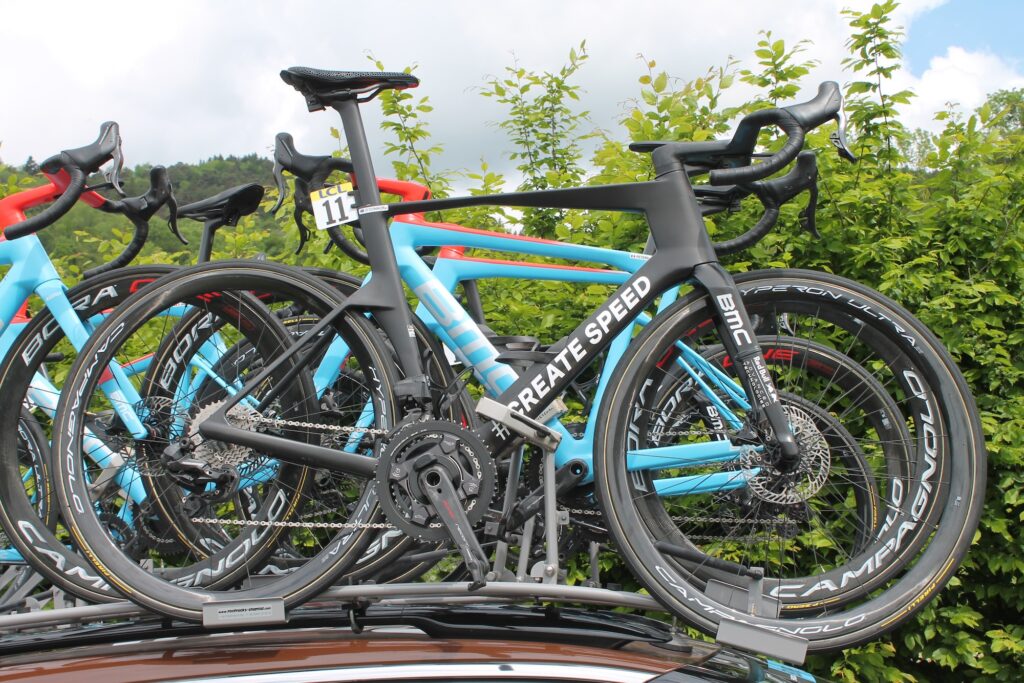

Part of the fun of watching big bike races like the Tour de France is to see the latest bikes and equipment that the pros are using. Occasionally you’ll be lucky enough to spot stuff that has yet to be released to the general public. So, can riders at the biggest races like the Tour de France on cycling’s World Tour actually use prototype bikes, and what are the rules here?
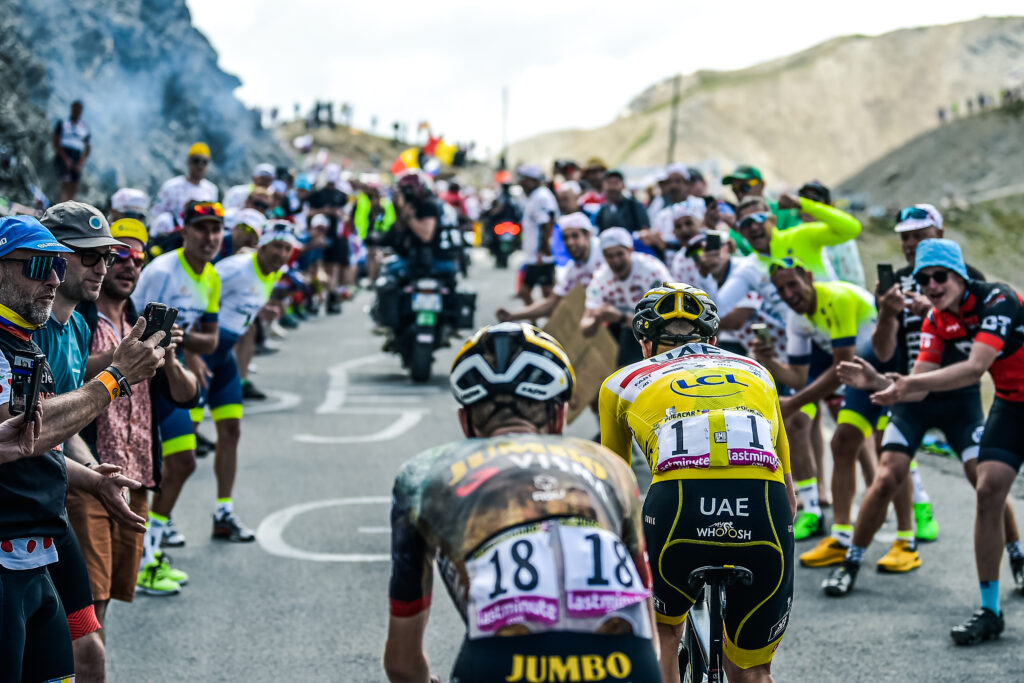
This isn’t the first time this season that we’ve seen new bikes being used, starting the year with riders from the EF Education-EasyPost men’s team being spotted riding a new road bike, the Cannondale SuperSix Evo 4.
Mathieu van der Poel has also been on an updated Canyon Aeroad all year, which he rode to victory at Paris-Roubaix.
More recently, AG2R Citroen, Lotto–Dstny and Cofidis were spotted on new bikes at the Critérium du Dauphiné, the main warm-up race for the world’s best before the Tour de France.
> 8 things we learnt at the Dauphiné 2023

Team Cofidis were on a Look which we first reported on back in January. This has been officially released in the past couple of weeks as the 795 Blade RS road bike, that’s been redesigned “to balance aerodynamics, stiffness and low weight.”
Next up, a new Ridley road bike ridden by Lotto–Dstny broke cover at Critérium du Dauphiné, which is also likely to be released in the next few weeks. The bike definitely looks as though it’s trying to combine aero and lightweight, as we’ve seen plenty of brands do in recent years. This is most likely to be Ridley’s new ‘do it all’ road racing bike.

Lastly, the release of the BMC prototype aero superbike spotted at Dauphine is also imminent, with our predictions being that it’s the latest generation Timemachine Road, an out-and-out aero bike in the Swiss brand’s range. There’s always the chance it’s an entirely new platform, but we’ll just have to wait and see on that.
Look’s bike has officially been launched but the Ridley and BMC are still prototypes, and not on the UCI’s public list of approved framesets.
The UCI ProSeries team Israel–Premier Tech rides bikes from Factor. Usually it’s the Ostro VAM, but a new O2 VAM has been spotted at this year’s Tour. We know that Factor is releasing a new bike on 10th July 2023, the first Tour de France rest day, so we’ll be keeping our eyes peeled.
Why do pro riders use unreleased bikes?
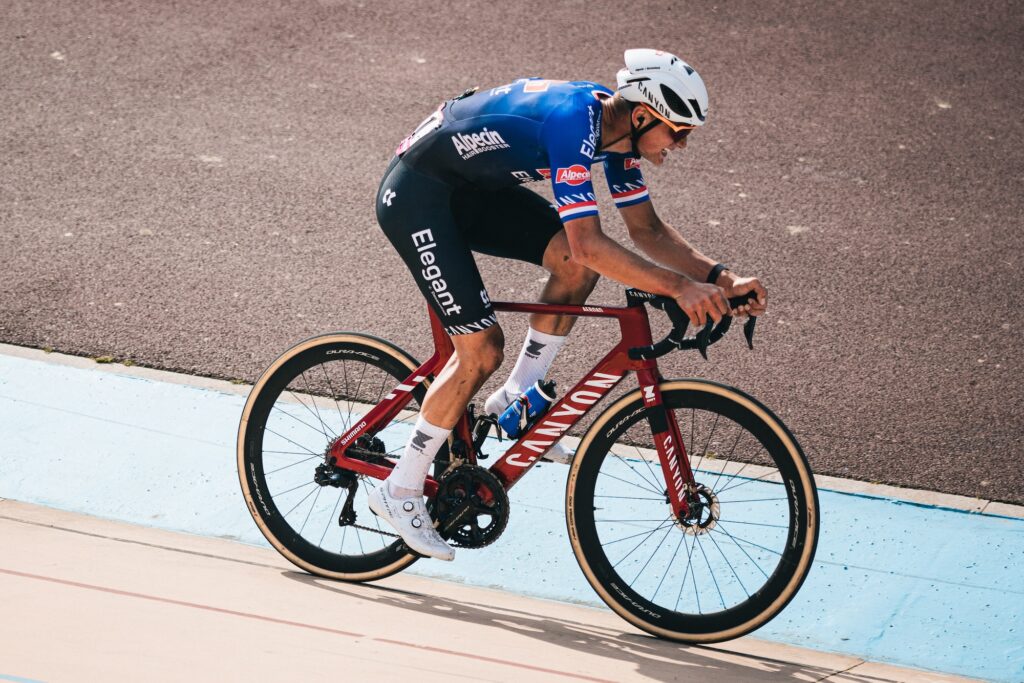
Never is the world’s cycling and general media more focused on bike racing than during the opening stages of the Tour de France. As a result, the brands that pay the riders to use their latest and greatest kit want it used.
Preferably, their star rider will use it to win, and then sing its praises to the waiting media; but why do we see riders on bikes that no one can buy yet, and is this allowed?
Professional teams have partnerships with bike manufacturers which allow them to ride unreleased bikes before they become available to the public. This serves multiple purposes: one being marketing and promotion, and also by riding unreleased bikes, teams generate excitement amongst cycling enthusiasts, generating publicity for when the bikes are eventually released.

Brands often tell us that they use feedback from the teams to help shape final products. We’re never quite sure how much of that is down to marketing, but the breadth and depth of feedback from different riders in WorldTour teams is going to be invaluable, because they are putting those bikes through a hell of a lot of abuse.
It does make sense, because the pros accumulate far greater mileage than you or I could in a shorter space of time, meaning the equipment tested undergoes a far greater level of stress more quickly. This, then, enables manufacturers to make necessary improvements before the bikes hit the market. But, you might be thinking, why would the pros want to use a bike that’s still in the development phase, in the biggest bike race in the world?
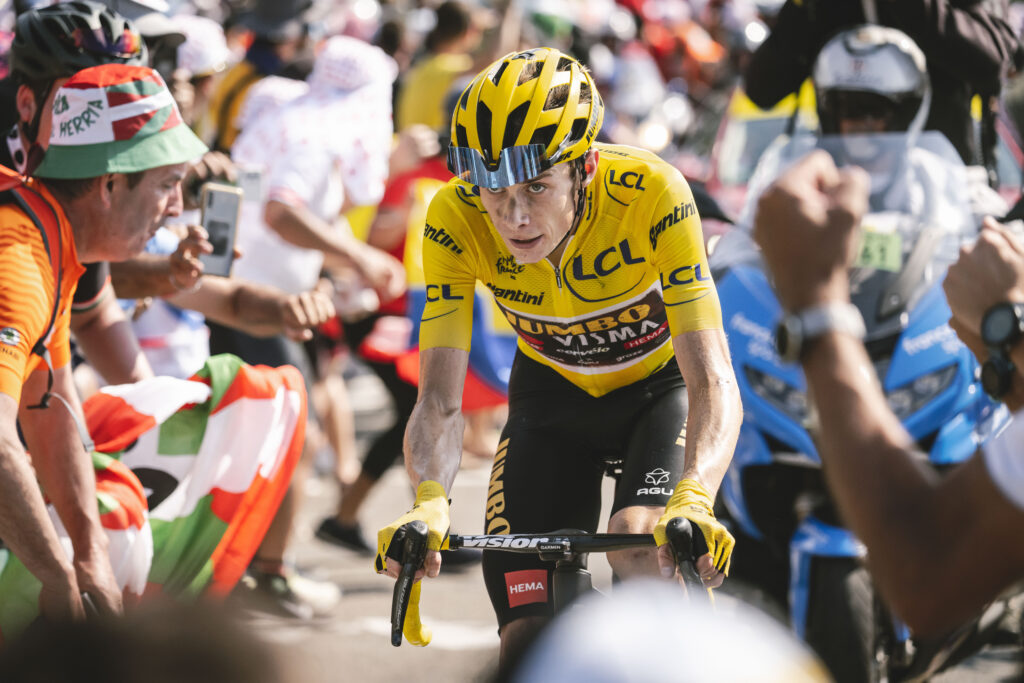
These bikes will have undergone thorough testing prior to the pros taking them to the world’s biggest stage, including a run out at the Critérium du Dauphiné.
Although high-profile technical issues do occur in big races, no brand wants to risk a product performing less than perfectly in the Tour de France. So you can be sure that there’s a lot of confidence in anything that has made it this far.
The advantage of riding unreleased equipment is that they feature the latest technological advancements, designs and lightweight materials, which can all contribute to a competitive edge over other teams.
Can prototypes be used in the Tour de France?

If you remember back to last year’s Tour, Pogačar and UAE Team Emirates were spotted on the Colnago Prototipo – the word Protipo is literally Italian for ‘prototype’. This was then officially launched as the Colnago V4Rs road bike in December 2022.
In short, yes, the pros can use prototype bikes and equipment at the Tour de France – but the UCI has introduced new rules and regulations in regards to equipment registration for this year’s Tour.
As with previous years, prototypes need to fall within all of the UCI’s usual rules. With wheels, for example, there are regulations on rim depths and spoke counts that need to be followed.

> UCI clamps down on narrow handlebars, pin-less number pockets and support car trickery
It’s a very detailed process, and brands have to give the UCI information about things like materials used and the manufacturing process. The UCI can then ask for plans, drawings and further information, and guarantees that everything provided during the approval procedure will remain confidential.
So, despite Look having to fill in a form earlier in the year to get permission for Team Cofidis to use its next-generation 795 Blade RS road bike, there’s nowhere that nosey journalists – or anyone else – can go to check out that material.
So, what actually are the rules?
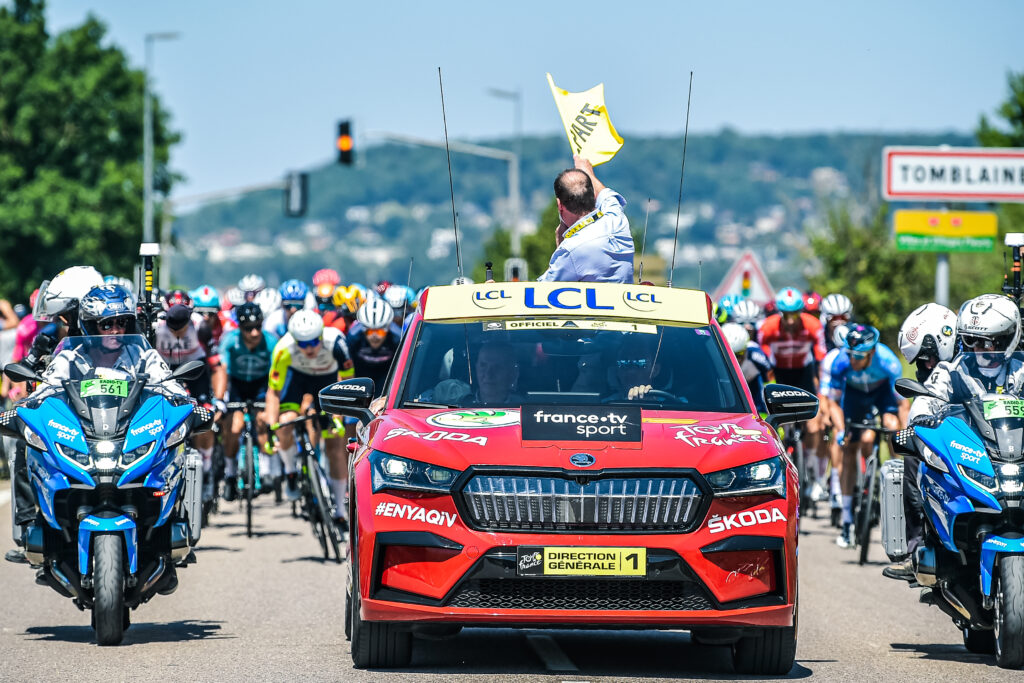
The UCI has always had strict rules ensuring that all bikes and components used in competition are available to the public. Article 1.3.006 states, “equipment shall be of a type that is sold for use by anyone practising cycling as a sport”.
> Get to grips with the new UCI rules
Cutting-edge bikes and equipment often make their debuts at the Tour de France, but the UCI has tightened the rules on the use of prototypes in competition. Interestingly, this rule won’t be enforced for other road events listed on the 2023 UCI calendar, and is only applicable at the Tour de France and Tour de France Femmes in 2023.
Framesets, wheels, handlebars, time trial bar extensions, clothing and helmets (standard and time trial helmets) must all have been registered prior to the start of each race – 2nd June for the Tour de France and 17th June for Tour de France Femmes – and must be made available to purchase no later than 12 months after their first use in competition.

> Check out Wout Van Aert’s super-fast Cervelo S5 aero road bike
To ensure the equipment used by the teams is the same as what they registered, all frames will have a tamper-proof tag using radio frequency identification (RFID) technology that will be scanned at random intervals during the Tour.
This new rule is aimed at promoting fair and equitable access to equipment in cycling events, and ensuring a level playing field for all competitors. Of course, there’s always going to be a bit of that, but the idea is that it’s kept within limits.
Luckily for us (or those that can afford to buy the very best bikes and gear that the pros use), we can be almost certain that anything we spot being used in the Tour de France will be released to the public sooner or later. Rules also prevent brands from making anything virtually inaccessible. Products must be available for delivery and “shall not unreasonably exceed the market value for equipment of a similar standard”, warn our pals at the UCI.
Have you spotted any other prototypes being used in this year’s Tour de France? Let us know in the comments section below…




















5 thoughts on “Can teams ride prototype bikes in the Tour de France? What are the rules around unreleased cycling tech in pro road racing?”
Quote:
I’ll be honest, that’s not part of the fun at all. “Ooh, look at that latest technology bike” is pretty much never in my mind when I’m enjoying bike racing. I enjoy watching humans at the limit of what it physiologically possible, using their strength and (sometimes) cunning to race each other.
The technology only comes to mind when it’s being pushed on us, by people keen to sell us stuff. I’d be quite happy if all that disappeared, and we had the Tour de France raced on spec steel bikes with friction shifters. Cause it’s _completely not_ about the tech for me.
I realise there’s a whole bunch of people in racing and the cycling industry around it who would be out work if the UCI required spec bikes. But… the racing’d be better for it.
I kind of agree, as much as I
I kind of agree, as much as I like seeing new technology come to the fore in races (even though I’m a fan of steel bikes more than any others), I don’t really want the race to be decided on who has the best technology/most money to spend on kit. And I especially don’t want it decided on there being an issue with one set of equipment vs another.
I don’t know how much of a difference in real terms it makes, would the winner of each tour for the last ten years have been the same if they’d been riding on a different team’s bike etc? As much as the brands would like you to think otherwise I’m pretty sure the answer is yes.
Difficult when it’s a sport that uses so much specific equipment vs almost any other. Runners get worked up about the shoes that people use, but imagine if they had 15 other bits of kit to deal with?
The one case that comes to
The one case that comes to mind is that Fignon would have 1 more tour win, and Lemond one less, if Lemond hadn’t had TT bars and aero helmet, OR if Fignon had had /either/ TT bars /or/ an aero helmet (just the helmet would almost certainly have made the difference; hell if he’d cut his pony tail that might have done it).
RobD wrote:
So do we go back to singlespeed bikes, baggy wool jerseys and tubs draped over the shoulders? Or every team rides the same groupset, wheels, tyres etc?
If it’s not the bikes themselves there is always inequality – altitude camps, clothing, paying big money to get the almost-best riders to be superdomestiques… it happened in the 80s and will continue. It’s the reality of competition.
For an idealist it’s not always easy to be comfortable with that but in the end it’s just some blokes (and of course women) pedalling around the countryside, trying to go faster than each other. Although it’s fascinating at times, I don’t give it too much importance.
You don’t have to go back.
You don’t have to go back. You can standardise on common, functional, mass produced, technology available today.
This would also make the sport more accessible. It’s daft that that the sport requires people to spend thousands and thousands to be competitive (particularly in TTs), for a sport that should be primarily about human ability.