



You need front and rear lights for cycling in the dark, but do you also need to use lights in the daytime? We look at the argument for using lights during the daytime and round up a bunch of front and rear lights to consider if you do want to increase your visibility.
The best daytime running lights
- Lezyne Strip Drive Front — £29.49
- Magicshine Seemee 30 Combo — £24.99
- Giant Recon TL 200 rear light — £29.04
- Exposure Link Daybright — £55.96
- Blackburn DayBlazer 1100 — £55.99
- See.Sense Icon 2 rear light — £79.99
- Exposure Lights TraceR DayBright — £39.60
- Exposure Lights Sirius DayBright — £75
- Lezyne Strip Drive Pro 300 rear light — £52
- Lezyne Lite Drive 1000XL — £59.49
- Specialized Flux 900 Headlight — £69.99
- Bontrager Flare R City — £24
- Moon Comet-X front bike light — £15.75
It may not have escaped your attention that all new cars sold in the UK legally have to have daytime front lights. So should cyclists also be looking to boost their visibility when cycling in the daytime with front and rear lights? In a recent survey of 500 road.cc readers on Twitter, 52% said they do want daytime lights. It perhaps wasn’t the result we were expecting.
Read more: The best front lights for cycling — beam comparison plus how-to-choose guide
To meet this demand, there are a growing number of bike brands marketing lights with daytime running modes, but what does this actually mean and are they any different to lights designed for nighttime cycling?
Exposure Lights has added a new Day Bright mode to its front and rear lights this winter. And it is more than just a flashing mode says Exposure’s Mark Swift. “The DayBright pulse pattern is the most noticeable to ensure it is recognised at distance on rural roads and also enable the light to cut through the noise of the urban town or city traffic and road distractions within daylight hours,” he says.
“As the pulse pattern is not regular, once seen DayBright stays highlighted by the brain’s receivers and ensures the cyclist is noticed,” adds Mark.
Why would a cyclist want to use lights during the daytime? Surely there’s no need when it’s light?
“Why not!” says Specialized’s William Watt. “Beyond smart responsible riding, visibility on the road is quite simply the most important investment a rider can make in their safety, particularly in a congested urban environment where every road user has a multitude of distractions. Daytime lights give the rider that extra layer of visibility on the road, particularly for that notorious black spot on the near side of traffic.”
It’s not always bright and sunny during a typical UK winter day though. It’s often murky, drab and almost dark. Daytime lights can be used in these conditions says Exposure’s Mark to help make cyclists stand out in changing light conditions and when “cycling in cities between building or country road in and out of tree cover where the sun cuts through the gaps but is then eclipsed by an obstacle the drivers eyes can sometimes not adjust fast enough. DayBright ensures the cyclist is spotted.”
It’s a stance that is backed up by See.Sense, a company that launched an intelligent daylight back in 2013 and every light since has had a daytime focus. “Daylight visibility has been really important to us right from the start,” the company tells road.cc. “When you consider that 80% of cycling accidents happen during the day, attracting attention to other road users as early as possible during these times is really quite crucial. Think about modern cars, they have their lights running almost any time you see them on the road. Why shouldn’t it be the same, if not even more important for cyclists?”
That 80% figure that See.Sense refers to is based on evidence compiled by ROAP and you can read more facts and figures about the number of cyclists injured or killed in accidents here.
The argument for using daytime lights is starting to gather pace, but has anyone actually carried out a detailed survey to assess the impact of cyclists running daytime lights? Handily, just such a survey exists. It was conducted in Denmark in 2004/05 with 3,845 cyclists and concluded that those cyclists with permanent running lights recorded a 19% lower incident rate than a control group not using lights.
“The study shows that use of permanent bicycle running lights reduces the occurrence of multiparty accidents involving cyclists significantly,” the controlled experiment concluded. You can read that paper here.
So should we all start using daytime lights then? See.Sense recommends using flashing lights to help attract attention sooner. “When you have lights that flash brightly from both front and rear can help alert drivers sooner than a solid light, reducing risks out on the road,” the company tell us.
13 front and rear daytime lights
If you’re interested in daytime lights, here are a selection currently available in bike shops. There are loads more lights to consider in this buyers guide and don’t forget the beam comparison engine if you’re shopping for lights as well.
Lezyne Strip Drive Front — £29.49

The Lezyne Strip Drive 400 has been updated with a bright and really eye-catching day time flash, commendable battery life and faster charging. As with the old model, it’s also fairly light, easy to operate, has loads of functions and is waterproof too. It’s more of a be-seen rather than seeing light, though.
Read our review of the Lezyne Strip Drive Front
Magicshine Seemee 30 Combo — £24.99

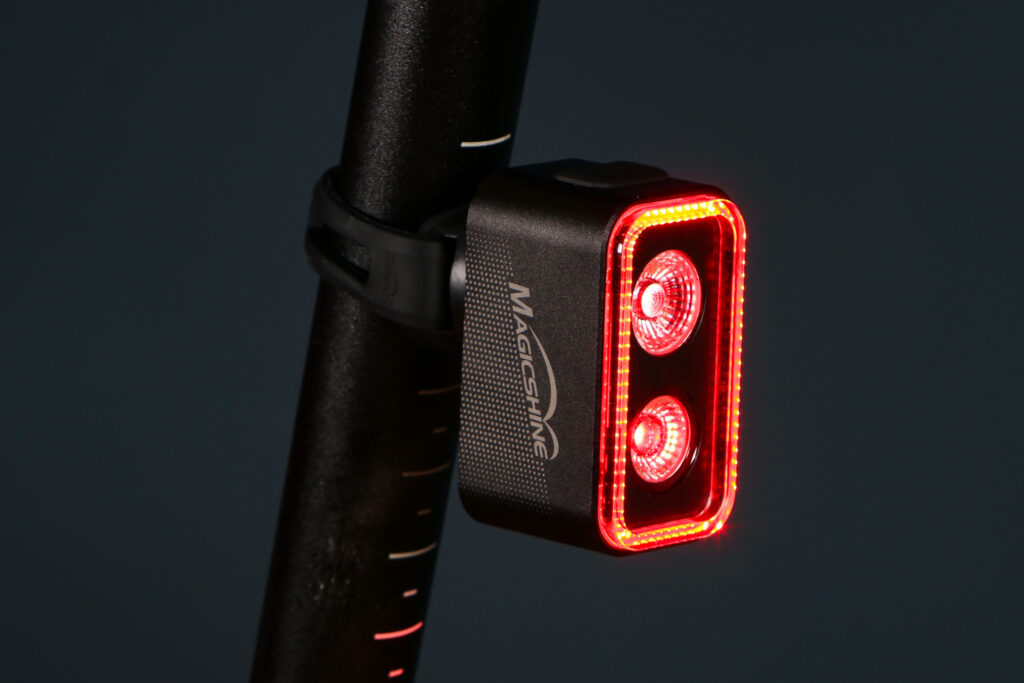
The Magicshine Seemee 30 Combo is a set of 30 lumen LED lights aiming to get you seen. The slim profile means they easily attach to seat posts, seat stays, forks or handlebars, and features such as infrared ambient light sensors are rarely found at this price. They’re easy to use, stuffed with useful features and very visible around town.
Read our review of the Magicshine Seemee 30 Combo
Giant Recon TL 200 rear light — £29.04

Giant’s Recon TL 200 is an excellent rear light, offering lots of brightness, useful modes and decent run-times.
The Recon TL 200 is a bigger and brighter version of the TL 100. Which you choose comes down to personal preference, but for the extra tenner the 200 gets our vote for the extra brightness and run-time it offers.
Read our review of the Giant Recon TL 200
Exposure Link Daybright — £55.96

The Exposure Link Daybright is a secondary helmet light that adds 360-degree visibility and is great for being seen in heavy traffic. Designed and made in the UK, build quality is exceptional, it’s very tough and run-times are reasonable bearing in mind its size and two LEDs.
Read our review of the Exposure Link Daybright
Blackburn DayBlazer 1100 — £55.99

The Blackburn Dayblazer 1100 front light is the biggest of the Dayblazer family. It’s a beautifully made, five-function, compact torch type, capable of producing – surprise, surprise – 1100 lumens in its brightest setting, great for blasting along backroads, but with lower settings, pulsing and strobing for more built-up areas and for daylight running.
Read our review of the Blackburn DayBlazer 1100
See.Sense Icon 2 rear light — £79.99

The See.Sense was arguably the first smart light that used sensors to alter the brightness and speed of flash to suit different lighting conditions, as well as being able to detect car headlights. The light was so well received that it won the road.cc People’s Choice award in 2015 and they’ve since followed up with the 300 lumen Icon 2. You can read the review here.
Exposure Lights TraceR DayBright — £39.60

The TraceR is Exposure’s smallest and most affordable rear light with its new Day Bright mode. It has a 75-lumen rating with a three to 24 hour run time, weighs just 35g and has three brightness levels. Side visibility has been considered in the design of the light as well.
Exposure Lights Sirius DayBright — £75

If you want a bright and lightweight front light for commuting then the Sirius is a good option, with 575 lumens bright enough for most riding situations and a choice of seven modes, including the new DayBright. It’s easy to use and mount to the handlebars, with a tactile power button and battery gauge LED.
Lezyne Strip Drive Pro 300 rear light — £52

Lezyne has been producing lights with daytime visibility in mind for the past five years, intended to be brighter with unique flash patterns to be more visible to other road users up to 1 mile away. It offers 15 lights with a daytime flash mode, here are two contenders.
The Strip Drive 300 rear light, with its 300-lumen output, is one of the brightest lights on the market right now but there are 11 modes to choose from to suit all riding conditions. It packs a 100-lumen punch in the daytime mode, definitely ensuring you’ll boost your visibility.
Read our review of the Lezyne Strip Drive Pro 300
Lezyne Lite Drive 1000XL — £59.49

For front daytime lights, Lezyne offers the Lite Drive 1000XL. The small unit comprises two LEDs pumping out 1,000 lumens with a high-visibility daytime flash mode.
Read our review of the Lezyne Lite Drive 1000XL
Specialized Flux 900 Headlight — £69.99

Not to be left out, Specialized has developed the Flux 900 front light with two different LEDs with dedicated optics to provide the ideal beam pattern, and it also offers a daytime flash mode which reduces the lumen count to 300.
Bontrager Flare R City — £24

Bontrager was an early proponent of daytime lights and this Flare R City light is its smallest rear light. Despite its diminutive proportions, the light packs out 35 lumens from a single LED and offers up to five hours in the dedicated daytime flash mode.
Read our review of the Bontrager Flare R City
Bontrager has even had some of the Trek Factory Racer pros using daytime rear lights during the 2015 Tour de France prologue stage, but that marketing stunt aside we’ve not seen the lights in use since.
Moon Comet-X front bike light — £15.75

Moon offers two lights with a dedicated daytime flash mode, using a slow pulse that is designed to boost visibility as well as maximising battery runtime, with a claimed 23 hours in this mode. It’s small and light and at 120 lumens in the daytime mode plenty bright enough. There’s also a matching rear light
Read our review of the Moon Comet-X light
So daytime lights then, will you be investing or is the cynic in you thinking that the bike industry is just trying to sell more lights? Let us know in the comments section below.
Explore the complete archives of reviews of front lights and rear lights on road.cc








121 thoughts on “Should cyclists use daytime running lights? Plus the best front and rear daytime cycling lights”
I think daytime lights are a
I think daytime lights are a good thing. I tend to run my rear light on all the time. The front one less often. Perhaps I ought to run the front one on too.
As an aside, it’s hard to credibly question spurious polls (as some recent articles have) and then report the results of a twitter poll as offering any insight beyond: people seem interested, we ought to investigate this properly.
Agreed, I won’t go out
Agreed, I won’t go out without a GOOD rear light (normally see.sense). I’ve recently picked up a Knog Mini Chippy on the front as well.
No daytime running lights.
No daytime running lights.
Other obstacles that drivers must avoid are not equipped with lights, why should bikes be any different? We need to put lights on pedestrians, traffic furniture, animals, trees, trash bins, etc. if we are going to go this route.
I feel that once again this puts all the burden on cyclists, and none on drivers, who need to pay attention.
Or perhaps I shouls just accept that drivers are NEVER going to pay attention, and get lights.
What to do?
reliablemeatloaf wrote:
I understand the sentiment, but Volvo’s run permanently with their sidelights on. I always drive with the sidelights on in my car (which I actively have to do because it’s not a Volvo).
I guess it’s down to where you draw the line between principle (we shouldn’t have to do this) and personal responsibility (I think this will benefit me so I’ll do it).
multimodal wrote:
Volvos run with side lights on because they are designed and built in Scandinavia, where they have much less daylight than here.
Since acquiring a tiny Cateye rear light and Lezyne front light, I have started to carry them for bits where there is lots of tree cover and hence shade, or long tunnels, or I get back later than intended, but I don’t have them on all the time.
multimodal wrote:
I drive with dipped headlights, because sidelights during the day (or in mist) are a waste of time: they don’t show up. You see the outline of the car before you see the lights! Cars without lights are a pain. Often I have been waiting to turn into a main road, see a car coming and think there’s time to pull out, only to realise at the last moment that there is another, closer vehicle without lights that I didn’t see straight away. Or I am passing a lot of parked cars and only realise when it’s too late that I should have given way to a vehicle coming the other way, but as it had no lights it just looked like another parked car. (You can tell by the annoyed look on the driver’s face as you pass.)
On balance I think it is probably a good thing that new cars have running lights and it would be better if all cars were required to show high intensity lights now, as those without any can be obscured by those that do. You can argue that the lights cause a problem that didn’t previously exist — they distract and claim attention when you should be noticing all vehicles — but really the problem is the inconsistency, and at least lights help to distinguish moving from parked vehicles.
But it isn’t particularly good news for cyclists. I figure that if I sometimes don’t immediately see cars without lights, what chance do cyclists have? It does mean that cyclists have to keep up or risk not being noticed, so I cycle with flashing lights in the day. Perhaps sad, but it’s today’s reality. Now, if we had proper segregated facilities like in Holland, it wouldn’t be a problem.
multimodal wrote:
Its not just Volvo’s. Daylight running lights have been a legal requirement for brand new cars since Feb 2011 !
reliablemeatloaf wrote:
Well, as I’m not a tree or a lamp post, and I’m able to make a rational choice – in this case a choice to make being hit as difficult as possible for a inattentive drivers – I’m running flashing lights all day long.
So we’ve got helmets, we’ve
So we’ve got helmets, we’ve got hi-viz, and now we’re moving towards a situation where largely redundant, irritating, expensive lights with unproven safety benefits are becoming a “must-have” accessory. If I was to set out to deliberately pare cycling back to a hard core of well-to-do middle-aged, overwhelmingly male enthusiasts, I couldn’t think of a better way to do it.
I’d say a maybe in the UK on
I’d say a maybe in the UK on the rear mainly…..in wet or low light…otherwise a huge NO…. in the EU…. you have no need to… the drivers are not self entitled in my experience
Personally I have always
Personally I have always ridden with a rear light on and in certain places/scenarios with my front light also but that is my personal choice. It also hasn’t stopped all of the fucktards close passing, left turning across me, right turning across me or any other chopper type activity but hopefully it has lessened it. Making it law I’m certainly not in favour of as it smacks of victim blaming again or a technicality for the odious insurance companies to wriggle out of paying out.
Very much depends on riding
Very much depends on riding conditions, but a good hi-viz would seem a better bet in my experience.
Obviously if you don’t like riding in hi-viz (saw a really effective pink gilet or jersey in the Lakes yesterday) then lights are a good option. But only decent ones, set up right.
I made up a runaround bike
I made up a runaround bike for the lady of the house from a frame i was given,i bought some wheels from Germany with a dynamo hub and B&M lights with the senso setting,She leaves them on all the time
and i’ve got to say mainly from looking over my shoulder to see where she is,They are certainly attention grabbing from quite a distance.(i don’t mean that to sound harsh but she doesn’t cycle that much).
I use them but even with a
I use them but even with a bright top and bright lights motorists don’t see me. They just aren’t looking.
For the ones that do then I’m sure lights make me stand out better. In an ideal world we wouldn’t need them but it’s not an ideal world. I’m not going to put my life at extra risk by not using lights just to prove a point.
My dyno lights have a
My dyno lights have a daylight mode. Since riding with them (early September) I’ve had two right-turning SMIDSYs.
There is undoubtedly an arms race out there, some of the latest generation car lights are painfully bright – I think in part its that they’re a very cold blue. As a driver I find them quite dazzling and at twilight I think there’s a risk that you won’t be spotted on a bike if you’re not running lights.
The whole debate is moot for me as my dyno lights are always on and half my commute is on unlit roads so I have to have good lights.
I own a bike with a dynamo
I own a bike with a dynamo and lights that are always on and the most infuriating thing is the number of people – pedestrians and even other road users – who feel I ought to be told that my lights are on… thats closely followed by the even more annoying gits who need to tell me that I left my bicycle lights on and, when I tell them, don’t worry they will go off all by themselves in 2 to 3 minutes they act like I am talking about some strange alien technology… whoever heard of lights that go off by themselves… whoever heard of making your own electricity by pedeling… burn the witch :.)
I have lights on front and
I have lights on front and rear, in the day and dark. It makes me more visible. I also use pedal reflectors. My choice. Happy cycling all !
One of the first lessons I
One of the first lessons I learnt as a motorcyclist was to make yourself visible through road positioning and use of lights. It is self preservation pure and simple and I use similar principles as s cyclist.
Grahamd wrote:
Evidence it works?
Answer to the Q, NO, NO, Thrice NO.
Slippery slope that we’ve already seen with other BS ‘safety’ features.
Putting the onus on the vulnerable DOES NOT WORK … EVER!
BehindTheBikesheds wrote:
Surely the article refers to a paper that provides exactly that evidence?
I have evidence – a man stopped his car in front of me recently and said “without those lights on your helmet I would have run you over and killed you”.
Case closed!
Jeffmcguinness wrote:
Actually the link is only to an abstract. A fairly cursory glance at which shows that although the authors draws an inference of a 19% reduction in accidents due to running lights the basis for doing so is rather deeply flawed. The number of accidents were quite low so drawing statistical inferences from it is dodgy in the first place, but the biggest flaw is that there was no attempt to establish or identify a causal link between daytime lights and the accident rate. To establish a causal link would require examination of the circumstances of each accident and for each case to establish whether lights or absence were a contributing factor. Whilst that might well be impractical without it the study really doesn’t provide any evidence.
It is a real bugbear of mine that the word “evidence” is so widely misused when discussing cycling safety – especially on line.
Has anyone else noticed how
Has anyone else noticed how many cars have ONLY their daytime running lights in at night? Obviously seeing lights out front fools the driver into thinking they have all their lights on when the reality is the rear lights aren’t on and the cars are unlit from behind? An unfortunate example of ‘enhanced’ safety proving to be anything but. My own thoughts are that the more automated you make any process, (sat nav, automatic gears, automatic lights) the less the driver is engaged. The side effect is they stop thinking for themselves and end up concentrating on other things ……..like their phones.
Bigmck64 wrote:
The problem is that in addition to the always-on DRLs many dashboards are now permanently lit (usually because they’re entirely digital). Takes away a valuable visual clue as to when you should be turning your lights on – if its dark enough inside the car that I can’t see my analogue clocks my lights go on.
There’s a related issue of DRLs washing out turn indicators. I know they’re rarely used anyway on Audis but recent models have the orange indicator LEDs sandwiched between two rows of white DRLs (because styling) which makes them difficult to spot. Some manufacturers (Volvo definitely) have countered this by disabling the DRL temporarily whilst the turn indicator is flashing.
Both fine examples of unintended consequences.
Bigmck64 wrote:
TBH in built up areas (at night) you should only ever drive with side lights, anything else is too much, as always a lighting war ensues and we have ridiculously bright motorvehicle lights. Weve already seen that DRLs are an utter failure and haven’t improved safety one iota.
BehindTheBikesheds wrote:
Where have we seen this utter failure specifically relating to DRLs? Please provide evidence, I would love to read it.
I just people would turn them
I just people would turn them on steady mode in a group ride
I use a rear light on most
I use a rear light on most rides in winter particualry in low light conditions.
Only use a front light at night or in darkness.
I run three rear lights – one
I run three rear lights – one each seatstay and one on my seatpost. In the day, I run the seatstay ones in flashing mode and the seatpost one in random mode. At night, I turn the seatstay ones in steady mode so drivers can judge my distance better.
Up front, I use a Cat Eye Volt 1200. In the day it’s either in HyperConstant (pulsing flash) or in full flash mode. At night it’s usually at the half-power 600 lumen mode.
I live in a country where pretty much nobody watches out for cyclists, much less those that can keep pace with city traffic, so most times I feel I have to be really un-subtle about being seen.
I am firmly in the no camp
I am firmly in the no camp for this one.
Do you know what, on certain winter or particularly miserable days, yes, stick your lights on, makes total sense. However this call for permanent day lights is bullshit.
Note that its the manufacturers that are calling the loudest for this, manufacturers who also happen to sell lights.
Go back thirty years and see who were the loudest advoctes of cycling helmets… yep it was the likes of Bell, manufacturers of motorcycling helmets looking to diversify markets.
Its a slippery slope. We’ll all toe the marketers line, fit our bikes with lights until it becomes law, and shortly afterwards, anyone riding without effective lights will be seen as fair game for our ever more aggressive, self-entitled motoring friends.
Rather than pandering to this marketing bullshit, why not put effort into pushing for greater safety on our roads where it counts, and that is changing driver behaviour / mindsets. Its the only thing that can make us ‘safer’.
That said, we are already perfectly safe. Perfectly. I’d imagine that nearly all fatal cycling accidents are covered by this website… our perception of risk is totally out of whack.
Should no, but do I yes.
Should no, but do I yes.
its more for the low sun/grey days etc, and I have some blinkies on the commute bike, the road bike is a CX so rather less of a issue!
Not a fan of daytime lights
Not a fan of daytime lights for cyclists, as a cyclist I find them annoying, especially front lights. Certainly overkill on a bright day. On a dull day, or when starting early or finishing late, then yes of course.
As an aside, this conversation has already happened in the time-triallng world. TTing is of course done (mostly) in the daytime. Many testers are vocal about the desirability of a really bright rear light, Scorpion or similar, others less keen, but visit any TT and 90% of testers will have a rear light even though they are not mandated by the governing body.
Miller wrote:
Disagree. Many times in bright sunshine on open roads, moorland etc you can then drop into heavily wooded areas and it’s the change from light to dark or going through dappled light where riders can be very difficult to spot, even hi-vis doesn’t work. Lights cut through all of that.
I’ve worked on numerous long-distance charity events and we always point out to riders that although they may be starting in bright sunshine, they’re travelling 100 miles point to point and the weather when they are arriving at point B in 7hrs time may be very different to the weather as they leave point A.
I’m in the always-on camp, a mate commented just yesterday about how good my Exposure TraceR is on Daybright mode (which has a built-in brake light as well, it’s very cool – works off an accelerometer.)
Most TT events mandate them now even if CTT doesn’t.
crazy-legs wrote:
Most events advise their use, only South DC as far as I’m aware tries to mandate them and this is controversial, technically they are not able to overrule CTT.
Miller wrote:
Our local club (KLCC) mandates them for all club events. Open CTT events are run with CTT rules (so no light required).
It’s all very well saying that it ought to be the motorists’ responsibility to look properly for bicycles, but we all know they don’t always, and there’s no reason why we shouldn’t try to help ourselves. Having an extra attention grabbing light on my bike is helpful. I do a lot of riding on NSL roads, and high vis isn’t that visible from a distance during the day time. But a flashing or pulsing rear light is, and given no other vehicle displays a flashing rear light it helps warn motorists that they’re approaching something with a likely much lower speed than them. Same thing at night – a pulsing rear light gives a motorist advance warning that the red dot in the distance is likely travelling more slowly than they expect.
Miller wrote:
I’ve got to agree to a certain extent. As a cyclist, motorcyclist and motorist in urban environment a day time pulse front light is very distracting and probably negates the safety benefits. Although on more open roads maybe there is more benefit.
Also cyclist should stop using the day time pulse at night, you just get blinded and can’t see the rider.
tugglesthegreat wrote:
Can’t win can you?!
Use lights and they’re too bright, too flashy, blinding, it’s dangerous.
Don’t use lights (or have ones that aren’t bright/flashy enough according to the random scale of whoever is deciding what constitutes “too bright”) and you’re a reckless idiot who will be blamed by police/media etc when you’re run over.
Same as the bell argument. Ring a bell and the pedestrian angrily tells you that they’ve seen you thanks and don’t be so bloody rude with that ding ding. Don’t use a bell and the pedestrian jumps a mile in the air as you safely bimble past at 8mph and screams “USE A BELL!” at you.
Miller wrote:
If you find them annoying its proof these lights have attracted your attention.
Where I live a lot of routes are under tree cover and simply a cyclist in dark clothing would be hidden in the shadows. Whilst Ive sometimes spotted another cyclist with a GOOD rear light, literally miles ahead.
If only some drivers could be trusted, because they cant it means I have to take extra precautions. In fact there’s some busy main A-roads that I will never cycle along
I think they are a good idea
I think they are a good idea given the gadget induced distracted nature of drivers, at least here in the States.
I run front and rear in flash mode on both my commuter setups which might take me into situations that demand more visability (higher traffic pattern, etc.) That said I don’t run any lights on my road bikes.
Have used Bontrager for last couple of years with great success. ION 350 R in front and Flare R in rear. Midday visability is impressive.
Michael Mason (RIP) had both
Michael Mason (RIP) had both a flashing red rear light and a reflector and was noticed by many witnesses. But apparently the driver Gail Purcell was unable to see him… “there are none so blind as those who will not see”.
There is a safety-scare coupled with unproven-yet-costly-remedies marketing move afoot in bicycling circles for quite some time. It started with freds wearing helmets and is now extending into the foolishness of daytime running lights, head-mounted lazer lights and other gimmicks. Wear and carry them if you want, but there is a distinct absence of evidence that they are going to do anything except empty your wallet.
Ush wrote:
So because one woman, who really ought not to be driving, failed to see Mason, daytime lights are pointless?
oldstrath wrote:
Fair enough. A single anecdote certainly proves little. However if daytime lights are as effective as many in this thread and the >50% in the poll seem to believe it certainly is odd that they did not work in this known incident.
As with helmets, hi-viz and other bolloxology which is now being marketed they are all claimed “treatments” on a population. A claim that they have a particular effect needs to be demonstrated, otherwise it’s all “I feel that I am safer” and “my mate would have been run down if he hadn’t had an argon laser mounted on his pedals”.
For vehicles in the USA the effects of Daytime Running Lights (DRLs) seem unclear at best: https://crashstats.nhtsa.dot.gov/Api/Public/ViewPublication/811029
So many people saw the guy.
So many people saw the guy. That’s good. If Gail Purcell had been paying attention she should have seen him too.
Just because there are really awful drivers out there doesn’t mean that lights don’t work. If you’re not paying attention you won’t see any thing.
As a motorcyclist I always
As a motorcyclist I always ran with lights on – anything to wake up the dozy motorists. On a bicycle we are even more exposed to risk and the need to be seen is the first defence so my lights are on day and night.
I am dead against daytime lights on cars because if you can’t see a car in daylight what are you doing on the road? But against rows and rows of dazzling leds we now have no chance with our 1.5 volts.
If it’s law for cars you might argue it should be law for our bikes; and if so they should be a standard fitting and not a bolt-on accessory. Can’t see the law makers or the bike makers doing that any time soon so meanwhile take care.
alg wrote:
If you can’t see someone riding a bicycle in daylight what are you doing on the road ?
dreamlx10 wrote:
Perhaps they should change the driving test, not can you read a number plate but can you see a bike.
alg wrote:
It’s not so much “can you see the car?” but more “is the car likely to be occupied / moving / about to move?”
Sometimes, it can be quite difficult to determine if a car that looks parked has just stopped momentarily or perhaps is about to move off or any number of “what if…” scenarios. DRLs make a lot of sense in distinguishing between parked (sometimes badly parked) vehicles, moving vehicles etc especially in very slow moving urban traffic where there are a lot of distractions, a lot of people stop/starting, pulling out, pulling in. DRLs give other people an idea of what might be moving off and help with judging speed/distance.
crazy-legs wrote:
This makes sense. What doesn’t, to me, is that the regs only apply to headlamps.
(I still wonder how much extra light ‘noise’ it creates – alg’s point.)
I think we all need to re
I think we all need to re-read Bez’s (of this manor) excellent article on how lights were forced on cyclists by motorists. https://beyondthekerb.org.uk/the-wedge/
It was the thin end of the wedge and the motoring industry won’t stop until cyclists and pedestrians alike are mandated to wear hi-viz and lights. Now we are feeding this by using daytime lights.
I’ve actually made a concious decision to stop wearing hi-viz. It sounds mad “surely you want to be seen?” but I’m quite certain that I am made from visible matter. Since I’ve started cycling in ordinary trousers (okay expensive Vulpine ones) and ordinary jackets (yes, sometimes expensive Vulpine ones) I’ve noticed fewer close-passes and certainly fewer acts of aggression.
Anecodotal I know, but I’m happy with my experience. I believe some motorists have a visceral hatred of cyclists and when they see someone is dressed in ‘normal’ clothes these nutters are more inclined to understand the guy on the bike is actually a normal human being, not some alien species.
The old “every little helps”
The old “every little helps” argument, with a spattering of “why wouldn’t you do everything you can do to make yourself safe / seen?”
Both fine arguments, however by following these routes to their natural conclusion you either ultimately buy a car to make your journey in or find a way to avoid the journey altogether.
For me there has to be a base point… a point where it is deemed reasonable that a basically competent driver can be expected to see you and take the necessary avoiding action.
If thats not the case with the current legislation then we have a problem, but that problem should sit with driver training and law enforcement, not pushing ever greater requirements on to vulnerable road users.
The other day, I was driving my car at night, and some dude on his bike came towards me on his bike, with no lights, drressed head to foot in black. “what an idiot” i said to myself, “he’s going to get himself killed” I said. Then I realised, I had had no problem at all seeing him, my lights did their job and he was clearly visible.
I am average at driving at best.
My point is that we should not allow society to continually decrease the level of driver competence and responsibilities placed on the motorist. we should not base safety standards on the lowest current standard of legal driving, and readdress this further downwards every time a driver stoops to an ever lower low. We need to stand up and demand better education of all road users and a higher standard of testing / regulation.
Jimmy Ray Will wrote:
Totally agree, as do the current regulations, by and large. The ‘cover yourself in flashing plastic’ campaign was largely driven by organisations with a vested interest in peddling flashing plastic, and, unfortunately, has taken hold to such an extent that flashing plastic coverage is referred to in court cases, where it is irrelevant.
Jimmy Ray Will wrote:
True, however I was riding my bike recently and the same yoof (or one of millions like him – shit mountain bike, smoking weed etc.) jumped off the curb right in front of me.
My lights aren’t set up to illuminate the pavement, cars probably have a better field, but still if something approaches side on then you’re less likely to picke them out.
On the other hand, I’d be quite happy if Darwinism kicked in occasionally…
Jimmy Ray Will wrote:
I had exactly the same experience on Saturday night driving home; two yoofs on mountain bikes, dressed in blacks and greys, hoodies, no lights.
My first thought was numbskulls without lights but then I too realised I had seen them in plenty of time.
As a driver I know its
As a driver I know its important to be seen.
I know my life is more precious than not buying a few lights and I always make sure I have a front and back light that catches attention.
Just because its not proven it doesn’t mean anything.
It’s all well to talk about
It’s all well to talk about cyclists with no lights that you have seen- but how many have you missed and don’t even know about them ?
Circumstances vary hugely. Pedal reflectors on a pitch black dual carriageway late at night are great – you see the guy miles off – even if he’s in black and with no lights.
If he’s pulling out of a sidestreet in front of you you might not see him until it’s too late.
I use them all the time..
I use them all the time…besides it distracts the dogs
I use daytime lights to
I use daytime lights to improve my chances of being seen by motorists, my choice.
ideal world I wouldn’t have to use them.
I commute wearing reflectives, lights on, camera on – narrows down the excuses careless motorists award themselves, and if it’s not on camera it didn’t happen.
Should always be the riders choice
Having read these comments, I
Having read these comments, I’m going to stop using lights. Ain’t no way anyone is calling ME a victim if I get run over by someone who didn’t see me….
BarryBianchi wrote:
Good work: you’ll feel better for it.
As a driver I now never drive
As a driver I now never drive with full beam headlights on, and am now of the opinion they should be banned. Drive to the conditions.
As a cyclist, since my friend was killed this year in full daylight, I now always have front and rear lights, as do all the people I ride with.
This is a classic example of
This is a classic example of partial evidence. The Danish study showed 19% lower incident rate between the two groups of cyclists. However, that only tells part of the story;
I should point out that I haven’t read the particular study, but if the reserach was done as a response to increased use of lights during the day (which seems likely) then a number of other factors need to be considered. For example;
1) Was the difference between the two groups because the use of lights resulted in a reduced risk to those using them or because more people using lights made those not less visible, thus increasing their risk? So, do increases in daytime use of lights result in a total reduction in incidents for cyclists (controlling for other factors)?
2) How is the the incident rate of other people in the environment not on bikes, e.g. pededtrians affected by daytime bike light usage, i.e. does making cyclists more visible make others less easy to spot?
3) How is the severity of incidents affected, e.g. if most cyclists become easier to spot, do drivers change their behaviour, e.g. speed up, because they expect to be able to easily notice cyclists resulting in perhaps fewer but more severe incidents?
4) Does promoting daylight light usage encourage the perception of cycling as dangerous and thus deter potential riders, resulting in negative mental and physical health impacts that would outweigh any benefits from daylight light usage?
5) Does promoting daylight light detract from a focus on tackling the real issues with encouraging cycle usage and rider safety thereby making it more likely that we will fail to take other measures that could have a bigger impact on rider safety?
tendecimalplaces wrote:
..perhaps reading it would be a useful first move then ?
Edit. This is not intended to be confrontational or dismissive of your points, just a serious suggestion.
tendecimalplaces wrote:
Why not read the study before proposing a list of questions of what’s wrong with it?
52% of people on road.cc are
52% of people on road.cc are idiots. To be honest, I expected the figure to be higher.
Normalising lights during the day time, wearing space lemon yellow and allowing yourself to be forced into inadequate cycle lanes just gives more ammunition to those who don’t want cyclists on the road. Why do we in this country try to make cycling so difficult and such a niche thing to do?
Milkfloat wrote:
Brexit gave you the same statistic expanded to the wider population!
I like to use my bicycle as a
I like to use my bicycle as a getway vehicle in bank robberies so I like to run without lights or hi-viz, but does it ever work?
I have these fantasies that people will say – he came out of nowhere and then vanished into thin air – but always someone with functioning stereoscopic vision eyeballs me and grasses me up to the dibble, regardless of the time of day!
Been riding road bikes for
Been riding road bikes for around 10 years and would never dream of going out at any time, Day or night with out flashing Front and Back lights. Anything to make sure that I am able to be seen by all and sundry.
No, cyclists should not use
No, cyclists should not use lights in the daytime.
How many things are driven past, succesfully, by drivers every day? Hundreds, thousands?
Few of these objects have lights on, yet they manage to avoid being hit, and if they are hit, it is the drivers fault. How can you blame an unlit tree for not being seen, then hit.
Trees, dogs, trash bins, pedestrians, parked cars, traffic signs, guardrails, and many others are avoided all the time, and they are not lit.
If you can’t avoid a moving, probably light colored five to six foot tall object right in front of you, you need to stop driving.
This is another case of blaming the victim, by suggesting that cyclists are at fault because they are not fifty foot tall, dayglo wearing beacons of light.
Why don’t drivers put down the phones, razors, eyeliner, tacos, vibrators and hamburgers and DRIVE?
A440 wrote:
The vehicles are moving at roughly the same speed so it’s easier to take care of things. They’re 2x-5x the rate of bikes so that a different, say, field of vision and perspective. Except foe the dogs, your list is off road. Pleanty of dogs and other animals do get hit. Agree with the put- down- the list of things but that has little to do with the responsiblity of the rider to make him or herslf more easily seen. It seems you;re implying that the drivers have all the responsibilities and the cyclists have few or none.
I’m in the yes camp
I’m in the yes camp especially for the rear, but to be effective it must be very bright and flashing.
Why? Well, they are likely to be at least partially effective:
Cost wise, frankly if I could spend £1,000 on a device that I could move between bikes that stopped cars close passing and crashing into me, I would. The enjoyment of riding the bike without having to worry about motorists putting me in the ditch, or worse, would easily be worth the cost Di2 or some carbon wheels. Said wonder device doesn’t exist yet, so in the meantime, I’ll spend a lot less on lights and take the proportionately smaller improvement they offer instead.
Pointless exercise. Those
Pointless exercise. Those drivers who are paying attention might notice you a couple of seconds earlier, those who are not paying attention still will not spot you. No malice involved on anyone’s part, simply acting the same way day after day and usually without any consequences.
That said, I am a hypocrite because my Fly6 rear camera is flashing away and my dynamo hub rear light us always on and I rarely bother to turn the front light off either.
I am in Japan (Yokohama prefecture) at the moment and the number of utility cyclists rivals anything I have seen in the Netherlands. No helmets in sight, very few lights at night, kids front and back with Mum or Dad pedalling away while holding an umbrella etc. It’s a relief to ride without all the faff I accepted as normal in London.
There are plenty serious athletes here as well. They head out on club runs dressed the same as I used to back home, helmet, sunglasses, team kit etc. Seeing them alongside the electric assist Mama Chariot users shows what a wonderfully broad church cycling is and how what applies to one group might not translate to all cyclists.
“It may not have escaped your
“It may not have escaped your attention that all new cars sold in the UK legally have to have daytime front lights.”
This has escaped my notice. I guess that means that all new cars are driving around with lights permanently on. Apart from being an unnecessary waste of resources, I find this a dangerous trend: More and more cars will have their lights on during the day and more and more drivers will become accostomed to seeing other lit cars, meaning that they will become less likely to register unlit cars AND BIKES.
Once spring arrives with longer daylight hours, I enjoy the freedom from charging lights and buying batteries and I can tell myself that my bike is a good few hundred grams lighter when I leave my lights at home (even if I can’t actually feel the difference). So, I am against running daytime lights! But, given the new law/trend, I can see a time when I shall probably use them.
‘I’m able to make a rational
‘I’m able to make a rational choice – in this case a choice to make being hit as difficult as possible for a inattentive drivers – I’m running flashing lights all day long.’
a rational choice would involve running steady lights all day long. A fashion- or battery life-conscious one would go for the daft flashing ones. HTH.
andyp wrote:
Research says that flashing would be more noticeable – which is sort of the point – so i’m not sure that’s a rational choice.
fukawitribe wrote:
I recall reading somewhere that although flashing lights are more noticeable/attention grabbing, they make distance evaluation more difficult. So, steady lights might be better in some circumstances (probably nighttime), but I’d go for flashing during the daytime. (I run 2 lights at night, one steady and one flashing).
Some great debate here. A few
Some great debate here. A few things I feel I can correct…
DRLs became LAW for all new cars and vans sold in the EU in 2011.
Trees and other unlit obstacles arent on the road and do get hit by drivers.
Drivers are generally not highly trained, it is possible to SMIDSY – most cyclsits are drivers and I have yet to meet anyone who didn’t SMIDSY a cyclist at some point. Surprise, surprise cars also hit….. cars. No driver wants to hit anything. It’s called an accident for a reason. No one is blaming cyclists or putting the emphasis on cyclists. It’s just life, get over it.
Flashing lights work to grab attention, as said above, that’s why the emergency services use them.
There is little downside to using high vis / helmets / lights – yes you have to buy and maintain them.
The studies and evidence is there and compelling – the links are in the article – read them!
Lights won’t make you safe, but they sure as hell help. Should they be law? I don’t think so. Should you use them? I do and I think most people should.
DA69 wrote:
Mostly a crock of shit.
You even get the law incorrect in your opening salvo. Compulsory to fit, not to use.
The rest of your post is so full of lies and empty meaningless guff that has been covered elsewhere I can’t be bothered to pick it apart.
You’re just wrong
BehindTheBikesheds wrote:
Am I really?
Let’s look at the UK Govt info page :
https://www.gov.uk/government/publications/daytime-running-lights/daytime-running-lights
Clearly stated right there : “automatically activate when the engine is started”
How is that optional usage? Soundsmandatory to me. Take any car since 2011 and tell me how to drive it with them off? Well?
Don’t be an opionated armchair warrior troll, do some proper research and post facts with evidence.
DA69 wrote:
I agree there is little downside to using them, but every extra thing that becomes expected of a cyclist, is one more reason that people who don’t cycle now will be put off starting, and that has wider implications for a society running out of space for single-occupant cars to get everyone where they need to go in good time, and one in which many would benefit from choosing to use active transport as an alternative.
Being expected (not even compelled) to wear a helmet and high vis and run lights at all times makes hopping into the car to pop down to the shop a mile away much more attractive than getting on your bike to do the same trip.
Excellent …
… but I think I’ll make my own decision, thank you.
Jetmans Dad wrote:
The number one reason people aren’t getting on bikes isn’t that they’re being asked to buy kit, it’s the perception that they might get hit by another vehicle. Until we get the secregated cycleways needed, surely anything that improves safety and the perception of safety is a good thing!
DA69 wrote:
No it isn’t when it deters/discourages people from opting to commute by bicycle instead of by vehicle, & shifts the onus of responsibility from drivers onto the most vulnerable road users;
as well as distracting from the implementation of more effective measures such as segregagted cycle lanes.
JF69 wrote:
So which is the greater proportion:
(a) people that don’t cycle as they have safety concerns
(b) people that don’t cycle because they feel they need additional kit
We won’t get segregated infrastructure until more people cycle.
Simply pushing back that drivers need to be more careful is being unrealistic. Drivers have accidents with lots of things (not just cyclists) and no one wants to have an accident.
Be idealistic all you want, but the reality is that only getting more cyclists will mean more cycling infrastructure.
DA69 wrote:
You have the psychology entirely wrong.
People don’t cycle because they have safety concerns.
Making more kit obligatory won’t reduce those concerns in any way. Rather it will send home the message that not only is cycling indeed dangerous, but that the responsibilty for keeping safe is on the cyclist and hence if you do get injured it will be your own fault.
The logical conclusion from that is that the most responsible thing to do, because the ‘safest’ is to not stop at getting more lights and kit, but to go the whole hog and get a car instead, the ultimate in safety kit.
Meanwhile, of course, drivers will also get the message that the responsibility for safety belongs to the potential victim, and will just stop looking in proportion to how much more lights and high-viz etc the cyclists wear.
At both ends you are sending the wrong message.
And if ‘nobody wants to have an accident’, can you explain why so many drivers _do_ have such accidents?
Again, your take on psychology is flawed. You don’t just ‘want’ or ‘not want’ an accident in some sort of binary choice – you balance the risks and costs of having one against the benefits and costs of taking more effort to avoid having one.
DA69 wrote:
(double post, sorry)
DA69 wrote:
*Clap, clap*
Motorists have the
Motorists have the resonsibility to watch our for and see cyclists. Cyclists have the responsibiity to be make themselves easily seen as possible. My street has loads of them and I can’t believe how many, especilly at dusk/night aren’t runnionf lights.Bright clothing isn;t the answer but at least a rear running light is. They’ll see you up to a half mile away. At, say 45 mph, boom! >> They’re on you but they’ve seen that blinky. There ‘s no guarantee that some idiot won’t hit you but it certainly lowers the odds. Like the gent with his motorcycle andnow his bike, I did the same. I use a front in urban situations and turn it on/oof in more rural settings. (Plug: I love my Blackburn Flea. About USD 30; no battery; very light. Comes with a USB and you recharge it on your computer)
Deep sigh,
Deep sigh,
Another pointless discussion.
If an individual wants to ride with daylight running lights, that’s their choice just like helmets and high vis – not legal requirement.
Good luck if you think requiring these things by law is going to solve anything as I live in a student town where the kids just ride on the pavement at night because they don’t have ANY lights. I went to the trouble of writing to my local MP many years ago asking why cheap bike lights are not legally required to be supplied with new bikes (like bells), he forwarded the question to the then minister for transport who replied that lights were required to be supplied with new bikes. I responded pointing out that the minister was wrong and subsequently received an apology from the minister – his name – Sadiq Khan! Did they change the law ? Nah, they didn’t even consider changing the law!!!
The rozzers won’t enforce it and the politicians don’t even know the laws they are elected to make. therefore, this is another pointless discussion.
BigglesMeister wrote:
whereas if an individual wants to have a pointless discussion that’s not their choice, they need your approval…?
This is to be expected
This is to be expected because as cyclists are making themselves less visible by wearing black clothing then we need something to get ourselves more visible again.
I personally refuse to become a blackshirt and wear everything bright I can.
The motorbike industry has shown us the folly of wearing black and have their headlights on constantly.
A message to the blackshirts, please use common sense and wear cycle clothing. As a motorist I’d rather see you sooner than later.
randonneur wrote:
Randonneur, you are not just ‘as a motorist’. You are a cyclist who also drives, or possibly a motorist who also cycles. You brain and thought processes are much more in tune with the visibility and vulnerability of cyclists.
There’s been a number of threads covering the pros and cons of hi-viz (your bright cycle clothing). My take is the average motorist may not take anymore heed of a cyclist wearing hi-viz, than they would one wearing dark clothing, as the object they ‘see’ is not a danger to them sat in their one ton metal cage doing 30mph.
Many motorcyclists still wear black, they just also run with lights on. I wear mostly muted colours including a nice black rain jacket, but also use lights during daytime as I believe that motorists pay more attention. ‘If it’s got lights it’s a vehicle’. However, as numerous ‘close pass’ vids show, there will always be some dangerous numpties who just don’t get it.
Safe touring
P.S. Your hi-viz picnic is making me hungry and jealous at the same time!
I have the Eposure Trace &
I have the Eposure Trace & TraceR. Both superb on the medium setting
I love this light with my
I love this light with my garmin. The Garmin Varia Radar rear light lets me know if and how many cars etc behind. really good on quite roads as it letsd you know a car has cought you up many times befor you hear it. Also good if you are turning right. It gives me an idea when best to look over my sholder to check before pulling accross the road. I do use a front light as well. short rides fly12 long rides a big exposuer light.
No because I ride 100-300 or
No because I ride 100-300 or sometimes longer at a time. I don’t want to carry 3kg worth of lights and batteries when I go out. This is more nonsense about putting the blame on people on their bikes than getting motorists to stop killing us.
No: because we don’t want to
No: because we don’t want to train motorists just to look for lights rather than, you know, objects.
brooksby wrote:
Fair point, but from what I’ve read, the human brain fills in blind spots and constructs images based on what it expects to see rather than the detail of what it is actually seeing, hence cyclists on busy roundabouts and junctions are missed because drivers are expecting to see other vehicles.
Flashing lights seem something which force the brain to process an image and react. Also, how about situations in strong sunlight when you cycle through a densely wooded section… a rear light will mean a rider can be seen when otherwise they might not.
Yes, its a failing of drivers that can be resolved by them looking properly but its not a perfect world.
PRSboy wrote:
All well and good, but why shift the onus onto the perfectly visible cyclist when surely the licensed motorist should only be driving according to the conditions and the limits of their vision?
hawkinspeter wrote:
Like I said, its not a perfect world, and I would argue a cyclist riding with no lights in dense woodland is not perfectly visible.
I would love for all drivers to be as vigilant and discplined as fighter pilots at all times, but that is never going to happen.
PRSboy wrote:
If you drive into dense woodland and can’t see other traffic on the road, then maybe you should think about using your headlights, maybe?
I appreciate that drivers aren’t as vigilant and disciplined as fighter pilots, but when the conditions change and you suddenly can’t see anything, then either pay attention or pull over until you’re not a danger to everyone.
hawkinspeter wrote:
They SHOULD be driving according to conditions, and most do – but there’s still a number of idiots out there.
I’ve got the lights already. There’s no cost for me to put them on in the daytime. I don’t see a downside.
I use the Exposure Trace and
I use the Exposure Trace and TraceR for daytime rides. They are excelent and bright enough on the medium setting, giving around 12 hours between charges
The study in cited in the
The study in cited in the article seem a bit suspect. I can’t wait for the first claim of, “they didn’t have a light on so I couldn’t see them” as a defense in an accident scenario. Cyclists need to ride responsibly and predictably and motorists need to take the time and care to ensure the way is clear for them to proceed. If you can’t see an object as large as a person on a bicycle in your path then you should not be driving. Even at night there are so few areas where it is too dark to see a cyclist or pedestrian. Perhaps it’s different in the UK than in N. America, but here most urban settings are lit up like alien landing strips.
I use then around town and in
I use then around town and in poor lighting conditions. I lso use them (perversely you might think) in bright sunshine – to highlight my presence when going under trees etc. where I might otherwise be hidden by the glare of the sun.
For awhile I did ride in the
For awhile I did ride in the daytime with both front and rear lights, but I soon gave up on the front because people just drove as they did with the light on, and I was doing a better job of noticing them then them noticing me; but I always ride with my tail light strobing since the doctors removed my third eye that was in the back of my head…
I’ve been using lights at
I’ve been using lights at sunset, when sun’s angle is low & can be blinding. Helps me to feel safe.
I tend to use my lights
I tend to use my lights according to the conditions of the day. Riding into school at 7am under grey September skies, I put my front and rear lights into flashing mode, riding in at 7am on a July day under blazing sunshine I don’t. Likewise, a couple of my longer, more scenic routes home have wooded sections, and I generally stop before those and put my lights on regardless of overhead conditions.
The problem I have with encouraging constant use of daytime running lights is it just gives drivers another excuse in an incident … sorry, officer, I didn’t see the cyclist I hit at lunchtime yesterday because he didn’t have his lights on. Anything that makes it easier for the police and courts to blame the victim is a bad thing in my book.
Yes, I want to be as visible as I possibly can, but I have also been driving for over 30 years without ever hitting a cyclist so I am not convince that daytime lights under all circumstances is the way to go.
if you are going to use a
if you are going to use a daytime light make sure it is a front one (I do).
as this document says:
https://www.rospa.com/rospaweb/docs/advice-services/road-safety/cyclists/cycling-accidents-factsheet.pdf
“Almost two thirds of cyclists killed or seriously injured were involved in collisions at, or near, a road junction, with T-junctions being the most commonly involved”
No
No
Does anyone have a solution
Does anyone have a solution to fitting a rear light to a non-standard seatpost? I have TraceR rear lights but the bracket is designed for a round seatpost whereas my new bike has a post with a square back – the causes the light to work its way round until it’s pointing sideways.
Advice/suggestions appreciated!
number9dream wrote:
Sugru
number9dream wrote:
Exposure make a saddle rail bracket
https://exposurelights.com/products/bike/saddle-rail-bracket
and also many other brackets for weird mounts
https://exposurelights.com/products/bike/brackets-and-mounts
ktache wrote:
I’ve an aero seatpost and the SeeSense lights come with a sleeve thing that will work on that. I’d think it would work for you too ?
“So should we all start using
“So should we all start using daytime lights then?”
Short answer – “Sorry, but fuck off.”
A wee bit longer an answer. So the most aggressively designed vehicles, appealing to the most aggressive drivers, increasingly have “get-the-f**k-out-of-my-fat-arsed-way” permanent lights … and cyclists should go down that route? FFS.
Curb the aggression of Audi/BMW/Volvo drivers.
growingvegtables wrote:
I’m guessing you don’t drive.
growingvegtables wrote:
Eh ? I don’t think theres any link between lights in cars and aggressive driving ? Drivers drive like tw@ts sometimes and I’ve not noticed any correlation between that and lights.
I run them. Does nothing with aggressive drivers but helps dozy and drivers with bad eyesight to see me easier.
I’ve always found the issue
I’ve always found the issue with lights to be a little too narrowly focused (sorry) . My issue is with cyclists without any lights or such pathetic lights that are useless anyway..AND…people with poorly positioned lights or lights that are over bright even at night. Commuting in London by bike it is quite easy to be blinded by cycle lights pointing up into your eyes and with a brightness suitable for the darkest countryside. This for me is as much a problem as not having lights. Context and appropriateness seems to get lost in the race to have the ‘brightest is best’ .
Personally….. I tend to use
Personally….. I tend to use lights at night or in poor lighting….. not day running lights…
Like hi viz and helmets, rear lights especially seem to give the green light to drivers that you are safe and so therefore they can take risks when passing you.
We as a group met for a ride last weekend and while pre ride faffing a guy on a black bike, with black castelli with no lights went past us, we passed pleasantries and we saw him easily as his silhouette showed up well against the light sky. If we could see him then why can’t drivers?
I’m not saying don’t use flashing lights during the day either, we used them last Saturday as it was low light and raining, if only cars were lit up …
As for best lights…..it’s like asking…. best tyres, chain lube, helmets, cycle kit… Take Care Out There #Respect
Personally….. I tend to use
Personally….. I tend to use lights at night or in poor lighting….. not day running lights…
Like hi viz and helmets, rear lights especially seem to give the green light to drivers that you are safe and so therefore they can take risks when passing you.
We as a group met for a ride last weekend and while pre ride faffing a guy on a black bike, with black castelli with no lights went past us, we passed pleasantries and we saw him easily as his silhouette showed up well against the light sky. If we could see him then why can’t drivers?
I’m not saying don’t use flashing lights during the day either, we used them last Saturday as it was low light and raining, if only cars were lit up …
As for best lights…..it’s like asking…. best tyres, chain lube, helmets, cycle kit… Take Care Out There #Respect
Personally….. I tend to use
Personally….. I tend to use lights at night or in poor lighting….. not day running lights…
Like hi viz and helmets, rear lights especially seem to give the green light to drivers that you are safe and so therefore they can take risks when passing you.
We as a group met for a ride last weekend and while pre ride faffing a guy on a black bike, with black castelli with no lights went past us, we passed pleasantries and we saw him easily as his silhouette showed up well against the light sky. If we could see him then why can’t drivers?
I’m not saying don’t use flashing lights during the day either, we used them last Saturday as it was low light and raining, if only cars were lit up …
As for best lights…..it’s like asking…. best tyres, chain lube, helmets, cycle kit… Take Care Out There #Respect
This article is over two
This article is over two years old and still gets dredged up every year at this time.
I think this bolg says everything you need to know about the subject: https://waronthemotorist.wordpress.com/tag/bollards/
alexb wrote:
Thanks for the link, made me chuckle.
If only all those fluroescent yellow, reflective, illuminated bollards had been equipped with daytime running lights….
*no, I’m not being serious!*
Lezyne Strip Drive Pro 300
Lezyne Strip Drive Pro 300 rear light
I have two. Excellent lights but VERY SHORT run time ;-(