



There is a long history of protests during bike races, and they have even created some of the sport’s most memorable moments. Think about the famous image of Bernard Hinault punching a shipyard worker in La Ciotat during Paris–Nice in 1984 – it’s iconic not just because it further cemented Hinault’s reputation as the peloton’s foremost hardman, but because it made clear the impact that protests could have on the sport of cycling.
Over the years, there have been many protests over many things, but few of them have actually been about the races themselves. Whether that’s French farmers stopping the Tour de France to protest about agricultural policy (only for the police to then accidentally pepper spray the peloton), or environmental activists glueing themselves to the road during the 2023 World Championships, road cycling provides a very accessible stage to get the point across, with near-guaranteed press coverage due to the continuously rolling cameras.
Most protests have used bike racing as the stage upon which they can draw attention to a cause that has little to do with the sport itself, but what we’ve seen at all three of cycling’s Grand Tours this year has been markedly different. Actively protesting against a team in the race itself may not be new, but I don’t think we’ve seen anything reach this level before. Standing in the road to block the race is one thing; jumping out on the race and causing crashes is entirely different.
I think what we’ve seen at the Vuelta so far has set a new precedent for protest, but it was always going to happen. We have a problem with sportswashing in cycling, like most sports, and what we’re seeing is that when the amount of dirt being created is too great, the sport ceases to do any of the ‘washing’ that the brand/corporation/”self-appointed Ambassador-at-Large” for a sovereign state desired in the first place. In the case of Israel-Premier Tech, I’d argue that the team’s association with the state of Israel is currently soiling the entire sport.

Israel-Premier Tech’s riders, of course, are not personally responsible for the actions of the state of Israel. They haven’t been found to have committed genocide against Palestinians by the International Association of Genocide Scholars, they haven’t been accused of using starvation as a weapon by the UN, nor have they sent an airstrike into what is known as ‘the Switzerland of the Middle East’ – however, the very existence of the team is threatened by their association.
The team itself launched as the Israel Cycling Academy, that aimed to give young Israeli cycling talent the opportunity to compete on the biggest stages and turn pro – but in recent years that objective appears to have become weaker, with the team now only employing three Israelis in its 30-rider men’s team roster. To me, this clearly shows that the primary goal of the team in its current form is to improve the image of the state of Israel, not develop emerging Israeli cycling talent.
It’s been reported that riders – and even the race organisers – have been privately calling for Israel-Premier Tech to leave the Vuelta, and the team attempted to compromise by continuing the rest of the tour in a “monogram-branded kit”. I think IPT’s participation at cycling’s highest level is looking almost untenable right now – although as the UCI has repeatedly backed the team, there’s no way IPT can be forcibly removed from the sport’s biggest races, and as long as Sylvan Adams is the owner, the team will always be proudly associated with the state of Israel.
With no end in sight, the question is whether the current situation that IPT and the entire sport of cycling find themselves in will have an impact on the way teams think about sponsors going forward, and vice versa. Could this be the beginning of the end when it comes to sportswashing in cycling?
Unlike other sports that often take place in highly controlled arenas, cycling is easier to disrupt. This means sportswashing is not as easy, because any protest against it can have a direct impact on the sporting event itself. If Man United fans protest against the Glazer family in the stands, it’s rare that this will impact the team’s ability to compete in a match. If a tennis player partnered with a questionable sponsor, someone who wanted to stop a major tournament match in protest would have to get through layers of security to have any chance of doing so. It happens (see Just Stop Oil at the Crucible in 2024) but cycling is an easy target. All somebody has to do in one of cycling’s Grand Tours is take a single step into a road across a course that is thousands of kilometres long.
This also comes at a time when sponsorship for cycling teams is harder to come by. Domination by one person – as is arguably the case in men’s road cycling right now – means sponsorship of others is less valuable. The economic climate in general also makes deals harder to come by from non-cycling companies, and the seemingly never-ending bike industry bust period that we’re in right now means deals with them aren’t going to be as lucrative as they may have been in previous years.
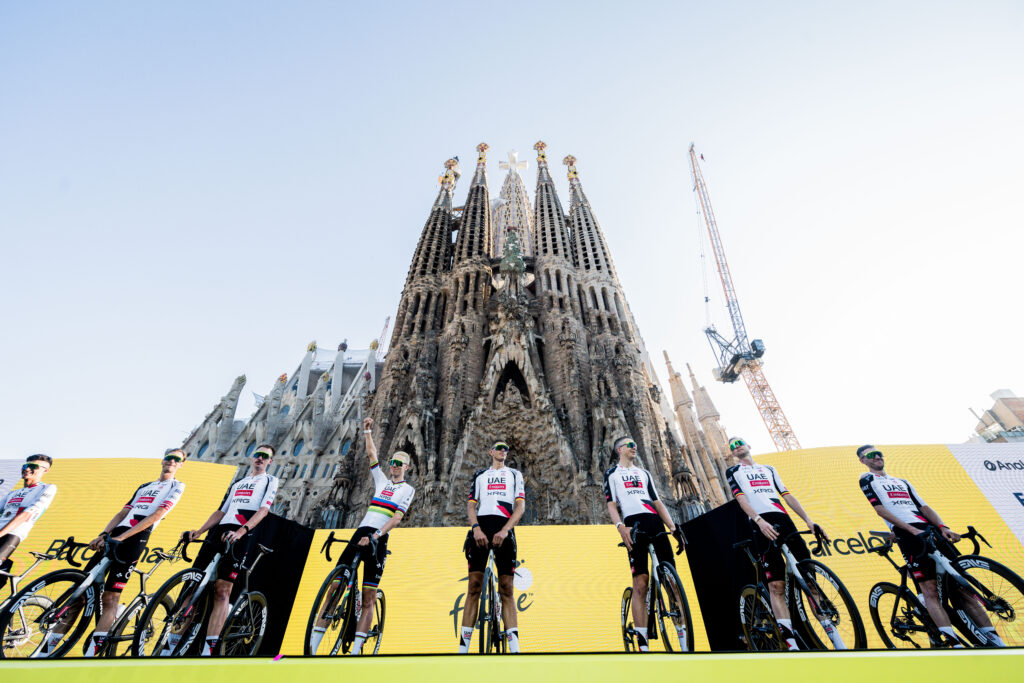
So, while teams like Ineos Grenadiers are greenwashing a company that is doing huge damage to our planet, UAE Emirates have the rider with the rainbow jersey, while also being backed by representatives of a country where being gay is illegal. Bahrain Victorious are sportswashing a country that has a human rights record described as ‘dismal’ by Human Rights Watch. They are all unlikely to reject this money until their backers do something so publicly awful that the existence of their teams are placed in jeopardy.























59 thoughts on “Israel-Premier Tech are finding out that sportswashing goes both ways”
Thank you George
Thank you George
Agreed. Nice to see a nuanced
Agreed. Nice to see a nuanced stance that doesn’t just tip toe around the main issue, and calls it like it is.
Seems a fair analysis. But
Seems a fair analysis. But thé basic problèm in cycling stays thé same – how to find enough sponsorship funding – clean or dirty …
Good article, well put.
Good article, well put.
Is Israel Premier Tech funded
Is Israel Premier Tech funded by the Israeli state?
The whole article only makes sense if it is.
I was under the impression it was not.
It’s funded by Sylvan Adams,
It’s funded by Sylvan Adams, a businessman known as the “self-appointed Ambassador at large for the State of Israel”. He supports the war against Palestine & has described it as ‘good versus evil’.
And?
And?
If I self appoint me to be an ambassador of the UK how does that suddenly mean Im an actual representative of the UK Govt? It doesn’t.
This whole mess is down to a bunch of ineffectual idiots who know they can do nothing to affect the Gazan genocide so they decide to lash at out the first target they can self justify, regardless of the actual validity of the target. So emotionally out of touch that they can’t internalise and admit their pathetic response is a child’s reaction to impotence.
They are the left wing equivalent of the stop the boats morons protesting outside hotels.
A pox on all of them.
Yawn
Yawn
Maybe we should interview the
Maybe we should interview the whole peleton, maybe with some waterboarding, to find their opinions on the Israeli Gaza war. Then people would know which individuals to attack, instead of stopping the whole race. Come on, you started it.
Maybe you should toddle off
Maybe you should toddle off back to Twitter where’s you’ll find a willing audience of gullible morons for the cobblers you spout?
‘Self appointed’ does seem to
‘Self appointed’ does seem to imply it’s not very official.
If we’re protesting based on what owners believe then we can kiss goodbye to any professional cycling for the foreseeable.
As the team is called Israel
As the team is called Israel Premier Tech, it does seem reasonable to assume a connection to the country of Israel.
If it was Iceland Premier Tech, there would be more room for doubt.
HarrogateSpa wrote:
Thats vile descrimination againsts purveyors of moderately priced frozen goods.
Beat me to it
Beat me to it
Mum’s gone to…
Mum’s gone to…
If a team was called ‘British
If a team was called ‘British Steel’ or ‘American Eagle’ would we assume an official connection to the governments of those countries?
With a comment such as “I’d
With a comment such as “I’d argue that the team’s association with the state of Israel is currently soiling the entire sport” I would need to know your opinion on the Israeli Hamas war before I could accept it as journalistic nonsense or as support for Hamas and terrorism.
What binary rubbish,
What binary rubbish, criticism of Israel’s actions does not imply support for Hamas.
Israel’s genocidal actions are far in excess of a proportionate response to Hamas’ murder spree.
Genocide? Israel has shipped
Genocide? Israel has shipped over 100,000 tonnes of food into Gaza. The only genocide is in the Hamas constitution, which is eradicate Israel and kill every last Jew.
Starship001 wrote:
And has shot people queueing up to receive it. This article might be of interest, demonstrating that the US/Israeli backed Gaza Humanitarian Foundation, distributing that food Israel has shipped into Gaza, employs members of MC Infidels, a US anti-Islamic biker gang, as security at £720 per day a man. This probably goes a long way towards explaining why hundreds of men, women and children have been killed around the aid sites whilst trying to get food.
Or alternatively “We were
Or alternatively “We were entirely fair – having locked them in prison, we even gave them a biscuit most days…”
The conditional provision (and limitations) of essentials – water, food, sewerage… – to some of the population in Israel is far from new to this latest war. Only the degree is perhaps.
No doubt Hamas etc. would reciprocate if they could – but they aren’t the occupying / surrounding power. And presumably even their current hostages are slightly more valuable to them alive.
This article may also be of
This article may also be of-interest.
https://www.npr.org/2024/11/21/nx-s1-5196553/a-closer-look-at-how-armed-gangs-steal-tons-of-aid-in-gaza
Those nameless “armed gangs” are Hamas. No one else in Palestine is armed, which is the whole point of Israel’s blockade. And despite those efforts, rockets and mortar rounds launched from Gaza rain down on Israel constantly.
https://www.amnesty.org.uk/unlawful-and-deadly-palestinian-rocket-attacks-gaza
It’s very interesting that Israel can supposedly control food distribution entirely, but they can’t prevent rockets and rocket materials (some are built in Gaza) from entering.
Regardless of that issue, it is asking quite a lot of Israel to expect them to secure Hamas’ supply lines while they are at war with Hamas, and to do so with, I guess, stern warnings and wagging fingers, so that no one gets shot.
dh700 wrote:
If the best defence of Israel you’ve got is an eleven-year-old article (2014, perhaps check your sources a little more carefully)…since the beginning of 2024, 14 Israelis have been killed by attacks from inside Gaza (source: United Nations Office for Co-ordiantion of Humanitarian Affairs) whilst 60,000+ have been killed by Israeli attacks on Gaza, 85% of whom (Israeli Defence Force figures) were civilians.
So your defense is that Gaza
So your defense is that Gaza has been raining attacks on Israel for many years — but you decline you count those victims.
If you want to believe in the innocence of Gaza, you’re going to find only disappointment.
https://www.fdd.org/analysis/2024/06/11/19000-rockets-launched-at-israel-since-hamass-october-7-atrocities/
https://en.m.wikipedia.org/wiki/List_of_Palestinian_rocket_attacks_on_Israel_in_2024
https://apnews.com/article/israel-hezbollah-hamas-latest-mideast-7-october-2024-d3d272d83e70d420ba547dbd7e09ef52
https://www.fdd.org/analysis/2025/04/07/10-rockets-fired-at-israel-amid-renewed-anti-hamas-protests-in-gaza/
As per usual, it’s amazing that are willing to comment here while being thoroughly unfamiliar with the topic at-hand.
Israel is outnumbered by
Israel is outnumbered by hundreds to one by neighbors who believe their god demands the obliteration of Israel. It doesn’t require an advanced degree in mathematics to figure out that a vastly outnumbered entity will be exterminated if they only respond “proportionately”.
This case is a relatively rare one where there is no middle ground. Hamas’ primary objective is the obliteration of Israel and a secondary goal is the extermination of all Jews. Both were declared publicly in their founding Covenant. Palestine elected Hamas two decades after that declaration, and Hamas’ support in Palestine skyrocketed after October 7. So one can either support Palestine and their genocide of Israel, or one can recognize Israelis’ right to exist and defend themselves.
And as I wrote previously, unless you have been one of 7m people fighting for your survival against roughly half the world — who hate you due to their belief in fairy tales and imaginary friends in the sky — I do not believe you have any standing to criticize Israel’s self-defense.
dh700 wrote:
Unlike Israelis of course, who believe that they have a right to all the lands from the Golan Heights to the Gulf of Arabia and the Dead Sea to the Mediterranean and the right to kill or deport all whose families have lived there for thousands of years because, umm…they were promised them in a fairytale from 3,500 years ago by their imaginary friend in the sky.
Even if accurate, which is
Even if accurate, which is questionable;
* Again, there is no other place on the planet that they can live.
* Displacing people is a damn sight better than exterminating them.
Even the right-wing Likud merely states, in their platform, that they want to control roughly that area. Nothing at all about genocide, which features prominently as the top agenda item in Hamas’ Covenant.
One has to be willfully blind to equate those positions.
dh700 wrote:
One has to be wilfully blind, deaf and staggeringly obtuse not to know that a United Nations special committee, Amnesty International, Médecins Sans Frontières, B’Tselem, Physicians for Human Rights–Israel, the International Federation for Human Rights, and the International Association of Genocide Scholars (amongst many others) all agree that Israel is carrying out a genocide in Gaza. So it’s OK to carry out a genocide as long as you don’t actually say it’s your aim?
Ah, but *their* fairytale was
Ah, but *their* fairytale was there first!
OTOH when did the Philistines get established? And of course they elbowed out (but intermingled with) pre-existing local folks whose baal(s?) probably had promised them the place (repeat)?
Beachboy wrote:
What part of this article suggests I support terrorism?
George Hill wrote:
I reckon it was the semicolon.
The part where you made
The part where you made accusations of genocide against Israel, but neglected to observe that there exists no definition of that word which applies to Israel’s actions and not also to everything that Hamas, Iran, Hezbollah, and others are doing to Israel.
dh700 wrote:
Even if one accepts that as true, you’ve entirely failed to explain how you make the leap from that to ‘supporting terrorism’.
Similarly, this is nonsense. They’re not ‘supporting Hamas’ – they’re supporting the rights of ordinary Palestinians to exist. Deliberately conflating the two does you no credit.
Perhaps not take it out on the entire population.
Binary nonsense. All sides
Binary nonsense. All sides wicked. Then read Ancient Near East Texts and see how current attitudes and behaviours go back many thousands of years
It seems that it’s becpme
It seems that it’s becpme obvious that so-called professional “sport” is no such thing but in fact a large set of PR organs designed to persuade we dafties who observe the various circus antics involved of some message or recommendation attached, from the advert to buy a daft cycling hat to the propaganda attempting to normalise the genocidal activities of a corrupt nation-state; and everything in between.
I recall a time when sport was actually abut the sport, played by amateurs to audiences of people who were associated with them via community or some other meaningful reltionship ………. although the Le Tour and its emulators have always been a commercialised enterprise created to sell things to people who don’t need them but are silly enoughto think that being a fan(atic) for some team or other is a good reason for buying or believing what the team represents.
Professional “sport” – just another armature of The Spectacle’s hegemony, made to keep the hoi-polloi groomed into believing and behaving as various Establishments prefer.
Cugel wrote:
You are Wowbagger the Infinitely Prolonged, and ICMFP.
Oh that it were so simple to
Oh that it were so simple to analyse multi-faceted situations ….
The ancient Olympic Games
The ancient Olympic Games would not meet your criteria as an apolitical and amateur event. You are pining for something that never existed
the little onion wrote:
Never existed, eh? Jumpers-for-goalposts to you, sir!
All them bike races and TTs I did, with a few friends looking on but no cameras. But I suppose you’re a-one o’ them that doesn’t believe anything not recorded (or generated by a vid-making AI) actually happened?
How much do they charge you for your cycle “sport” PR-loader sofa-fodder, BTW? You’ve got to admit that its a good trick – feed adverts and propaganda into your eyes and ears and also charge you for the “service”! Win-win for mass-media Svengalis.
Cugel wrote:
Those still exist though. A bit apples to oranges to compare those to elite sport, no?
And I wasn’t paid for playing
And I wasn’t paid for playing football in park. OP of elite amateur past forgot amateur sport of now and shamateurism of past
Nor clean… sheep testicle
Nor clean… sheep testicle for testosterone boost
Still is amateurs at local
Still is amateurs at local level and city centre criteriums are very low paid semi-pro or amateur. But local road racing is dying to rising costs and falling incomes. Sports with grounds fare better, eg cricket. UK amateurs of old were at big disadvantage not just to Eastern Europe but also mainland Western Europe. Beryl Burton did OK with her job of rhubarb farm labouring giving good training for bike riding. Pro cricketers had to get low level jobs in winter to make ends meet
“UAE Emirates have the rider
“UAE Emirates have the rider with the rainbow jersey, while also being backed by representatives of a country where being gay is illegal.”
This is some puerile fluffy-minded nonsense.
george wrote:
true though.
And which is basically
And which is basically bankrolling the genocide in Sudan
Says the straight entitled
Says the straight entitled dude.
george wrote:
Is this the new “woke”?
What part of “true” offends? https://en.m.wikipedia.org/wiki/LGBTQ_rights_in_the_United_Arab_Emirates
Team backed by representatives of government?
https://en.m.wikipedia.org/wiki/UAE_Team_Emirates_XRG
Headed up by His Excellency Dr. Sultan Ahmed Al Jaber (XRG Executive Chairman):
https://en.m.wikipedia.org/wiki/Sultan_Al_Jaber
I don’t think he’s trying to
I don’t think he’s trying to dispute that the UAE treats its LGBTQ+ citizens and visitors appallingly – the facts are there for all to see as you have shown – but rather saying it’s pretty silly to write as if there is some sort of irony or hypocrisy in the UAE team holding a rainbow jersey when there’s absolutely no connection between the rainbow awarded for cycling world championships and the LGBTQ+ symbol. Got to say I think he’s got a point there.
It’s true, not fluff at all
It’s true, not fluff at all
There are two true things
There are two true things there, but they’re entirely unrelated, so don’t form a coherent point.
mdavidford wrote:
They’re not quite __entirely__ unrelated. Rainbows have become sufficiently associated with LGBTQ that just this year, two people that I know — who are not fans of cycle racing — expressed to me, in different situations, the misunderstanding that World Champion rainbows were related to the former. In one case, surprise was expressed that a vintage bike would have such a modern “political statement” on it. I corrected them on both the meaning of the stripes and the fact that human rights are not a political statement.
The point being, if you ride a bike with WC rainbows on it, or use some Ritchey components older than this year, some people will misunderstand those symbols.
I find it disgusting that Mr
I find it disgusting that Mr Hill dare describe Israel as sportswashing. 1500 innocent Israeli citizens were victims of the most depraved and barbaric pogrom since the holocaust, by an outlawed terrorist group. Even before Israel launched any retaliatory action to retrieve the hostages, so-called Palestinian flags were flying throught the west. And now even a formerly serious cycling blog is essentially saying it has no right to defend itself. Goodbye!
Misreading of article. Nobody
Misreading of article. Nobody denies Hamas and Iran are devoted to annihilation of Israel so Istael faces existential threat shown to get real by that event. But decades of settler and other Israel attitudes and actions account for more than 1500. Reading Ancient Near East Texts shows current behaviours, attitudes, and language go back thousands of years in that region of Fertile Crescent bottleneck
So, a couple things… On the
So, a couple things… On the day that Hamas was founded, they made the obliteration (their word) of Israel their primary objective, in their “Covenant”. A subsequent goal is the extermination of all Jews. This document is available online, and anyone can read it. And the repulsive individuals supporting Hamas by waving their flags at races and elsewhere desperately need to do so, if they are unaware that they are supporting neo-Nazis bent on actual genocide. If they are aware, then they are neo-Nazis themselves.
Secondly, Israel has tried to make peace many times over the past almost-century, to no avail. They even gave back the entire Sinai, after Egypt got FAFO’d, which might be unprecedented. But the unfortunate bottom line is that no one can negotiate with people who believe that their god demands your extermination. And Israel is outnumbered by hundreds to one by neighbors who hold that belief.
So what, exactly, would you suggest that Israel do? Roll over and die? How does that not make you a genocidal maniac? Continue to allow their enemies to exact a death by a thousand cuts? Same question follows. There is nowhere on the planet where Israelis can live in reasonable peace and security — that’s the entire reason why Israel had to be created in the first place. Meanwhile, just about every Muslim country in the world could offer to resettle Palestinians in reasonable peace and safety. Yes, I realize this means people would have to leave their homes — welcome to club, as that’s already the case for most Israelis who were unwelcome in their former homelands. No country will make this offer, though, because dead Palestinians are more valuable to their cause than live ones.
Unless you have ever been 7m people fighting for your survival against half of the world, who hate your kind for imaginary reasons, I question your standing to judge Israel’s conduct. Especially since there is no means by which one can prosecute a war against an enemy who has no military facilities and no compunction against using human shields, without incurring civilian casualties. There is nothing stopping Hamas from fighting in the open, except that doing so would starve them of the “martyrs” that they use as fundraisers.
Finally, the only definition by which Israel has committed genocide — the uselessly vague UN Article 2 definition — also includes every attack that Hamas, and Iran, and Hezbollah, and others are launching at Israel every day. In fact, every bit of violence with more than 1 victim is “genocide” per that definition.
There are only two solutions to this problem. Either eradicate anti-Semitism (good luck, considering the number of neo-Nazis lining recent race courses, and the number of same voting for far-right parties across much of the world) so Israelis can live elsewhere in safety, or move the Palestinians elsewhere and kill every member of Hamas. Israel can’t do the first option, so they are trying the second one. They’ve no other choices, except dying.
Israeli government spokesman
Israeli government spokesman perhaps ?
Suggesting people who support
Suggesting people who support Palestinian people are ‘neo-nazis’ who also support Hamas is really not helping your argument.
Yitzhak Rabin found an answer
Yitzhak Rabin found an answer and was assassinated for it. His murderer was not a Palestinian but an Israeli right-wing extremist. So, the tragedy continues to spread its malevolent shadow while destroying and devouring more innocents than demons.
Starship001 wrote:
Support Israel’s actions or don’t, say the Palestinians deserve everything they get or don’t, but please don’t insult everyone’s intelligence by saying that bombing hospitals and residential tower blocks or shooting dead children queueing for water is in some way an action taken to “retrieve the hostages”. Just don’t.