


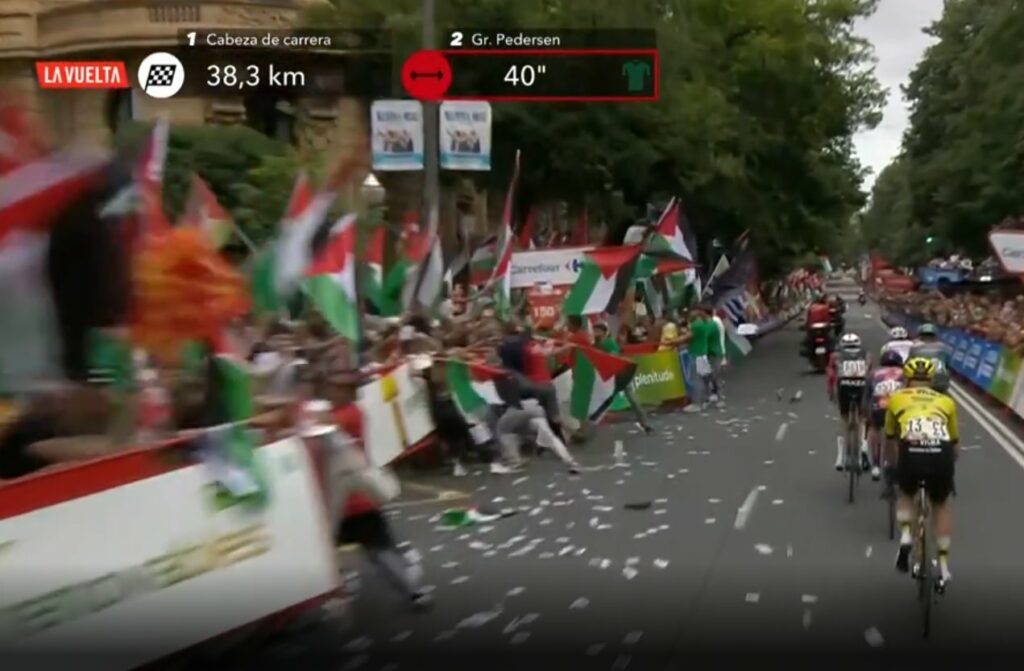

Stage 11 of the Vuelta a España was dramatically curtailed on Wednesday as organisers ruled the finish in Bilbao unsafe due to barriers pushed further back than usual and large roadside flags creating risks for the riders, with no stage winner declared and general classification times taken 3km from the line.
The race organisers announced via Radio Tour: “Due to some incidents at the finish line, we have decided to take the time at 3 kilometres before the line, we won’t have a stage winner. We will give the points for the mountain classification and the intermediate sprint, but not on the finish line.”
🇵🇸| Bilboko Kale Nagusia Palestinako banderez josita dago, horrela igaro da lasterketa helmugako lehen pauso honetan. #LaVuelta25 #StopGazaGenocideNOW 👇🏼 pic.twitter.com/Ek7gzVTpkJ
— Malcolm iXa 🍉 (@ideiazabaldub) September 3, 2025
Once the announcement was made, João Almeida and Jonas Vingegaard, the top contenders for the red jersey, were seen talking to each other — before it was confirmed that riders were not to go through the finish line in Bilbao at all.
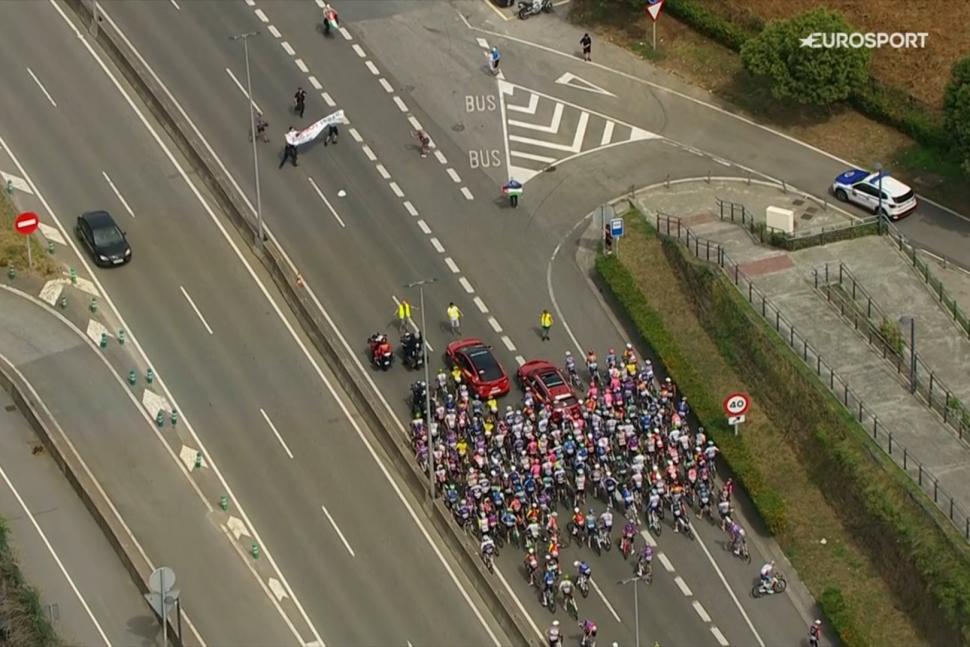
The disruption began even before the racing had started, when protesters blocked the road in the neutral zone and forced the peloton to a halt. Riders were stopped while police cleared the demonstrators, who carried banners and Palestinian flags, before the stage was eventually able to roll out of Bilbao.
🇵🇸| Segundo intento de cortar la etapa en la subida al Vivero. La organización de #LaVuelta25 acaba de anunciar que la etapa no finalizará en la meta de La Gran Vía de Bilbao ante la presencia masiva de manifestantes. Se tomarán tiempos 3km antes.
WIN✌🏼pic.twitter.com/FWFOvi11bN
— Malcolm iXa 🍉 (@ideiazabaldub) September 3, 2025
When the race passed the finish area for the first time with 38km remaining, pamphlets bearing the slogan “Israel Genozida. Euskal Herritik Kanpora” (“Israel genocidal. Out of the Basque Country”) were thrown onto the road, and large Palestinian flags were draped over set-back barriers, adding to safety concerns.
Then, at 27km to go on the Alto del Vivero, protesters held a banner across the road, forcing riders to move out of the way, with Tom Pidcock having to duck underneath it. Shortly afterwards, organisers confirmed the finish would be neutralised with GC times taken at 3km to go.

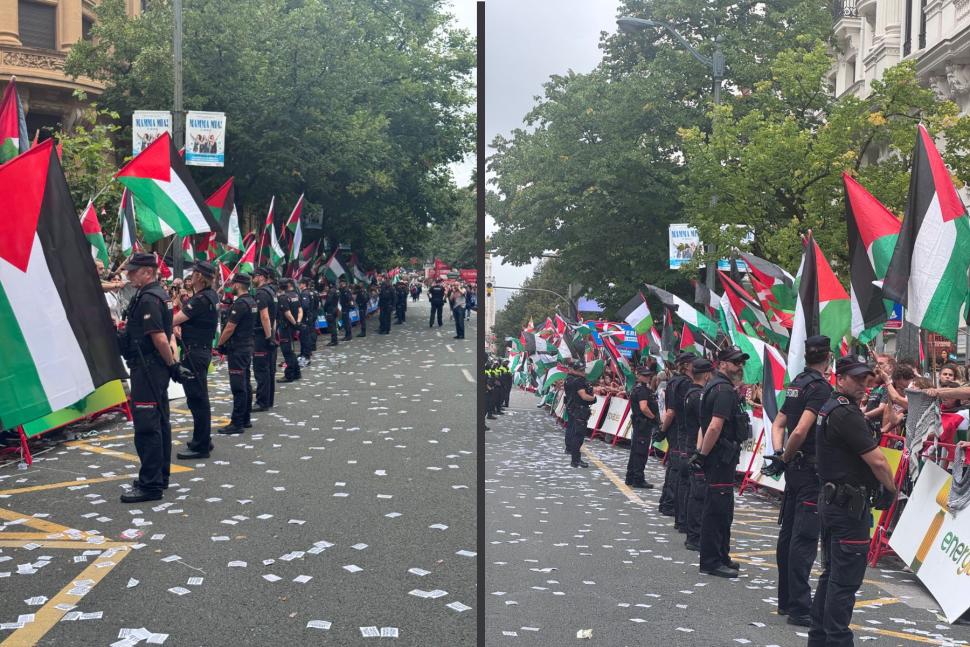
Images showed a heavy police presence at the line, with riot officers facing protesters holding flags over the road. One local activist posted on Twitter/X: “There will be no winner after the stage finish was suspended due to the massive presence of pro-Palestine protesters. The finish line is packed with Ertzaintza riot police. This is what happens when you try to whitewash genocide.”
Another message from the same account, sharing video of the Vivero disruption, read: “Second attempt to cut the stage on the climb to Vivero. The organisation of La Vuelta has just announced that the stage will not finish at the finish line on La Gran Vía de Bilbao due to the massive presence of protesters. Times will be taken 3km before.”
The protests once again targeted the presence of Israel-Premier Tech in the peloton, following similar actions at stage five’s team time trial in Figueres and during stage 10 to Belagua, when Intermarché-Wanty’s Simone Petilli crashed after demonstrators entered the road.
Petilli said afterwards that riders “feel in danger” and are “just cyclists doing our job,” comments echoed by the CPA riders’ union president Adam Hansen, who stressed this morning: “Cyclists are not involved in political or social disputes — they are simply doing their job: racing. Their safety must never be put at risk.”
CPA representative Elia Viviani told the Cycling Podcast that the union would support racing continuing as long as protests remained peaceful. “If it’s all peaceful, then there’s no problem, so the race will proceed normally. We are dependent on that. If there are falls, danger and so on, then we’ll decide what we do,” he said.
The neutralisation overshadowed what had been a tense day of racing, with repeated attacks on the climbs around Bilbao. Tom Pidcock and Jonas Vingegaard both gained time on the Alto de Pike, while João Almeida was dropped, but with the stage ending 3km out those gaps will be reflected only in the general classification.
The Basque Country has shown strong solidarity with Palestine throughout the race, with roadside flags, chants of “Palestina” and graffiti reading “Netanyahu Assassin” visible on previous stages. Guernica, from where the peloton passed earlier today, has one of the region’s most active pro-Palestine movements, its history as a symbol of resistance during the Spanish Civil War often linked to the current struggle.
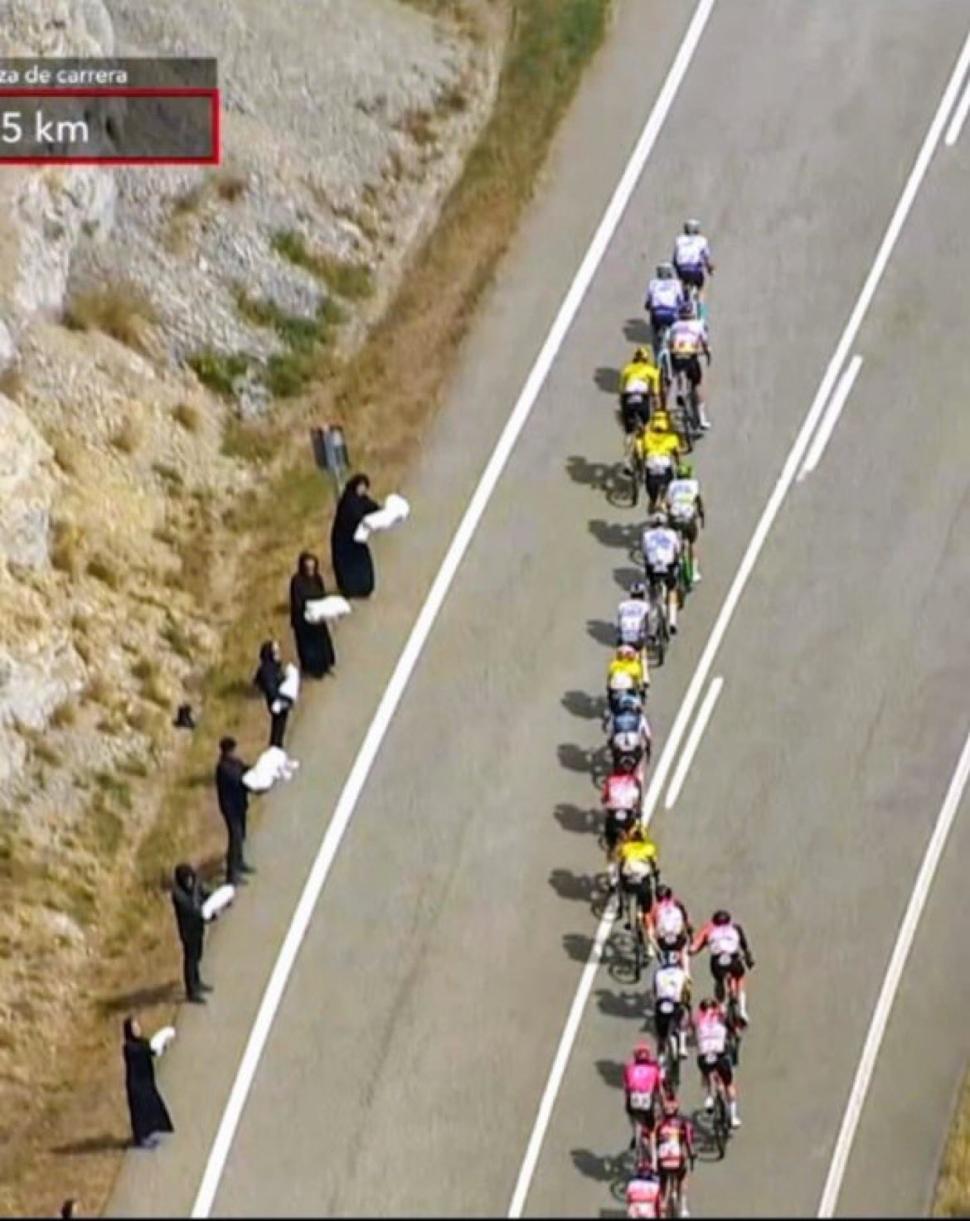
On one occasion today, the broadcast cameras caught a line of people dressed in black standing silently at the mountain roadside, each holding objects wrapped in white cloth to symbolise the children killed by Israel in Gaza.
Israel-Premier Tech, co-owned by Canadian-Israeli billionaire Sylvan Adams, has long been criticised by campaigners who describe the team as a vehicle for “sportswashing” Israel’s image.
Earlier this year, Adams said the Israel Defence Force “needs to finish the job” in Gaza, remarks that provoked outrage among human rights groups. Protesters argue that the team’s place in the peloton endangers riders and that the UCI should follow its precedent of banning Russian and Belarusian squads after the invasion of Ukraine, with the Boycott, Divestment and Sanctions movement (BDS) brandeding IPT as “Team Genocide.”
Spain’s prime minister Pedro Sánchez, the first senior European leader to accuse Israel of genocide, reinforced that view in an interview with the Guardian published today, calling the assault on Gaza “one of the darkest episodes of international relations in the 21st century.” He warned that Europe’s “double standards” in its responses to Ukraine and Gaza risked undermining its credibility.









22 thoughts on “Vuelta finish scrapped after pro-Palestine protest in Bilbao, with no stage winner and GC times taken 3km out”
¡No pasaran! indeed
¡No pasaran! indeed
Sorry riders but opposition
Sorry riders but opposition to genocide trumps how hard you’ve worked. Its one stage. You probably weren’t going to win it anyway.
Trumps bike racing full stop.
Trumps bike racing full stop.
With no intent to bring Trump into this, it’s bad enough already.
Earlier this year, Adams said
Earlier this year, Adams said the Israel Defence Force “needs to finish the job” in Gaza, remarks that provoked outrage among humans.
Fixed it for you roadd.cc. no need for “rights groups” at the end of “humans”.
Here’s a suggestion of a
Here’s a suggestion of a small way all roadcc readers can help.
Why not stop buying all sponsor supplied equipment used by the Israeli team and tell your friends to do the same.
Mr Blackbird wrote:
And just as important is to tell the brands that you’re choosing to do that and asking others to follow suit.
Factor, Ekoï, Dare 2 Be, Elite, Selle Italia, Morgan Blue and more.
If race organisers and riders don’t want the stage disrupted then they need to think long and hard about what prompted it. We’re not talking here about obstreperous French farmers or exploited factor workers, this is genocide by one nation against its neighbour. If anyone is not outraged by what is happening in Gaza then they are in effect a supporter of the deliberate murder of many thousands of innocent civilians including children, medical staff and volunteers, aid workers and journalists and the systematic eradication of a population.
Simon E wrote:
Although that would be another reason to protest IPT.
mdavidford wrote:
Although that would be another reason to protest IPT.
— Simon EHa ha, well spotted! It was completely unintentional.
Thanks for the list, made my
Thanks for the list, made my job easier.
So that’s a Factor Ostro VAM with Black Inc wheels and Selle Italia saddle for my next bike then.
“Spain’s prime minister Pedro
“Spain’s prime minister Pedro Sánchez, the first senior European leader to accuse Israel of genocide, reinforced that view in an interview with the Guardian(link is external) published today, calling the assault on Gaza “one of the darkest episodes of international relations in the 21st century.” He warned that Europe’s “double standards” in its responses to Ukraine and Gaza risked undermining its credibility.”
So why is the Spanish Prime Minister allowing IPT to race in the “Tour of Spain” if he doesn’t want double standards
EK Spinner wrote:
Money?
EK Spinner wrote:
Because Spain isn’t a dictatorship and hasn’t been since 1978, the Cortes Generales or the EU would have to pass legislation banning Israeli athletes or teams representing Israel, he can’t just do it by fiat.
So a bunch of Basque
So a bunch of Basque separtist terrorist supporters disrupt a cycling race in support of Hamas and Hezbollah terrorist supporters.
VoiceOfLondon wrote:
Alternatively, a bunch of people who believe in freedom and autonomy for the Basque region supporting those who believe in freedom and autonomy for Palestine. Even in Gaza Hamas is only supported by around 35% of the population; labelling everyone who supports a cause for which some people have committed terrorist acts as a terrorist supporter is naive and cheap. I personally support a united Ireland but I abhor every act of violence committed by the IRA; I support an independent Palestinian homeland but the massacres of October 7th revolt me; I support Israel’s right to exist as a sovereign nation but not her desire to slaughter, oppress or displace every Arab between her 1967 borders and the sea.
Perhaps the Arabs should have
Perhaps the Arabs should have though of that before they started it.
Anyway, I’m not losing any sleep over it, I’d rather watch the cycling, come on IPT!
VoiceOfLondon wrote:
You appear to be suffering under a misapprehension, we’re talking about a seven-decade-long conflict that has cost hundreds of thousands of lives, caused untold suffering and has the potential to act as a flashpoint for a global war that would annihilate civilisation as we know it. It’s not a fight in the primary school playground at lunchtime.
But all that can still
But all that can still clearly be summarised as “the ‘arabs’ started it” (possibly in the 7th century? https://en.m.wikipedia.org/wiki/Early_Muslim_conquests) as our knowledgeable friend puts it ?
chrisonabike wrote:
Well what about old Moses and Joshua then? Or Jehovah, ultimately…
Personally I’m with Havelock Ellis (from memory so forgive errors): “The entire religious complexion of the modern world is due to the absence from ancient Jerusalem of a decent lunatic asylum.”
Are you counting Moses as a
Are you counting Moses as a middle-class Egyptian revolutionary (with a convenient origin story) or a Hebrew irridentist? And both traditions claim him.
And of course the Philistines? Bunch of foreigners who barged in to the place and oppressed the locals… https://en.m.wikipedia.org/wiki/Philistines
Highly suspicious chap, old
Highly suspicious chap, old Moses: I remember seeing a Jewish comedian years ago, name escapes me, who said: “So Moses, he goes up the mountain on his own and comes back down and says I’ve been speaking to God and he says this is what you’ve got to do. Seriously, he said that to a bunch of Jews? If they were anything like my family they would’ve been like, ‘Oh so this God of yours only speaks to you, what we’re not good enough for Him, He’s too busy to have the manners to come and talk to our faces? What is He, agoraphobic?'”
Rendel Harris wrote:
Hopefully they have one now, it sounds like it’s needed:
https://en.m.wikipedia.org/wiki/Jerusalem_syndrome
VoiceOfLondon wrote:
You are you a geopolitical advisor to Donald Trump and ICMFP.