



Last month, we published an article asking if the bike industry is doing enough on climate action, which referred to the results of a survey that found 62% of those in the industry thought they were doing a good job on sustainability. This compared to only 23% of consumers who believe the same thing. To be honest, I am not surprised by either of these numbers, because I think the entire cycling industry and the way it sells products is fundamentally unsustainable.
Granted, those 62% of industry people patting themselves on the back have overseen massive improvements in manufacturing sustainability, supply chain sustainability, and even basic packaging improvements. This is undoubtedly something to celebrate, because being better than we were yesterday is positive. However, the way this should be seen is not that we are now doing well, but that we are – in general – just not doing as badly.
We know that once a bike leaves a shop, it is one of the most sustainable modes of transport ever invented. So much so that research has shown that a human on a bike is not just the most efficient way for humans to travel, but more efficient than any living thing. However, the reason the performance cycling industry is not sustainable, and cannot be in its current guise, comes from almost every step before that.
Think about the way that the industry sells bikes and components, combined with the iterative development practices that almost every manufacturer uses. There is no other sport in the world that is more wedded to the secret squirrel philosophies of lots of small training and equipment improvements, making a larger compound performance improvement.
We are seeing millions being spent on components that have a tiny improvement over what they replace, then the component that is replaced is normally just chucked in the bin or left in a box for years before being chucked. Think about how many high-end derailleur cages have been lobbed in the bin because somebody heard that oversized jockey wheels will save you a couple of watts over 100km, then think about whether the proportion of people buying them who would have the athleticism to even come close to seeing the performance benefits.
Even when we picture a modern performance frame compared to 20 years ago, it is made from carbon fibre, a material that releases an estimated 24kg of carbon for every kilogram created.
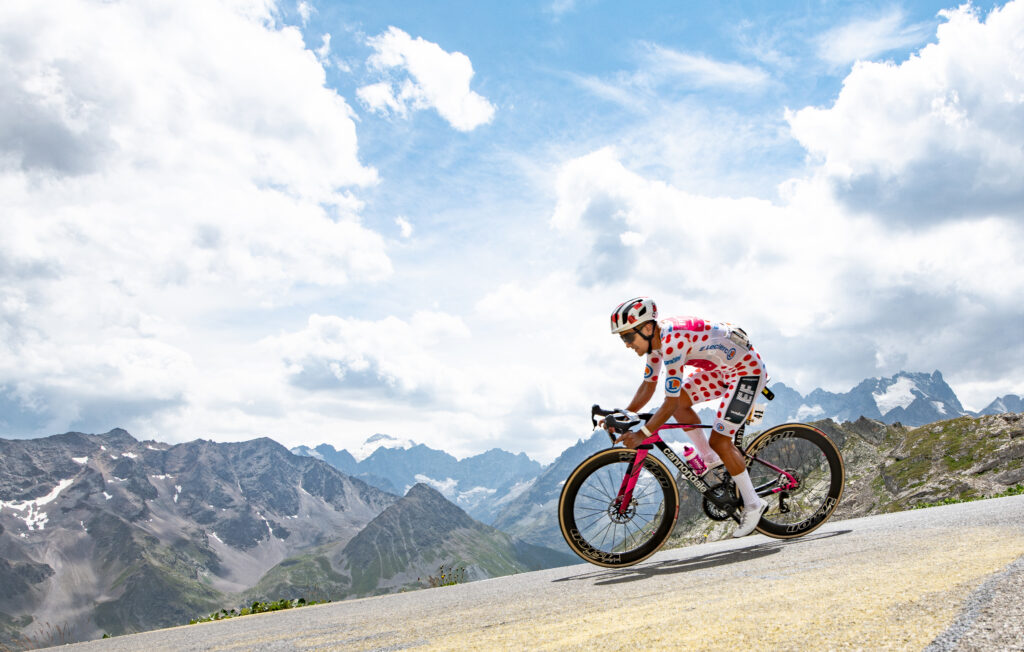
Yet, the fastest ever ascent of Alpe d’Huez, arguably the most famous climb in cycling, was done by Marco Pantani on an aluminium bike in 1997. It’s highly likely other unethical things were going on to get that record, but his bike was a very respectable 7.8kg, and the frame was made from a material that emits under 4kg of carbon for every kilogram created. Despite this, no team has competed in the Tour de France on an aluminium bike since 1998, and besides a handful of titanium frames, carbon fibre is the material used by almost every serious hobby cyclist since then.
Let’s say for sake of argument that 1 million carbon frames have been made each year on average since 1998 (the true figure is much higher) – if those frames had been made from the same material that Pantani used to conquer the Alpe d’Huez, we would have saved well over half a billion kilos of carbon released into the atmosphere, which is the equivalent weight of 50 aircraft carriers. All because we’re told that carbon fibre will make us a little bit faster, and make our bikes a little bit lighter.

There are bright points where we have genuinely seen an improvement in sustainability due to new cycling tech, so I don’t want to put a total downer on things. Disc brakes being used on basically every serious new bike, regardless of discipline, over the last decade has had a massive sustainability improvement. With this change, wheels have ceased to be a consumable and have become as much of a component as a frame or bars, all while improving braking performance and increasing rider safety.
With the majority of disc brake rotors being made from stainless steel, 1kg of which can be made with as little as 0.5kg carbon released, this significantly reduces the environmental impact of a bike compared to having to replace your wheels every few years, and burn through lots of pads.
I say all this, but the idea that performance-orientated cyclists should be self-flagellating because our hobby is unsustainable is insane. Bikes get us places with practically no emissions after the bike has been made and transported to wherever you bought it from. They keep us fit and healthy, and give us a genuine alternative to more polluting forms of transport. In fact, the tactic that thousands of towns of cities across the world have used to try and increase their sustainability has been to increase the number of people using bikes, so it would be a mad to say the industry is a net negative on the whole.
However, I think we should look in the mirror at what we’re doing as consumers and how damaging the performance end of the market can be to the environment.
Performance does not always come from carbon intensive materials. Of the few bikes that have even received a perfect score in road.cc reviews, most of them have steel frames. The Fairlight Strael 4.0 that got a 10/10 score just this year is steel-framed, it looks amazing, and is “the closest bike to perfection I have ever ridden” according to Stu. It’s far more sustainable to produce than a carbon fibre equivalent, yet better according to, I would argue, one of the most experienced bike reviewers working today.
So, do we really need to sacrifice sustainability for performance? Evidence would say otherwise.










56 thoughts on “The cycling industry is not sustainable by design”
Yeah there’s a lot of BS
Yeah there’s a lot of BS going on with the eco thing and bikes. One recent WTF was seeing that starva adds a tag to rides saying I ‘saved’ Xkgs of emissions. I mean seriously? On a Sunday group right I would only be saving emissions compared to myself driving around the same route. Even comutting ‘saving’ emissions assumes I am driving to work where I suspect that my commute by tube probably saves zero emissions (the electric tubes are going anyway right?) In reality I emit more because I ride a bike – 50% of my car use is getting to the start of rides. I am not anti eco at all but we do need to start with some basic honesty about our consumption habits and stick to some obvious principles like: Ride everything until it wears out before you replace it. Second hand is good. Ignore cycle tech influencers and cycling websites 🙂
… don’t drive to the ride?
… don’t drive to the ride? 😉
Strava only descrobes CO2
Strava only describes CO2 savings on rides tagged ‘commute’. I doubt you would do this for your Sunday group ride or if you drive somewhere to start your ride.
My option if I don’t cycle to work is to drive. In my case it is probably fairly accurate to describe those as saving emissions.
Ok, I didn’t know that
Ok, I didn’t know that
Just a quick edit for ya:
Just a quick edit for ya:
You’re welcome!
There’s this principle which says “anything before BUT doesn’t count”. So true.
alotronic wrote:
Does that mean the other 50% is getting home again afterwards?
Touche!
Touche!
It’s called ‘capitalism’ and
It’s called ‘capitalism’ and it’s no way to run a planet with finite resources. While I hope that I’m doing my bit, I’ve had the same metal bike since 2013 and the metal bike I had for ten years before that is now my cousin’s, individually we can do little, collectively we can do much. We just have to collectively push ourselves away from shop counter shouting “no more shiny bling for me Ma…’
jaymack wrote:
TBF nobody has told the viruses yet. A natural solution would be to ensure they *do* die where they have consumed all the local resources – but of course that’s too bad for everyone else. (And governments tend to prop them up or let them off the hook). So perhaps we need something that preferentially eats successful capitalists? (of course they already have cannibalistic tendencies).
chrisonabike wrote:
You mean progressive taxation?
These comments are at odds
These comments are at odds with the ethos of all the Campag. topics around at the moment. Apparently, their components ‘look beautiful’ whereas, to the Philistines among us, anything that works well on a bike looks good. I was surprised by these comments and I don’t think I have ever overtly considered the looks of a bike except for ones that look obviously stupid and therefore ‘ugly’. I’m fairly sure I had a Campag rear derailleur around 1970 because Shimano Crane I saw at that time were all short arm. Since then it’s all been Shimano or Rohloff and they all look good to me!
…and the lead story on Road
…and the lead story on Road.cc right now?
“Game-changing” Q36.5 x SRM collaboration promises “the most direct and efficient pedalling system on the market”
https://road.cc/content/tech-news/check-out-most-direct-and-efficient-pedalling-system-317149
It feels like the focus on
It feels like the focus on frame material is misplaced. Sure, using aluminium or steel is better for the environment, and you can still get excellent performance, but over the lifetime of a bike, the difference is pretty negligible.
For context, the average UK carbon footprint is (depending on source), in the region of 10 to 13 tonnes per year. This equates to 27 to 36 kg per day. So the difference between an aluminium and carbon frame, something you might purchase once every few years, is less than the average amount you emit every single day.
The average petrol car has emissons of around 130g CO2 per km, so it emits 24 kg of carbon every 185 km or so. The average person drives that far every roughly two weeks [source].
A latte has a carbon footprint of around 0.55 kg, so if you go out with your cycling club once per week and always get a coffee, in under a year, that weekly coffee would have contributed more to climate change than the bike you’re riding.
Also maths check: if an aircraft carrier weighs around 100,000 long tons [source], that’s 101,600,000 kg. So you only need 5 aircraft carriers to hit “half a billion kilos,” not 50.
Not to mention the 6-8 kg of
Not to mention the 6-8 kg of CO2 you exhale per 100 km of riding. You wouldn’t do that if you decided to stay on your sofa
This is mostly a nonsense.
This is mostly a nonsense. Dedicated road bikes are not particularly sustainable, but their sustainability impacts are minimal coz their volumes are so low. For every bike featured in Road.cc there are a hundred BSOs made and distributed that never need a service or fixing.
By and large the volume bike industry is sustainable.
I have two bikes, one is
I have two bikes, one is nearly 30 years old and has received new wheels, chain set, derailer, saddle and other parts in that time, but is capable of recieving long established standard components, with everyday tools being all needed, My other is eight years old but again is easily repairable, with standard components. As I’m aging and struggling on hills with a loaded bike I thought about a lighter weight e_bike but was alarmed to find that the batteries of such bikes are built into the frame and not easily replaced with an expected lifetime of only five years!
Robert Hardy wrote:
If you only have to replace them every five years, it doesn’t have to be easy, just doable. The largest bike company in the world will sell you a replacement battery, so it can be done.
Robert Hardy wrote:
They’re generally fairly easy to replace, on Mrs H’s Orbea Gain e-road bike (which uses the common Mahle X35 system) you just take out six screws and unplug two wires and it slides straight out of the frame. In terms of battery lifetime, she may not be a typical use case as she only weighs 55kg and rides most of the time on the lowest assistance level, but she’s done 17,800 km on it, according to the app that links to the bike, and it’s still charging to 100%.
Rendel Harris wrote:
With old batteries, the 100% figure you see on the display rarely means 100% capacity.
With that said, modern batteries are indeed light years ahead of their older counterparts.
That’s true of on-bike
That’s true of on-bike displays, certainly, but this is a battery health reading from the ebikemotion app which connects via bluetooth to the battery and from previous experience with the same model does show battery degradation pretty accurately.
That is quite impressive then
That is quite impressive then – and speaks well of Orbea. Good for you!
I agree. Batteries can last a
I agree. Batteries can last a long time if you look after them. Keep them indoors when it’s cold, don’t let them run flat, keep them at 75% charge, don’t use the ‘turbo’ mode all the time . . . . . I have Bosch batteries that are older than 5 years and still give optimum performance. The one battery that I have replaced in the last ten years makes an excellent door stop.
Rome73 wrote:
So they’re not ready for a decent ride at short notice?
“this significantly reduces
“this significantly reduces the environmental impact of a bike compared to having to replace your wheels every few years, and burn through lots of pads. “
Bicycle rims are also made from steel and aluminium, you know. Besides, carbon rims are more durable than you think. I have decades old carbon wheelsets that are nowhere near needing replacement.
The real villain is in convincing people they desperately need the new thing every year or two, which is also what sustains websites such as this one
I think the energy taken to
I think the energy taken to create the items, as well as the carbon footprint of the raw material is key. A6061 alu frame and fork requires 1700kwH to make one frame, the same that the average household uses in a year! for our own clothing industry, we are moving to fully recycled fabrics BUT have yet to find a recycled polyester that is produced at a lower energy requirement than origin materials. so which is better for the earth. ‘New’ plastic polyester and nylon made from the earth’s limited oil reserves or recycled fabrics which require more energy (oil) to turn them from oil into lycra.
Buy less is the only real option
galibiervelo wrote:
I’m calling bullshit on that figure unless you have information to back it up!
I can’t vouch for any of
I can’t vouch for any of these numbers, but I am pretty certain that the 4kg of carbon per kg of aluminium number in the original article is wildly innacurate.
For purity reasons, very little of the aluminium alloy that is used in cycling is sourced from recylcing. It’s almost all primary aluminium which puts the cradle to gate value at an average of 14kg per kg. Add in the fact that most of the alumimnium is from China and the fact that alloy production is probably relatively small scale and my guess is you are looking at 20-30kg per kg for A6061 depending on the facility and source of the various alloying materials.
Trek has some numbers. Their
Trek has some numbers. Their website isn’t the easiest to navigate (I found this by following a link from another page, from a google search result – no idea how I would navigate to here just from Trek’s home page): https://www.trekbikes.com/gb/en_GB/the-rule-of-430/
My reading is that making the aluminium frame of a Marlin contributes 17% of 116 kg CO2e total, so that’s 19.7 kg CO2 for the frame, which apparently weighs ~2kg (depending on size). So ~10 kg CO2 per kg of finished frame.
For the carbon framed Madone, the frame contributes 29% of 197 kg CO2 total, or 57.1 kg CO2. Apparently the frame plus fork weigh ~2kg (for the Gen 6 disc) so let’s guess ~1.5 kg for the frame alone (emissions for the fork are listed separately), so this is then around 38 kg CO2 per kg of finished frame.
My take home messages:
George’s numbers do differ from those presented by Trek, but the pattern is the same (i.e. manufacturing carbon frames does contribute more CO2, per frame and per kg, than aluminium ones).
I don’t want to say George’s numbers are “wildly inaccurate” as there are many aspects to consider, and lots of genuine variation depending on e.g. where raw materials are sourced from; how factories are powered etc. It may also be that George’s numbers don’t take into account full frame production (i.e. going from an aluminium billet to a finished bike frame).
“kg CO2 per kg material” is not necessarily the best metric – “kg CO2 per frame” is better. It doesn’t change the overall picture, but if a steel frame weighs more than an aluminium frame, which in turn weighs more than a carbon frame, then that needs to be taken into account in any calculation.
The frame is only one part of the overall carbon footprint of a bike. It’s possible that something like the Fairlight Strael, as reviewed with deep carbon wheels, carbon seatpost, Di2 shifting etc. would end up with a total carbon footprint greater than an entry level carbon-framed bike (with alloy wheels, mechanical groupset etc.). Obviously that’s not a like-for-like comparison, but illustrates that it is overly simplistic just to say steel/aluminium frame = good; carbon frame = bad.
I’m sorry to disagree, but
I’m sorry to disagree, but aluminium mining is a 100% enviromental disaster where I live. The miners do excellent PR and have the public thinking it’s green because beer cans are recyclable. But really most aluminium is used in construction and cars and planes and food packaging where it gets bonded to other materials making it expensive to recover. Alcoa was even at one time principal sponsor of Birdlife Australia at the same time as being a major reason black cockatoos were on the brink of extinction. (Cockatoos need trees at least 200-300 years old for nesting as these have hollows in them – Alcoa and South32 and the other miners have to clear fell the forests to get to the resources below.) This article is mostly about the CO2 emissions but it shows the clear felling areas as well.
https://www.abc.net.au/news/2025-08-14/wa-alcoa-expansion-drinking-water-concerns/105651722
I agree aluminium has
I agree aluminium has environmental problems
Nothing humans do is
Nothing humans do is sustainable with 8 billion of us on the planet. The best thing we can do is reduce our personal footprints as much as possible while not having children.
TBF like many several species
TBF like several species over the ages we’ve just burst out of prior constraints (see eg. the great oxygen catastrophe). In our case we’ve managed to eat or starve our predators, vastly expand our food sources and even dodge some pathogens.
We can see if we can set up some conspiracies to maintain the commons. But also recognise that we aren’t *that* special – environmental destruction and extinction are natural phenomena.
Regarding disc brakes,
Regarding disc brakes, downside is that the pads are less sustainable than rubber rim pads and in my experience need replacing more often.
Regarding disc brakes,
Regarding disc brakes, downside is that the pads are less sustainable than rubber rim pads and in my experience need replacing more often
Except that’s obviously untrue- unless you mean that you can’t use the rim brake bike in all those nasty wet, gritty conditions because the brakes don’t actually stop you, so the brake blocks are preserved by lack of use. Some of these recurring anti-disc sentiments are so daft that they suggest desperation. Rim brakes have had it, except for very minor special cases, and they’re not coming back.
but they haven’t gone away
but they haven’t gone away either… have they?
<>but they haven’t gone away
but they haven’t gone away either… have they?
Disc users have no interest in whether they ‘go away’ or not, whereas rim evangelists seem to be obsessed with the futile Cnut-like task of trying to stem the tide of better brakes
Couldn’t give a flying fuck
Couldn’t give a flying fuck if discs become/are the norm. I’m not arsed about trying to stem the tide of anything. I have both rim and disc brake bikes. The rim brake bike works absolutely fine (so does the disc brake bike). As long as I can still purchase brake pads and cables I see no reason to get rid of the bike. Environmental footprint and all that.
wtjs wrote:
As a clarification, Cnut, unlike thse anti-progress folk was well aware his tide forbidding protest was in vain. He was demonstrating that he was just a human not a divine appointee.
wtjs wrote:
In your own bicycle stable / pros perhaps …
Discs are good, happy with mine, and getting used to them now. (I came very late to them). Would I go back? Well, I still have one rim braked bike… perhaps I’ll really find out the first time I need to bleed and service my hydraulics…? (Or maybe I’ll change my habits and just take it to the LBS.)
FWIW I’ve tried a fair smattering of bike braking solutions in my life (from hydraulic discs and rim brakes, cable discs, v-brakes, calipers, drum brakes, “leg brake” (fixed) … and a few scary times “shoe brakes”). Rim brakes have been “good enough” for most of my life! (Also recall back when eg. Shimano were concerned about “better” brakes being *too* efficient for casual users …)
As to whether the market will drop the older, simpler technology – dunno. Certainly there’s always a pressure for “but this one goes up to 11” delivering us “necessities”. Usually better in some way … but as time goes on it seems to be “diminishing returns”, especially for our use of resources.
In your own bicycle stable /
In your own bicycle stable / pros perhaps …
In those two cases, there’s no perhaps about it. New bikes with rim brakes constitute 0% of those markets. The clue for the general cycling market comes with the new Cues- no rim brake option. Spares will continue for some years, along with some non-prestigious new rim brake calipers- after all, Penny-Farthings are still around.
Hmm… pretty sure penny
Hmm… pretty sure penny farthings are essentially like “historical reenactment”. My thinking is globally disc brakes are still rather niche! What? So…
… as far as I’m aware the Dutch (a rich nation) have an awful lot of non-rim-braked bikes … and they are still mostly not discs! They’re running coaster brakes and the likes of Shimano’s roller brakes!
Dunno what the most common ones in South America, Asia and Africa but I suspect it’s not disc.
Certainly “things change”. And people are readily sold on “better” (as long as they can scrape the cash together). In europe (outside of high- cycling nations) it’s often looking to what the athletes are using, more generally it’s more copying what the richer folks have … If “the market” has its way it’ll be “e-bikes” (hopefully just EAPCs) everywhere as soon as they can and imagine at that point they’ll all have disc brakes (watch this space in NL…)
However I think globally disc brakes are still a minor thing – the tech has got cheaper no doubt but I suspect the likes of Shimano will be selling them for my lifetime. (Handy for me when on my old Dawes Galaxy).
If your bleeding is anything
If your bleeding is anything like mine it will start off hard, but interesting, with a bit of desperation and frustration, easier as you get used to it, and get helpful tools and then fascinating as you build technique.
It took me about a decade to get good at tweaking my Curve cantis. And they needed a lot of fettling once I put them on the Getting to Work bike.
Not when you run kool stop
Not when you run kool stop salmons.
My xtr v ceramic pads never seemed to wear. Just a tiny bit. Only swapped them out when I found a new set of ceramic mavic XC717s and then found xtr front then rear hubs. Swisstop blues, hoping they don’t “glass” the rims like the Shimano’s did.
Went ceramic for the good bike in the late 90s, I was eating standard rims, still do on the Getting to Work bike, hence the salmons. Because the ceramic doesn’t wear, other faults are allowed to develop, cracks develop in the well, spreading the braking surface slightly, but as it won’t wear down creates a judder when braking. My disk brake tubeless rear went on the ultimate commuter, cracking between the spokes, but this time on the inner face. Entropy, the ultimate leveller…
Damc2000 wrote:
The nonsense anti-disc brake come out with seems never ending. Apart from disc brakes working even if it’s wet, I once had to replace some Shimano rim brake pads after a single ride in the rain. It was like they disolved whilst braking in the wet. Disc brake pads seem to last ages in comparisson to normal rim pads, let alone those particularly awful Shimano ones.
I’m slightly baffled by the
I’m slightly baffled by the horror of rim brakes expressed by some. I don’t know if you’ve mostly / usually had disc brakes, but some of those are folks who aren’t so young. People who no doubt have been riding a lot harder and further than me, for the bulk of their lives, on … rim brakes! How did they survive so long? Did they have some “no grip” terror moment and then never go out in the rain again?
I’ve both … certainly discs have some benefits for their users.
Whereas, I’m a lot baffled at
Whereas, I’m a lot baffled at the persistence of the notion that people who say disc brakes are manifestly better than rim brakes are gullible Johnny-come-Lately types, still wet behind the ears. We say they’re better because they’re better. I had never even pulled a disc brake lever until the £650 Vitus gravel with TRP Spyre cable discs arrived in October 2019. I am 73 and have been cycling fairly long distances since I cycled down to college in the Soft South from the Northumbrian coast in September 1970. I managed perfectly well with the available brakes until much better ones arrived, and it was instantly clear I would never buy a new rim brake bike again. The old bikes still get used a little, especially the titanium Merlin Ultegra 9 speed triple with Hollowtech II. If its feasible, that will go disc too, but it can wait- that’s not hauling the trailer and camping gear and holding them on nasty, long wet and muddy/ gritty descents like the Vitus does. The Vitus is going Cues with Hollowtech when I’ve worn out the remaining non-Cues stuff, cassettes, chains etc. It’s unlikely Cues will fail, and relevance of what is happening elsewhere in the world is not apparent – we will only be able to buy what Shimano Europe sends to the UK and they’re not going to be sending more than a tiny trickle of rim brake stuff. Campag may not even exist away from a few very rich Super-Fans, and I suspect SRAM don’t even list rim brakes.
“and I suspect SRAM don’t
“and I suspect SRAM don’t even list rim brakes.”
actually they list four different rim brakes on their website with current prices…
Sounds like you’ve taken them
Sounds like you’ve taken them up about the same time as I did! I had a couple of outings on hired disc- equipped bike prior though.
Pros and cons – haven’t lost braking ability with disks yet. OTOH I have wiped out a couple of times, at least once from wheel lock (certainly did that early doors). But then that’s possible with most brake types!
I just threw away 9 perfectly
I just threw away 9 perfectly good cogs because just two of them were too worn for a new chain.
Hopefully they will be recycled but it would be far better to be able to just replace the worn ones.
Over 20+ years I’ve been
Over 20+ years I’ve been given 4 British made bikes, steel frames, 2 are hand made frames; so it’s find this article very appropriate, there is a wasteful tendency today that just discards perfectly usable bikes and equipment, merely for the latest trend or gadget. Keeping up with technology is necessary, if your competitive; if not, it’s very wasteful just to keep up with trends.
I cycle for exercise and transportation, it’s a pretty simple technology which, after a lifetime of tuning motorcycles and cars, hardly stretches my capacities. We really shouldn’t be soo enthusiastic about ‘keeping up with the Jones’s’!
Parts don’t last as long on
Parts don’t last as long on purpose. I have found old cassettes and freewheels from the 70s-90s that still run great. People pushed for lighter components that are less durable and this is where we are. The other issue being that companies have too many proprietary parts. Universal parts are more sustain. The industry lost it’s way a while ago and that is the reason why I left.
People pushed for lighter
People pushed for lighter components that are less durable and this is where we are
So Big S invented Cues with the stated intention of durability and interchangeability and I believe them, so I’ve bought it. We’ll see in the coming years if it’s true
So Big S invented Cues with
So Big S invented Cues with the stated intention of durability and interchangeability and I believe them, so I’ve bought it
It arrived while I was away, but I collected it last night. Looks very good to me, with some better design (as far as the non-designer can tell) features than the Sora it’s going to replace. Somebody claimed the RD was badly made, but it looks solid and I don’t think Shimano is going to deliberately insert sloppy linkages in what is going to be a very popular and lucrative group for them. It’s not going on until next summer, while I wear out the previous stuff, so I won’t be able to tell people any more. I hope somebody on here will be installing it sooner
At the risk of ‘whataboutery’
At the risk of ‘whataboutery’ I will say this often RE the impact of bikes and parts – yes we should slow down the product churn and yes I do buy bikes with long-term use in mind, but if we fly to ride more often than we buy a new bike the destination travel aspect of cycling has a greater impact. The carbon footprint of just one flight to Majorca or the Alps is somewhere between equal to or dounble the impact of a bike’s production and transport from factory to owner.
“All because we’re told that carbon fibre will make us a little bit faster, and make our bikes a little bit lighter.”
– we are, by the media and the brands, and one day if they’re (or, we’re) serious about all this stuff the focus might shift to how we enjoy riding more and get more healthy on the bike. The product would have to take a back seat with the experience going up front. That might mean a contraction of the industry as we buy less stuff, and we’d have to deal with that. I wonder if one way to deal with that is prices going higher along with quality and durability being higher by the same proportion.
do buy bikes with long-term
do buy bikes with long-term use in mind, but if we fly to ride more often than we buy a new bike the destination travel aspect of cycling has a greater impact
I claim unsurpassed eco-credentials for my 2018 Vitus gravel. I don’t think it’s been anywhere not powered by me except for a few trips Southport to Chester on MerseyRail. That includes multiple trips to the Lakes and my sister’s in Carlisle, down to the start of the Pennine Bridleway, along it then cycling home, ditto on Way of the Roses and Coast to Coast
The marketing is led by sport
The marketing is led by sport cycling, which is as mad as sailing (my like): we travel long distances (guzzling gas) to expend energy racing around a course. The efficiency comes where for a few they follow Ivan Illich analysis of using a bike for practically going faster than any one else.