


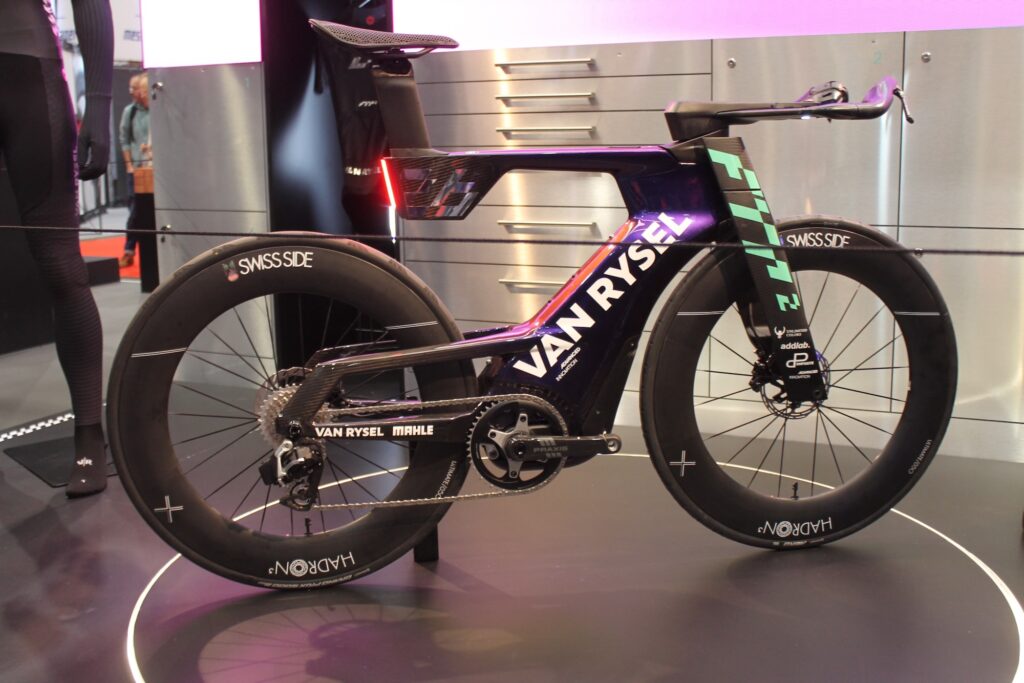

When bike-tech geeks talk about innovation, we usually mean incremental improvements: a slightly lighter frame, a marginally more efficient wheelset… Every so often, though, something comes along that challenges our assumptions about what a bike can be, even if it’s not road-legal or commercially available. The Van Rysel FTP^2 concept bike – which made the headlines at the Velofollies show in Belgium last week – is precisely one of those rare projects. It’s a bold design that might – or might not – give us clues to where technology will be heading next.

Firstly, let’s acknowledge what the FTP^2 really is: not a production bike, but a fully functioning concept bike designed to explore new horizons in performance and integration. It’s a platform where Van Rysel has fused cutting-edge tech and aerodynamic design, creating not just a bicycle but a whole ecosystem — “panoply” is the word it uses – including shoes, helmet, cockpit and clothing, all engineered to work together. Van Rysel has two fully functional examples.

At the heart of the FTP^2 lies a radical idea: multiply the rider’s power and explore what happens when mechanical limits are lifted. With the help of a bespoke Mahle electric motor system integrated into the carbon frame, the FTP^2 reportedly multiplies the rider’s effort by up to four times and can reach speeds conventionally unheard of for a bike. Now, before purists gasp, remember this isn’t about turning cycling into motorcycling – it’s about understanding how assisted performance can be managed safely and effectively at extreme levels.
Why does that matter? Because innovation in cycling has historically come from projects that dared to think differently. Today’s aero road bikes, electronic shifting and power meters were once fringe ideas. FTP^2 pushes the envelope further by rethinking the rider-machine interface itself. For example, the shoe-pedal system eliminates traditional pedals and cleats altogether, integrating the pedal axle directly into the shoe for direct, low-loss power transfer — something that’s ripe for exploration.

Similarly, the cockpit abandons conventional controls in favour of a centralised, Formula-1-inspired interface, giving riders the ability to adjust power modes, gear changes and even shoe tension without ever removing their hands from the bars. This is the kind of ergonomic innovation that, in time, could influence future road and triathlon bikes.
Aerodynamics is another area where FTP^2 shines. Every surface — frame, wheels, helmet system — is shaped and integrated to minimise drag and manage airflow efficiently. By collaborating with specialists like aerodynamicists at Swiss Side (best know for its wheels), Van Rysel is testing ideas that could translate into better speed and stability for commercially available bikes.
It’s very easy to scoff and ask: what’s the point? Realistically, who wants to ride a bike that doesn’t allow you to unclip from the pedals instantly? (The FTP^2 comes with standard cranks and could be used with a normal pedal/shoe system, incidentally.) And a bicycle that can achieve speeds of up to 100km/h, according to Van Rysel… well, that’s never going to be legal on the road, is it?
Of course, the FTP^2 will never be UCI-legal or seen in WorldTour racing. That’s obvious. But that’s the point: it’s not a race bike, it’s a technological bellwether.

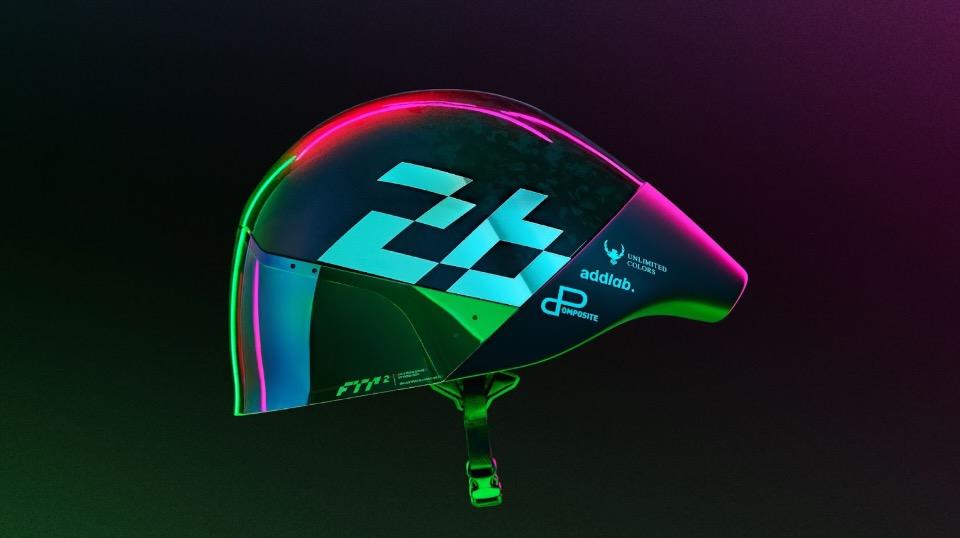
Will the FTP^2 ever come to market? Nah, almost certainly not. But I had a good chat with Van Rysel’s Wim Van Hoecke, project manager for FTP^2, at the Velofollies show. He reckons, for example, that the helmet – an aero shell that fits around a standard EU-certified lid, reducing drag and offering protection from rotational forces in the event of a crash – will probably be available two or three years down the line.
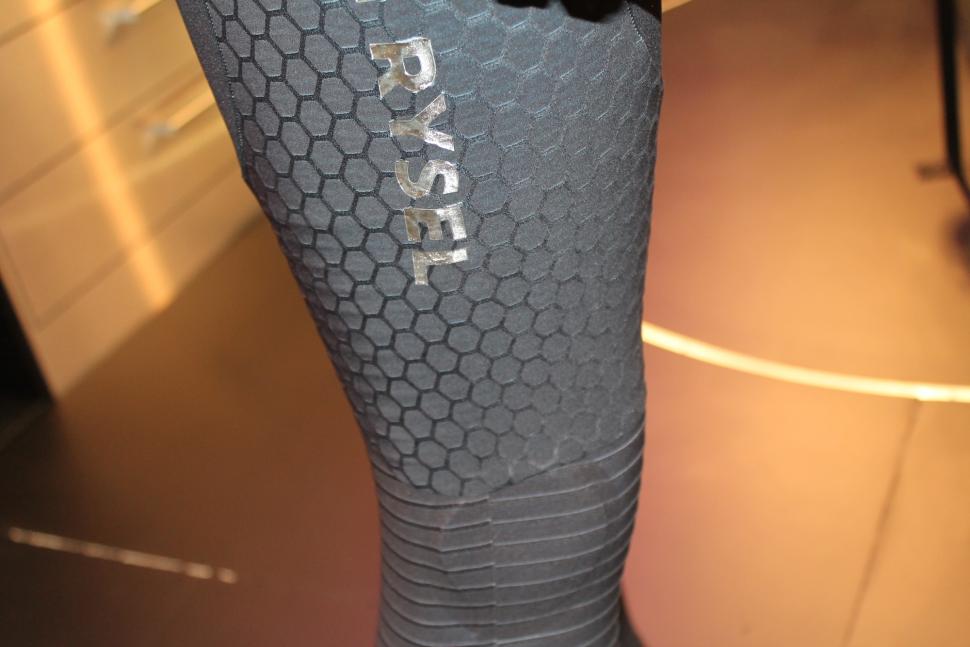
The clothing includes low-profile Armaurto abrasion-resistant padding, as found in the world of motorcycling, to provide some protection in the event of a high-speed crash. Ever more brands are looking at technological solutions to reduce the severity of accidents in the pro-peloton and elsewhere (we first told you about the AerObag system in 2024, for example, and it had working examples of its products at Velofollies).
Cycling has always benefited from visionary projects that shake up the status quo. Mike Burrows (the track carbon-fibre Lotus 108 time trial bicycle, compact Giant TCR frame) and Grame Obree (his DIY track bikes) are two relatively recent British pioneers who dared to go their own way. In the past, the use of carbon fibre was revolutionary. The same goes for clipless pedals, mountain bike suspension, derailleur gears, even pneumatic tyres, for goodness sake.
No one is saying that FTP^2 is going to revolutionise cycling. Van Rysel is perfectly well aware of that. But projects like this can give a glimpse of a future where boundaries are pushed, technologies converge, and the sport/pastime evolves in ways we’ve barely begun to imagine. It happens.
For example, a few months ago, I spoke to Chris Dodman, Cannondale’s chief engineer for advanced projects, about the brand’s ON bike.
The ON bike was shown as a concept at the Eurobike exhibition in 2007, and it actually made it into production later on. It didn’t last long – e-bikes came along and took that market – but it goes to show that free-thinking projects can occasionally become reality.
> Whatever happened to the ON bike – Cannondale’s strangest bike?
The Van Rysel project took about a year and involved 30-40 people. All of them had other jobs within the company, treating the FTP^2 as a side hustle where they could bring together their various areas of expertise.
In that sense, the FTP^2 isn’t just good for cycling – it’s inspiring, reminding us that innovation isn’t dead in a world of tradition, but very much alive and pedalling hard into tomorrow.








17 thoughts on “Why Van Rysel’s 100km/h concept bike is good for cycling”
Have they tested that 100 km
Have they tested that 100 km/h claim yet? Do a few laps of the velodrome in Roubaix and see how close they can get.
Empty wrote:
Given that last year Matt Richardson averaged over 80 km/h in his flying 200 metre sprint world record, no pacing or drafting, it would hardly be surprising if a decent rider with up to 850 W electric power added couldn’t get into three figures, in fact it would be astonishing if they couldn’t.
Going from 80 to 100 km/h,
Going from 80 to 100 km/h, you’d need just over 1.5x as much power to overcome drag. So it might be close.
lesterama wrote:
Fair point actually, it wouldn’t be as “easy” (!) as I was imagining.
…all things being equal.
…all things being equal. Aren’t they claiming less drag?
Indeed, but the rider still
Indeed, but the rider still creates loads more drag than the bike.
That’s why the concept
That’s why the concept includes aero helmet, skinsuit and shoes.
Hmm, I’m writing this after a
Hmm, I’m writing this after a few glasses of wine, which is a risky approach to commenting on issues of mathematics, but wouldn’t you need nearly twice as much power? Drag (i.e. force) is proportional to velocity squared. Power is force x velocity.
ReluctantPotHoler wrote:
Yes, I ran it through a wattage calculator just to prove I was wrong above: drag at 80km/h 1817W, drag at 100km/h 3549W.
Hmm, I’m writing this after a
Hmm, I’m writing this after a few glasses of wine, which is a risky approach to commenting on issues of mathematics, but wouldn’t you need nearly twice as much power? Drag (i.e. force) is proportional to velocity squared. Power is force x velocity.
I remember a few years ago
I remember a few years ago cycling NCN 8 down to Machynlleth on a fully loaded touring bike and hitting 90kmh – it was terrifying!
I could never imagine going any faster (without leathers)
The most important question
The most important question isn’t answered here, though: is it just the P that’s squared, or the F and the T too?
mdavidford wrote:
I’m sure the sales & marketing team have fully thought this through, and if they’d meant not just for the P to be squared, they would have named it the (FTP)^2.
A moto with skinny tires that
A moto with skinny tires that you can pedal, too! How nice.
Regarding Van Rysel’s
Regarding Van Rysel’s protective clothing, it may be less sexy than the FTP^2 bike, but it’s more likely to get my money.
Aero clothing with some impact and abrasion resistance would get me reaching for my Mastercard.
It’s not clear exactly what
It’s not clear exactly what was on display, but the partner brand mentioned, Armaurto, already has various bits of protective cycling gear available, including an “aero” base layer. https://armaurto.com/collections/road-bike
It’s these guys: https://road
It’s these guys: https://road.cc/content/tech-news/armaurto-says-impact-protection-products-dont-add-drag-289181
https://road.cc/content/review/armaurto-impact-pro-base-layer-elite-289655