


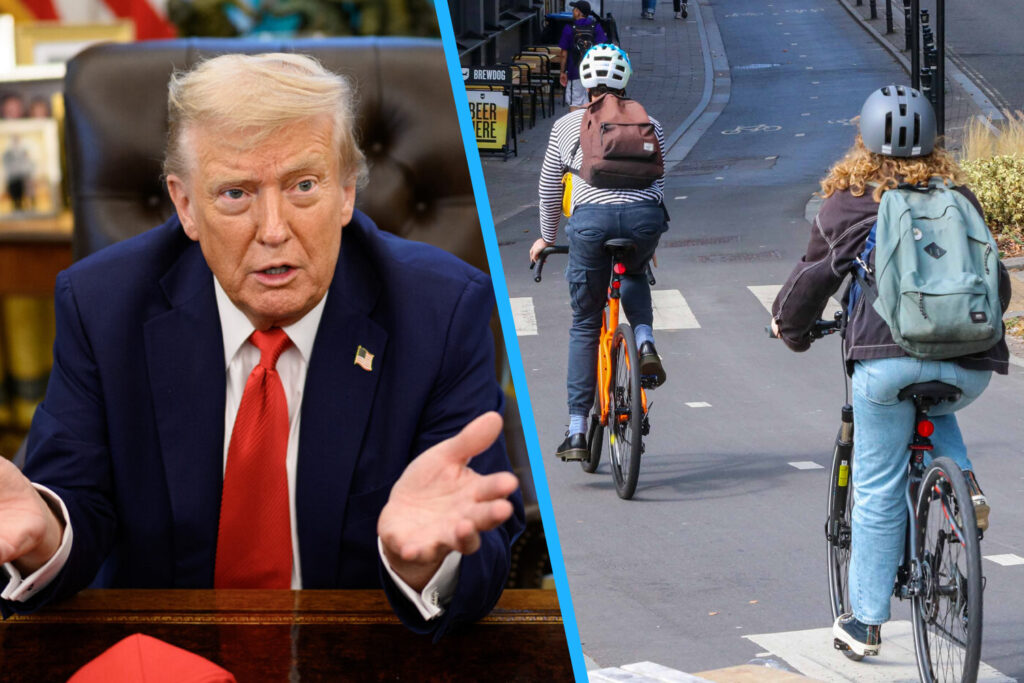

In my opinion, Donald Trump’s war on Iran has been nothing short of a disaster with no perceptible positive outcomes, no obvious exit strategy, and no real justification for starting it in the first place. Iran now has more power than before, the regime is still in place with more extreme leadership than ever, and the Strait of Hormuz has been closed, causing a huge energy shock. The global market is suffering as a consequence.
This is not just a spreadsheet issue, and it’s not just something we’ve seen in headlines that hasn’t actually had much of an impact on our day-to-day lives. I saw a petrol station with diesel at over £2 per litre this morning, compared to £1.43 on 1st January. That’s a 39% jump in four months.
These are the kinds of numbers that we haven’t seen in a long time, but the last time we did, it sparked some of the biggest changes in cycling behaviour and infrastructure that we have ever seen.
Whether it was banning cars from the centre, trying to increase tram revenue, or simply how Danish people viewed cycling, each saw significant shifts in cycling in what is now regarded as one of the most cycling-friendly cities in the world, where bikes outnumber cars.
However, since around 1975 this boom or bust approach to cycling has disappeared, and instead cycling is seen as the obvious way to get around the city. The idea that any government would rip up cycle lanes would be absurd.
This was originally a direct result of the 1973 energy crisis, which saw Danish people hit particularly hard by increases in oil prices. The country even banned driving on Sundays to conserve fuel. It literally pushed people onto their bikes, forced governments to build the infrastructure to allow this to happen, and since then, Danish people have simply never gone back. Even when car ownership levels increase, the number of people using their bikes to get around has stayed the same.
It’s not just utopian Scandinavian countries where these energy shocks have seen an uptick in cycling, either. In the land of gas-guzzling trucks and presidents who deny climate change, the 2008 financial crisis hit particularly hard, and for the first time since the 1970s, more bikes were sold than cars after oil hit over $150 per barrel. After this boom there was a bust, with states not investing in the infrastructure to support more cycling, and sales crashed back to earth the following year.
We are only at the start of this now. With Trump’s latest idea of blockading the Strait, the slow drip completely dries up, so this may well get a lot worse before it gets better. We are already seeing the knock-on effects, with European airports rationing fuel and the Philippines working a four-day week.
While there may not be much appetite for it yet, with the current government pushing hard for green energy adoption, this is also the time to push for active travel, as the economic argument is now much clearer than purely the environmental one. Whether they will or not is another question, but we have seen how those countries who invest strategically in cycling infrastructure during these times have had positive impacts.

















10 thoughts on “Donald Trump’s senseless war could be an inflection point for cycling infrastructure across the world”
I am less familiar with Copenhagen (which itself may not be the pinnacle of Scandinavian cycling infra – see Malmö) as I’m yet to visit, but:
– while both Copenhagen and NL may have had a boost from the oil crisis I think there were a combination of factors (likely different in either case) which drove the changes they made. And at least in the Dutch case it was in part because they already had quite a bit of infra which cyclists used already – and indeed still had significant levels of cycling (as compared to the UK, where it had tanked).
Also there’s a significant difference in the rules and infra between CH and NL. The numbers certainly show the former is a great place to cycle.
However videos * show the infra is pretty different – indeed CH is overall somewhat 2nd tier (albeit with impressive “flagship” bits).
OTOH given it’s still recognisably “lots of space for drivers, with cycle infra fitted round it” some have suggested that it may be seen as “possible” in places like the UK. (eg. see Robert Wheetman’s series of articles on NL vs. Denmark vs. UK street designs.
* eg. by BicycleDutch, NotjustBikes – will post separately as moderation seems to take a while.
I think it’s just as possible that “general dissatisfaction” drives people to pick parties and councils who look at eg. congestion and high oil prices and respond by seeking to increase the use of ICE vehicles! And remove cycle infra to make room for one more lane and further reduce money for large centralised projects like rail public transport. So in practice working against things which will promote active travel and reduce motor dependency.
I hope not … but all of those could be framed as “responding to crisis” and “reducing waste”. And could well deliver short term benefits for some.
I believe that approach would lead to even more problems in the medium term. But … the political systems of countries like the UK aren’t always well-suited to working to that time scale. And a restive public may not be interested in “in a decade or so…”
“general dissatisfaction” drives people to pick parties and councils who look at eg. congestion and high oil prices and respond by seeking to increase the use of ICE vehicles! And remove cycle infra to make room for one more lane and further reduce money for large centralised projects like rail public transport
Yes, the UK combination of successive governments, the police, the hyper-junk press and the general public antipathy to active travel, or active anything for that matter, has elevated the country to the title of Slob of Europe. They’re presently focussed on reducing the price of petrol, bringing in all those ‘one more lane’s and frightening cyclists off the roads.
> And at least in the Dutch case it was in part because they already had quite a bit of infra which cyclists used already
No, there wasn’t anywhere near the level of infra back in the 70s. There were some paths, but nothing like today. That got built out in the late 70s and 80s.
What there was in NL was a strong affinity with the bicycle, with the bicycle being part of the national identity. And a strong reaction against the car culture that had developed and become overwhelming and a threat to the bicycle culture through the 60s and into the 70s.
(My other reply is awaiting moderation because links…) I agree that there definitely is more to cycling in NL than just “when it’s the easiest way to travel people will”.
BUT I think that too. Much can be made of that also. For example I’ve seen the possibility of mass cycling elsewhere being dismissed as “we’re not Dutch or Danish – we don’t have a cycling culture”.
Well, “cycling culture” didn’t stop large numbers of people in NL choosing to drive instead when that was made easy (and cycling became less pleasant because motor vehicles). And it hasn’t stopped places “with no cycling culture” growing their cycling by making serious efforts to provide for it eg. Seville is probably the most striking example.
Not sure it was a senseless war.
After all Trump looks set to receive the Israeli Presidential Medal Of Honour, which will look great on the mantlepiece alongside his FIFA World Peace Trophy. The war also served as a distraction from public demands to publish the Epstein files in full, as well as highlighting that Peter Hegseth is probably an avid Battlebots viewer.
Trump also received the ‘medal of honour’ for his services to genocide in Palestine and increasingly Lebanon. Genocide Joe gets an honourable mention in the former too.
There wasn’t the *level*, I agree and also agree there was a step change in the 1970s and 80s.
… but weren’t there still quite a few cycle paths of the 1950s and 60s?
Maybe considered more as “non-car paths” eg. for motor scooters (because it was seen as dangerous to have those on the roads)?
Not sure i would agree with all therein but see the paper here:
https://journals.sagepub.com/doi/10.1177/00225266211011935
There are some images of what certainly appear to be cycle infra from eg. 1960s on David Hembrow’s blog: https://www.aviewfromthecyclepath.com/2022/06/some-dutch-cycling-infrastructure-is.html
While the UK had a very brief go at building cycle paths across the country in the 1930s (to get those pesky cyclists off the roads so they didn’t block motorists!) and with a few “flagship” new towns like MK and Stevenage (albeit those still prioritised the convenience of motorists) we have never had anything like the country-wide provision that appears to have existed in NL *before* the real “take-off”.
For the change in NL in the 1970s there were certainly multiple factors (including anger at the “demolish buildings to make way for drivers” and Stop de Kindermoord).
Utopianism needs some reconsideration here. Scandinavia’s embrace of cycling as transport is not utopian, it’s intelligent. What is utopian is the UK’s (also America, Australia, et al’s) misguided obsession with the motor car and burning fossil fuel as a modus operandi in the world. It’s utopian to think this can continue, in the face of all evidence to the contrary, in terms of the climate emergency, the economy, and active healthy lifestyles.
The cycling industry globally should be booming as the most realistic and obvious solution.
As someone who was around in 1973 I wish that we’d learnt our lesson then. If we had we wouldn’t have the panic over fuel prices that we’ve got now or be caught between a delusional narcissist and a bunch of religious fanatics.
This is the best opportunity since 1973 to persuade our country to move away from a car-centred transport system to one based around walking, cycling and public transport.