



Team Ineos Grenadiers’ announced earlier this week that it is switching from rim brakes to disc brakes, the final UCI WorldTeam to do so; have the pros made the change as part of a cynical ploy by the bike industry to get more money out of you?
Why do we ask that question? If you look on social media you’ll see accusations that the bike industry is promoting disc brakes on road bikes simply to increase profits and that forcing pro teams to use discs is all part of the plan. This is an idea that has been rolling along for years and doesn’t seem to go away, so we thought we’d do some fact-checking. We’re not going to go into technology or performance here, but into what’s driving the market.
Of course, there are those who’d have you believe that road.cc and the rest of the cycling media is in on this disc-brake conspiracy too. If that’s you, you might as well stop reading because, well, what’s the point if everything here could be a tissue of lies?
First off, are disc brakes being forced on a reluctant pro peloton? There was certainly some opposition in the early days with several riders claiming that injuries had been caused by rotors back in 2016, and Chris Froome provoked headlines much more recently when he said, “I don’t think the technology is quite where it needs to be.”
It’s hard to judge pro riders’ opinions because they usually talk positively about sponsors’ products for obvious reasons, but we’re certainly not hearing as many doubts expressed about disc brakes as we once did. Either most pros are now cool with them or the sponsors have managed to convince them to stay shtum.
Top-level pro teams started shifting over to disc brakes five years ago, so what has prompted Ineos Grenadiers finally to make the shift now?

“We are always looking at ways to improve our kit, technology and bike setup to ensure the riders have the very best options that are available,” said Carsten Jeppesen, Ineos Grenadiers’ Head of Technical Partners.
“Our relationship with Pinarello has always been grounded in a love of racing and innovation, and their work on the Dogma F Disc should enable our riders to race to their maximum.
“Working closely with Pinarello and Shimano, we will continue to develop the all-round disc package, optimising weight, the integration across Dura-Ace, and improvements in the quick release system.”
Let’s be honest, that’s a pretty vanilla statement that doesn’t explain much.
The more cynical might say that until the Dogma F Disc was launched earlier this year, Ineos couldn’t get a disc brake Dogma to an acceptably low weight, so it was forced to stick with slightly lighter rim brakes.

The Dogma F Disc frame kit (including seatpost, headset, fork, and Talon cockpit) is said to be 265g (21%) lighter than the disc brake version of the F12, and Pinarello reckons that a size 53, built up with Shimano Dura-Ace Di2 (R9100, not the recently launched R9200 version) and DT Swiss ARC1400 wheels, weighs 6.8kg (no pedals) – 6.8kg being the lowest permissible bike weight for racing.
What about the idea that the bike industry would rather have you using disc brakes rather than rim brakes to make more money out of you? Well, if a brand convinces you that your current bike is out of date and you need to buy a new one they’ll make cash, but do they get more money by persuading you to opt for a disc brake model?
A contact from the British arm of a major global bike brand – who didn’t want to be named for commercial reasons – said, “More money comes in when we sell a disc brake bike than a rim brake bike simply because, if they’re an equivalent spec, the disc brake bike costs more. It’s the same as in the mountain bike world comparing a full-suspension bike with a similarly specced hardtail because the retail price is higher.
“However, on the flip side, a disc brake bike takes longer to build. Routing hydraulic hoses internally, attaching them, bleeding the system… all this means that the assembly time is much longer for a disc brake bike, and we only have so many production lines and man-hours.”
In other words, according to our source, it’s not as black and white as you might think because a manufacturer can assemble fewer disc brake bikes in a given amount of time.
Wilier’s Kevin Izzard makes a similar point.
“In terms of manufacture, there are no advantages to the factory in building disc brake bikes,” he said. “Disc brakes with hydraulic hoses and the requirement for bleeding etc are far more difficult and time-consuming to instal onto a frame than rim brakes.

“This is especially true with modern fully integrated frame/handlebar designs. Although discs are more expensive than rim brakes, the purchase price is also higher so, together with the extra assembly costs, there are no benefits in terms of profit margin when assembling disc braked bikes as opposed to rim.”
Everyone we’ve spoken to in the bike industry has argued strongly that the shift towards disc brakes has been driven by consumer demand rather than by marketing plans. Of course, you could argue that they would say that, wouldn’t they?
Shimano has just launched new versions of its two top-level road groupsets, Dura-Ace and Ultegra, and although both are Di2 (electronic shift) only, they’re each available with disc brakes and rim brakes.

“If you’re talking about business benefits then it’s about offering a wide customer choice,” said Shimano’s Ben Hillsdon. “The reason for both disc brakes and rim brakes within our product line up is to support current customer demands. We offer bike brands the components to match what they feel is the best bike for their customers’ cycling preferences. Consumers are making choices with their components (eg their brakes) to fit their cycling goals and our product developments reflect that demand.”
That’s the official line – changes to the market are consumer-led, according to Shimano.

Giant says that it could have made the TCR road bike disc-brake only when it redesigned the platform last year but figured there was still enough demand to make a rim brake option viable, especially given that there are fewer models out there from other manufacturers. Specialized’s Tarmac SL7 is now disc brake only, for example, as is the latest Trek Émonda. There are plenty of other examples.

On the other hand, many high-end road bikes are still available in both rim brake and disc brake versions, including the Ineos Grenadiers’ Pinarello Dogma F and the Colnago V3Rs ridden by 2020 and 2021 Tour de France winner Tadej Pogacar and his UAE Team Emirates colleagues, allowing consumers to choose between them directly.
Giant’s David Ward said, “We will continue to offer rim brake bikes as long as the demand is there. If we thought we could sell 10 different rim brake TCR models, that’s what we’d offer, but demand has shifted over the past few years.”
In model year 2020, Giant offered seven rim brake TCRs and two framesets in the UK, and nine disc brake TCRs and two framesets. However, a massive reduction in demand for rim brake bikes meant that it offered only two rim-brake TCRs and one frameset in the 2021 model year. Meanwhile, the number of disc brake TCR models in the range increased to eight complete bikes and one frameset.
The swing will continue for the 2022 model year; there is just one TCR complete bike with rim brakes – the Shimano 105-equipped TCR Advanced 2 at £1,999 – and one rim brake frameset – the TCR Advanced SL at £2,549. The rest of the range is disc brake.

Moving on to the Propel aero road bike, Giant decided to bring only disc brake models into the UK in 2021, even though the Taiwanese brand had a rim brake version available globally, simply because that’s what the market demanded. The fact that Giant has spent a lot of R&D time and money on a rim brake Propel and still doesn’t feel it worth importing into this country probably tells you something significant.
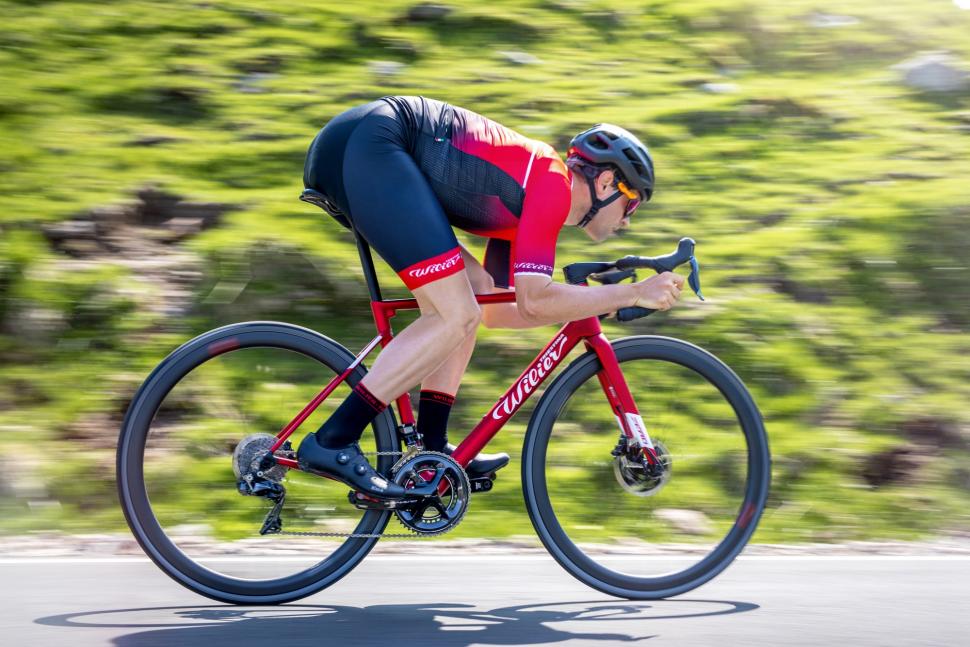 Similarly, when we went to a Wilier bike launch in 2019 the brand’s Claudio Salomoni told us, “We have already designed a Wilier Zero SLR with rim brakes, and started a pre-production version for our internal tests, but it looks like today’s customer wants to buy disc brakes so there will probably be no market for the rim version.”
Although the Wilier Zero SLR Rim has been approved by the UCI, it has never come to market and, according to Wilier, isn’t likely to.
“Wilier was initially a somewhat reluctant entrant to the disc brake market, but has developed the new products purely in response to customer demand,” said Kevin Izzard. “In a remarkably short space of time, Wilier saw the market for rim brakes plummet and customers switched to ordering almost exclusively disc brake-equipped bikes.

“Wilier still produces some rim braked bikes, but to give you an example, the Cento 10 NDR is a frame that was designed to be built with either rim or disc brakes on the same frameset. Currently, only around 2% of sales are for the rim braked version, all the others are disc. This split is purely dictated by customer choice.”
Whether disc brakes offer a significant performance benefit on road bikes is a different – although related – discussion that we’re not covering here, but our conversations suggest the idea that disc brakes are being forced on a reluctant bike buying public is a complete myth.















98 thoughts on “Does the bike industry really want to force you on to disc brakes?”
The demand has shifted. Of
The demand has shifted. Of course, I’d say, we’re past the tipping point. People would be crazy still to invest in rim brakes if they notice that the number of rim brake models is becoming scarce (some pro oriented models and lower end models notwithstanding). People are switching, willingly or not. Look at the used market: if you want to buy a high-end carbon rim brake wheelset at a dumping price, now is the time. (Myself, I had a steel frame made and even though I favoured rim brakes because of their simplicity, the frame is disc-only. Purely to be future-proof. As a result, I couldn’t just transfer my groupset.)
The integrated handle bar and internal cable routing thingy is of course “new” and complicates things for bike brands. But component manufacturers benefit. (Shimano can already argue that they gave bike brands center lock to work with instead of 6-bolt discs.)
And yes, what can be appreciated about disc brakes, is their stopping power (if you need it), all weather reliability and the option to roll on wider tires. But for simplicity and ease of maintenance, rim brakes any day. (Of course, it’ll cost wheelsets over time.)
But for simplicity and ease
But for simplicity and ease of maintenance, rim brakes any day
After 55 years of rim brake adjustment and maintenance, I take the opposite view: TRP Spyre cable disc brakes are fantastic and are functionally better in all weather conditions and are easier and cheaper to adjust and maintain. Pads last a year- old ones out, new ones in, no adjustment or a small turn on each individual pad adjuster, no toeing-in rubbish and hardly any squealing, rims don’t wear out (OK, so I experienced a collapsing disk brake wheel recently, but that was just a crap wheel). It may be different for pro bikes, but the change is clearly occurring there also. Disc brakes any day
Fully agree that mechanical
Fully agree that mechanical discs may be the best of both worlds. But the industry is only using them as a low-cost-let’s-still-have-discs alternative. Higher-end groupsets that support mechanical brakes are a dying breed.
Higher-end groupsets that
Higher-end groupsets that support mechanical brakes are a dying breed
They may be, but lower end Sora 9-speed cable-cable is excellent, and you don’t have to use the £35+ 12 speed chains with the chocolate side plates
I will say that, as someone
I will say that, as someone who owns a disc-brake bike but is reluctant to shell out for hydraulic levers and brakes, Sora mechanical levers and simple cable discs brakes (Promax ones, as specced by Cannondale) have so far proven to be a perfectly acceptable alternative. I’ve been tempted by the TRP HY-RD hybrid cable/hydro brakes before but have never really seen the necessity.
TRP HY-RD brakes have most of
TRP HY-RD brakes have most of the problems of full hydraulic brakes. If you want better braking go for Spyres – cheap and light.
I’m a big fan of full
I’m a big fan of full hydraulics, and have had a set on my CX race bike for years, and MTB for many more years. Only maintenance on the CX has been cleaning the mud out of the shifters, and pad changes, and they are still solid.
I agree on the TRP HY-RD. I aquired a bike with these on, and couldn’t get them set up or effectively bled to give a decent braking force. I replaced them with Spyres, which are more effective, though not as good as my Rival hydraulic.
I certainly won’t be buying a new bike with rim grinders on.
Paul’s do an insanely high
Paul’s do an insanely high end mechanical disk, the Klamper.
You’re relying on mechanical
You’re relying on mechanical levers, which are doomed as well.
wtjs wrote:
I agree. TRP Spyres are great. I’m just about to replace TRP HY/RD calipers on one of my bikes with them. I’m not a qualified bike mechanic but am a retired engineer so I often get bikes from friends to work on. One of the most common issues is disc brakes dragging due to one piston sticking. My “best bike” for summer riding has direct mount rim brakes. They’re the nicest brakes of any of my bikes. But I’ve never ridden them in the wet…
There are a number of things that have been foisted upon us by “The Industry”. Internal cables, integrated bar/stems, hidden cables/hoses in those bars, non-threaded bottom brackets, disc brakes. I’m not convinced any of those actually improve the cycling experience for the vast majority of us…
My friend is about to buy a
My friend is about to buy a low end hybrid/comfort bike. He will probably do a few hundred miles a year on it, at most. He’s looking at a couple of Trek bikes (FX 1,) and the model with a front suspension fork and Tektro mechanical disc brakes is about £100 more than the one with straight fork and cantis.
My advice to him was the cheaper one. I see no advantage for him to get probably a mediocre suspension fork and mediocre disc brakes. His brake shoes and rims will be fine long after he’s done with the bike. He’s unlikely to ride in the rain. The bike comes with 35 mm tyres, so I doubt he’ll need suspension on the roads and paths.
Contrary advice welcome. Which of these two would you suggest to a casual/occasional cyclist friend who is going to ride 5-10 miles at a time, in fair weather, on roads and paved trails?
https://www.trekbikes.com/us/en_US/bikes/hybrid-bikes/fitness-bikes/fx/fx-1/p/17446/
https://www.trekbikes.com/us/en_US/bikes/hybrid-bikes/fitness-bikes/fx/fx-1-disc/p/35001/?colorCode=black
Couldn’t agree more.
Couldn’t agree more. Suspension unnecessary here, though no big problem. But I have got some tektro mech brakes and they are a royal pain. Need adjustment every couple of days, either rubbing the disc or they don’t start to stop until the lever is touching the bars. My rim brakes don’t wear out the rim until 25000km, though it doesn’t rain much where I live.
For the intended use, I’d
For the intended use, I’d accompany him and purchase a lightly used fitness bike for a song. Technically it’ll likely be far superior to the bikes shown. Disc or rim for his use doesn’t matter. But I’d ditch the triple, if there’s one thing likely to trip him up then it’s that.
Xenophon2 wrote:
Yes, I saw the triple and think it should be at most a double. Seven speed is meh, but it’s at least Shimano and from my experience can be tuned to shift reliably. He’s turned off used bikes, unfortunately, due to bad experiences. He won’t consider a used car, either, but at least he’s smart enough to keep them a decade or so, well after they’re paid off.
JL77 wrote:
Yeah, I mean, I had to change the pads on my disc brakes. That’s 10 minutes of my life I won’t get back. I’ll probably have to do it again, next year. Dunno how I’ll keep this up.
And can you bleed the brake
And can you bleed the brake hoses yourself, too?
I’m not a good mechanic but
I’m not a good mechanic but tbh. Ive changed multiple disk pads and never had to bleed a system. Sometimes need to spend a while pumping the brake to get the pressure back up thats it. Nowhere near the effort needed to get rim brakes set properly.
Also as I said if you cycle in the urban environment were hard stopping can be quite helpful go discs every time.
I’ve bled my brakes a couple
I’ve bled my brakes a couple of times (e.g. routing hoses through a new handlebar) and it’s an easy enough job once you know where the bleed ports are.
Mineral oil or DOT4?
Mineral oil or the aggressive DOT4 stuff? 😉
JL77 wrote:
I’m not sure if DOT4 is supposed to have any advantages over mineral oil when it comes to bicycle brakes, but since DOT4 is nasty stuff, and there is plenty of choice using mineral oil (Shimano, Tektro, Magura), I’d stick to mineral oil.
But as I say, I’ve yet to find the need to bleed the brakes – sounds mediaeval.
Reading the thread, it seems that people who have tried both are happy with their choice, caliper or disc, and are free to make that choice. In the end suppliers will doubtless back the winning horse. They “forced” us to use johnny-foreigner’s 700c wheels after all, instead of our perfectly good 27″ rims.
JL77 wrote:
Shimano mineral oil
What effort is there is
What effort is there is setting rim brakes up properly? Slide pads out (Shimano undo grub screw first), slide new pads in (Shimano tighten grub screw ) Spin the adjuster. Done.
That’s the bit after you have
That’s the bit after you have set them up. Then there is fiddling about with avoiding squeal.
JL77 wrote:
Maybe I’ll find out one day, so far the occasion has never presented itself. But you may have a point there – I’ve wasted loads of time, reading about the travails of bleeding hydraulic brakes. Maybe all the “how to” articles lead some people to believe it actually needs doing. I think it’s mostly about column inches.
Had hydraulic discs for years
Had hydraulic discs for years on MTBs. Never Bled ’em. Every year or two I top up one or other master cylider reservoir. World’s easiest job.
Geoff Ingram wrote:
Same here, 6 years of use on my Shimano XT disk brakes. Never bled them, never topped them up.
My Hopes needed fluid
My Hopes needed fluid replacement, got the hope kit, watched the videos, did it. Enjoyed the process, serviced the pistons, then a week later bled them and redid the pistons. Only thing is, I have to remove my bell to fit the top up reservoir.
Also glad I had the Park piston press.
But I do like new and interesting bicycle maintenance.
ktache wrote:
I bought this. too wide for shimano ultegra calipers. (luckily soon I will have hope on both my disc bikes)
There’s no reservoir on road
There’s no reservoir on road groupsets, you need to get the bleed kit out, remove the pads, depress the pistons so you can fit the oil level spacer, attach bleed kit without losing too much oil, suck some oil in without getting air with it, fanny about with the levers a few times to get bubbles out, remove the need kit and dribble some oil on the kitchen floor, have a think about how to dispose the excess oil in the syringe for a while before pouring it down the sink, screw all the screws back in, replace the pads while hopefully not disturbing the carefully balanced Heath Robinson-esque brake system you spent a few days trying to mostly eliminate random noises from the year previous. You will, and you’ll spend a similar amount of time eliminating those noises again, before finally fixing it just as the levers go spongy again
Nice write-up, but…
Nice write-up, but…
in the sink?
I have hydraulic disc brakes
I have hydraulic disc brakes and have never had maintenance problems with them. For sheer stopping power they can’t be beaten. If youve never had them I’d recommend trying them
Also I have worn through several wheel rims using rim brakes
I would not return to rim brakes.
nicmason wrote:
This. I do lots of miles in all types of weather and indeed, while using rim brakes I’ve worn through more than one set of rims, a couple of which cost a pretty penny at the time. If you get paid to ride or only ride limited mileage in fair weather, the above doesn’t apply, else it adds up in maintenance costs.
Also, although I admit to never having used a really high end rim brake system, braking power simply doesn’t compare favorably to my disc brake bike, especially in the wet. Never had problems with leaks, I ask a mechanic to change the fluid every 2 years and then I’m good to go. Never had any problem with disc brake pads either, with rim brakes I always found it a faff to dial them in just right.
nicmason wrote:
This is a really good point. I’ve seen one video and heard of several other instances where carbon rims fail at high speed during a long decent, apparently due to the heat poured into the rim by the rim brakes when on a long winding decent. For carbon rims I would consider rim brakes to be extremely dangerous.
That’s a very old wives tale.
That’s a very old wives tale. Modern brand carbon rims don’t fail in these circumstances.
MTB Refugee is not incorrect.
MTB Refugee is not incorrect. Neither are you when you speak of “modern brand carbon rims”.
It’s a resin issue. If the melting point of the resin used is too low, the heat buildup can make a rim desintegrate. (The heat buildup can also have adverse effects on tire pressure and can cause sudden tire failure.)
There are two ways you can prevent the resin issue: avoid situations that can cause the issue. Or buy decent brand rims.
Or swithc to discs. But there, too, you can get into overheating trouble if your discs are too small. And people also tend to forget that it is best to brake differently with discs. With discs it’s best to learn to modulate and pulse brake.
Another thing disc users tend to forget: it is best to ‘brake in’ the pads.
And a final word about bleeding: you may get away with not bleeding for years. Then again, air bubbles can cause your brakes to suddenly do zip, nada, nothing anymore. Not exactly what you want when going downhill.
“Another thing disc users
“Another thing disc users tend to forget: it is best to ‘brake in’ the pads.”
Put them in. Cycle down the road. Brake a few times . thats it.
Brake HARD a 5-10 times. Yet
Brake HARD a 5-10 times. Yet people forget.
Sadly that’s not true, I saw
Sadly that’s not true, I saw a brand new pair of Zipp carbon rims fail in Majorca a couple of years ago due to overheating. Admittedly it was a fairly novice rider braking a lot, but that’s no excuse…..
[quote:]Does the bike
I for one am sick and tired of the Disc-lobby’s machinations. I’m a hard-pressed v-braker, and this is just another stealth tax. This isn’t what I voted Brexit for! It’s political correctness GAWN MAIRD!
Currently I’ve got SRAM Force
Currently I’ve got SRAM Force AXS disc on one bike, Campagnolo Ekar on the gravel bike, and I’ve got Campagnolo SR EPS with rim brakes on another. The rim brake bike has Bora Ultra 35s, and I can say without ANY doubt that the stopping on it is the best of the bunch, and that’s in all weathers – including Biblical rain on Alpine descents. So yeah, discs are nice, but they’re just as good as a quality brake/rim match.
*I’ve used Shimano in the past and it’s just meh as far I’m concerned, but that’s for another (very tired) debate.
spot on….. I’ve one disc
spot on….. I’ve one disc bike a CX and that is finally matched now rotors and pads….and I’m on the tools…. all this disc thing does is put more cash through the tills for me and other bike traders…..as customers seek the noise free disc brake experience…..can’t beat my Campy brakes on my 2 rim brake bikes…
No, I’m not having that; you
No, I’m not having that; you’re making it up. There is no way a rim braked bike will be better on a wet Alpine descent than hydro disc braked bikes.
I agree, I have Bora Ultra 35
I agree, I have Bora Ultra 35’s and Bora One 50’s and both have fantastic stopping power when used with my Dura Ace brakes and decent brake blocks. I also have a set of Caden Carbon Superlight wheels and they also perform just as well.
“Disc brakes with hydraulic
“Disc brakes with hydraulic hoses and the requirement for bleeding etc”
Is actually true? I know the retail kits from Shimano come pre-bled and as long as you are careful even a numpty like me can fit them without needing bleeding. Are the OEM ones any different?
You can’t install pre-bled
You can’t install pre-bled retail kits on a bike with internal cable routing, which is pretty much any bike over £1000 these days.
Um. Why not? This numpty
Um. Why not? This numpty managed it for the down tube at least. The way Shimano seal it it was fine.
Accepting that disc brakes
Accepting that disc brakes perform better, it’s also in the interest of manufacturers to entice riders onto more expensive equipment with higher cost consumables….
With 4 bikes I’m stuck on rims – but as a heavier rider I’d certainly think twice about screaming down an Alp on my carbon rims with rim brakes….
Some very nice looking bikes here, by the way. I have a thing for Giant Propels and Wiliers….
Chris Hayes wrote:
This. I’m 80kg and frankly find riding down steep gradients on my carbon rims unerving in the dry, terrifying in the wet – they simply don’t stop well. I live in Essex, so trips to more ‘up and down’ parts of the country have me swapping to aluminium shallow section rims (which brake amazingly in comparison). If I could afford hydro discs I’d be all over it but I can’t. Better for me would be if someone still made modern profile aero wheels with aluminium brake tracks that would be perfect (eg like old Swissside wheels).
hmmm, well I am 78Kgs and do
hmmm, well I am 78Kgs and do not find riding down steep gradients on carbon rim brakes unnerving, not remotely in the dry and not really in the wet. In fact they perform better than my alloy rim brake wheels. Probably because I use top end wheels and dura ace brakes and the correct brake blocks whereas my alloy wheeled bike has not so good brakes or pads.
I own both hydro disk and rim
I own both hydro disk and rim brake bikes.
In the dry (ie when most people ride bikes) the stopping power is the same. Let’s just get that straight. Consider your use case before buying a heavy disk bike.
So what you’re saying is,
So what you’re saying is, with discs, you can have one bike which has brakes which work well rain or shine, regardless of type of wheel.
That’s the sort of thing why people are voting for disc with their wallet.
Prosper0 wrote:
This is what I find. In the dry my rim brakes on carbon rims are close enough to the disks to not be an issue. In the wet it’s a very difefrent story.
Ever gone out for a ride in the dry, only to get caught in an unexpected downpour?
I’m still hapy with rim brakes on my summer bike, but there are hills I would not go down if I got caught in unexpected rain.
Prosper0 wrote:
— Prosper0
It’s obvious that you don’t live in Glasgow!
No comprendo. Why would you
No comprendo. Why would you go for a [i]heavy[/i] disc bike, when you could have a light one?
I’m certainly being forced to
I’m certainly being forced to go disc, very much against my will, there are just fewer and fewer rim brake frames available on the market these days.
If manufacturers could just resolve the issue of squeeling in the wet then I would probably embrace them and just accept the higher cost/heavier bike.
For now though I’ve got Rourke building me an 853 rim braked gravel bike. Replacing a front rim every 18 months will be worth it for blessed silence! ?
IanEdward wrote:
If it helps, I use Shimano 105 brakes with Shimano resin pads. They don’t squeal, wet or dry. Never have.
Thanks, I’ve spent a fortune
Thanks, I’ve spent a fortune trying different brands/pads/rotors, and still have a couple to try, but nothing has worked. I’m beginning to think it’s just a weight/frame size/riding style thing.
I haven’t tried recent Shimano road callipers but it’s a lot of money to invest only to be disappointed! I noticed a LOT of squealing going on during Tour of Britain/Tour of Romania which makes me think it’s just unavoidable in certain circumstances!
But the pros will almost
But the pros will almost certainly be using metallic or sintered pads because they have the strongest stopping power, the downside is they are noisy. Organic pads are much less noisy, I dont think I’ve heard so much as a squeak out of mine in several years of riding on them, but the trade off is they wear faster and performance isnt optimal
Awavey wrote:
I got about 1200 miles from my front brake pads. But a new pair of Shimano resin pads cost £9, and it was a much easier job than changing brake blocks. Sintered, metallic, ceramic – maybe they give a greater level of performance needed for the professionals, but I’m lacking for nothing on resins.
Totally, it’s a marginal
Totally, it’s a marginal gains thing for pros for sure, I’ve been happy with resin pads, prob got about 2000miles this year on the front and that’s worse than normal as it’s been wet and the roads are usually full of sand or fine grit near the coast, which totally wrecks rim blocks very quickly.
IanEdward wrote:
no one is forcing you to stop using your existing bike.
Quote:
No, but it’s basically a CX frame so I’d like something with a taller headtube and bigger tyre clearance, my 40mm Terreno rear tyre is starting to look pretty scuffed on the sidewalls!
IanEdward wrote:
Rim-braked gravel bike… right. Why would anyone do that?
Quote:
Me, which is why I’m paying upwards of £1000 specifically for the priviledge. And which is why in the summer (and especially in the winter) I’ll be plugging away through all terrain and all conditions, squeak and scrape free.
One evening every year (or two) to re-rim a front wheel is a small price to pay.
Your car has disc brakes, and
Your car has disc brakes, and tubeless tires. So does your motorbike. Because they are flat out better under all circumstances, and regardless of any weight addition.
Also not mentioned in the article is that we are heading towards a merging of “aero”, “gravel”, “road” and electric powered bikes. This design direction involves a more efficient aero design of the bike frame and cockpit, use of wider tires, accomodation for an option of a battery and wireless gear controls….and yes disc brakes. Particularly so because of the assumptions of electric power and wider tires.
In this new world, rim brakes will be a quaint leftover but otherwise really irrelevant, much like cars with manual transmission. Especially as the bikes industry reconfigures itself and its supply chain around this new design direction.
That’s why. It’s not an illuminati plot to impoverish bikers or anything.
I got disc brakes on a bike I bought about 10 years ago, found them to be shockingly better, low maintenance in practice and I would never go back to mucking about with rim brakes – or rim brake wheels. It’s so yesteryear.
It’s fascinating that it’s mainly in the british press that I still see these kinds of disc–vs-rim storylines. Everyone else has pretty much moved on.
The loads on cars and m/bikes
The loads on cars and m/bikes are completely different to a bike. You *could* put tubeless and discs on a child’s balance bike but nobody would because it’s totally unnecessary. That’s the point here – are these developments actually needed? If you want them/believe they are that’s absolutely fine but I think you’re wrong to say that there isn’t a valid case for rim brakes for those that are happy with them/don’t think disks are needed.
Yupz, the discussion, and the
Yupz, the discussion, and the article, is no longer relevant.
What IS i.m.o. relevant, yet almost always forgotten, is the discussion whether the technological/industry advancements are heading in the way we, as a society, want them. Or if we should put legal requirements in place to make sure that adverse side effects are limited.
To take a completely different examples:
Our food chain is controlled by 5-10 big companies. Do we want that?
Five commercial social media companies control a lot of our world view. Do we want that?
More tech-related: do we want more proprietary stuff? Can a tech company just with the flick of a switch render devices useless? What about the right to let things be repaired by third-parties, instead of the manufacturer?
Most of the time society is (too) late to answer these questions.
Of course, technology changes fast and you never how how exactly things pan out. Yet the smallest discussion up front wouldn’t be too bad.
That being said, the article is 3-4 years late in trying to start a meaningful discussion on the disc-brake subject. We’re past the tipping point.
Cars are not bicycles. My
Cars are not bicycles. My horse has metal shoes on it’s hooves, my house has a hot water tank, my aeroplane has propellers. So what?
They’re not flat out better
They’re not flat out better under all circumstances, and the advantages of these technologies for cars and motorcycles don’t translate to cycling like you think. On cars and motorbikes tubeless is used because tubes don’t work at high speeds, and discs are used because they’re the ONLY thing that works satisfactorily. When have you last seen a car or a motorbike with rim brakes? None of that applies to bicycles. On a bicycle, rim brakes WORK excellently, they’re lighter, simpler, easier to maintain, They work equally well or better than discs in almost every situation except for wet conditions. I have disc brakes on my commuter bike because I’m likely to be riding it in rain or snow. With the road bike I ride in the wet if I’m caught out – and I can deal with that.
Also, thanks for the American arrogance of assuming you’re the measure of all things. In Europe manual transmission is not “quaint” or “irrelevant” by any stretch of imagination, seeing how the vast majority of cars have manual gearboxes.
Borrowing a comment from
Borrowing a comment from another topic; disc brakes for MTBs, gravel, commuter and winter road bike. Rim brakes for a summer road bike. My take is that rim brakes are easy to maintain, especially if you’re on a bike related holiday. That said I have a 20 yr old hybrid (town, commuter etc bike) with a hydraulic Magura rim brake (rear); apart from new pads it’s never needed any maintenance, even when the bike’s been at the LBS. The latest forks have a Shimano disc brake on them; apart from pads, never needed a service. Guess we shouldn’t be resistant to discs?
Best thing about discs in the winter/wet; no filthy wheels from the muck spread by rim brakes.
You would have to be naive to
You would have to be naive to think this situation hasn’t been engineered to a degree, there is profit where there’s obsolescence so manufacturers are inclined to push the new technology as a comprehensive improvement. Publications such as this play their part by regurgitating press releases to encourage the public perception, they need us to believe what they tell us and they need their sponsored teams to be using the new technology at the top end in order to sell the mid range volume products. The fact is, discs offer no benefit in terms of road bikes for racing, the best you can hope for is that you don’t notice the difference. Making 2 versions of something costs more so we don’t see high end bikes with rim brakes any more. So the situation has certainly been engineered to maximise sales and profits which means yes, discs have been “forced” on us merely by removing the alternatives
So… what do you think about
So… what do you think about the covid vaccination programme?
I think you need to find
I think you need to find better strawmen
Nick T wrote:
This is entirely contrary to my understanding and experience, I have Ultegra rim brakes on the carbon road bike and Tiagra discs on the alloy/carbon forked one; both brakes are great and you’d be hard pushed to find any difference in good weather, but if it’s raining and there are going to be fast descents I would take the disc brake bike every time, even though the other is my favourite. Given that road racers will often be taking on severe descents in the wet at far greater speed than I, I would’ve thought the superior wet-weather braking would be a massive advantage for racing.
So you’ve established that
So you’ve established that disc brakes are better for nonracing/training use, thats perfectly valid. There’s plenty of bicycle types that benefit from the technology but not road racing particularly; given the hesitance of teams and professional riders willing to change initially and the fact that rim equipped bicycles are still winning at the highest level suggests that rim brakes have never been a limiting factor
But I’ve also established
But I’ve also established that disc brakes are better at high-speed braking in the wet, which enables one to brake later if trying to go as fast as possible, so why wouldn’t this benefit a racer?
Because races aren’t decided
Because races aren’t decided by who can slow down the quickest, this isn’t formula 1
Nick T wrote:
A smartarsed comment which makes no sense. On a descent most riders are capable of reaching the maximum velocity available to a cyclist and spinning out their gears, so any escape or catch is dependent on who can keep speed longest and brake latest in corners. In the wet, that’s the rider with discs.
My question is, how many road
My question is, how many road/race bikes that are bought each year are actually used for racing? Discs are a better technology for the majority of casual riders, especially those new to riding. With the increase in popularity of cycling in the last decade, there’s more and more people willing to buy a fairly high end bike as a first or second bike, so haven’t necesarily spent a long time learning the skills of using rim brakes, discs are much more intuitive for someone who drives and is new to bikes.
As for companies pushing buyers onto a technology, surely the ideal for them would be for people to be on rim brakes, the technology is old, cheap to produce, can be claimed to be lightweight etc and probably costs them a lot less to utilise.
RobD wrote:
True, it took me 6 months and 2 exams to master the skill of using rim brakes. Disc brakes was just seconds.
Of course, for that same reason the Flintstones mobile is making a come back next year. Profits will go through the roof!
You’ve got that wrong. There
You’ve got that wrong. There’s no intuition to disc brakes. If you ask me, they’re more demanding and require more knowledge and skill to use. Rim brakes are stupid simple, cable-operated and operate using something with a huge thermal mass and surface area to brake with (i.e. the rim), and if something goes wrong, you can bodge something out of sticks and leaves and mud. Disc brakes can be overheated and may suffer from fading, both in the pads and the hydraulic system. You need a lot of skill and knowledge and tools to maintain them – bleed, set up, retract the pistons, adjust the caliper etc., while rim brakes are something that most of us have been servicing since we were kids. Forget to put in a distancing block when you take the wheel out, operate the lever and pop out the pistons. That’s your ride over, you sure ain’t fixing that on the side of the road, and probably you can’t do it yourself either. And you have an oil spill. I case of DOT fluids, a highly corrosive. Hook the disc under something and bend it, that’s either the ride over or pinging and rubbing and pumping to brake until you get a new one.
Just because cars have disc brakes doesn’t mean that new cyclists are better off with discs. The car brakes are proven, maintenance free (for the user) and pretty much bombproof. Bike discs aren’t.
(No subject)
I think this topic has been
I think this topic has been beaten to death now.
If I wanted to buy a new bike, it would be a disc version as I can see the advantages.
I don’t, and as its not possible to upgrade an existing bike, I will remain happy with rim brakes.
That is all.
Rim brakes are no good for
Rim brakes are no good for commuting as the rim wears down too easily. I swapped to swiss stop, used the special rubber to clean the rims (2 hours a time) but they still didn’t last as long as they should.
Performance in the wet is much better too with disc.
Yep. I’ve just got my first
Yep. I’ve just got my first disc brake bike, and one of the main reasons I wanted to make the change was I was fed up of wearing out rims commuting all through the winter. (Although I’m not commuting as much now, so not as big an issue.)
I’m a complete convert to
I’m a complete convert to disc brakes and have bought a new frame to enable me to have discs on my second bike. Performance is better in the dry and the wet, yes they are a bit more fiddly to maintain but worth the extra hassle.
To those who say slowing down faster doesn’t make you faster, see how much later you can brake on discs then accelerate back up to speed after a corner and see how much further ahead of your rim brake friend your are!
Then factor in the joy of jot having to listen to my expensive rims being ground down by my brakes in the wet and mud, worth every minute of that extra hassle!
I don’t care what the bike industry thinks, I’ve tried it, I love it and won’t go back – but I won’t buy a new bike JUST because I want disc brakes, I’ll wait until I’ve ground my way through another set of rims!! ?
So many apologies to the bike
So many apologies to the bike industry. If one choses to go with disc brakes… the industry makes money off the new frame and new wheels you have to purchase, its not just the brakes. And the industry is forcing riders to buy new frame and new wheels. Try to find carbon wheels for rim brakes, Mavic used to make them but they are no longer available. They are also forcing riders get new groupsets, phaseing out 10 speed, 11speed by not keeping cassettes and chains supplied. Shops must love disc brakes and electronic shifter as riders need maintence more frequently. These are great for pros whi have mechanics, but regular folks who try to do their own work are being taxed.
With disc brakes the wheels
With disc brakes the wheels will last longer, so how does that help the industry?
There is no such thing as
There is no such thing as ‘the industry’. Every participant has it’s own goals.
(For example, Shimano & SRAM & others want to make as much money as they can from selling components. But bike brands want to make as much money as they can from selling the bikes they build. So they want cheaper parts and ease of first installation. … )
There are other means to make people want to buy new stuff (e.g. wheels)
You are replying to the wrong
You are replying to the wrong person, as I did not introduce the phrase ‘bike industry’.
Anyone like me who came to
Anyone like me who came to road biking from years of MTB simply expects the same level of braking you get from disc brakes and anything else just feels inferior. It’s true disc brakes are more faff to install and setup but the results are worth it. I can’t help feeling that the current shift toward acceptance of disc braking in the pro peloton has more to do with the fact that the top riders (who are bossing it in all disciplines) have come from MTB and/or cyclocross, and their unquestioning adoption of disc brakes on their road bikes has resulted in a wider acceptance of the inevitable….
It’s true disc brakes are
It’s true disc brakes are more faff to install and setup
No it isn’t, with cable discs. Twin moving piston with independent pad adjustment = dead easy
The other thing nobody has
The other thing nobody has mentioned is the big advantage of disc brakes when you pop a spoke – especially on low-spoke-count wheels, losing a spoke can result in a wheel that (even with a spoke key) can’t be persuaded to pass thru the rim brake caliper. A disc wheel will take an immense level of pringleisation and still work well enough to get you home. I’ve been on group rides where a rider with fancy lightweight rim brake wheels has had to bail out miles from home due to a broken spoke and not being able to get the wheel to move thru the caliper…
My bike for loaded touring is
My bike for loaded touring is fitted with cable-operated disc brakes – best of both worlds in my opinion. My MTB has hydraulic disc brakes.
My road bike has caliper brakes. With the latter I can quite happily descend the steepest decline in the district, a category 2, and the brakes work just fine. And I have never yet worn out a rim.
Two things, you have to have
Two things, you have to have new bike if you want disc brakes, new frame, wheels and the disc,s, Ofcurse it generats more money for manufacturers, Tony Martin has just retired, stating safty issues, discs are so fast & efficiant, in the peloton when accident starts, riders brake so fast the rest cant react fast enough, so mass crash, it was seen on TV one of the last one week tours, a rider nearly lost rear wheel on wet road becuase brake was too affective, wait till the amateur comes unstuck on ice road.
Disc brakes are the devil’s
Disc brakes are the devil’s work. Boris Johnson and Donald Trump have bikes with disc brakes. Disc brakes are magnetic and contain microscopic trackers. It’s all just a cycling industry conspiracy to control us. Britain would be better if we left the European Disc-Brakers.
Stone the heretics who say otherwise.
(edited to further annoy those without a sense of humour).
This topic never fails to
This topic never fails to bring out the cranks…
Oh you bad, bad person. Don’t
Oh you bad, bad person. Don’t get them started on cranks.