


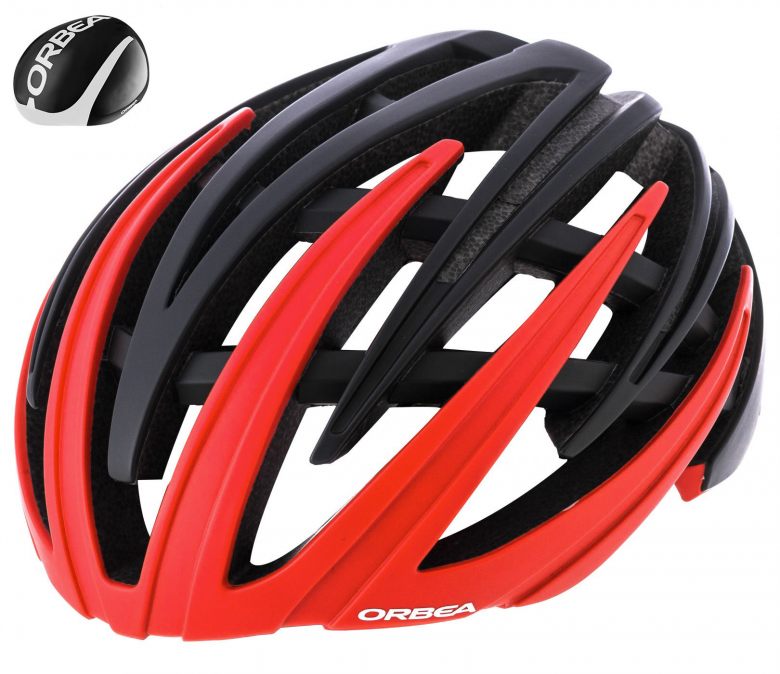

More and more bicycle manufacturers are getting into the helmet business and Spanish company Orbea is no exception. It has recently unveiled its new £150 R10 aero helmet.
Every helmet has to offer something unique to the customer. It might be aerodynamics, ventilation or lightness. Orbea has aimed to make the R10 as slim as possible. By reducing the volume, material and contact patches, Orbea reckons the R10 combines good ventilation with low weight, and even claims the aero performance rivals the best aero helmets on the market.

Orbea claims its own wind-tunnel testing has shown that the reduced profile of a helmet are as important as the number of air vents for reducing drag. Most bike designers have been concerned with reducing the frontal surface area of a bike, clothing manufacturers concentrating on tighter fitting materials and hidden seams, and Orbea is applying similar thinking to its R10 helmet.
“If the shape of the helmet is closely adjusted to the rider’s head and doesn’t lie too far above the skull, the helmet will produce more efficient results than a standard high-volume helmet,” says Orbea
An optional UCI-legal cover can be attached to offer aerodynamic performance that matches other aero helmets. Orbea isn’t the first company to offer a clip-on cover, Lazer has been doing that for many years, as one of the first companies to commercialise the concept.
– Cycling helmets — everything you need to know
“If it's windy or rainy, cover up. If it's 35º C on the Tourmalet, let the breeze in. Instead of owning two helmets that may or may not do what they look like they do, choose the R10 and win in all conditions,” claims Orbea.
The R10 helmet is constructed with a polycarbonate injection in-mould shell with nylon reinforced EPS layers. There are 29 vents to suck and push air through internal channels and the reduced contact patches are claimed to help increase ventilation.
A micro-adjust dial retention system is said to be easy to use with one hand, and the cushion pads are washable. Straps are a breathable mesh material with an adjustable closure buckle.
The R10 costs £150 and is available in three sizes and a choice of colours. More at www.orbea.com/gb-en/gear/r-10-eu/
















12 thoughts on “Orbea’s new R10 reduces volume to improve aerodynamics + video”
So what’s the effect on crash
So what’s the effect on crash safety of reducing the thickness of the helmet?
DaveE128 wrote:So what’s the
It would be interesting to see a star rating system (similar to cars) when it comes to safety. I imagine that they’re all relatively close in terms of protection, meeting the minimum standards. But we don’t know any more than that, if they could be rated, there might be some reason for them to make helmets safer and let us know which helmets are safest.
DaveE128 wrote:
So what’s
DaveE128 wrote:
So what’s the effect on crash safety of reducing the thickness of the helmet?
As Australia and The Netherlands show us that helmets have zero effect on KSI figures , the answer must be that the removal of material , even down to no material will have no effect on crash safety.
Equally I expect to see no difference in the number of claims that ” My helmet saved my life” miracle claims.
marcswales wrote:DaveE128
Good grief! Do you people never stop with the same old tired moaning? If you don’t want to buy or wear a helmet, then don’t. No one is forcing you. It’s so tedious having to wade through the extremes of both sides of the argument everytime the “H word” is mentioned.
You won’t convince the other end of the spectrum just as they won’t convince you, so why bother?
Well said harragan, it’s
Well said harragan, it’s getting ridiculous isn’t it?! Makes me cringe all these idiots arguing over wearing a friggin helmet! If you like it, get it. If not, don’t. FFS!
marcswales wrote:DaveE128
that’s a hugely flawed argument. population-level KSI figures are influenced by a wide range of enivronmental and cultural factors. saying that there’s no correlation between population-level helmet use and population-level injury statistics doesn’t mean a particular helmet can’t be made more or less effective at mitigating against an injury in a crash. nor does it take into account an individual’s riding preferences and attitudes to risk. you can’t use population-level data to assess helmet efficacy at a per-incident level. it’s nonsense.
Dave Atkinson
that’s a hugely flawed argument. population-level KSI figures are influenced by a wide range of enivronmental and cultural factors. saying that there’s no correlation between population-level helmet use and population-level injury statistics doesn’t mean a particular helmet can’t be made more or less effective at mitigating against an injury in a crash. nor does it take into account an individual’s riding preferences and attitudes to risk. you can’t use population-level data to assess helmet efficacy at a per-incident level. it’s nonsense.— marcswales
what’s that quote….. oh yeah ..
lies, damn lies and statistics!
I wonder if the excellent Radio 4 program More or Less has ever covered cycle helmets? They’d sort the wheat from the chaff.
So, less ‘volume and
So, less ‘volume and material’ = less energy absorbing foam?
If someone hits me over the
If someone hits me over the head with a bat, it hurts less with a helmet on. That’s enough evidence for me.
Hiltler would/wouldnt make us
Hiltler would/wouldnt make us wear a helmet. There you go Godwin now can we stop? :W (|:
Nice helmet
Nice helmet
Colin Peyresourde wrote:Nice
+1.