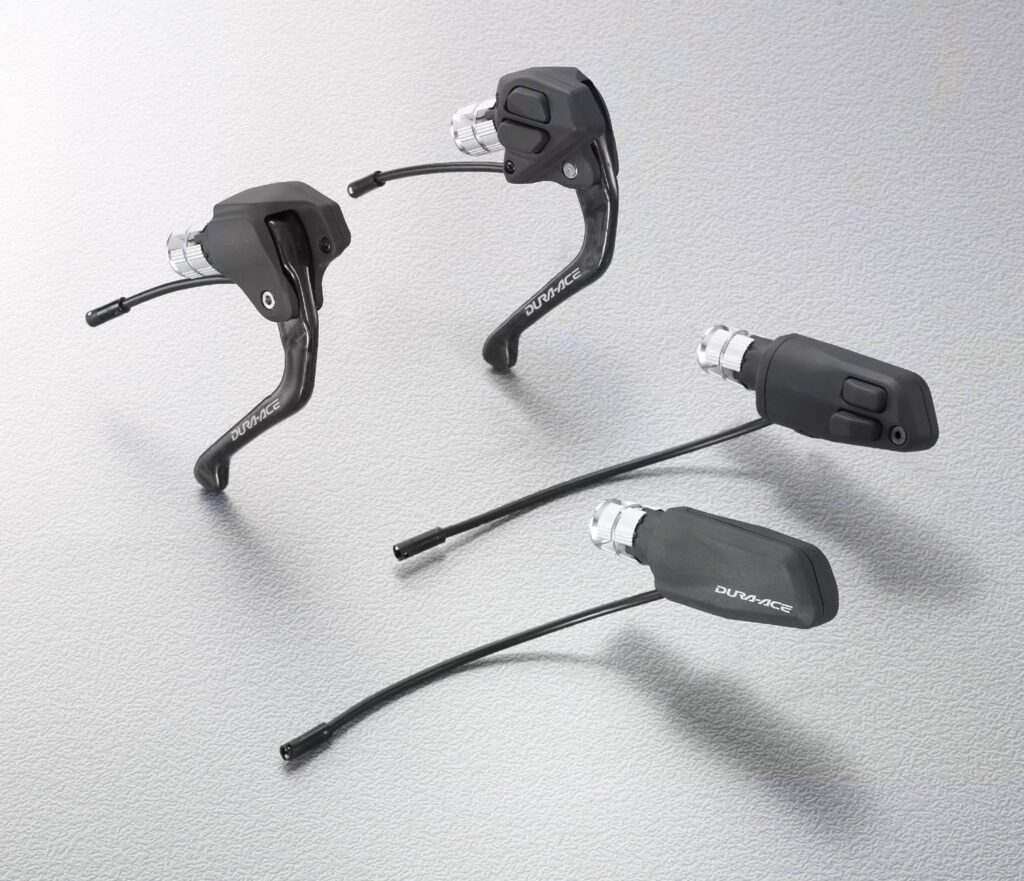

Shimano have just released official pics of the new electronic time trial shifters that will be part of their 2009 digital Di2 range. The shifters, which were snapped in the wild for the first time in this year’s Tour de France, can be controlled from the ends of the aero bar extensions as usual, and also from the dual control levers on the base bar. It’s the change from cable to electrical operation that allows Shimano to offer these two different control points. The base bar levers mean that you can now change gear when you’re riding out of the saddle; there’s no need to sit back down, move your hands to the extensions, change gear, move your hands back to the base bar, and then stand up again. That’s always been a bit too much like hard work when you’re trying to get into a climbing rhythm. If they fulfill their promise, these shifters are set to make a huge impact, especially on hilly time trials and also in triathlon where race organizers often plan a climb as early as possible in the bike leg to split the field and reduce the problem of drafting. The Dual Control Levers, which have buttons for Shimano’s new FlightDeck cycling computer in the hoods, feature carbon blades and come in at a claimed weight of 127g per pair. The satellite switches – the aero extension shifters – weigh 103g per pair, and the wires can be plumbed internally through your aero bars. Of course, you’ll need the new Dura-Ace Di2 mechs too. It’ll be interesting to see how the other big players in the market respond. In the meantime, we can’t wait to get our hands on a set.
Shimano launch electronic TT shifters
Help us to bring you the best cycling content
If you’ve enjoyed this article, then please consider subscribing to road.cc from as little as £2.49. Our mission is to bring you all the news that’s relevant to you as a cyclist, independent reviews, impartial buying advice and more. Your subscription will help us to do more.
No Comments
Read more...
Read more...
Read more...
Latest Comments
@Robert Hardy indeed, just because its rated for 2 kW doesn't mean it's putting that out under no load. They probably looked up the model number.
I.e. that wasn't determined as a result of the 'pick it up and rev it' test. It may just mean they got back to the station and looked it up on the internet, or even that it advertised the output on the motor itself.
It was a road in public park and the spot where she was killed was in close proximity to warning signs to traffic of the need for caution as regards pedestrians. If they had been cycling with due caution it is much more likely that they could have stopped in time and very much less likely she would have been killed.
Cycles are better than cars per urban mile travelled in terms of injuries contributed to, but not by as much as to justify complacently dismissing the issue. I don't think it unreasonable for cycles to be expected to keep below 20mph in 20mph zones. That is a fair lick by any standards on a bike and considerably faster than the vast majority of other cyclists on the road.
Not quite sure how he determined the 2kW thats pretty close to the heat output of a 3 bar electric fire, if it wasn't moving to generate sufficient airflow it wouldn't take long to be glowing red! Certainly the motor couldnt demand and output that kind of power without the resistance of the road against the weight of rider and bike and some frighteningly aggressive acceleration.
@mattw "I think we already have a “safety system” on our roads – that interventions are evidence based." Partially. We can - for example motorway design/rules are a fairly good example of a broader "safety first" approach. (Possible exceptions being the removal of some the hard shoulders to add capacity - more on "capacity" later). BUT contrast what happens on other roads. Particularly our "multi-function" urban roads which act as both "places" (parking, lots of pedestrians about) and "routes" (motorists wanting to pass through). Under e.g. the Dutch system that would be a fundamental conflict of interests which would need to be resolved (streets / roads should serve a single function). There is a fundamentally different starting point: the Dutch system starts from "*everyone* can travel *safely*". But baked into the UK system is the notion of "flow of *motor* traffic" being at least as important as safety. Thus it ends up making it OK to provide for vulnerable road users effectively as an afterthought - and particularly at the expense of their convenience, because that motor traffic capacity is one of the most important things. (In the machinery of local government we have all kinds of metrics related to this which ensure that happens e.g. "journey time reduction" etc. which is what Chris Boardman et al. were looking at). This also helps explain why "our roads are relatively safer than other places in Europe in that context" We have achieved safety by literally driving the vulnerable road users off the streets! As many streets have effectively become roads it then becomes logical to all that they are "for" motor traffic, and people should just get in the car. That has become self-reinforcing. And for anyone left who can't / won't it's "well ... take your chances; or use the narrow footway, wait several minutes to cross the road at the lights or descend into the occasional unpleasant and socially unsafe pit of an underpass..." Note that NL road safety is still very good *despite* having a sizeable fraction of the population cycling, including the rather young and old. (Cycling is (in isolation) probably inherently a little more risky that walking - I don't have numbers though). And IIRC it's safer specifically for *pedestrians* there (despite all those dangerous cyclists...)
In this case, it got to that speed by use of the throttle alone, when power should have cut out well before that, so it's not quite such a terrible test as the one where they turned the pedals and said "there - see - it's doing 45!". That said, reaching more than walking pace with just the throttle should be a fail*, so the actual speed it reached is neither here nor there. [*unless it's ancient]
LeBron's rack just looks like a Canyon LOAD front rack to me - £38 on their accessories page
"Tiger Woods gets five-year driving ban after reckless driving plea" I guess he won't be facing any exceptional hardship... https://www.bbc.co.uk/news/articles/c5y7xvpn5kno