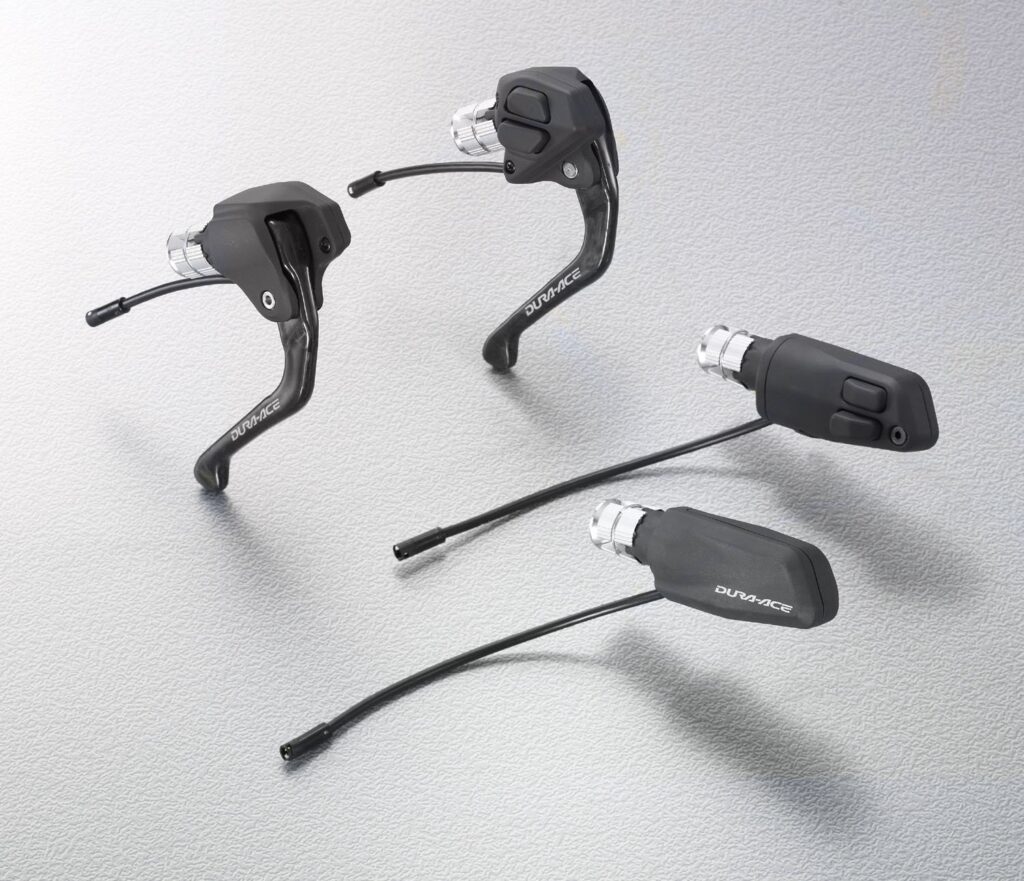
Shimano have just released official pics of the new electronic time trial shifters that will be part of their 2009 digital Di2 range. The shifters, which were snapped in the wild for the first time in this year’s Tour de France, can be controlled from the ends of the aero bar extensions as usual, and also from the dual control levers on the base bar. It’s the change from cable to electrical operation that allows Shimano to offer these two different control points. The base bar levers mean that you can now change gear when you’re riding out of the saddle; there’s no need to sit back down, move your hands to the extensions, change gear, move your hands back to the base bar, and then stand up again. That’s always been a bit too much like hard work when you’re trying to get into a climbing rhythm. If they fulfill their promise, these shifters are set to make a huge impact, especially on hilly time trials and also in triathlon where race organizers often plan a climb as early as possible in the bike leg to split the field and reduce the problem of drafting. The Dual Control Levers, which have buttons for Shimano’s new FlightDeck cycling computer in the hoods, feature carbon blades and come in at a claimed weight of 127g per pair. The satellite switches – the aero extension shifters – weigh 103g per pair, and the wires can be plumbed internally through your aero bars. Of course, you’ll need the new Dura-Ace Di2 mechs too. It’ll be interesting to see how the other big players in the market respond. In the meantime, we can’t wait to get our hands on a set.
Shimano launch electronic TT shifters
Help us to bring you the best cycling content
If you’ve enjoyed this article, then please consider subscribing to road.cc from as little as £2.49. Our mission is to bring you all the news that’s relevant to you as a cyclist, independent reviews, impartial buying advice and more. Your subscription will help us to do more.
No Comments
Read more...
Read more...
Read more...
Latest Comments
I know many a mechanic who feels fear every time one of her branded cycles is presented for a service. They are astoundingly bad quality; cheap components, shoddily put together, difficult to adjust and usually not worth it. The Pendleton e-bikes are exceptionally cr@p. Why do people put their names to such rubbish?
@Rendel Harris Market forces, probably. But I'm no expert. I realize some of us here love cycling, but what would make forfeiting extra income excusable? And even if the tickets were cheaper, how would you prevent extra demand so that people prevented from participating would not complain about being treated unfairly? Why don't we simply acknowledge TdF is not a public good, it is just another commercial event. With a bit of luck you can probably survive without it.
@slownomad From the DVSA/DoT Guidance Notes that your link refers to: "To be classified as an EAPC under the EAPC regulations[footnote 1], the cycle must:" etc. . It then goes on to say: "If an EAPC does not comply with the regulations, it is treated as a motor vehicle under the Road Traffic Regulation Act 1984 and the Road Traffic Act 1988" So no, it does not say that the only EAPC is a legal EAPC. As you say bike may refer to pedal cycles or motorbikes. E-bike logically follows the same usage and includes EAPCs. "Electrically Assisted Pedal Cycle" is a technical description. The EAPC Regulations 1983 allow for some EAPCs to be treated in law as pedal cycles. The Guidance Notes finish with a disclaimer: "This guidance is a summary of DfT’s understanding of what the law requires." etc.. & finishes with "You are therefore advised to consult the relevant legislation and, if necessary, seek independent advice." So even the DVSA & DoT don't actually know what it all means.
Not noted in the review but the old Crux was a CX - gravel racer whereas this new one seems to be pure gravel, taking inspiration from road race bikes more than anything. What’s happening with specialized and CX? Is it just being left behind or is this the bike still for CX?
@RayG In my experience many of the people who attend overpriced events like these aren't genuine fans but people with high disposable incomes who like to go "for the experience" and to say that they were there. In any case, even if every ticket was sold to a dyed-in-the-wool cycling fan who was prepared to pay silly money because it's a once-in-a-lifetime chance to see the Depart in their home town/country, why would that make charging exploitative prices excusable?
The title of the review sounds almost as if it was the "tier number" you pay for, not the actual performance. I thought bikes were about riding, not bragging about them? If the bike is so great, what is the problem really?
@Rendel Harris I see the average cycling fan protested by snapping up the available tickets immediately.
@RayG Even if the ticket revenues for this event were all going straight into rider safety, which I'll wager they're not, there would still be perfectly relevant questions to be asked as to why the ordinary cycling fan was being stung for the cost rather than it coming out of ASO's €30M profit from the Tour alone and the €130M it makes annually from its race portfolio.
@Daclu Trelub I'm also wondering if they're putting matting down over the setts leading up to the esplanade - imagine the number of potential pre-race retirements if they try to ride slowly over them uphill if it's bucketing down that night! 🫣
@HoarseMann I considered that probability - Just expecting the prime 'mid-priced' seats to have already gone. Not to mention there'll likely be an even bigger strain on the terrible ticketing platform...