


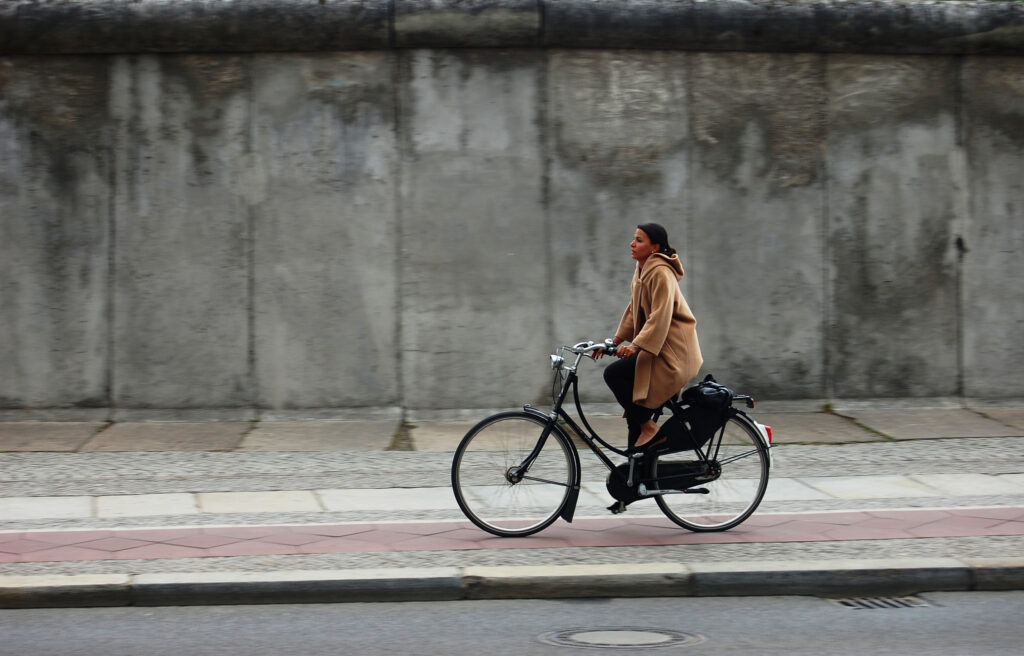

As the Parliamentary Inquiry that aims to ‘Get Britain Cycling’ opens, many will ask why the UK can’t follow Denmark and the Netherlands in making the bicycle a leading choice of everyday transport for the masses. Those two countries are beacons of cycling due to policy decisions made in the 1970s and of course there is an awful lot we can learn from them, but more recently, Germany is showing what can be achieved.
According to an article on the website of the European Cyclists’ Federation, Germany’s national cycling plan, introduced in 2002, currently aims for 15 per cent of all journeys to be made be bicycle by 2020. That goal may already have been overtaken nearly a decade early, with 2011 figures from Mobility Panel Germany revealing a 14.5 per cent modal share in that year.
While Sustrans today called for Britain to show the political desire and investment to get more people cycling, a spokesperson for the national cycling association in Germany, the ADFC, says that the rise there has less to do with government intervention in the shape of the national cycling plan and is more due to people simply deciding to use bikes more.
That should perhaps be viewed as intervention at national level – the organisation cites several cities that have seen a boost in the number of cyclists due to local initiatives. The evidence is that policy decisions and hard work at municipal level do have an impact.
“It’s been a revolution from below,” said the ADFC’s Bettina Cibulski. ”Young, urban, well educated people have started cycling. And this group gives an example to the rest of the population, who have also started to cycle.”
That’s not the whole story, though and we suspect there is a chicken and egg situation at work. Visit any German city a decade ago, and you’d have been likely to see cycling infrastructure already in place that would be the envy of pretty much anywhere in Britain.
Those facilities were already seeing high levels of usage – the ECF says that modal share for cycling even in 2002 was 9.5 per cent. Figures released last year showed that there were only three local authority areas in England with a statistically significant population – Oxford, York and, way ahead in the lead, Cambridge – that have 10 per cent or more people riding a bike at least five days a week.
So in the case of Germany, there is perhaps an element of, as the saying goes, ‘build it and they will come;’ it’s not enough to encourage people to cycle, they also need to be given somewhere they feel confident that they can ride their bikes safely.
But again, that’s not the full picture, with Cibulski’s colleague at the ADFC, David Greve, highlighting that some cities in Germany are at a more advanced stage of provision for cycling than others.
It is the latter that are showing the stronger growth, with levels of bicycle use (by which specific measure is unclear) in Munich, for example, jumping from 6 per cent in 1996 to 17.4 per cent in 2011.
“We have ‘the classical’ cycling cities as Münster, Freiburg or Bremen,” said Greve. “They all see more than a quarter of trips by bicycle thanks to a long tradition of cycling and pro cycling policies.
“But the best cities to look at are maybe cities, which are ‘on the jump’, working hard to develop cycling, have their own budgets for cycling for staff in the municipality, for infrastructure and also for campaigns and have made ambitious plans to advance cycling in their cities. Examples include Munich, Frankfurt and Hanover.”
While the country’s capital is often focused on outside Germany as providing a case study in good cycling policy, Greve says that doesn’t reflect the reality. “Is Berlin the best cycling city in Germany? We don’t think so.”
He explained: “Berlin has an infrastructure plan and a special strategy to develop cycling. But there is only a high number of cyclists in the centre and special quarters of the city.
“Because of the long time tradition of car orientation it’s not easy to reach a change in the Berlin transport policy – and also in the minds of the Berlin politicians”
“We think an average of 20% modal split in Germany is not a dream but possible within the next five to ten years,” added Greve. “In the cities, the number of cyclists may rise up to 40%.”
That would even put Copenhagen, where one in three residents are said to ride to work or their place of study, in the shade; perhaps policy makers in Britain, rather than looking to the Dutch or Danes for inspiration, would be better advised to look at the more recent efforts of their larger neighbour instead?











13 thoughts on “Never mind the Dutch and Danes – it’s following the German example that could Get Britain Cycling”
http://innercitymobility.blog
http://innercitymobility.blogspot.de/2011/08/getting-around-berlin-cycling.html
Like in all German cities, some quarters are fine, some are rubbish. Some roads feature cobbles and tracks at the same time – both no good for a race bike! 🙁
Berlin or Copenhagen? Copenhagen, no question.
Why? I think Germans are good in making up numbers: Set up a sign, spill some paint and claim it a cycle path! While Copenhagen really did/does build infrastructure!
So maybe the British Goverment would also rather like to tune number than spending money. There is nothing wrong in motivating people, but it should not be an excuse to do nothing yourself.
Me? I’ll prepare myself for the Critical Mass on Friday. (Riding sooo slow I got cold the last time.)
Dr. Ko
As my user name suggests, I
As my user name suggests, I live in Cologne and I can agree with Dr. Ko about some German cities being better with cycling provision.
Cologne isn’t the best by any stretch and is terrible if you are on a road bike, but it reasonably OK for ‘normal’ bikes. And this brings me to onto one of the problems I see with cycling in the UK – the type of bike for ‘normal’ use.
Here in Germany almost every bike for everyday use has a decent and bright dynamo lights (that don’t just go out when you stop), mud guards and a rack with straps. They are sturdy beasts and tend to be just the ticket for getting around town and going to use a bike for everyday needs.
Bikes like that just aren’t sold en mass in the UK. Why? Unfashionable? No idea? But not having these features as standard will make it harder for people to get into cycling as part of their everyday life. I know that people could add these things to bikes, but they should be standard in places like Halfords and the mass market.
Here people cycling around in all weathers because they are going to be covered in spray. They aren’t going to forget their lights because they are screwed to the bike. And they can carry lots of stuff on the back or in a basket. An attitude shift in the bikes themselves will help almost as much as infrastructure.
colognejon wrote:Here in
I agree. Perhaps because cycling in the UK has for many years now been an loose aggregation of subcultures – roadies, MTB-ers, fixie-hipsters, BMX-ers – rather than a simple mode of transportation, the manufacturers and retailers have responded accordingly. Hence the slightly bonkers phenomenon of cycle commuters in lycra on four-figure road bikes speeding to work in the traffic at 18mph.
I dream of a mass-produced but attractive and well-put-together basic bike for the masses, with mudguards, parcel rack, dynamos, 5-speed hub gear and belt drive (or even shaft-driven) at a £300-ish price point. I suppose that’s not very sexy though, is it?
Nonetheless – infrastructure first, please.
Ghedebrav wrote: Hence the
I am a slightly bonkers phenomenon!
Bedfordshire Clanger wrote:I
And not the only one. :H Some morning rides might be more competive than a Belgian sportive. 😀
Regards,
Dr. Ko
So colognejon, am I gone see
So colognejon, am I gone see you on Friday at the critical mass? I think 5:30 pm
Regards,
Dr. Ko
Dr. Ko wrote:So colognejon,
At Rudolfplatz? If I can get out of work in time to be there, yes.
While I would certainly agree
While I would certainly agree that we can learn from more than one – ywo European neighbours how to build a cycle culture, I am not at all convinced by the argument for Germany.
The message seems to be that hte growth has been achieved bottom-up there. Well, aspects of it – the shift in attitudes among young people making it hip to ride, or whatever they are getting at – have been advocated her for a decade or two and have achievede the remarkable growth in cycling from 1 % to – well – 2%?
If we have to rely on our local authorities, counties and boroughs, for movement on cycle infratsructure then frankly we are doomed. The “cabinet member” in Surrey for highways has stated explicitly that his party, the conservatives, in Surrey, are proud of their achievement in blocking any moves towards 20mph zones in the county. If they can’t even swallow this because it might slow down their mates in their BMWs by a second or two, what hope is there for real expentiture on cycle lanes and taking road space away from cars?
The ONLY way anything will happen here is if the national government imposes compulsory, statutory obligations on councils to develop cycling, just as it imposes compulsory standards for highways provision and maintenace and for education already.
To learn how a car culture
😕 To learn how a car culture like Germany embraces the bicycle Cambridge Cycling Campaign has organised a study tour to Oldenburg and Bremen over the last May Bank-holiday weekend 2013. The comprehensive programme includes a guided tour of Oldenburg (part of a ministry of transport example tours), a guided tour into villages and new developments with the local ADFC group, visits to schools, an overview of the German dual education course for bike mechanics, and a tour of Bremen with the producers of the award winning film "Beauty and the Bike" and much more. Traffic planners, town planners, politians and cycling campaigners are welcome to join the tour. :B
I think you are looking at
I think you are looking at this subject from the wrong angle! I was married to a girl from Hamburg for 10 years and cycled there on every visit. On a race or tri bike I was on the roads among the BMWs and Mercs not on the cycle paths. Try biking at 20mph + on a path and you’re asking for trouble.
On a commuter bike I used the cycle lanes which were good but cobbled or bumpy.
No, the big difference in Germany is the attitude of drivers towards cyclists, not the quality of the road surface (though the roads in the UK would embarrass a third world country in places) German drivers have to respect pedestrians and cyclists. When making a right turn they give way to bikers and walkers who are on the designated paths. I cannot envisage British drivers ever doing that. How demeaning would they feel to actually give way to a cyclist when making the corresponding left turn on our roads?
Educate and prosecute bad driving. And fix our rubbish roads while you are at it.
I lived in Munich between
I lived in Munich between 2004-2008. There is a complete different mentality that stretches beyond ‘cycling’. People respect each other more and weekends are days of rest for the entire family; shops close early such as closing Saturday midday and closed all day Sunday. This encourages everyone to spend time with one another which includes getting out on their bikes. Pretty much every village, town have several dedicated cycle paths interlinking them. Imagine a cycle autobahn to reach all the beer gardens! 🙂 Most are tarmac but others are like sandstone which made hybrid and mountain bikes the most adaptable. As zagatosam mentions, drivers must give way to pedestrians and cyclists. I think this is amplified due to everyone pretty much having third party liability so they know if they knock a cyclist off they’re going to have not only the police but insurance companies knocking on their door. Anyway, the red paved areas in towns/villages are cyclist priority and to be honest I did pity the car drivers from time to time because you just cycle/walk out and you do expect them to stop. It’s a kind of ignorance that actually worked but try this anywhere else and you’d get run over for sure!
Kebab Meister wrote:to be
Actually, it used to be like that in Norwich – except for the ring and some radial roads – but I don’t know if it still is. There used to be significant Dutch and Polish influence and Baltic/Scandinavian to a lesser extent. Never mind not having priority officially – the swarms of pedestrians just walking out across Rampant Horse Street and so on just left vehicles no choice.
a.jumper wrote:Never mind not
Safety in numbers! 🙂
I’m living near to Bristol and I must say that there are plenty of cycle paths/routes and so far the drivers have been aware. Having said that, I have tons of lights and hi-vis clothing! I was living in Brussels too and although they have cycle paths, mostly on the side of the roads, I never felt very safe and my cycling suffered. The drivers are complete idiots in Brussels and it’s bad enough driving let alone cycling. Very sad for a cycle mad country.