



Halfords has recorded its strongest sales increase in its cycling division this year, the latest evidence suggesting the British bike industry may be slowly rebounding after its prolonged and turbulent post-Covid slump.
In a similar manner to Shimano’s role in the global cycling market, Halfords, Britain’s largest cycling retailer, can be viewed as a bellwether for the bike industry in the UK, its fortunes a marker for the strength or weakness of the overall industry’s position.
In 2024, for example, the business warned the cycling market is “significantly worse than expected”, and the past few years have been regularly punctuated by stories about Halfords’ falling bike sales and worsening financial performance.
However, things have been looking much brighter for the retailer and its cycling division over the past two years, despite the current market volatility caused by the ongoing conflict in the Middle East, an outlook reinforced by Halfords’ most recent set of financial results.
The latest trading update, released ahead of the publication of its full financial results for the year up to April 2026, shows that cycling sales have increased like-for-like by 6.4 per cent on the previous financial year. That significant growth compares to a 2.9 per cent increase in its motoring sales and 4.8 per cent for the business as a whole.
The company adds that it forecasts that pre-tax profits will be “in the upper end” of expectations, potentially totalling between £36 and £41.2 million, a result it says of “further gross margin expansion and well managed costs”.

Halfords added that despite the current war in the Middle East, which it notes is contributing to an “uncertain macroeconomic backdrop”, trading in March and April has remained in line with expectations.
The business’s energy costs and foreign exchange requirements are also “hedged with freight rates largely contracted in advance”, Halfords says, “supporting visibility and mitigating near-term volatility”.
That relative stability, coupled with the growth in sales, has also enabled an optimistic forecast for 2027, the retailer predicting pre-tax profits between £42 and £48.1 million for 2027.
“I am pleased to see the positive results that are starting to materialise from the ‘optimise’ phase of our ‘Fit for the Future’ strategy as we focus on driving operational excellence and strengthening our foundations for future growth,” Halfords chief executive Henry Birch said in a statement.
“This momentum further underlines the significant potential that exists within the Halfords business, and I look forward to sharing more detail on our progress at our full-year results announcement in June.
“In the meantime, I want to thank the 12,500 trusted experts in our stores and garages who have played a critical role in delivering this performance. They are the heart of this business and will continue to make Halfords the nation’s first choice for motoring and cycling, providing our customers with the helpful advice and service that keeps them moving day after day.”
> Halfords are clearing the Boardman SLR 9.6 with Ultegra Di2 for a crazy price of just £1,750!
Despite the continuing positive cycling sales, Halfords remains cautious when it comes to its bike division, the retail giant freezing its bike prices for 2026 in February.
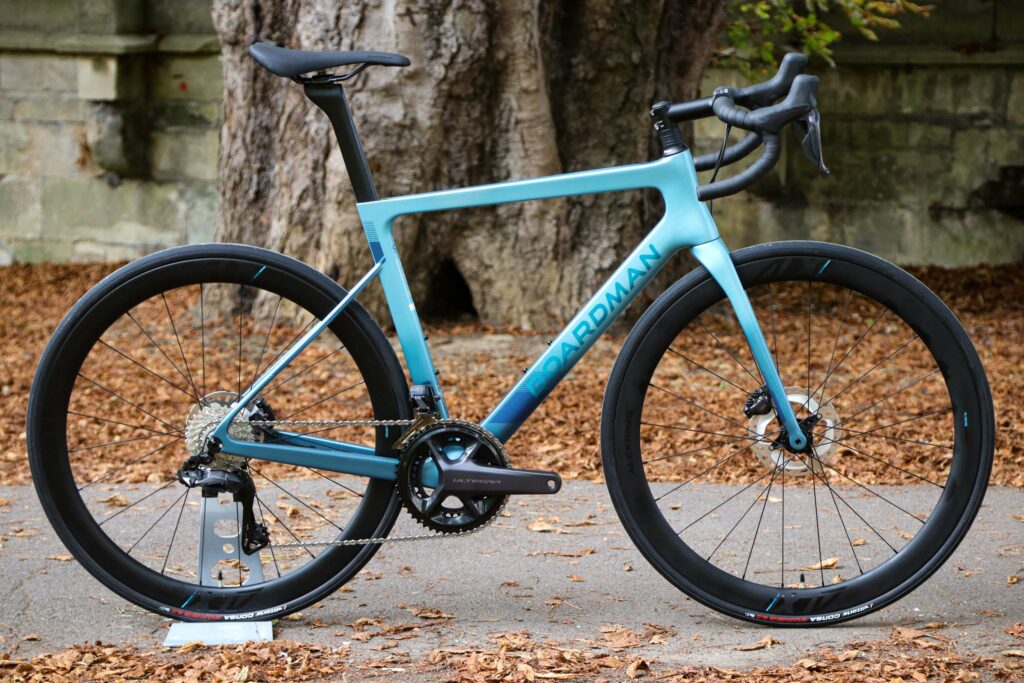
For example, the entry level Carrera Vanquish, featuring eight-speed Shimano Claris shifting and some mixing and matching of components to cut costs, is still priced at £485, the same as when we reviewed it last year. Elsewhere, the Boardman SLR 9.0 Carbon, which achieved a road.cc Recommends badge of honour, also remains the same price in the sub-£2,000 road bike category.
And earlier this month, Halfords slashed the prices of some of its Boardman bikes, including lowering its Boardman SLR 9.6 Disc road bike, complete with a Shimano Ultegra Di2 12-speed groupset, to just £1,750. Unsurprisingly, it sold out quick.





21 thoughts on “Bikes driving Halfords’ renewed “momentum” as retail giant’s cycling sales jump by over 6%”
Yes, the industry does seem to rebound a bit. It’s not great yet, but definitely better than last year!
This ties in with the recent Cycling UK survey that showed an increase in cycling since the Iran war started. looks like a cycling revival may be coming.
Like the optimism, but recall the pandemic lock down? Cycling went up a bit … but even though there have been some longer- lasting changes (remote working, probably less going out in general) that hasn’t been sustained. Certainly cycling hasn’t boomed.
(Although perhaps it’s “too early to tell”?)
I think it takes more than just “driving is expensive”. Beyond driving being literally unaffordable people have to feel there are (good enough) alternatives.
And all foreseeable governments will act at some point to fix it so people can still drive. Aside from the thought of “millions of angry voters” (particularly older people, who both drive and vote…) many politicians also see “mass motoring” and “the economy” as inseparable.
Well I’m an older person that doesn’t drive but I do vote, and won’t be for anyone that chases the petrol head vote. Looking at the comment threads on many fuel related stories it’s clear that a lot more people now realise that we need to change. We have to break our reliance on fossil fuels from unstable areas, and the only way to do this is to move over to renewables and alternative transport. The Greens will be an important voice in local and regional government after next week, so the political will is going to be there.
Also not a car owner, and still liking the optimism!
I think there’s the usual “crisis division” – as things get harder * people *may* decide to work for a new direction (which takes time)… But they may also decide they don’t have the time (or money) and they want “better for me, right now”. Or just to give a kicking to the leaders holding the hot potato at that point.
Humans are highly sensitive to losing status (and losing things we consider “ours” generally), and as “doing well” is relative people can get very aggrieved over not much privation!
* And it can be very hard … but still not “my children all died and the neighbouring village got swept away” bad.
I don’t see it this way.
Cycling did boom (not just ‘went up a bit’) in Covid, and there are clear numbers to confirm that – both on the streets and in the shops. It’s just that the boom was caused by circumstance and necessity, not a change in people’s attitude.
We always gravitate towards ease and convenience and that’s generally good, that’s what promotes progress.
The problem is that politics works short-term and even though most of us (or at least enough to win an election) probably agree that climate change is real and cycling is good for health, we are just not ready to pay the price for transformation today (and even less to actually move that arse of theirs right now). We’ll do that tomorrow. Next term, maybe. Now is not the right time for change ’cause Brexit/war/pandemic/whatever. The same happens with saving money for retirement or even something as banal as writing that essay due next Friday.
Add massive lobbying to the mix and you get the recipe for sustaining the status quo.
One person’s boom is a 46% increase. Well, 200% at weekends, so I’ll happily concede “it boomed at weekends”.
https://www.gov.uk/government/statistics/walking-and-cycling-statistics-england-2020/the-impact-of-the-coronavirus-pandemic-on-walking-and-cycling-statistics-england-2020
Regardless I broadly agree *, but that’s the point: for change to stick it takes more than a single (time limited) special circumstance.
I don’t know if there are enough data points to go beyond the specific circumstances of each case but it’s maybe interesting to look at where this *has* happened. Certainly in the Dutch case it was more than just the oil crisis.
Plus they had a good base to work from in terms of existing public transport, cycle infra existed (it did dramatically increase starting in the late 1970s / 1980s but was around before) and cycling was still mainstream transport.
* for “…that’s what promotes progress.” I might substitute “that’s what promotes products being invented and offered that promise enhanced convenience” but that’s maybe a little cynical.
The Dutch and Scandinavians have very different cultures, and that’s exactly what I’m talking about. They understand much better than Anglo-Saxons (or Slavs, for that matter) that they are part of something greater, which is why they are more willing to make sacrifices for the common good, whereas Brits are famous for NIMBYism.
That’s not to say I don’t believe Britain has the potential for change. It’s just that, for that to happen, it would need to be more managed, as it’s unlikely to happen organically.
(Reply to feature also seems awry) @tomlew “The Dutch and Scandinavians have very different cultures,”…
Culture is a factor, but that is variable within places. (For example there are arguments that eg. Scotland has much more in common with some aspects of Scandinavian culture).
I’m not aware that eg. Seville (not Scandinavian) was renowned for its cycling culture before its transformation started (that case appears to be related to political horse-trading and … Communists!) And rightly or wrongly the inhabitants of Paris aren’t usually regarded as self-sacrificing for communal good.
I do agree that the UK has a driving culture (although… doesn’t everywhere? And it’s a culture that was heavily *promoted*. with government decisions on infra).
Obviously “top down” is important because that’s where rules are made and infra is commissioned. I think there always has to be a measure of both – in the Dutch example there were popular movements, that then got support at the top. But there were then serious conflicts with people resisting change (eg. an early demonstration cycle project was physically damaged by locals including shop owners and the plan was dropped – sounds familiar). No doubt some politicians sought to make progress by saying “this is going too far…”
I think one issue with the COVID cycling boom was that the market wasn’t prepared for it.
People were motivated to cycle, but apart from quiet streets, the other bits of infrastructure were working below par, ultimately putting a lot of people off becoming true bike converts.
Any current boost in cycling that coincides with the current increased fuel costs would be different, as I’m not aware of any significant impact on bike parts etc. But I’m not sure if the boost in cycling figures are true new converts, or fair weather cyclists who decided to start their cycling season a bit early?
The fixed costs of driving are still high in relation to the per journey costs of fuel, especially for the shorter journeys that bikes replace, so investment in a new bike would rely on people realising that the price of fuel is likely to stay high for the forseeable. We had queues at petrol stations in the run up to Easter, so some boost may have come from people who wanted to delay filling up.
Then again, people also realise that fuel prices are unpredictable, and we’re seeing increased interest in solar panels, battery storage, heat pumps, and electric cars, so it’s unrealistic to assume there won’t be anyone motivated to switching out car journeys for those on a bike.
I expect any increase due to the current conflict to be less dramatic than during COVID, but perhaps it will be more sustainable?
Here’s hoping.
A lot of people actually have access to bikes – but
a) they’re sat unused in garages / sheds / on balconies and most people aren’t familiar with (very) basic bike maintenance
b) the reason they’re there is that people have no mental patterns of bike use – certainly not for “transport” use.
On the infra / authority “support” – I think over my lifetime this has waxed and waned. Overall it’s probably increased … slightly. (Although I think there’s a fair chance that could reverse at the next election).
Unfortunately while the “public” provision is creeping towards “good enough” * – at least as far as Edinburgh is concerned …
… new developments are still being built with at best “cargo cult” understanding of “making places for people, not motor vehicles”.
So there may be “brick surfaces” and no road markings – but the streets are far too wide, and the development is permeable (in two directions) tempting “driving through” and requiring more space. There may be a cycle facility. And probably there shouldn’t be – if the street layout had been done properly to reduce motor traffic speed and volume it should feel safe to cycle in the street!
But “place faking” / ticking boxes means there it is… and it will be “shared use”, be too narrow, won’t have proper drainage, will give up at tiny side roads, will have sharp right-angle turns, will not connect well to wider networks…
I don’t know to what extent this is cynicism / market pressure to maximise sale value by cramming on houses, incompetence / ignorance or just that neither local authority nor developer feel this is really their responsibility.
* That is “good enough to tempt current non-cyclists to cycle – and more people to walk”. Not “Dutch” level, perhaps not even “Scandinavian” level, but “feels safe” and not obviously inconvenient.
(That 46% was the road traffic estimates – as you note higher figures are available!)
I do agree that the UK has a driving culture
It’s notable that your 11:20 comment had underneath it a JLR advert- which reminded me of the recent TV advert in which the annoying tosser drives up the steps of a stately home. They say that all publicity is good publicity, and I’m in favour of UK manufacturers, but I hereby undertake never to buy a JLR vehicle- or any other Panzer
Scotland has much more in common with some aspects of Scandinavian culture…
But not the healthy bits
Ha! TBF Scandinavia wasn’t known for moderation in drinking until the prices went through the roof and they got better at finding the private stills … so that bit used to be closer.
Chrisonabike was right about British NIMBYism. It’s got completely out of control and those concerned are delaying important projects with their selfishness. I was very heartened to see Ed Miliband standing up to the Reformer NIMBYs of Lincolnshire over a solar farm project recently. we need more of that if we’re ever going to free ourselves of this car-addiction and embrace active travel.
Well… logically you could say that the antis are right and we *don’t* need such things as solar power and indeed electric wind turbines! That is – as long as they’re content that all the motor vehicles quickly become hugely expensive to drive, and stop working whenever Nige’s pals Vlad and Donald take out the fuel supplies.
And Reform’s * crypto backers would find it’s financially prohibitive to play the game of inventing money via computer work.
We *could* just radically use less – but that’s counter to the laws of financial thermodynamics! It’s quite rare for people to tighten their belts; it seems almost all change (other than catastrophes that is) has to concentrate lots of money for someone to provide the motive power.
* (Of course they’re very happy to slosh money at any party who will overlook regulating them).
Not sure building more solar farms is going to help us to escape auto dependency, given that one of the big drivers of renewable energy increases is to provide power for electric vehicles. More renewables is obviously desirable for other reasons and electric cars are better for pollution than petrol ones, but as I’ve often said, they don’t kill you any less dead if they hit you.
Indeed! Cars 2.0 take up no less space on the footways! The infra for them is still space and resource intensive, they’re not quieter *, they still emit health-damaging particulates…
But but they’re a step on the way to cars 3.0 (self driving / shared autonomous taxi-pods) which will fix most issues of cars! Perhaps … though the usual technology story is that we can indeed fix many of the problems in one domain… but by substituting them with new problems in another!
I do have a little sympathy with those pointing out the downsides of the great electrical energy transition. Observing Jevon’s Paradox (and the data centres for the Internet – now plus crypto and AI) I believe we’ll soon be demanding a lot more electrical energy than the (massive) amounts we needed for mass motoring.
* Above a certain speed due to “road noise”.