



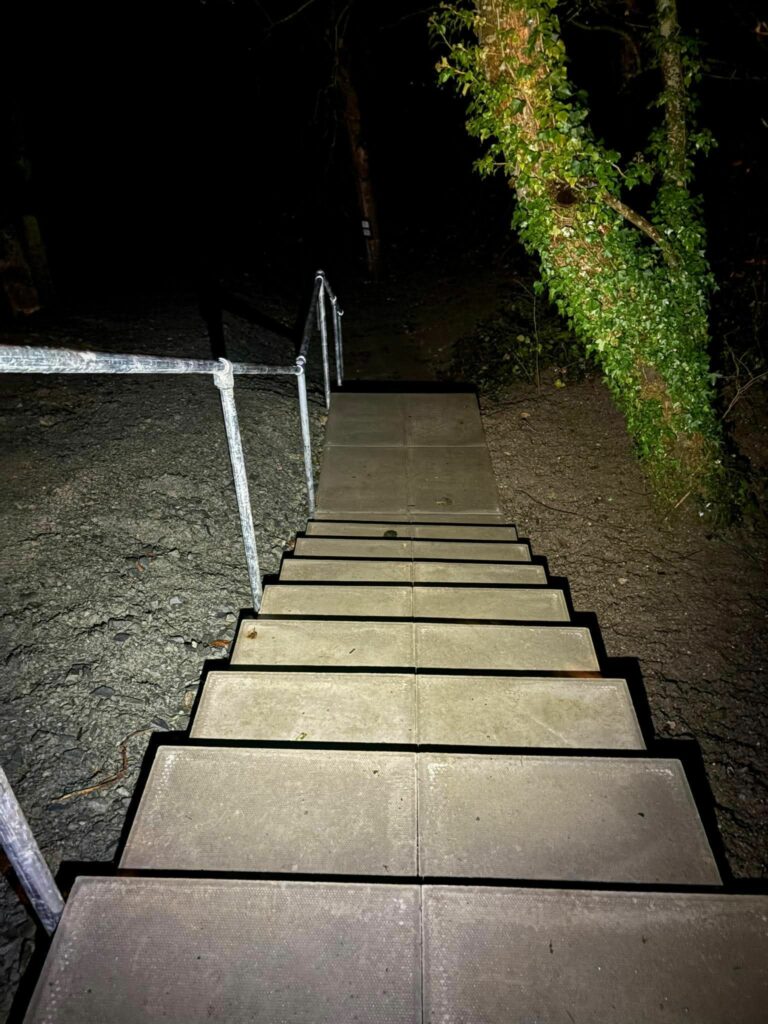
Cycling campaigners and wheelchair users have criticised a new active travel path in Denbighshire, which they say is inaccessible thanks to the presence of 15 steps on one side of the route and fences and stiles on the other.
However, despite critics branding the £1m project “pointless”, with Cycling UK even questioning why the scheme was given the go-ahead in the first place, the local council insists that it is working on the path’s accessibility and that a ramp will be installed by next spring.
Following a series of delays caused by “unforeseen circumstances”, last year Denbighshire County Council announced that work had commenced to create a two-mile-long shared walking and cycling route between Corwen and Cynwyd and along a former railway line that runs adjacent to the B4401.
Funding to upgrade the former railway line was secured from both the UK government’s Levelling Up fund and the Welsh government’s Active Travel Fund, which aims to increase walking and cycling levels in Wales and reduce the number of short everyday journeys undertaken in cars.
The work has so far involved laying a new tarmac surface to ensure, the council says, the route, which reopened in December, is “accessible throughout the year”.
However, the council has come in for criticism this week after locals pointed out that the path is only accessible at Cynwyd via 15 steps, while at the Corwen end the route passes through private land, forcing users to climb over fences and stiles.
“I can’t understand why the council hasn’t put in that ramp,” local wheelchair user Morgan Jones told the BBC, questioning why the route is currently not accessible to all.
“I feel that disabled people in a wheelchair are a second thought. I’m quite frustrated to be honest. It’s 2026. It’s a shame that I have to fight for accessibility.”
Meanwhile, Cycling UK spokesperson Ross Adamas described the path as “pointless” if measures aren’t swiftly put in place to make it accessible.
“It’s great that progress was made but then it stalled and it’s got to a situation where it may as well not have started because it’s almost a pointless exercise,” he said.
“We’ve got a situation at both ends of the active travel corridor where people can’t really access it, so it begs the question, why was it put in in the first place?”
Dafydd Morris, from Corwen Town Council, also told the BBC: “We desperately need accessible gates here so horses, bikers, wheelchairs – everybody – can access.
“Denbighshire County Council and the landowners need to come to an agreement. It’s a beautiful path along the riverside and it’s a shame so many people can’t access it.”
In response to these complaints, a spokesperson for Denbighshire County Council pointed out that the first phase of works – including the laying of the new tarmac surface and “improvements to the existing steps” – has just recently been completed, and more work is scheduled to be completed over the next year, with funding secured to install a ramp to the path at Cynwyd.
“We understand that the existing route is popular with the local residents and would like to thank them for their patience and understanding during the first construction phase whilst the path was closed,” the spokesperson said.
“The council have been successful in applying for further funding to introduce a ramp at the Cynwyd end of the path to improve accessibility for pushchairs and wheelchair users which will be completed by spring 2027.
“We are also currently developing works to improve the accessibility of the path at the Corwen/A5 end.”
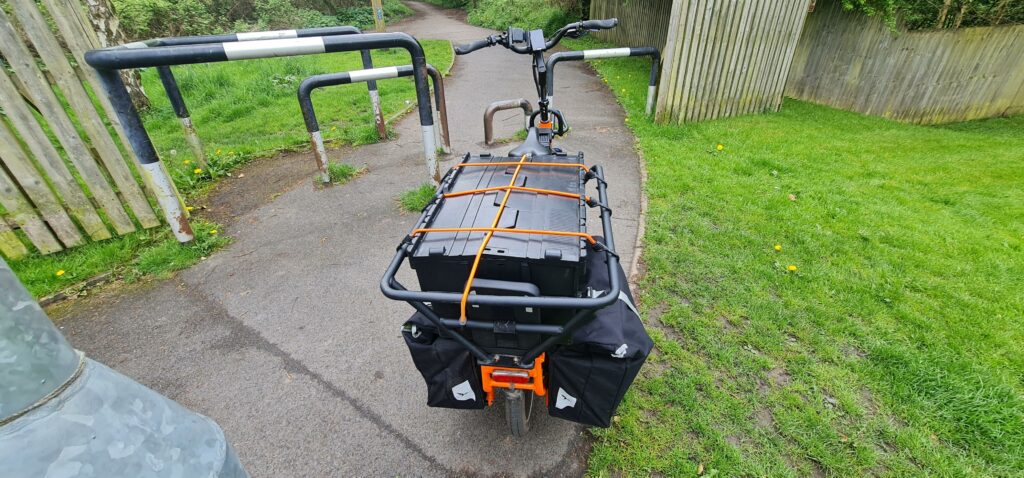
Accessibility – or the lack thereof – on walking and cycling paths has been an issue we’ve covered extensively on road.cc over the years. This week on the live blog, a cyclist in Manchester claimed that he wasn’t able to access an off-road cycle route because his cargo bike could not fit through the barriers.
And last June, campaigners complained about a council’s decision to install “prohibitive, discriminatory” barriers on a steep ramp at the exit of a park in Wandsworth Park in southwest London, a move purely based on anecdotal evidence, it was revealed.
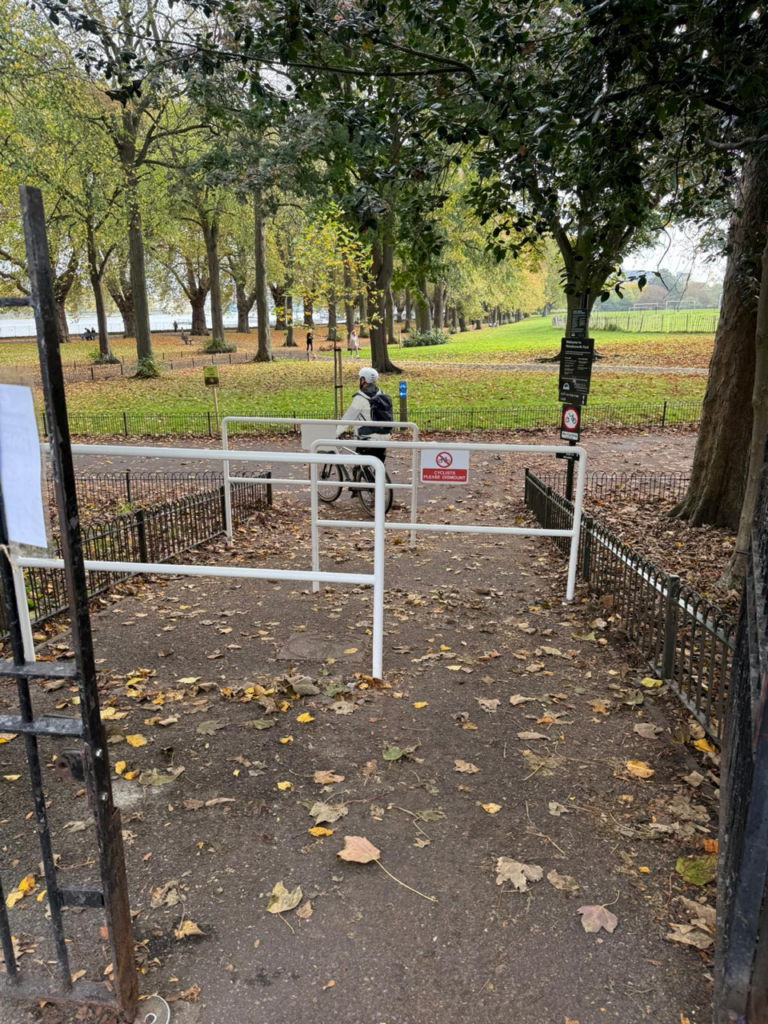
Park users said the steep ramp’s barriers had forced families using cargo bikes or those with disabilities using mobility aids or non-standard cycles onto a busy road with no cycling infrastructure.
















18 thoughts on ““Why was it put in in the first place?” £1m active travel path branded “pointless” as steps and fences render it inaccessible to cyclists and wheelchair users”
To be fair to the council, looking at the steepness of the stairs, I imagine having to put in ramps there would be a massive ball ache. You can’t just make a straight slope because the wheelchair regulations need a shallow grade. So you’ll have to cut down all the surrounding trees to make room and come in with an excavator to build a monolith like this…
They’d have to be 15 very tall steps to require that amount of ramp…
But you’re right – ramps do require a lot more space. That’s why motorists have to carry or push their motor vehicles up Cheddar Gorge, the Wrynose pass etc…
Are you under the impression the average wheelchair is motorised…?
Um – I think you may have missed CoaB’s point there. Just by a tiny bit.
As a comparison it makes zero sense. We shouldn’t care about complying with wheelchair slope regulations because cars can go up snake pass? What?
Try:
“It’ll take up loads of space (and effort)” isn’t considered a problem when we’re providing for cars, but for some reason, even though it’s on a much smaller scale, when it comes to facilities for cyclists / wheelchairs / etc. it’s seen as an insurmountable obstruction.
(So instead they, er, build an insurmountable obstruction.)
Unfortunately with the way funding streams come in a lot of the time now the choice is:
1) Do it piecemeal as you can and hope you’ll join it all up in time.
2) Do nothing – things can’t be lined up to do everything in one go
🙁
Agree, what would be the alternative? build a ramp and have nothing to connect it to? people would complain there was a road to nowhere. People will find a way to complain no matter what you do. They make it clear there is plans to resolve the steps and barriers. its not like its an oversight. Budgets are tight. they can only spend what they have in any financial year
But why not make the ramp the first thing you build and if necessary put in steps later, rather than vice-versa? If you’ve only got the budget for one option you choose the most accessible one first, no?
Then they might be in the situation where they’ve built the ramp, but can’t create the route. Perhaps there were negotiations with land owners over access etc.
At least this way, the route is established.
I meant they had the resources and the space to build the stairs, so why not use those for a ramp that everyone could use then add the stairs as more funds become available? Would a ramp cost that much more than the stairs?
Quality paths usually attract more walkers and their dogs.
Anywhere nice, guaranteed not to be muddy is your everyday dog walker requirement.
Yes, it increases tourism too, something neglected by our councils, especially so on the publicity side of things.
I think we could go a lot further on the “make places fully accessible and *everybody* benefits.” (At the cost of more cash / concrete / visual intrusion as eg. thrawed notes. I also stop short of “pave every moor and put a lift on the mountains” )
BUT … there *is* another issue (at the moment at least). Adding that to your positive note: “Anywhere nice, guaranteed not to be muddy **where you can drive to easily and leave your car** is your everyday dog walker requirement.”
The tragedy of the commons / “overuse” is massively exacerbated by mass motoring and the space-inefficiency of motor vehicles. Rarely does “but our scenic gorges / historic streets are too narrow” hold back that tide.
Inclusive mobility doesn’t seem to include common sense. A travel path that starts or ends with 15 steps is expected to have a closed and heated cargo lift for wheelchairs and ebikes. This is 2026, and a public project can’t leave anyone out. Like it or not.
“Like it or not” … or “not like it, invoke an absolutist position and make a silly caricature of that” it seems? This is 2026 after all and the wild and often childish rhetoric of social media has leaked out widely (even into the language of government …)
Your comments certainly don’t. What sort of begrudging nasty Tory mind do you have to have to see wheelchair users asking for a ramp to grant them fair access and somehow twist that into being equivalent to demanding “a closed and heated cargo lift”?
Seems a bit daft but is it actually declared finished? Until it is then moans are pointless. It is also fair to say that partial access is better than none which might be the only other option. Make access too easy and all sorts of other users use it. Hmm
Let’s hope the council here can actually get the ramp installed in the next 12 months.
In Torquay, Torbay Council built a similar walking and cycling path with “temporary” steps in 2016, with plans to build the ramp…this summer! Only 10 years late 🙄