



Motorists in New Zealand could face fines of up to $3,000 (around £1,300) for close passing cyclists, according to a raft of new road safety rules proposed by the country’s National Party-led government.
However, the government’s proposed minimum passing distance of one metre at speeds of up to 59kph (37mph) – and 1.5m if driving faster – has been criticised by opponents, who have called for 1.5m to be introduced as the minimum safe passing distance, arguing it would “reduce the dangerous impact of slipstream effects”.
Like the UK’s Highway Code, New Zealand’s road code recommends that motorists should leave at least 1.5m of space when overtaking cyclists, though there is currently no specific ‘close passing’ offence in both countries.
But, unlike in the UK, that passing distance recommendation applies to all speeds, whereas the Highway Code says drivers should leave even more space when travelling at over 30mph.

This week, New Zealand’s government announced a package of transport policy changes, which if passed would allow children under 12 to cycle on the pavement (currently banned in New Zealand), permit e-scooter users to ride in bike lanes, and make it clear that bus drivers have priority when pulling out of stops.
The proposed road safety overhaul would also introduce a maximum $3,000 penalty for motorists found guilty of close passing people on bikes or horse riders, based on a mandatory passing gap of one to 1.5m depending on speed.
Transport Minister Chris Bishop announced on Wednesday that a public consultation had opened on the changes, made under the Land Transport Rules Reform programme, which he claimed would help “fix the basics” of New Zealand’s transport system.
Bishop said the changes would address common areas of confusion, including “a parent unsure whether their 10-year-old is allowed to ride their bike on the footpath, a driver not clear how much space to give a cyclist, an e-scooter rider not sure if they can use the cycle lane, a bus stuck waiting to pull back into traffic, or a truck operator tied up in paperwork just to move an empty trailer between depots”.
However, the decision to make one metre the minimum distance for overtakes committed at up to 59kph has been criticised by New Zealand’s Green Party, who argue that 1.5m should the absolute minimum safe passing distance.
According to data from New Zealand’s Ministry of Transport, the survival rate for cyclists involved in crashes at 50kph is 55 per cent. This rises to 95 per cent if the motorist involved is driving at 32kph.

“Anyone who thinks that one metre is suitable has never been on a bike that’s been overtaken by a logging truck,” Green Party transport spokesperson Julie Anne Genter said in response to the proposals.
“1.5 metres reduces the dangerous impact of slipstream effects and takes into account the fact that bikes often wobble when they’re being overtaken by much bigger, intimidating vehicles.”
Speaking to The Post, a spokesperson for Bishop insisted that the government’s proposed rule balanced safety with “the efficient use of the roads”.
“These minimum passing distances were considered most appropriate because they account for the safety of other road users but also seek to enable passing where it is safe and practical to do so,” the spokesperson said.
“Transport officials advise that the 1 metre and 1.5 metre distances are informed by survey data collected in previous research around rider comfort, as well as safe distance from the lateral pull force of air from a vehicle passing (predicted to be one metre in a 50kph).
“While greater minimum passing distances were looked at, the Ministry of Transport considered these options to be impractical and to have a negative impact on the efficient use of roads.”

The spokesperson added that the rules were now subject to a public consultation and that the government was open to changes.
“We are fixing the basics by making sure the rules are clear, practical, and reflect how people actually use our roads every day,” they said.
“This is about safer school rides, smoother bus trips, clearer guidance for drivers, and fewer compliance headaches for truck operators.”
While close passes aren’t, in their own right, a criminal offence in the UK (the Highway Code states that drivers ‘should’, not ‘must’, leave at least 1.5m when overtaking at speeds of up to 30mph), drivers who pass cyclists too closely can be found guilty of careless or dangerous driving.
In 2024, this legal ambiguity was highlighted when Gloucestershire Constabulary’s non-crime unit head – announcing that the force was adopting the Operation Snap portal – was criticised by cyclists after claiming that “a lot” of people who ride bikes “don’t realise that… a close pass itself isn’t an offence”.
The officer also said that the police “need to try and find a way of educating” people who submit footage to Operation Snap that the clips need “to show that the driver or rider is being inconvenienced in some way”, while bizarrely adding that “in the Highway Code you have something called a close pass, where you should allow cyclists 1.5m width”.
The muddled messaging from Gloucestershire Constabulary was widely criticised on social media by cyclists, who have argued that the officer has failed to realise that close passes often constitute an example of careless driving.
Some campaigners also claimed that the officer’s comments misrepresent cyclists’ concerns about road safety and highlight “the mess in which we find ourselves as we seek to lower road crime against cyclists and encourage more people to cycle”.





16 thoughts on ““Anyone who thinks one metre is suitable has never been overtaken by a truck”: Drivers in New Zealand could be fined $3,000 for close passing cyclists”
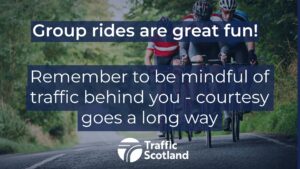
Regarding the photo from Police Scotland.
Shouldn’t that be measured from the widest point of the cyclist? Handlebar or elbow?
dangerously close to hate speech there, talking about wide cyclists. and they actually arrest people for that sort of thing. 🙄
Yes, my mate Dave met a bloke called John in the pub who said that his workmate Trevor knew somebody whose brother-in-law got arrested just for calling a girl fat online, it definitely happens.
Everything is possible :
Father-of-two, 43, who called a lesbian police officer a ‘tattooed fat d***’ after she arrested him for loitering in someone else’s garden is fined £150 for hate crime as judge accuses him of ‘living in the Stone Ages
https://www.dailymail.co.uk/news/article-10986777/Father-called-lesbian-officer-tattooed-fat-d-arrest-fined-150-hate-crime.html
Insulting someone on the basis of their ethnicity, gender or sexuality is a hate crime, calling them fat isn’t. It would be the homophobia, not the fat-shaming, for which he was charged.
Regarding the photo from Police Scotland. Shouldn’t that be measured from the widest point of the cyclist? Handlebar or elbow?
It hardly matters, because they have no intention of ever enforcing any minimum distance. We’ve had 1000 NMoTD, yet there still no acceptance from the police that there is any such thing as a close passing offence. The only evidence of ‘passing a little closer than preferable’ they’re willing to consider is a KSI’d cyclist. For some inexplicable reason, there seems to be a great reluctance among cyclists that their greatest corporate enemy is the police.
cdamian wrote : “Regarding the photo from Police Scotland. Shouldn’t that be measured from the widest point of the cyclist? Handlebar or elbow?”
The recommended distance for passing parked cars is 1m not 75cm so if the handlebars are 60cm wide the police car is 85cm too close. That is not a trivial distance.
In my opinion it is not safe to overtake a cyclist with cars parked both sides in a street that wide.
Let’s not forget the protruding “side” mirror…
That picture says a lot about them. Have Police Scotland handed out a single penalty for a close pass? Do either of the guys in the pic even ride a bike?
Ahh yes, the old “I was pulled off my bike by someone going too fast and too close”. Thats the least of my concerns. I’m far more concerned about hitting a pothole and needing more than 20cm to wobble before I hit the passing car. Its got very little to do with wind/sucking effect of close overtakes and everything to do with giving space for cyclists needing to move laterally to avoid things.
We all know that drivers are fucking awful at judging….anything, especially speed limits so saying 1m just means that they will do 50cm. At least 1.5m means that unless they are doing it intentionally, most give around 1m.
Or even the driver having a wobble because they’ve dropped their phone in the footwell or are busy changing track on the stereo. Or are just a bit crap at driving.
The officer’s comments unfortunately reflect the reality of UK law.
While the Highway Code guidance indeed refers to 1.5m, that is not anywhere in the law. And the criteria in law for proving a charge of careless driving does in fact rest on whether the rider is being “inconvenienced”, as the discovered several years ago when the Met prosecuted a taxi driver who nearly hit me when cutting into my lane from the left near Marylebone.
The prosecution lawyer was a barely competent newbie who fumbled over his words. The court computer was barely capable of playing the video footage, which kept freezing and crashing.
The cabbie had an highly assertive defence lawyer who immediately seized on this point, and argued to the magistraite that I clearly hadn’t been “inconvenienced” because I had not stopped or swerved, and had carried on my journey.
Never mind that didn’t have time to do either of those things, or that I was centimetres from being hit – the magistraite acquitted him on those grounds.
That is unfortunately the outrageous reality of actually prosecuting a close pass incident. I know it’s popular to blame the police and the CPS for not prosecuting enough close passes … but the fact is the law is inadequate, and if the driver has a good lawyer then they can likely get off most close pass prosecutions.
reply to Velo-drone
I think this decision reflects the relative quality of the prosecution and defence lawyers. As far as I can see magistrates have no legal training and are therefore swayed by the arguments of the lawyers. As mdavidford points out the offence is careless OR inconsiderate driving with the empahasis on the OR. This point has been made to the officer concerned but I guess they have to play it safe when they decide who to prosecute with resources and court time being in short supply.
On the plus side Gloucestershire are now sending out advisory letters to close passing drivers when I report them so at least they know what they have done. It does seem to have improved most drivers in my local area but there are always the punishment passers.
One last point. I have had one close pass report which resulted in points and a fine. NMOTD 931
https://road.cc/content/news/near-miss-day-931-314751
However this did not go to court, apparently the driver admitted it after being shown the video and the only results I’ve had for close passes apart from that one are when an oncoming driver has been forced to pull in and stop, ie inconvenienced!
Am sorry,but that is never 3ft3in which equals 1 meters so maybe get the tape measure back out
The defence may well have argued that, and the magistrate may have accepted it, but that’s not what the law says. It says that you have only driven without reasonable consideration for others if someone is inconvenienced. But the offence is committed if you drive without due care and attention, OR without reasonable consideration for other person. You have done the first if the driving falls below what would be expected of a careful and competent driver, regardless of whether anyone was inconvenienced. And CPS guidance specifically cites driving too close to another vehicle as an example.
I have had one close pass report which resulted in points and a fine. NMOTD 931
Good work – I have never achieved that, although I do suffer from the b******s at Lancashire Constabulary. This first one is similar, except it’s in the wet and dark. No response at all to any of these, obviously
There’s even ‘inconvenience’ on the last one: the oncoming black Audi parked in right turn lane ahead had to move sharpish to avoid the laundry lorry bearing down on him.