



A cyclist has claimed that people riding bikes on Cheshire’s roads are “at the mercy of dangerous drivers”, after the police deemed footage he submitted of several drivers’ close passes “insufficient” – due to the incidents “not being witnessed at the time by a police officer”.
In April, road.cc reader Martin lodged a formal complaint with Cheshire Constabulary and the county’s police and crime commissioner over the force’s treatment of his bike camera submissions, following a close pass incident with a motorist on Sunday 20 April.
Martin claimed that Cheshire Constabulary’s argument that his bike camera footage “wouldn’t be enough evidentially” to pursue a case against the driver on its own indicates that the force will not act on Operation Snap submissions, leaving cyclists with “no recourse” for submitting footage of road crime – a stance, he says, which has led to him avoiding cycling on the road.
“I have a camera on my bike and have submitted footage to Cheshire Police which have resulted in letters and a couple taken further,” Martin told road.cc.
However, the cyclist says he noted a “change in approach” from police this spring, after he was told that no further action would be taken concerning his close pass submission in April.
The police’s response to his Operation Snap submission, seen by road.cc, reads: “In this case having reviewed the footage you had provided I’m afraid there wouldn’t be enough evidentially from what can be seen to pursue any offences on this occasion.
“Due to the incident not being witnessed at the time by a police officer your footage is the only independent means we have available to review that incident and must be able to provide the following.
“If offences were pursued, for various reasons, the matter could potentially go to court, therefore it’s essential footage shows enough of an incident to a degree it is clear what has occurred in order that any offences can be evidenced from that footage, with all of the relevant points to prove for that offence clearly visible being committed ‘beyond any reasonable doubt’.
“Any offending vehicles registration plates at the time offences are committed must also be clearly identifiable to prevent legal argument over the identity of those vehicles.”
The email continued: “Please bear in mind that your footage is the only independent evidence I have to review, and I can only go from the perspective that gives which isn’t always a true reflection on what occurred.
“Without knowing the equipment that you use or how this is fitted, would you able to adjust your camera so that a part of your bike or wheel would be visible during future rides? This may assist in future should you have cause to submit any further footage to us.”

Reflecting on the force’s response, which he believes was largely a “standard, copy/paste email”, Martin told road.cc: “The implication of this is basically saying that any cyclist on their own has no recourse for submitting any dashcam footage for close passes or any other offences.
“We are fair game for the crazy drivers out there as we need a witness, and they don’t take dashcam footage alone as sufficient evidence.
“If this approach is being taken for cyclists, then the same should apply to dashcams in cars with no witnesses.
“It looks like I need to cycle with a police officer from now on to be a witness in case I get close passed. It is just very poor. If they don’t have the resources, then just say so.”
Martin then lodged a formal complaint about Cheshire Constabulary’s response, prompting the force to admit that the wording of their email could be “misleading”.
“But nothing has changed, I still get the same response from submissions in the last couple of weeks,” Martin said.
Another response seen by road.cc, this time related to a close pass from earlier this month and sent to Martin by the force’s journeycam reviewer, is broadly similar to the one the cyclist received in April.
“Please bear in mind that your footage is the only independent evidence I have to review and I can only go from the perspective that gives, which isn’t always a true reflection on what occurred,” the traffic police officer said.
“Obviously, you were there at the time and experienced the incident and may feel it occurred differently, but I have to be able to evidence using your footage that any offences can be clearly seen to any other party to have been fully made out beyond any reasonable doubt.”
“My personal view is that they are not interested in any cycling video submissions that do not have an independent witness,” Martin says.
“They say ‘insufficient evidence’ to pursue a prosecution. That very much puts us cyclists at the mercy of dangerous drivers. It’s very disappointing and I am now mainly gravel cycling away from main roads.
“I am very much of the opinion that basically unless an incident has an independent witness or secondary witness then Cheshire Police will not do anything about it. As a cyclist it is virtually impossible to have a second witness, especially if you cycle alone which I do. No incidents are witnessed by police officers.
“I just think this makes Operation SNAP virtually pointless and leaves me very vulnerable to dangerous drivers. Every time I cycle on the roads, I get close passed and it has scared me enough to force me to ride gravel more often.”
road.cc contacted Cheshire Constabulary earlier this year, but the force declined to comment due to the ongoing nature of Martin’s complaint. We contacted them again last week but are yet to receive a response.
Martin’s claim that bike camera submissions are being ignored comes a month after the National Police Chiefs’ Council was forced to respond to the revelation, first reported by road.cc, that police in Wales are to stop taking action on cyclists’ close pass videos by insisting that it simply is not the case that there is anything in its guidance to warrant such a controversial decision.
Cyclists were alarmed to hear at the start of June that motorists who are caught on camera overtaking cyclists, pedestrians, and horse riders too closely in Wales will avoid punishment for the foreseeable future because GoSafe Wales, the country’s road casualty reduction partnership, has chosen to temporarily suspend taking action on close passes – a decision it said was based on “national guidance” advising forces to avoid “dealing with incidents involving distances”.
The “national guidance” in question was issued by the National Police Chiefs’ Council (NPCC) and the Forensic Science Regulator, GoSafe Wales interpreting some parts as a reason to suspend taking action against drivers who pass cyclists, pedestrians, or horse riders too closely.
This is essentially, in GoSafe Wales’ interpretation, because it advises that what the NPCC calls “journeycam units” do not have the “capability to measure speed and distance from digital media submissions” and that such measurements would need to be carried out by trained forensic specialists.
However, the Forensic Science Regulator, which regulates the application of scientific principles and methods in legal decision-making in England and Wales, insisted that it has not issued any guidance “that would suggest forces suspend taking action on evidence submitted to Operation SNAP”.
Meanwhile, a spokesperson for the NPCC also confirmed that it is simply not the case that its guidance would mean that police forces cannot take action on the Operation SNAP submissions in question.








56 thoughts on ““We are fair game for crazy drivers”: Cyclist says “I need to cycle with a police officer from now on” after bike camera footage of close passes rejected as “insufficient evidence” due to lack of witness”
Institutionally anti-cyclist
Institutionally anti-cyclist
If this government were truly
If this government were truly interested in change, and joined up government between
Department of Transport,
Department of Health,
Department of Culture Media and Sport,
They would change road users attitude and behaviour by changing mainstream and social media output by using the existing Equality legislation to make cyclists a protected characteristic.
Where do they teach the
Where do they teach the coppers to write that badly? Absolute word salad.
DJameson wrote:
Makes one’s teeth itch, doesn’t it? Hard as it is to believe I’ve seen worse, I had a letter from a Chief Superintendent last year that wouldn’t have achieved a C at GCSE.
It will be of no consolation,
It will be of no consolation, but I know from bitter experience that Cheshire police are extremely reluctant to proceed with any evidence from cyclists.
My experiences go back some eight years and with one apalling close pass I asked for a senior officer to review the (negative) decision. A sergeant called me back and said he agreed with the initial decision. There was a bit of back and forth between me and him and I took a view that he’d actually not looked at the footage himself, so I challenged him directly. He said “I don’t need to look at the footage, I know the road, there’s plenty of space there”.
Said all I needed to know bias.
“I have to be able to
“I have to be able to evidence using your footage that any offences can be clearly seen to any other party to have been fully made out beyond any reasonable doubt”
That’s not true though, is it? The evidential test for putting a case for prosecution is whether the evidence is enough to give a “reasonable prospect” of a conviction, i.e. a conviction is more likely than not.
The police are not the courts, and they shouldn’t be applying the criminal standard of proof in deciding whether or not to charge: it’s not what they’re there for. And we don’t have a requirement for independent witnesses to found a case in England & Wales either.
This all has the whiff of a
This all has the whiff of a lack of manpower about it. If that is indeed the case, is it worth the suggestion that the appraisal of camera footage be outsourced to a (properly regulated) private company? The companies remuneration to come from the result of any fines imposed in the case of a conviction. It seems to work for parking violations and PSPO contraventions, so why not for the road bandits as well?
This way the decision to prosecute would be a clearly commercial one, provided that the clear and legal bounds of safe and considerate driving have been breached; not one where it’s down to the opinion of an often overworked PC, stuck behind a desk, who may or may not have an antipathy toward cyclists: or would rather be out and about catching ‘real’ criminals.
There are probably reasons that this would prove unpalatable to the driving lobby, do I hear, “Perpetuating the war on motorists,” anyone? I do not see why it cannot work for driving offences caught on camera, when it already works for parking and PSPO enforcement.
Waiting for the FLAK…
To get a conviction you have
To get a conviction you have to prove the offence beyond reasonable doubt. It’s a basic tenet of criminal law. Therefore, to have a reasonable prospect of a conviction, you need proof beyond reasonable doubt.
RayG wrote:
These are the CPS guidelines:
They are meant to ensure a consistant approach, but AIUI some police forces are happy to prosecute close passes while other police forces make up bullshit excuses to do nothing.
And? You still can’t get a
And? You still can’t get a conviction without proof beyond reasonable doubt.
Not the whole picture since
Not the whole picture since court proceedings have different outcomes depending on the pleading, appearance or not, and so on.
Aggrevating factors are considered, too. For example where the defendant was offered an interview with the police or education, and didn’t turn up.
Kent Police were able to get
Kent Police were able to get a conviction, 3 points, fine and victim surcharge, so quality evidence and a genuine interest in road safety policing can work as the law intended.
However, why go to such risk, cost and time expended if there’s a better way…
Please see my post above!
If your interpretation was
If your interpretation was true, every case put forward would result in a conviction and really there would be no point in all those expensive judges and courts.
The “beyond reasonable doubt” test (which I think is now expressed to juries as “so that you are sure” of guilt) is the standard to be met in the mind of a jury (or judge) who has seen the evidence and heard the defence.
The hurdle for putting a case forward for prosecution is (by design) lower than that, as has been pointed out to you below. The test there is “on the face of it, would a judge/jury be likely to decide it was sure that the offence had been committed?”
It isn’t hard to grasp the reason for this. Once someone is charged, the onus is absolutely on the prosecution to make its case to the criminal standard and it’s well-established that guilty people will get away with things as a result. Your reading would turn the police into judge and jury, rather than the people who apprehend people suspected of a crime so that they can be tried by people empowered to do that.
You could literally get away with murder – “it wasn’t me officer, it was my twin/doppelgänger and he hasn’t got an alibi either” “well shit, I don’t know for certain it was you. Off you go then.”
Maybe it’s time for a new
Maybe it’s time for a new offence of ‘driving that threatens a cyclist’.
The only test required is the cyclist feels threatened by the manner of the driving.
Similar to the hate speech / public order offences etc.
Good idea but given the anti
Good idea but given the anti cycling law more riders are being got by car-centric police forces when you can actually find an officer who isn’t stood outside a hotel or arresting children!
If this government were truly
If this government were truly interested in change, and joined up government between
Department of Transport,
Department of Health,
Department of Culture Media and Sport,
They would change road users attitude and behaviour by changing mainstream and social media output by using the existing Equality legislation to make cyclists a protected characteristic.
The police don’t police any
The police don’t police any more
They do but they are very
They do but they are very selective in what they police which isn’t helpful in tackling violent crime and theft e.g. arresting peaceful protesters.
Anything that involves chasing crims lands in the too difficult category because:
– not enough regular coppers are trained in pursuit
– getting approval from above to pursue takes time by which time the crims have whizzed off
The country has gone to hell in a handcart as low-level crime has been allowed to become so widespread that the Police can’t be bothered and have decriminalised it.
This appalling response from
This appalling response from police forces will continue and the cycling organisations need to apply greater pressure and lobbying. Submissions could easily be automatically analysed by AI and penalties applied without needing court. In this video it is obvious the car is less than 1.5m from the verge let alone from the cyclist.
No they couldnt – stop living
No they couldnt – stop living in fairyland.
I’ve complained about the
I’ve complained about the police not taking action many times, but I think this article is misleading. The statement: ‘… the police deemed footage he submitted of several drivers’ close passes “insufficient” – due to the incidents “not being witnessed at the time by a police officer”’ is just not true. From the quotes given, they said that the footage did not provide sufficient evidence because the position of the bicycle could not be seen, and in the absence of an officer, that was the only corroborating evidence.
This whole article is about the submitter misreading what the police said in their letter. Perhaps the case should have been taken forward – we haven’t seen the video – but the claims raised in this article are not valid.
The annoyance I have here is
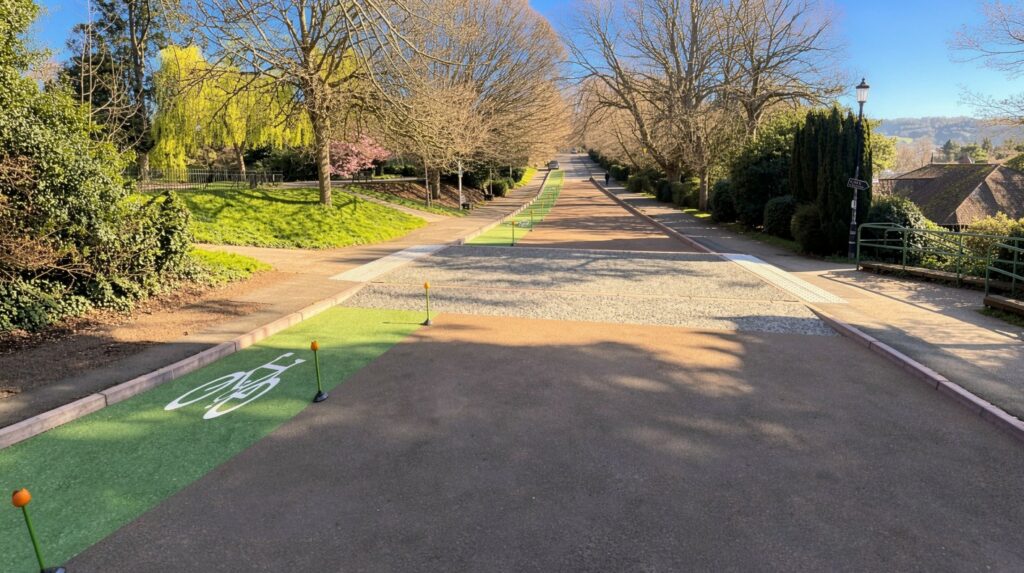
The annoyance I have here is see the slow writing on the road on top image.
Which is almost certainly standard size.
And doesn’t fit into the opposite lane.
At which point it should be trivial to show the driver was overtaking dangerously – I seriously doubt the road is wide enough to allow a cyclist 1.5m without being well into the bushes…
qwerty360 wrote:
The writing isn’t slow, you’re just reading it slow.
I do wonder if submissions of this sort would benefit from some ‘free’ analysis to help the 5-O: references to aerial photography (eg Google, Bing or OS maps) with measurements taken from those (imprecise) or from physically measuring the road width if possible (requires a revisit or carrying a tape measure on rides). I think a stock library of measured marks viewed from the camera might also create reference material (bearing in mind that changing camera settings can change relative distances, and that a helmet camera changes the perspective relative to the lens, not the bike).
GMBasix wrote:
I did once do this when I was really furious with a Ranger driver with a trailer who had passed me at a reasonable (though not the recommended) distance then cut in immediately so that the trailer missed my bars by a gnat’s whisker: I went back after reviewing the video and took pictures of a manhole cover at the scene with a tape measure added, showing that its outer edge was 60cm from the kerb and pointing out that the inside wheels of the trailer had gone over it at the same time I did meaning it must have been within 10cm max of me. Five points and £300 and something fine, as I recall. I don’t know how much the extra evidence helped as it was one of those pleaded guilty on the day ones but hopefully made the driver realise he hadn’t a leg to stand on and change his plea.
Rendel Harris wrote:
…I don’t know how much the extra evidence helped as it was one of those pleaded guilty on the day ones but hopefully made the driver realise he hadn’t a leg to stand on and change his plea. — GMBasix
Quite possibly two effects:
On the latter point, I think the likes of Cycling Mikey have commented that pleas are often changed when the witness shows up. From the defence pov, it’s always worth a shot.
Otherwise know as Road.CC
Otherwise know as Road.CC posting clickbait.
Does none of the camera makes
Does none of the camera makes have some kind of built-in distances calibration?
i tend to report only when there’s also no insurance / VED on the plate, for all the good it does.
David9694 wrote:
Don’t think so (maybe a Varia can provide linked data?) and if they did I’m fairly sure it wouldn’t be accepted as evidence given the way even official speed camera evidence can be rejected if it can be shown that the device hasn’t been tested and calibrated regularly. I’ve offered in the past to provide Garmin Virb data showing that I was riding at the speed limit at the point I was close passed, proving that speed was an aggravating factor, but been told it has no evidential value.
South Yorkshire police do a
South Yorkshire police do a mat with distances on which you can use with a camera still which you then submit with the video. Or you could do your own version at home.
I tried that using a piece of
I tried that using a piece of wood with distance markings on. Only a rough attempt but I did not take it further after I got this response in Gloucestershire.
And yet that’s what another
And yet that’s what another force does.
Where is the national standard that Andy Cox is after ?
As someone else has pointed
As someone else has pointed out, this is not about independant witnesses but whether or not the footage is sufficient evidence on its own. There appear to be a few problems. One is the clarity of the reg plate, another is the ability to judge distance (which we have seen in many other forces) and the fact that the bicycle is not visible in the footage (we have had this one before as well). It may be that a skilled prosecutor could get a prosecution from the video but with a skilled defence lawyer casting doubts in the jury’s or magistrate’s mind I suspect that there would be a chance of a not guilty verdict. We haven’t seen the video so can’t really comment on the reg issue and the first picture would clearly indicate less than 1.5m but that is not a legal requirement and then we are down to how close is too close.
Here is one of mine from Gloucestershire.
No problem with the plates and the bike shown in the footage but :
I have reviewed the two clips submitted. While I believe it probable that the vehicle passed less than 2 metres from you there is no offence of ‘close pass’ in law.
I have considered the offence careless/inconsiderate driving and in doing so have applied the evidential test as set out in the Code for Crown Prosecutors, relevant case law and the Directors Guidance on charging (sixth edition). I do not believe the evidential test is made out in this case and have concluded that there is no realistic prospect of conviction. No further action will be taken.
I appreciate this will not be the outcome you wanted. Every case submitted to Op Snap is reviewed in the same way and the outcome determined on the available evidence. Please do not be put off making further submissions as you feel warranted.
I use the cycliq C12 on the
I use the cycliq C12 on the front and have it linked to my strava account.
This then overlays the footage with the speed and other readings. But the most important thing is that it overlays two red lines on the screen to show the width of the handlebars.
This then gives the perspective to the viewer that the vehicle has been this close to the handlebars and me. Also its all about wording in your statements.
Describe where the camera is fitted on the bike, describe the view from the camera and then on how far the car was away from your body, normally your right elbow and knee.
As the officers have said, tilt the camera down, we dont need to see the sky, we need to see the road and the vehicles on it, That way you should get the top of your front wheel in the picture.
For a close pass a rear
For a close pass a rear camera works best ( well, not in Gloucester!)
This is from a recent
This is from a recent interview with West Midlands Police.
How easy is it to measure such a specific distance via dashcam footage? That’s down to the officer’s judgement, but most will be clear from the clip, explains Sgt Evans.
“It’s often obvious as it’s not a case of meters they’re giving, some of the drivers are just centimetres away from the cyclist.”
Though it’s possible to
Though it’s possible to gather evidence when close passed with a camera, there is a better, less risky, less expletive provoking way.
That is Avoidance of spacial errors by providing visual support to the negligent motorist. Specifically by showing them the 1.5m width separation that is the minimum acceptable.
This is easily achieved with about £2 of plumbing spares; 1.5m of 15mm plastic pipe, four tube fasteners, and two nut&bolt sets to attach two pairs of tube fasteners back to back. Other permutations may suit your bike depending on tube diameters. Thus it’s easy to install the pipe perpendicular to the top tube on the rear A trame or seat post, on the offside.
This visual aid ensures that other road users are able to judge the minimum width and so make a safe pass. No need for personal risk, expensive cameras, time spent reviewing clips, reporting, or court appearance.
I’ve observed about equal positive or negative feedback, including positive feedback from my local police service.
I prefer a white plastic pipe, but it’s up to you..
I sometimes think about
I sometimes think about permutations of this, but filtering presents a problem.
In theory some combination of
In theory some combination of this with a camera might (!) prompt a few more police to take things seriously *.
Something like appearing yourself at the start of each ride, on each camera, with said pipe stuck to the bike as a constant visual reference, measuring out distance with your own arms at a couple of points?
I was thinking “hold up (some physical artifact like ruler)” but of course lawyers will sport with “fake tape measure” and “is that a small, near thing or a big, far thing?” arguments. I then thought that if you use yourself as a measure you can produce yourself in court … and they’d have to up the ante to “prove you don’t have a giant twin”. But … “highly uneven camera lens distortion” perhaps? And probably we’re very close to “it’s camera trickery” with all digital evidence – so “You made it with AI” maybe a sufficient argument for any digital evidence (that we don’t like) without a detailed forensic trail and analysis?
* Probably won’t – as others have suggested (and ignoring the “they’re just lazy / hate cyclists” explanation) it sounds much like all these are excuses for a problem of resource (people/time) or focus (not on the chief’s key targets list) – or both.
Police Commissioners are
Police Commissioners are available to push road safety up their Objective list, and so the Police Chief, too. Obviously culture change is a hard problem by that’s the Chiefs job too.
lonpfrb wrote:
From what we’ve heard from posters here, it seems that the PCCs are even more ornamental (without necessarily being attractive) than they appeared!
Fair point. It’s not intended
Fair point. It’s not intended for metropolitan riding where bus or cycle lanes exist. However the pipe can easily be slid to the centre or just removed because the clips don’t trap it.
Doesn’t the (1.5m) separation
Doesn’t the (1.5m) separation then apply to the end of the pipe?
I love my bike wrote:
Good point. What we’ll need to do is attach another pipe to the end of the original one to indicate that…
mdavidford wrote:
Unfair to put the burden (and aerodynamic drag) on the cyclists. No, cars should be fitted with these, then it’ll be *obvious* when drivers are too close, problem solved!
Hmm, point of impact then
Hmm, point of impact then transfers to the cyclist as the passing vehicle pipe strikes them. Sorry but that requires improvement.
lonpfrb wrote:
I should have more clearly tagged that as satire… (As in “ah – that was a careful driver there – they only hit me with PVC pipe at 30mph rather than their whole vehicle…”
Can I hang a grenade on the
Can I hang a grenade on the end?
A paint bomb might get you in
A paint bomb might get you in to “less” trouble.
Didn’t work for those climate
Didn’t work for those climate change activists…
ChrisA wrote:
That has strong evidential value on driving without due care and attention so as to collide with a vulnerable road user. Plus the delightful attribute of driver self incrimination by providing evidence of that damage to their weapon / vehicle..
eburtthebike wrote:
Literally not because those are too heavy for the strength of plastic pipe.
You’d need to upgrade to Toray T800 carbon fibre pipe for the required strength and source a grenade with a kill zone of less than 1.5m to avoid shrapnel injuries.
A shaped charge within the pipe seems more likely to create an outward effect and be effective against metal objects. However plastic explosive suitable for the shaped charge is a controlled substance that would require you to hold the appropriate licence to own and transport it.
Another option is to reduce aerodynamic drag by closing the outward end of the pipe with a structure that may not be smooth so as to slide over vehicle paintwork. Any marks in vehicle paintwork being definite evidence of contact with force that’s not consistent with due care and attention.
lonpfrb wrote:
Can I hang a grenade on the end?
— lonpfrb Literally not because those are too heavy for the strength of plastic pipe. You’d need to upgrade to Toray T800 carbon fibre pipe for the required strength and source a grenade with a kill zone of less than 1.5m to avoid shrapnel injuries. A shaped charge within the pipe seems more likely to create an outward effect and be effective against metal objects. However plastic explosive suitable for the shaped charge is a controlled substance that would require you to hold the appropriate licence to own and transport it. Another option is to reduce aerodynamic drag by closing the outward end of the pipe with a structure that may not be smooth so as to slide over vehicle paintwork. Any marks in vehicle paintwork being definite evidence of contact with force that’s not consistent with due care and attention.— eburtthebike
Clearly metal tube to mark distance, connected to an oxygen tank and filled with pasta…
I’m sorry officer; I had no idea my homemade pasta carrier doubles as a thermal lance…
Or stuff a big paint pen in
Or stuff a big paint pen in the end? You can get acrylic markers with a 15mm tip. That would be fairly damning evidence.
I go to the Lakes for a trek
I go to the Lakes for a trek for a few days, and the same problems with close passing are being rewound when I return. I have shown you more times than enough the quality of my evidence, including verifiable measurements from road furniture like hatch covers etc, and it makes no difference. The b*****d police have decided at the outset that they’re not doing anything about offences against cyclists, and the pathetic excuses they deploy to justify the inevitable NFA are just verbiage. We are in trouble with the police officers we have, and close passing is getting worse. Cyclists must appreciate who the Primary Enemy is!
How many other “crimes”
How many other “crimes” qualify under the “If we didn’t see it, it didn’t happen”? Robbed at knife point? Sorry. Rob a bank? Nope. Steal a car? Nah.
How many other “crimes”
How many other “crimes” qualify under the “If we didn’t see it, it didn’t happen”?
All of them, if they can get away with it- which they are doing, where offences against cyclists are concerned. It would be a dream for them, given their acknowledged proficiency at looking the other way in all directions at once