



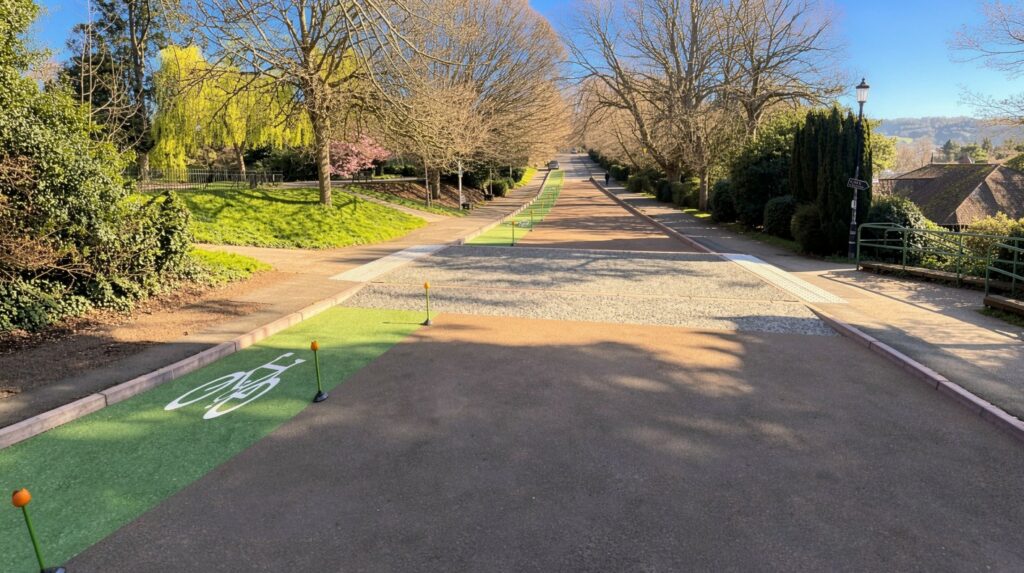
The majority of Limerick’s protected cycle lane schemes do not impede ambulance drivers and have, in some cases, enhanced accessibility for emergency services in the Irish city, a new report has found.
Earlier this week, members of the Metropolitan District of Limerick were briefed on a new report assessing the city’s active travel infrastructure, the first of its kind in Ireland and which will be used to ultimately inform a wider nationwide active travel study.
The independent report, titled ‘Integration of Active Travel Programme with Emergency Services – Integration and Impact Assessment Study’, was commissioned by Limerick City and County Council to “understand and address any challenges that the new, segregated cycling and walking schemes might pose to the work of emergency services”.
The study was based on a combination of design reviews, field analysis, traffic flow assessment, and consultation with key stakeholders, including the Irish police force An Garda Síochána, Limerick Fire and Rescue Service, Limerick Marine Search and Rescue, and the National Ambulance Service.
According to the report, the majority of the city’s active travel schemes “successfully maintained or enhanced emergency service accessibility”.
“The implemented designs, adhering closely to the guidelines outlined in the Design Manual for Urban Roads and Streets (DMURS) and the National Transport Authority (NTA) Cycle Design Manual, effectively facilitated the movement of emergency vehicles by ensuring adequate carriageway widths and junction radii,” the report said.
“Such design considerations not only supported emergency vehicle manoeuvrability but also enhanced pedestrian and cyclist safety, contributing to broader community benefits.”
These findings have been shared with the National Transport Authority and will be used, Limerick Council says, to guide future cycling and walking schemes.
Issues surrounding road width and accessibility for emergency services have long been cited by opponents of proposed cycle lane schemes across the UK and Ireland.
In 2020, Cycling UK accused the Mail on Sunday of spreading “alternative facts” on the impact of cycle lanes on emergency services after the newspaper quoted a spokesperson for the College of Paramedics claiming that cycling infrastructure and low traffic neighbourhoods were delaying ambulances and putting people’s lives at risk.
“Lots of areas have segregated roads now in such a way that you physically can’t get down the road and therefore we’ve had to do long detours,” the Mail quoted Richard Webber, the national spokesperson for the College, as saying.
“In some areas where they once had two lanes, they have now gone down to one lane of traffic and a cycle lane and the problem with that is there is nowhere to go.
“People can’t get out of the way and ambulances get stuck in traffic. It has been the same in various city centres.”
However, in the wake of the article’s publication, the College of Paramedics expressed its disappointment at what it described as the selective quoting used by the Mail.
The College said that the point it was making was that “segregated cycle lanes save lives, however ‘raised kerbs’ can obstruct drivers from allowing ambulances to pass”, adding that “we are disappointed with how these comments have been reported and request that emergency vehicles are considered when planning highways”.

A few months later, Cycling UK submitted freedom of information (FOI) requests to the 12 ambulance trusts operating in England, Scotland and Wales, asking whether councils were engaging with them before installing new cycling and walking facilities and whether the new lanes had been the cause of any delays.
Of the ten who responded, none said they were against the new lanes, while a third expressed strong support for them because of their public health and road safety benefits.
Only one – East of England Ambulance Trust – expressed a concern, pointing to a location in Cambridge where a lockable barrier had been installed.
Meanwhile, earlier this month, a row over a protected cycle lane and ‘floating’ bus stop in Shropshire saw the chairman of Shropshire and Wrekin Fire Authority, David Minnery, tell a scrutiny meeting that fire engines have been “using the cycle lane” to get past traffic jams.
Minnery said that this is “not a solution” and could be a risk to cyclists who are hard of hearing or wearing headphones. The committee also heard that there was a video on social media of a fire engine “embedded in traffic” and “unable to proceed”.
“It is putting lives and property at risk, and solutions need to be found,” he said. “We are very disappointed at the lack of consultation on this.”

And while Limerick’s cycle lanes have been given the thumbs up when it comes to accessibility, over in Kildare, a new protected cycle lane has been the subject of protests and widespread criticism in recent months, including from local farmers, who say the infrastructure has made the road too narrow for combine harvesters and other large vehicles.




















6 thoughts on “Majority of new cycle lane projects “maintained or enhanced” ambulance accessibility in city, new report from Irish council finds”
Quote:
The obvious question here is what is “the majority”? It could be anything between 51% and 99%.
It can’t be right at all! I
It can’t be right at all! I’ve read that by cycle facilities taking space from the road there is less space for motor traffic (including emergency vehicles). Stands to reason.
That in turn means more congestion for emergency vehicles to get through. That’s just simple logic.
Then there’s all that pollution caused by the cycle lanes – that’s making more people suffer. Finally thoughtless cyclists getting themselves injured takes capacity from the NHS – plus they don’t even have insurance.
Quote:
Bloody pedalos – clogging up the shipping lanes…
Excellent example of the
Excellent example of the problem of combine harvesters in the last pic, they are twice as wide as a modern car and should only be allowed on the roads with a convoy vehicle to warn oncoming traffic and close narrower sections of road. It happens with static caravans that are not as wide as that so why are they exempt?
This will, of course, be
This will, of course, be front page news in the Daily Fail.
Link to CyclingMikey’s clip
Link to CyclingMikey’s clip (from the screenshot at top of article).
This shows that if a segregated cycle lane is designed and built to an adequate standard, then there is no issue for emergency services.