



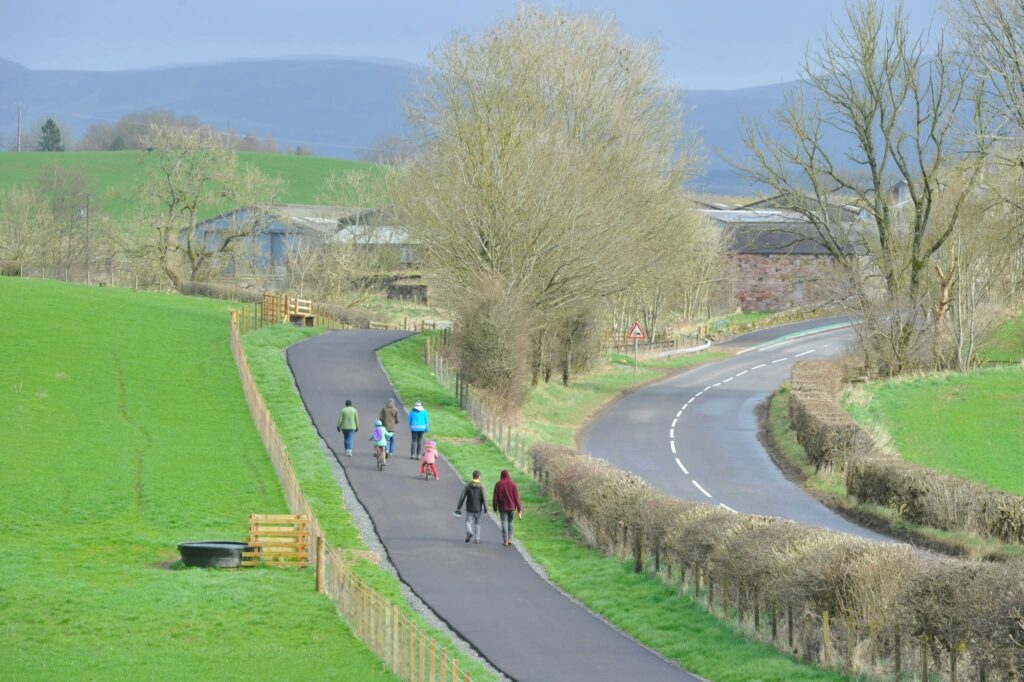
The latest cycling infrastructure project to attract ire from sections of the local community comes from Kildare in Ireland where farmers have claimed construction on a new 3.5km route means they are having to make diversions on their combines as the road is now too narrow.
Kildare County Council and Transport Infrastructure Ireland are investing €1.6m to improve active travel routing along the R448 between Moone and Timolin, but the Irish Farmers Journal says the project has prompted criticism from the farming community, some saying they are having to avoid the road entirely when using their larger vehicles.
The Irish farming news site said the 3.5km stretch, currently subject to roadworks while the infrastructure is installed, is too narrow for large combines and farmers are “struggling to use the road because of the works and that larger combines have had to divert from using the road completely”.
A local resident from the Moone Timolin Positive Action Group claimed to the news site that last week two articulated lorries lost wing mirrors, due to them passing on a narrow stretch, the damage apparently costing €1,200 per mirror to replace.
Mark Hilliard also suggested a delivery driver had “lost a tyre because of the high kerbs”, although no further details of how that incident unfolded were published.
“Nobody asked for it and nobody will use it. It’s a North Korean-style capital project,” he said. “By anybody’s standards, it’s a complete and utter white elephant. We’ve had no help from elected representatives – it’s a disaster. It’s our desire that the roadway is put back to the way it was or, at the very least, engagement from Kildare County Council. This has been rammed down our throats.”
The Irish Cycling Campaign has expressed concerns too, notably last year when the project was consulted upon.
“In short, ICC is disappointed at the poor quality of the consultation material presented and the dearth of background context,” the group said at the time. “We urge Kildare County Council and TII to revisit the material and the general proposed designs, and to give interested parties, such as ourselves, a clear idea of why this trial is being proposed and where this design proposal fits into the national context.”
While the campaign group said, naturally, it was happy to see such a cycling infrastructure project being advanced, there remained concerns about the “shoddy presentation of this important pilot scheme”.
“In the assumed context of the long term development of a National Cycle Network (NCN), any proposed developments along these lines need to be clearly signposted, explained, and contextualised,” the group told the council. “While the presented material provides food for thought, there is not enough background explanation of why different systems have been chosen or different junction types proposed. We elaborate on our criticisms below. Public consultation should be about clarity and ease of access overall. This is not the case here.”
Daytime works are set to run from July until December, with temporary traffic management in pace for the duration of the cycle route’s installation. Kildare County Council said it apologises for any inconvenience caused during the period.









45 thoughts on “Irish farmers claim new cycle lane means road too narrow for combine harvesters, as local group angry at “North Korean-style project””
I’ve yet to hear a farmer
I’ve yet to hear a farmer express joy or delight at any changes, ever. Still, it’s going to happen one day….
jaymack wrote:
There’s a great line in the fabulous England Their England (1933) where Donald, the central character, is informed by his lawyer that the tenant farmer to whom he has rented his late father’s farm “…had a melancholy tale of woe to tell when he came in on the first of every month to pay the rent. The advocate, however, guardedly advised Donald not to worry too much about it, for he added that the tenant had just bought a new Morris saloon car and had been overheard, in an incautious moment in the bar of the Imperial Hotel, to remark to a crony that, taking everything all round, by and large, it was just conceivably possible that a man of exceptionally powerful brain might be able to imagine a state of things just a fraction worse than they were at present.” ‘Twas ever thus.
jaymack wrote:
I am sure the farmer near me is really pleased with the Brexit he wanted and got. I am sure his business has done really well since….what’s that, he sold up and moved away.
If it is true, access to
If it is true, access to fields at harvest time is not something to go yaboo sucks at.
Design is the key, whether it can be made smaller at these pinch points or designed so the harvester can make use of the path and be on the road as well.
As I said problems to be solved.
It’s a month a year that as
It’s a month a year that as far as I’m concerned, agricultural machinery has absolute priority. Plus on smaller roads whether one is in a car or on a bicycle,the tractors etc are only going a few miles at most before they’re out of your way. So be patient😊
Go a few miles??? Never been
Go a few miles??? Never been stuck behind a tracker etc on the A518 on a Friday afternoon then.
Try all the way from Newport to Stafford without pulling in to let the 30 or so cars which queue up behind them go in front.
You can be patient but when they are simply taking the micky, a little less so.
essexian wrote:
Speaking from around here (rural SE Ireland), I can say the majority of agric drivers are on the ball, especially the young wans with lightning fast reactions.
Why, I’m quite confident I’ll not be killed by a 16 year old driving a tractor.
<caution, above may contain irony>
Tangentially, it’s a much
Tangentially, it’s a much more pleasant journey with a bike down the Newport Greenway.
The last time I went down
The last time I went down there, the section between Haugton Station and Gnosall was also impassable due to the overgrowth of plant life, whereas the track surface now makes it impossible (for me who has NO off road skills) to use a road bike.
If I want to travel between Stafford and Newport, I’d stick to the roads goind out of town via Doxey, then to Selighford, Ranton and into Gnosall from the north and then to Newport via Beefcote, Moreton and the Fox public house… much nicer ride IMHO.
didsthewinegeek wrote:
The claim is not that the bike lane is making the road too narrow, but that the works to install it are.
mdavidford wrote:
The claim is not that the bike lane is making the road too narrow, but that the works to install it are. — didsthewinegeek
Is it that the works are making the road too narrow or have they purchased a combine that is too big for the UK, I regularly see combines with tyres overhanging both sides of the lanes near me, causing problems with other traffic (even when using the passing places) and damaging the edges of the roads.
Backladder wrote:
I don’t know, but the road in question is in Ireland, not the UK…
Good point but I suspect
Good point but I suspect there is negligable difference in the type and size of roads over there.
Not sure about that – I’d say
Not sure about that – I’d say they’re generally smaller and even more unsuitable for outsized machinery.
Backladder wrote:
Tell me you’ve never been to Eire without telling me you’ve never been to Eire.
Some of their roads are amazing – put UK’s to shame – billiard smooth black top funded by the EU. But bear in mind its a highly rural country with lots of back lanes.
At one point when I was living there 20 years ago the main road between Dublin and Galway (4th largest Irish city) had a gravel stretch!
I have been but only to the
I have been but only to the north west and we stayed off the main roads, the back roads were very similar to my local roads in Scotland.
Combines are too wide for
Combines are too wide for most lanes that they drive on, local, regional and national secondary, bike lane or not. I’ve even overtaken my fair share on the bike. This sounds like an unnecessary gripe to be honest, most of the local roads are barely wide enough for a combine and I’ve regularly had to pull in or reverse back to a driveway or field entrance to make room. Having said that I’m fairly happy to share the roads as a live in a rural agricultural community and theyre certainly in the minority of road users.
September is a horrible month
September is a horrible month for cycling on the lanes around here what with farm workers speeding from one job to another, all the mess they leave on the road and the oversize machinary they use. Best to stick to off road riding until they have gone onto their next job IMHO.
Agricultural equipment as a
Agricultural equipment as a whole (particularly tractors and combines) have massively increased in size (and weight) over the last 30-40 years. They no longer fit in the lanes and roads around farms and although this has had a positive effect on productivity it has had a negative effect on many other things.
Wide units are known to damage road signs, heavy units damage bridges, and don’t get me started on the number of potholes adjacent to every farm where bloated heavy tractors with wide tyres and finger light power steering are constantly churning up the road surface.
There are some fellow
There are some fellow cyclists I’d love to see in front of a “working” combine😆🤣😂
Here’s one officer…
Here’s one officer…
Nice… Some of us don’ think
Nice… Some of us don’ think the death of other cyclists is a funny topic but then, we may just not have a sense of “homour.”
Ah yes, rolling on the floor
Ah yes, rolling on the floor laughing at the thought of a violent death of another human being.
And the wing mirrors missing
And the wing mirrors missing from those lorries are precisely why cycle lanes get built. Luckily for all concerned, those careless, dangerous lorry drivers trimmed their vehicles on construction equipment, not cyclists’ heads.
If people would learn to drive, none of this would be an issue.
dh700 wrote:
And if people would just learn to get along, we’d have no violent crime…
We could probably do a bit more on “standards” – especially with “professional drivers”. OTOH Farming in general is associated with long hours and high incident rates, as a profession so that’s a mission.
I think numbers of people crashing their vehicles is in large part just number of people times time driving times number of things to crash into (and some people will happily crash even without those).
That gives us a pointer – reducing the *amount* of driving (and speed is important also). And in particular reducing amount of driving where those outside of motor vehicles are mixing with those inside is the way to go.
The latter doesn’t save drivers or their passengers from themselves – but the vehicle manufacturers are somewhat motivated to do that already – paying customers and repeat business and all…
chrisonabike wrote:
The next time this works will be the first.
It is long past time for us to stop naively repeating the same expensive mistake, and hoping for a different result. You may recognize that pattern as one of the definitions of insanity.
Which one – hoping human
Which one – hoping human drivers will behave better, or that the police will do their job when it’s just a silly cyclist getting in the way of a motorist?
What makes drivers suddenly decide to learn to drive now, when they didn’t before, even though they knock their own wing mirrors off and sometimes crash their own vehicles and injure themselves?
Strangely I’ve never been close-passed by a driver e.g. on the path here… (Probably shouldn’t say that, might give a boy racer ideas for off-roading)
chrisonabike wrote:
Hope is not a strategy, hope is what one does when their strategy fails, or is non-existent.
No fix is going to be sudden. But since construction has proven to fail at improving the situation in every single location where it has been attempted, what precisely is your objection to trying, well, anything else?
And as I’m sure I’ve explained here previously, we know how to fix this problem. It isn’t easy nor quick, but it’s a damn sight of both better than construction — which is enormously expensive, terrible for the environment, scales negatively, politically disastrous, and doesn’t improve the safety situation.
What prevents a driver from driving on that path you showed us? Nothing but the law, and fear of the consequences inherent in it. So let’s expand their fear. If we enforce the traffic laws that our legislators have taken the pains to write and pass, we fix the problem. If the people we pay to do that job refuse, they are welcome to seek other means of grift, and alternative employment.
That’s not easy, but it works, as we’ve seen in Japan, and other places. And it improves safety for everyone, not just cyclists.
What, precisely, is your objection to following the strategy that is known to work, in favor of one that has never yet worked on this planet?
Apologies to others for
Apologies to others for replying – but I’ll just appreciate your own “show, don’t tell” humour: 😉
(Followed by you repeating exactly what you wrote all the other times. eg. “because Japan” (having previously eg. dismissed stats from the Japanese authorities themselves which didn’t support what you assert – apparently because “they would say that”. Plus ignoring people explaining that this example doesn’t show what you think it does – for one because the building development pattern and road infra design there plays a very significant part there too – as it does everywhere, in fact …)
Plus:
… followed by … what appears to be more a hope more than a strategy – at least you’ve left out any mention of “how” so no tactics.
“Let’s make drivers afraid…” – again, how? What starts that off? What feedback loop drives that process? Don’t forget (returning to the original article, although that seems superfluous in these chats) drivers are *already* damaging their own vehicles through their bad driving! The more reckless are already injuring and killing themselves.
Strikes me if you want to really stop them killing others we’d need a bit more than “…and you’ll get a driving ban / prison sentence after!” Presumably none of them believe they’ll crash. Pretty sure it’s similar with being caught for most, even with an elevated rate of detection. Mrs. Miggins never *meant* to kill anyone when she drove to the shops! And how does this extra detection / enforcement happen? Lesser minds enquire, but AFAIK you’ve never said, just “police do their job” or something?)
I can certainly agree with:
… although eg. Seville shows you can do a lot in a decade from almost nothing. Paris – similar. (I think they’ve both been doing things differently for 15-20 years now).
chrisonabike wrote:
You have completely lost the plot, and are either imaging your own history, or lying.
The building development patterns and road designs of Japan are precisely part of my point, which has been repeatedly. Japan has almost no transport infstructure dedicated to specific vehicle types, and their building patterns are dictated by their very scarce land available for such — both points that I have repeatedly explained. As a result, Japan finds itself disadvantaged in comparison to just about all other countries in those respects — and they still have the world’s safest roads for pedestrians and cyclists, because they enforce their traffic laws.
Are you seriously entirely unfamiliar with the process of law enforcement? And still commenting here anyway?
Sigh. Okay Chris, here’s how law enforcement works. A law is written and passed by legislature. The law defines a crime, and sets the punishment for that crime. If a person commits that crime, and is convicted by a court, they are sentenced to that punishment. All of this is announced to the public. Other people hear about said punishment, and would prefer not to be subject to same, so they don’t commit the crime.
This is why, for example, murders in Scotland are 1/3rd of traffic fatalies. Not because people never want to kill one another. And not because the means to do so aren’t available — you can just shove a person in front of a train, or stab them with a kitchen knife, or poison their food, if you are so inclined. But most people don’t want to spend the remainder of their life in prison, so they don’t commit the crime.
We could apply the same phenomenon to traffic fatalities, but instead, we choose, in most municipalities, to attempt to deter this crime by issuing minor traffic citations for those who will with a vehicle. Unsuprisingly, this provides zero deterrent, and the crime continues to be very popular.
Both municipalities that have precisely been forced to pivot to traffic enforcement, after their construction-based strategies failed entirely.
So again, what is your rationale for encouraging the strategy that has been proven to fail everywhere that it has been attempted on this planet, versus the one that we know works? Especially when the effective strategy is cheaper, faster, more environmentally-friendly, more politically-feasable, effective at scale, and more equitable to the entire population?
dh700 wrote:
No, he’s not, he’s repeating exactly what you have said before. Even if he was lying, it wouldn’t be a really big lie like, just off the top of my head, claiming that 40% of Dutch people not only never cycle but do not have access to a bicycle, or that 130 million Americans are cyclists. Those ones are right up there with some of Trump’s biggest.
Rendel Harris wrote:
— Rendel Harris
Oh jeez, now Harris is going to waste everyone’s time with more garbage.
Every study ever done has found that around 1-in-3 Americans cycles. That was true over 20 years ago — way before the Pandemic boom — and it continues to be.
“About 27.3% of the driving age public (age 16 or older) reported they rode a bicycle at least once during the summer of 2002 (see Glossary for definition of a bicyclist). https://www.bts.gov/sites/bts.dot.gov/files/docs/browse-statistical-products-and-data/bts-publications/archive/203331/entire-1.pdf
Don’t you ever tire of humiliating yourself here, Harris?
Oh dear. Every study ever
Oh dear. Every study ever done has found that one in three Americans claim they ride a bicycle at least once a year. That does not make one in three Americans cyclists. Surely even somebody handicapped by your monomaniacal, egotistical and nationalistic desire to be right can understand that? That’s a rhetorical question, of course you can’t.
Personally I’d find it humiliating repeatedly to write 500+ word comments on a website insisting on some imaginary expertise and not have a single person agree with me or even like my comments, but there we go.
Rendel Harris wrote:
Yes, it precisely does make them cyclists.
And, for the record, you misquoted the study’s parameters. Unsurprisingly.
And now we see Harris’ SOP — when shown to have absolutely zero idea of what he’s trying to discuss, resort to pathetic and childish ad hominem attacks. Quelle surprise.
dh700 wrote:
In fairness (and in kind) – you started it!
Another room needed for the
Another room needed for the weekend I feel…
Anyway, thanks for the a
Anyway, thanks for the reminder of your interesting beliefs.
Other people do indeed hold some of what you’re “writing large” there eg. “but we already have roads” and “just need to police it better”. And although you caricature it thus I’m not aware of anyone proposing “no enforcement” – just that it’s not going to get more people cycling, and ultimately driving a bit less – which as you’ve noted previously (I think?) is a very important part of “nicer places, safer streets”.
And I hope we can both continue to enjoy cycling – especially without any worries or hassles from drivers of motor vehicles! Particularly on “failed construction” which “has proven to fail at improving the situation in every single location where it has been attempted” – such as “rail trails” (I’m guessing) for you and the local cycle path network for me. (Much of which is sort of “rail trails” – former urban railways now paved over, with lighting, but connected to the streets forming the start of a network). And also on more failed infra – pavements (when walking). And failed motorways / interstates (when driving).
To the particular – I’d suggest the reason I am not troubled by drivers on that particular path section I linked (chosen adjacent to a road, much is further from drivers and more pleasant) is not “fear of prosecution”. It’s that other human motivator, laziness and “just doing the same thing as before”. There’s a nice wide road adjacent to the path, connected to all the other roads at junctions. No drivers are tempted (tempting fate again… 😉 ) to use the path, because they’ve already got what they need!
In fact it would be *less convenient*! They’d have to get onto it, then back off at a junction – the main route of the path crosses the two junctions via a bridge and an underpass, and – foreseeing idiots – there are intermittent bollards on it eg. at possible entry / exit points.
chrisonabike wrote:
There are an enormous number of cops and prosecutors around the world — not to mention lawless drivers — who are proposing, and even implementing “no enforcement”.
Only the worst, but far from the only, example is Maricopa County Attorney Rachel Mitchell, in Arizona, USA — who declined to even charge with a felony a killer who mowed down a peloton of 20 cyclists without even touching his brakes, killing 2 and hospitalizing most of the rest, and who subsequently told a handful of lies about that killing.
https://www.abc15.com/news/region-west-valley/goodyear/driver-in-deadly-2023-goodyear-cycling-crash-accepts-plea-deal
It is very common for cyclists to feel safer on cycle tracks, paths, and whatever the local terminology calls them. Unfortunately, intersections still necessarily exist, and all those paths serve to do is relocate some crashes from “mid-block” to those intersections — where they are more likely to cause serious injury, due to physics.
Driving on that path would be less convenient, until there’s a delay on the road. At that point, it may become an attractive alternative. You might be surprised at what motor vehicle operators will do, if they think it might save a couple seconds.
Among many other examples where cameras where not handy.
Combine harvesters go out to
Combine harvesters go out to each field literally once a year. So we should definitely design all transport infrastructure around them. Farm vehicles are very dangerous for all other road users due to their width attached tools and couldn’t give a fck attitude.
Most combines are designed to
Most combines are designed to have the cutter head quickly removed and re-installed for transport and a lot of famers around here seem to be able to do that, so why can’t the farmer do that in this case?
NB The name comes from the combination of the reaper and the thresher so the vehicle is obviously a combination of 2 parts
North Korea would never do
North Korea would never do this as they prioritize food production.
Really? They don’t seem to be
Really? They don’t seem to be doing a very good job of it. I thought they prioritised missile programs and large displays of ‘support’ for the regime.
mdavidford wrote:
It’s literally “military first” I believe. Presumably the (few decent) roads there are designed more for military trucks or the odd ballistic missile launcher.
Think you’ve answered your
Think you’ve answered your own question. They aren’t good at it, so they prioritise it. Anyway, i was aiming to disarm the farmers comment re NK.
I live in the area, it’s a
I live in the area, it’s a lovely wide road with a wide hard shoulder. I’ve cycled it a few times a year for the past ten years and never once thought this section needed a cycle lane. Next time I pass through, I’ll be expected to cycle on the cycle lane and will probably get a puncture from all the crap that’ll never be cleaned out of it.