



In the world of folding bikes, the Strida stands out as a unique and innovative creation. Designed by UK engineer and designer Mark Sanders, this portable, belt-driven folding bicycle has evolved over the years around the ‘A’-shaped, collapsible frame. Here we take a little delve into the history and peculiar design features of this bike.
Over the years, Strida has garnered a bit of a reputation and become a sort of cult classic for its riders. What sparked our interest in this bike was a video that popped up on X/Twitter recently, showing a rider hauling what seems like quite an unrealistic load on their Strida. We also spotted one right outside the road.cc office a few years ago!
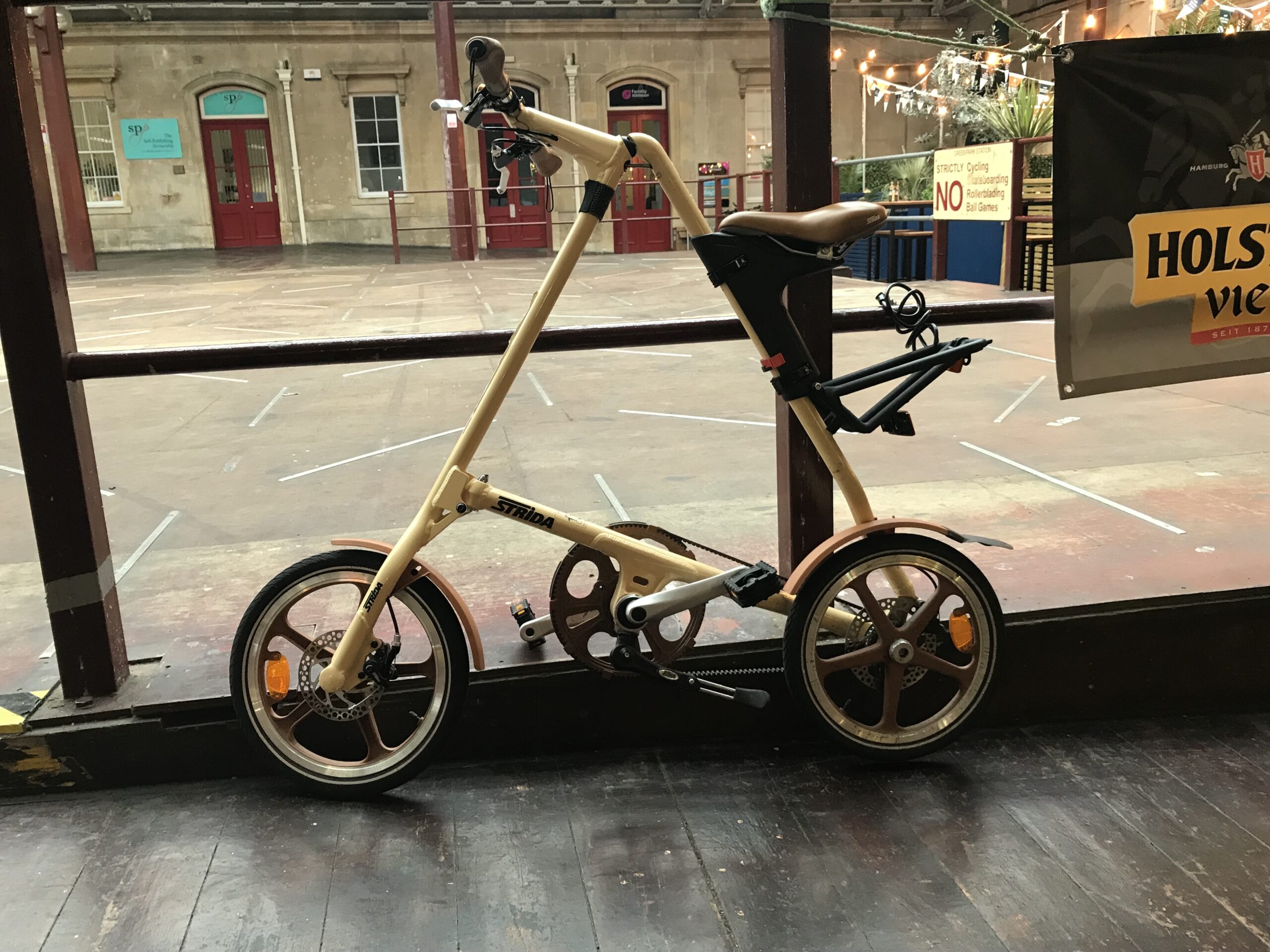
The Strida was originally created by Brit Mark Sanders as part of his master’s degree project between 1983 and 1985. It was born as a solution for urban commuters seeking a portable, easy-to-use, and maintainable folding bicycle.
The ‘A’-shaped frame and belt-driven system were chosen for simplicity and ease of maintenance, and the form was inspired by the Maclaren baby stroller, which was renowned for its compact fold.
> Forget about folders… the Pop-Cycle’s sliding frame aims to revolutionise the compact bike genre
The production of Strida 1 started in 1986, in Springburn, Glasgow, and the bike was launched in Harrods the following year. In a couple of years, the production moved to Nottingham (near the Raleigh Bicycle Company factory, which at the time, as it is now, was in financial trouble).
The Strida won quite a few design prizes, and sold in the tens of thousands in the UK, but also in Japan, USA, Australia and Germany.
In online discussions and reviews, the bike is praised for its rapid folding capability and low maintenance requirements. The unique ability to roll the bike when folded eliminates the need for carrying it, adding to its practicality and for the joy of many, saving your arms and your back.
Some bikes are made for the looks, or more like pieces of art, and it does seem that the upright riding position on the Strida Evo is a source of contention, and doesn’t seem to lend itself too well for long adventures. Then again, despite some people doing so, folding bikes aren’t designed to be touring bikes.
The OG Strida was equipped with a greaseless Kevlar belt that replaced the traditional chain drive to avoid mess, and it was built on an aluminium frame and came with a single-speed drivetrain. The bike was rolling on 16-inch wheels (the same as Brompton), which could be increased to 18-inch.
The Strida has quite a short wheelbase of 895mm which makes it nimble in turns, but perhaps also not quite as stable as longer bikes. It also comes with a rack that you can use to… well, carry things.
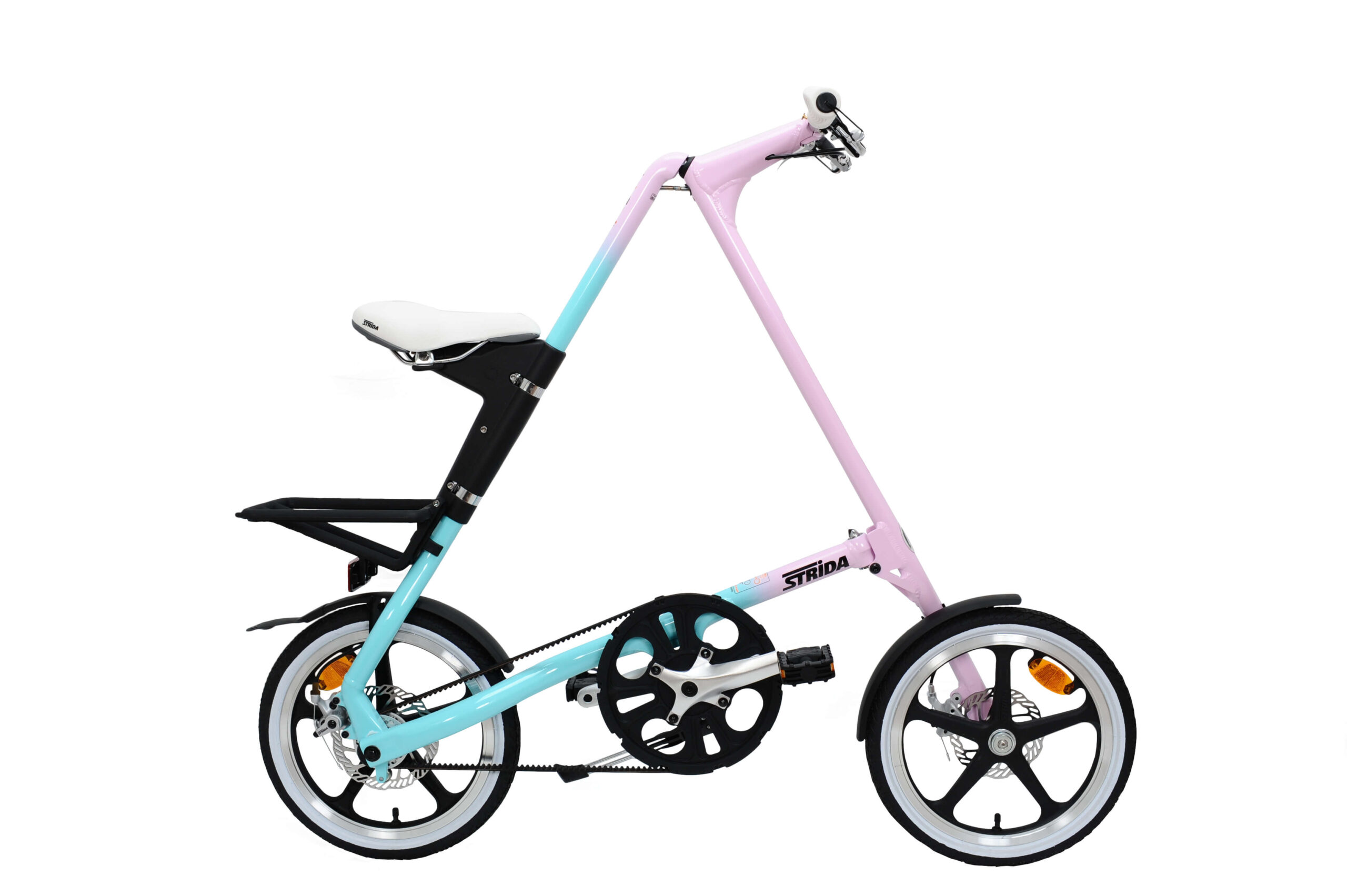
Although the look of Strida has barely changed, the components have evolved over the decades. Its now available with disc brakes and different colourways in special editions. After decades of attempts to add gears to the bike, the latest addition, the Strida EVO, has incorporated a three-speed Sturmey Archer cable-free kickback bottom bracket to the bike, and this model is said to weigh 12.31kg.
Despite its British roots, Strida doesn’t really seem to have much of a presence in the UK anymore. Taiwanese Ming Cycle acquired Strida in 2007, and has since taken over development of the bike. If you want to get yourself one, though, eBay seems to have plenty listed, with a lot of them priced at around the £300 mark.
What do you think of this folding bike? Let us know, and remember to also check our other Bike at Bedtime features.



















7 thoughts on “The history of the Strida folding bike, one of the most unusual city bikes ever made”
I really like that bicycle
I really like that bicycle but do not see on my roads too often.
To be honest though it lack gears.
The older ones, the
The older ones, the components gave you a “cheap plastic” feel. The top ball joint could visibly wear and gave me nightmares of the whole thing turning into a 3-section-staff mid-ride. Very variable as to whether you could get drivers to let it on a bus.
Deploying it to get quickly round a large B&Q though – good fun.
I would not want to hit a pot
I would not want to hit a pot hole riding those size wheels and nowadays British roads are 80% pot hole.
Utterly awful bike.
Utterly awful bike.
Mr Strida came to the bike shop I worked at in the late 80s to try and persuade us to stock it.
I took it for a test ride: it was flexible as all hell and twitchy AF, and had the fundamental design problem that as you raise the saddle to get it to fit you, the reach to the bars gets *shorter*, which only someone who knew absolutely nothing about bikes would consider a good idea. It has that problem still, of course. We declined to stock it.
Choice magazine, the Australian equivalent of Which? tested one in a bike round-up in the early 2000s, and unusually for that type of mag got some cycling journalists to help, as well as some regular folks. The Strida scored lowest of all the bikes in the test and got a worse rating from the members of the public than from the journos.
Tens of thousands? Hundreds maybe. There’s a reason you almost never see them in the wild: they’re rubbish.
Try a newer one – you might
Try a newer one – you might change your mind.
In the 80’s few bikes had belt drives, internal cables and hub/disc brakes.
Not a roadies choice but for around town, pretty damn good. Check out owners groups lots of love, and little ‘awful hate’.
I had a Mk 1 in the early
I had a Mk 1 in the early 2000s. I think I only ever saw one other person riding one at the same time. It certainly got some looks.
I used to commute into London and then whip it out way faster than all the people with Bromptons. And you didn’t have to carry it as you could push it.
It fell off my stand when I was servicing it and a couple of parts broke which couldn’t get any longer. I put it on eBay and an engineer in Spain bought it who could manufactur his own parts.
Got one and love it !
Got one and love it ! Different, yes – but refreshingly so.
My 5 year old LT has been reliable, fun with some surprising benefits:
Originally bought as a 1/2 price alternative to a brompton, it was great for train/bike commuting – more like an umbrella than a suitcase. I get back trouble inspite of multiple (and varied) ‘professional fittings’. After w/e 700c rides, strida is my N+1 weekday go-to. Its upright ‘dutch’ ride and short wheelbase seems to do wonders for my back. Mines a lighter single speed with 5 spoke side mounted wheels – I’ve gone through 3 sets of tyres and changing them is easy. When folded its like a stick with big wheels, it fits in overhead luggage space and takes up little room standing when train is full. In Netherlands Stridas are much more common as they ride like a dutch bike and they have more active users and strida.nl support.
Ignore the naysayers, after 30+ years it has grown into an effective tool.