



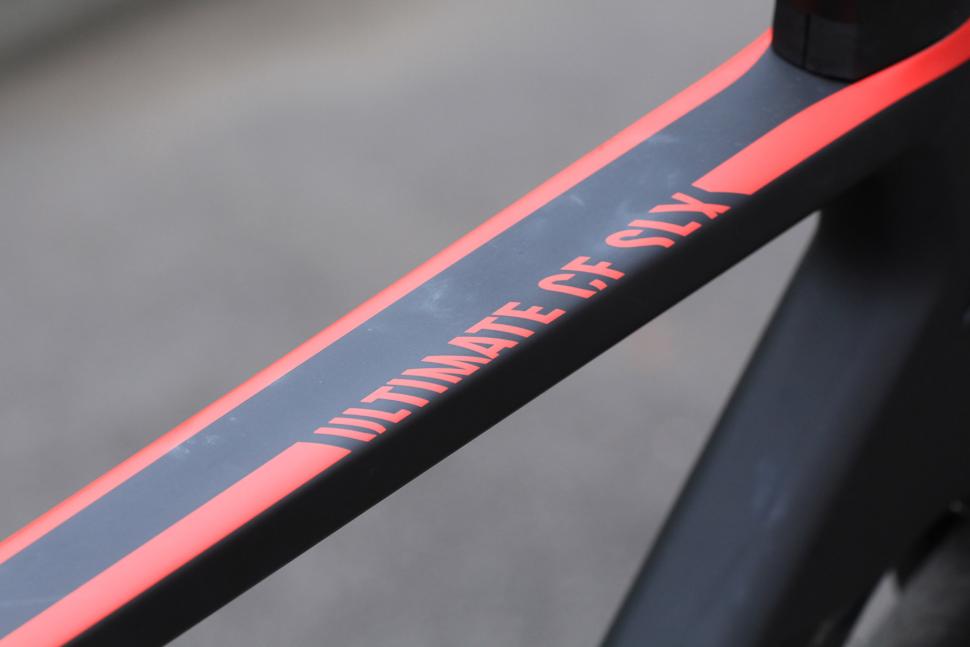
The Ultimate is Canyon’s go-to race bike, an all-rounder that balances the three demands of weight, stiffness and comfort. The fourth-generation version was launched at the Tour de France last year – we had a first ride on it – and it gains some aerodynamic improvements to eke out even more performance.
Canyon is a direct-sales business, and as such it passes some impressive savings on to the customer, which means you get a lot of kit for your money basically. There are 11 bikes in the Ultimate range, priced from £2,699 up to £5,399. The bike pictured is the Ultimate CF SLX 9.0 costing £3,599, and which includes a complete Shimano Dura-Ace mechanical groupset and Mavic Ksyrium Pro Exalith SL wheels.
Related: Canyon unveils new Ultimate CF SLX with aero features
We’ve been impressed with every Ultimate we’ve ridden over the years, and the new bike, based on a first ride last summer, was no less impressive. The changes to the new bike are subtle and not immediately detectable, Canyon has retained the key lines and shapes that identify the Ultimate. It’s a good looking, if unassuming bike.
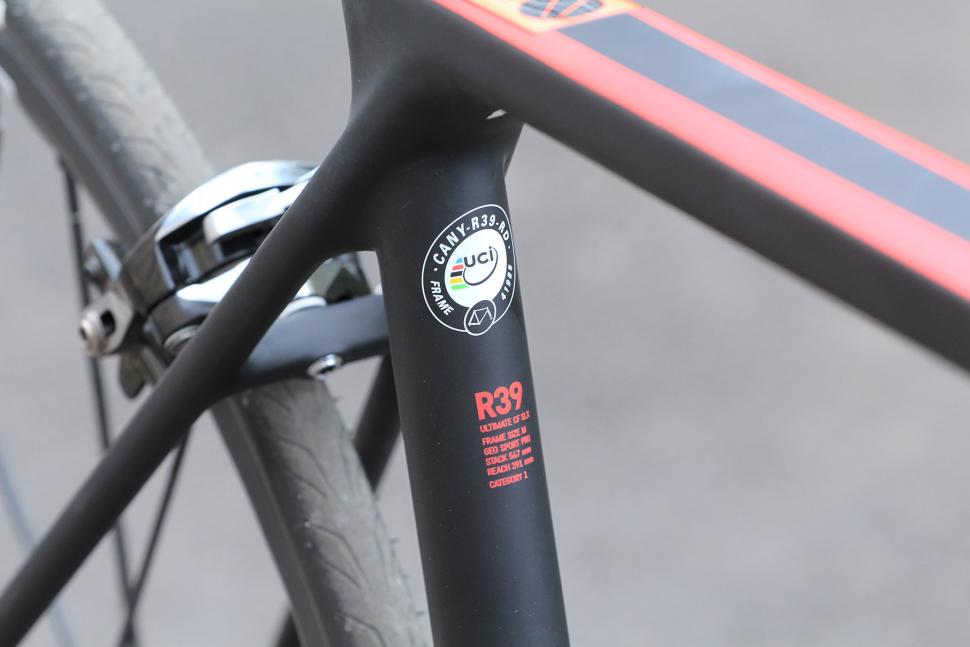
The big change is an attempt to bring some aerodynamic gains to the Ultimate platform. Canyon, of course, offers the Aeroad if aerodynamics is top of your list of priorities, but Canyon isn’t trying to push the Ultimate too much in that direction. It’s instead a small number of changed that bring about better aerodynamic efficiencies while maintaining the same stiffness-to-weight ratio of the previous version.
Related: Canyon Ultimate CF SLX 2016 first ride
The key feature is the D-shaped downtube. It has a narrower and rounder nose profile compared with the previous Ultimate, and it’s designed to decrease flow separation by ensuring the air sticks to the tube. The new down tube is narrower which impacts stiffness, so to counter this, Canyon developed a new box section top tube and wider seat stays to provide the necessary frame stiffness.
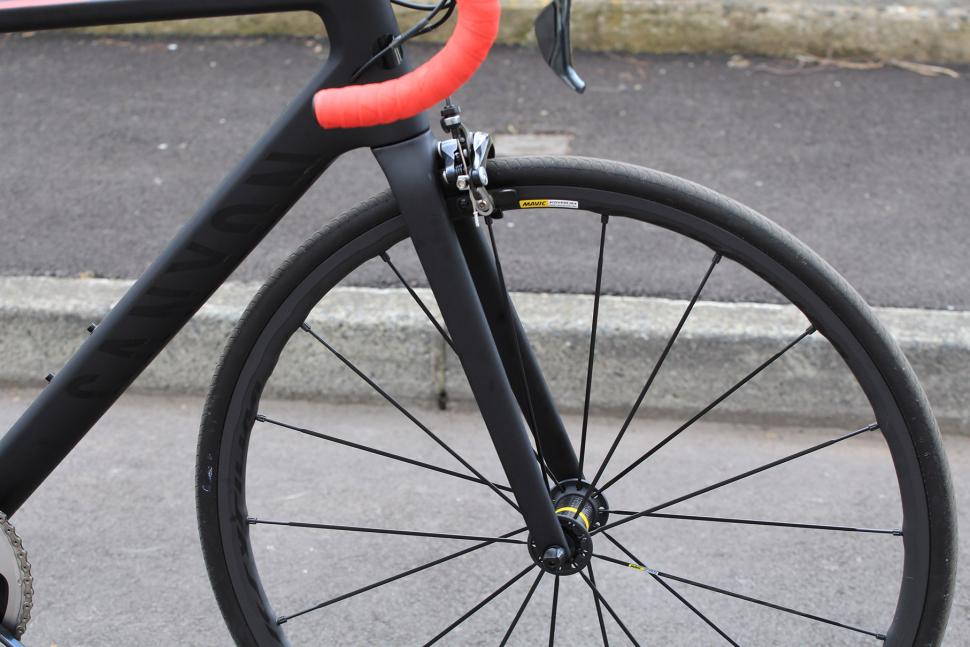
The frontal surface area – how much of the bike is presented to the air – has been reduced. The head tube is narrower with a 1 1/4in steerer tube, an hourglass profile and some very slim headset bearings. The fork blades are slimmer as well.
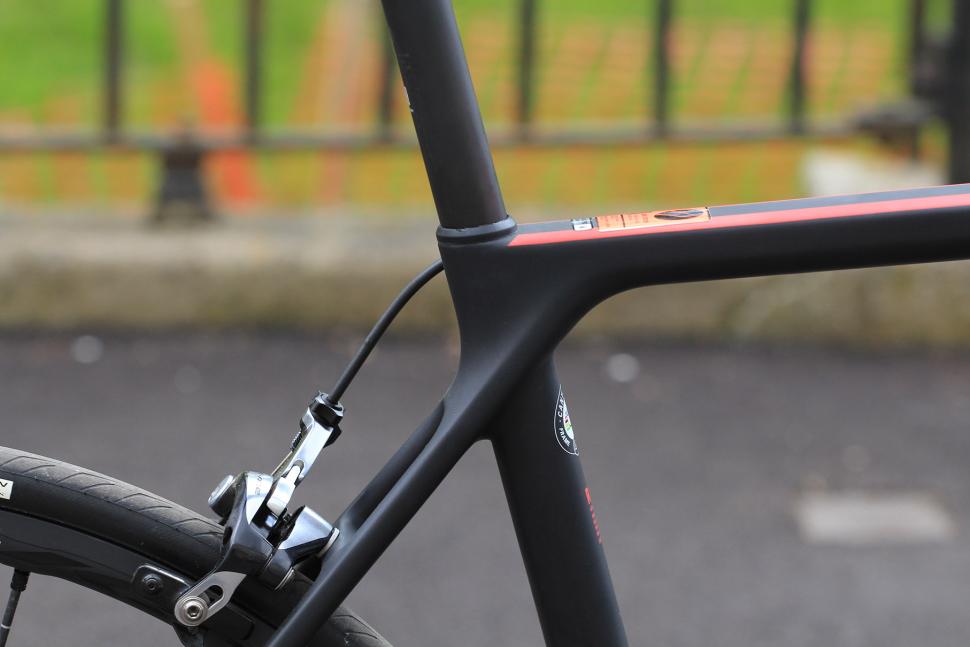
One of the biggest visual differences is the new top tube and seat tube junction. Canyon has sought to increase comfort and has integrated the seat clamp into the seat tube. This provides more exposed seatpost which increases the available deflection.
“The fundamental difference here is that the actual clamp is moved from the conventional position at the exit of the seat tube further down inside the frame,” says Canyon. “The hybrid injection moulded synthetic insert is one of the most complex components Canyon has ever developed and consists of three parts: a fibre-reinforced base, a soft seal where the seat tube ends and an aluminium press to transfer the tightening screw’s force onto the seatpost.”
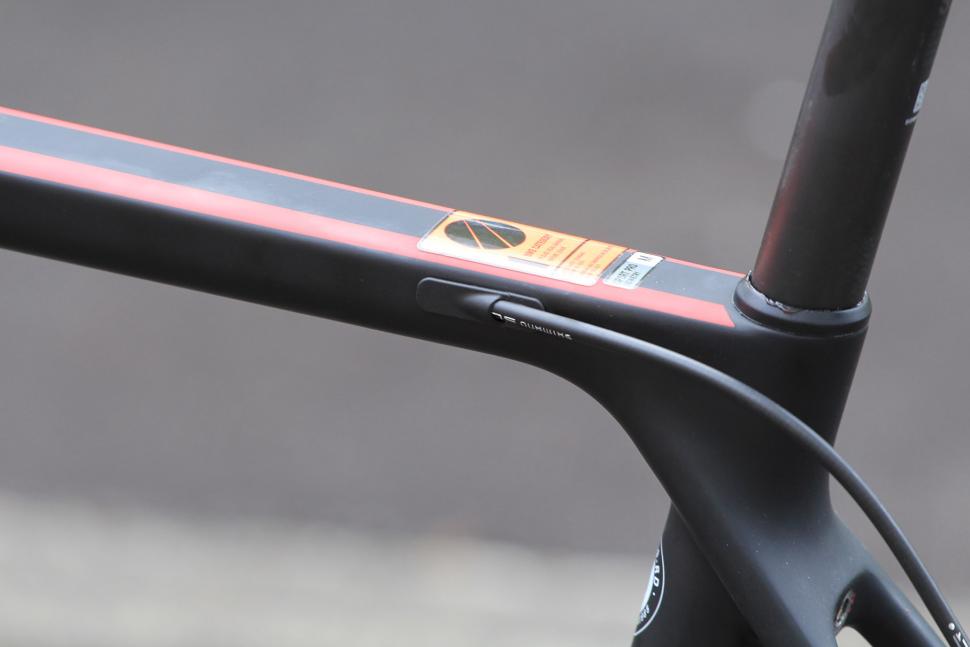
The result of those changes is a frame that, according to Canyon’s claims, is 10 percent more compliant and 10 percent more aerodynamic. The frame weighs 780g and the fork is 295g.
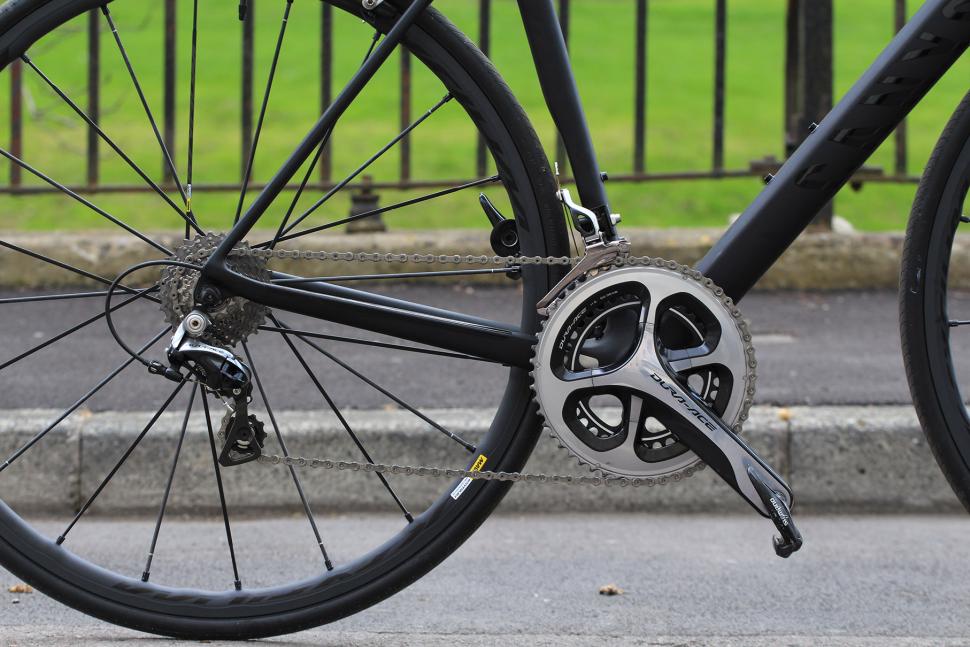
So we were impressed with our first ride on the new Ultimate last year, and now we’ve got our hands on the bike for a proper test. As mentioned previously, this model has a full Dura-Ace mechanical groupset with a 52/36 chainset. Wheels are Mavic’s Ksyrium Pro Exalith SL model with matching Yksion Pro Griplink and Powerlink tyres.
Another nod to aerodynamics it Canyon’s H36 Aerocockpit CF one-piece handlebar and stem. The handlebar came about at the same time as the development of the Aeroad. Realising that the handlebar is a critical part of the whole aerodynamic discussion, the designers set about creating a product that would reduce the frontal surface area.
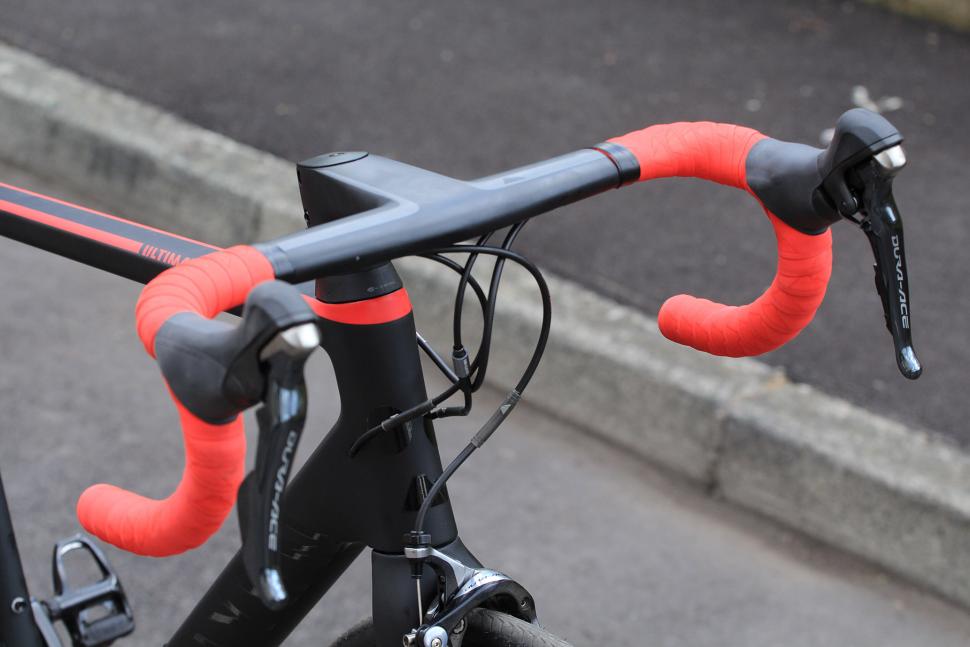
Related: Canyon Aerocockpit CF integrated handlebar
In its tests, Canyon reckons the Aerocockpit CF provides an “aero advantage that adds up to approximately 5.5 W at 45 km/h against a conventional bar and stem, thanks to the minimal frontal surface area.”
As well as the very flat top section, Canyon has reduced the width of all the bars, following tests that showed that a narrower stance (pushing arms closer together) provided aerodynamic improvements.
As a result, they recommend a bar that’s 10mm narrower than you would normally use – so if you normally ride a 42cm, you’ll be put onto a 41cm bar instead. Make sense? There will be three widths – 39cm, 41cm and 43cm – and five stem lengths – 90mm to 130mm.
Lastly, there is a Fizik Antares R5 saddle. On the scales, the size medium bike we have here weighs 6.53kg (14.39lb).
More info at www.canyon.com














9 thoughts on “Just in: Canyon Ultimate CF SLX 9.0 – updated frame and Dura-Ace for £3,599”
Making the bars narrower and
Making the bars narrower and ignoring comfort seems shortsighted. Not that you can adjust those bars for anything but height, which seems massively limiting. Maybe it’s all fine for the pros, but for the rest of us?
DrJDog wrote:
I would have thought that the idea is that you can switch different sizes for no cost so that you can find the best balance for you.
This is great in theory, but there’s a massive flaw in this relating to Canyon’s customer service.
I ordered the 8.0 Di2 Ultimate CF SLX around Christmas time and was pleasantly surprised to find it delivered on time at the end of February. When I ordered the bike, I specified a longer stem/narrower bars, but when it came to the delivery date i was told that this didn’t matter and that i would have to order them *after* delivery of the actual bike. I didn’t think this was a big deal, but after weeks and weeks of missed dates, the bike is still sitting in bits, ready for a set of bars/stem that never seem to arrive. This is just for the standard bars/stem too, so i’d dread to think what it would be like for this setup.
Canyon’s response has been that they have no control on when these parts ship, so as far as I understand it, the parts get allocated at the bike assembly line and would only be shipped for replacements as and when spares come available, which seems like rather a big flaw, given the whole system is probably setup to only order in the parts just in time for assembly. I’ve sent no end of emails and had countless chat sessions with Canyon support and they still seem to be unable to resolve this, it’s ridiculous as they still can’t even give me an ETA. For all I know, I could be waiting for Christmas.
Funnily enough, I only wanted the frame/bars in the first place originally as I had most of the other parts, but the estimated delivery at christmas time was June which seemed far too far away. It now seems like I would have been better off waiting for that! I suspect that by the time I get it on the road, they’ll be advertising their 2017 range..
Strange sizing policy
I usually ride with a 42 bar as i’m broad shouldered for my height. the corresponding bar on the size of frame i was after are 39’s. I contacted canyo and was told that the bar/stem combo can’t be changed. Was also told that 90% of customers are happy with their configuration,that means 10% aren’t! Along with their dreadful delivery record,i’ve decided against ther Canyon and i’m looking at the Rose x-lite team or a TCR advanced pro 0.
gafferg wrote:
I take back what I said then, that’s bonkers.
It’s a fine bike but I don’t
It’s a fine bike but I don’t want to have to wait months and months for it. So I’ll look elsewhere.
Good luck waiting for any
Good luck waiting for any Canyon bits. Last Canyon bike (I have three) took forever to arrive and after 8 months I’m still waiting for a part ordered at the same time. They make their money on the off the shelf bikes and are just not set up or interested in dealing with replacements/exchanges etc.
Just bought a Boardman – delivered in a couple of days. Never going back to Canyon and I’ve made sure all my cycling mates know!
I rode one as a hire bike for
I rode one as a hire bike for 10 days in Spain – the position was actually fine in spite of the fractionally narrower bar and the bike handled brilliantly, especially downhill, it was really sure footed.
I think a big part of that was the integrated bar/stem combo and it also made the cabling really neat – everything was routed internally then out through a hole in the underside of the stem (where the Di2 junction box was also housed).
Really well thought out – the only slight pain is that mounting lights, Garmin etc onto the flat bar would be a bit problematic. Mine had an out-front Garmin mount and I didn’t need lights, to be fair the bike is designed as a thoroughbred race machine, not a commuter!
I can’t deny Canyons are
I can’t deny Canyons are great value for money but I’m completely sick of the minimal stealth design. I don’t think they’ve ever made a beautiful looking bike.
I had no idea that Canyon’s
I had no idea that Canyon’s customer service was horrific. Glad I didn’t take the chance. It’s hard to put value on great customer service. I was really hoping to get an Aeroad.