


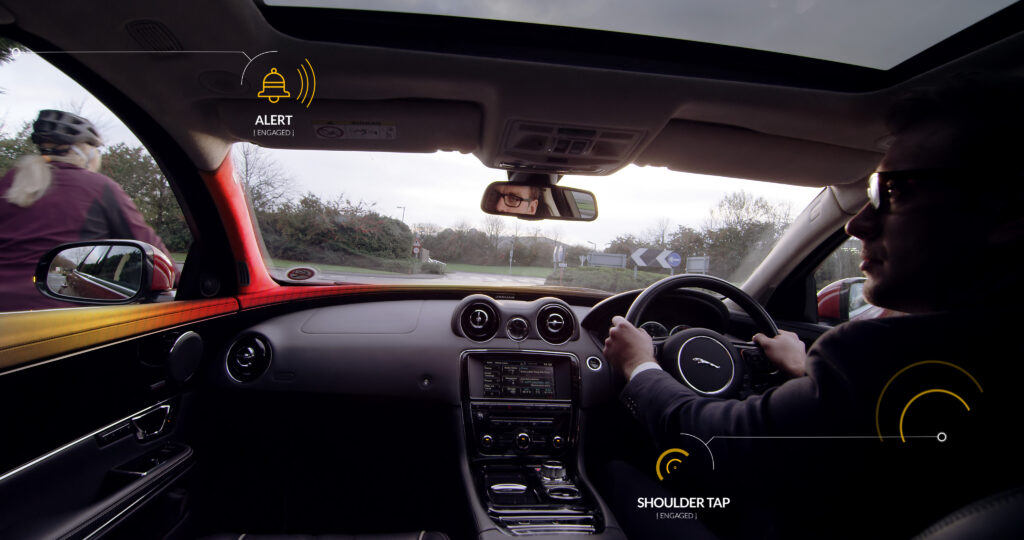

Jaguar Land Rover is the latest car maker to announce a system designed to alert drivers to the proximity of cyclists to try and reduce car-bike collisions. But rather than just sounding an alert, the car maker says its system will tap the driver on the shoulder and sound a bike bell inside the car.
Jaguar says its 'Bike Sense' reearch is about trying to find the best warning signals that will trigger an instinctive response from the driver to prevent accidents.
That includes door handles that 'buzz' the driver's hand to prevent doors being opened into the path of bikes, and an accelerator pedal that will vibrate if moving the car would cause an accident.
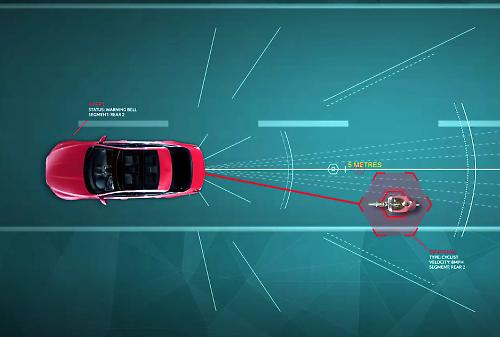
Sensors on the car will detect when another road user is approaching and identify it as bicycle or motorbike. Jaguar says drivers will instinctively associate the lights and sounds the system uses for warnings with the potential danger.
Here's Jaguar's video showing how it works:
To help the driver understand where the bike is in relation to their car, the audio system will make it sound as if a bicycle bell or motorbike horn is coming through the speaker nearest the bike, so the driver immediately understands the direction the cyclist is coming from.
But what about that tap on the shoulder? If the bike or motorbike is overtaking the car or coming past on the inside, the top of the car seat will extend to tap the driver on the left or right shoulder. The idea is that the driver will then instinctively look over that shoulder to identify the potential hazard.
As the cyclist gets closer to the car, a matrix of LED lights on the window sills, dashboard and windscreen pillars will glow amber and then red as the bike approaches. The movement of these red and amber lights across these surfaces will also highlight the direction the bike is taking.
Dr Wolfgang Epple, Director of Research and Technology, Jaguar Land Rover, said: "Human beings have developed an instinctive awareness of danger over thousands of years. Certain colours like red and yellow will trigger an immediate response, while everyone recognises the sound of a bicycle bell.
"Bike Sense takes us beyond the current technologies of hazard indicators and icons in wing mirrors, to optimising the location of light, sound and touch to enhance this intuition. This creates warnings that allow a faster cognitive reaction as they engage the brain's instinctive responses. If you see the dashboard glowing red in your peripheral vision, you will be drawn to it and understand straight away that another road user is approaching that part of your vehicle."
The system will prioritise the nearest riders or pedestrians so the driver isn't overwhelmed with warnings, and will be able to alert the driver to pedestrians and cyclists obscured by, say, stationary vehicles.
Dr Epple added: "By engaging the instincts, Bike Sense has the potential to bridge the gap between the safety and hazard detection systems in the car and the driver and their passengers. This could reduce the risk of accidents with all road users by increasing the speed of response and ensuring the correct action is taken to prevent an accident happening."
Volvo has been working on systems that automatically detect and avoid cyclists for a couple of years and recently announced a collaboration with POC on a helmet that a car's onboard electronics would detect.
Ford has also been experimenting with automatic collision avoidance systems, and last year the Cycle Eye bike detection system was trialled on buses using Bristol's notoriously crowded Gloucester Road.




21 thoughts on “Video: Jaguar bike detection system taps driver on the shoulder”
Good stuff. Now, in the
Good stuff. Now, in the interest of education, can we add something to the system so that it will perform a more ‘robust’ action than a tap on the shoulder when a driver passes a cyclist too closely? I’m not usually one to advocate violence, but …
This would just frustrate
This would just frustrate drivers in city traffic, though would be good on rural lanes I’m sure.
Better just make the car take decisive action if an incident seems likely (and by that I mean stop / ignore the accelerator).
Not to be pedantic…but in
Not to be pedantic…but in the first scenario I would normally recommend that if a car is ahead of you at the roundabout and clearly indicating left, you shouldn’t proceed on their inside. Still, a good system that will help compensate for bad cycling and bad driving.
Will we be seeing law suits against Jaguar in future though when “I didn’t see you” to “my car didn’t see that I didn’t see you”?
Mike_Hanley wrote:Still, a
Exactly. Even better if we remove the faulty wetware operating a piece of heavy machinery as much as possible.
Agreed re first scenario.
Agreed re first scenario. Dubious decision making on the part of the cyclist shown. Would have thought someone at Jaguar (or producers of video) would have avoided ambiguity wherever possible in order not to ‘leave the door open’ for the selfish and careless drivers to comment…
Ok! So the driver gets a
Ok! So the driver gets a warning. Wonderful! Unless the driver reacts and takes action – what exactly is the point?
I’ll illustrate.
This morning just after 0500 I was driving westbound on the A2016 towards the Belmarsh lights near Thamesmead. Weather is cold & frosty and the visibility is good. I am in the outside lane as there are two cyclists riding in the secondary position, working lights, reflective detailing and about 100m apart. Basically they are very visible and riding correctly.
Also in the inside lane is a large silver S-class Mercedes weighing, if I remember rightly, just over 2.3Te. I hold back to give the Mercedes driver a generously proportioned protected space to pull out into. Generous in this case means that I am 20m behind him.
Does he pull out? No is the simple answer. He maintained his course and speed (50mph) and if he passed either cyclist by more than 30-40cm then I would be very surprised.
Technology is not the answer. Attitude and education is.
I completely agree. I am an
I completely agree. I am an avid cyclist (more bike miles than car miles per year by far) but all the technology in the world will not and does not substitute common sense, manners and to be honest a basic level of intelligence.
Sadly cars and their drivers will always be kings of the road – we are in a very fragile/vulnerable position out their. We have to expect drivers to do irrational things and have to ensure we act defensively at all times. Simple things including wearing HI- VIZ and not the perennial trendy black will be a decent first step.
We have so much more to loose – limb and life vs. a superficial stratch.
As jacknorell indicates. It
As jacknorell indicates. It wo’nt be long before the driver is completely uneccessary anyway. Just think; they’ll all keep the speed limits. keep their distance, stop at lights . . . 8}
Frankly im grateful for
Frankly im grateful for anything that helps but the real answer is and always will be segregating the cars and bikes in barriered lanes. Even then some vehicles will im sure cross this and cause injury. Sadly you cant take the stupid or even random weather and road conditions totally out of the equation.
Still heres a thought to ponder we all know the risks and yet we still ride and many of us go skiing and skydiving etc and its dangerous and we still do it…perhaps a life without some risk is like an egg without the salt…and i still see plenty of ‘cyclists’ without any vis, helmet or lights and riding on busy main roads in black….go figure..
Would you want to be excluded
Would you want to be excluded from riding on country lanes or up Alpe d’Huez or so ?
We’ll have to share the roads in the vast majority of places.
If you put lipstick on a
If you put lipstick on a gorilla it’s still a gorilla.
This is just lipstick.
Not only that, it’ll be turned off after a few weeks because drivers will find it irritating.
The only way to stop motor vehicles bumping into bikes is to separate them; either through segregated infrastructure, or banning motors.
As others have pointed out,
As others have pointed out, we already have the “answer” to cycling safety, clearly demonstrated in some continental countries, and it isn’t clever cars.
This reminds me so much of the helmet debate, with drivers and car manufacturers promoting things to save cyclists which has the only effect of reducing the responsibility of the drivers and manufacturers.
I think self driving vehicles
I think self driving vehicles and collision avoidance systems are far closer than we might imagine. Most people *want* to be zoned out, on their phone, texting, listening to music, eating, talking, working, thinking about riding their bike etc., – not driving – just look around at occupants of vehicles today!
Insurance companies start heavily ramping up the premiums for non-autonomous vehicles…private self-drive (how quaint) disappears or becomes the preserve of “track days”. Most buses disappear replaced by robot on-demand taxis. Unions complain bitterly that buses, taxis, trains, vans and trucks can’t possibly be better driven by a computer but the lure of hauliers to have a vehicle running 24hrs non-stop without needing a pay cheque proves too much – after all aviation and marine sectors went most of the way years ago.
In the end, the only self-drive non-autonomous vehicles will have pedals…
jstone1 wrote:I think self
Wrong. Because, in order to protect pedestrians, guide dogs and New Forest ponies you have been chipped. In fact all free will has been abolished to protect you from yourself. It’s for your own good! Resistance is futile! 👿
I’m not a fan of the ‘no
I’m not a fan of the ‘no human required’ approach! I’d rather the money was put into technology that monitors and records the drivers actions e.g. ‘black boxes’ to record (or control?) speed relevant to speed zones, and cameras. Statistical information could be used by insurers to assess individual driver competence and evidence would be available in the event of an accident. Drivers would be responsible and accountable for their own actions. It mat not affect attitude but it would affect behaviour?
I think there is already
I think there is already something on the new Range Rovers that blinks lights in the wing mirror if you are approaching the rear quarter blind spots.
No doubt this is designed to prevent the owner from spilling their Latté and ruining their clothes rather than to protect cyclists.
@dalbyka – already exists :
@dalbyka – already exists : http://www.gocompare.com/car-insurance/telematics-car-insurance/
This is technology to be
This is technology to be embraced.
The company I work for makes GPS data logging systems and JLR is a customer of ours, so some of our kit was used to develop this stuff. It’s not going to go away – the advent of ADAS (Advanced Driver Assistance Systems) is pushing towards truly autonomous vehicles, and that will almost certainly make life easier when it comes to sharing road space. Volvo are championing such systems and lead the way in commercial vehicle ADAS. The tests required for this kind of technology to be passed as fit for purpose – administered by NCAP in Europe and NHTSA in the US – are robust and detailed. Vehicle manufacturers are competing with each other as much within the safety sector as those of performance and economy.
Further development of stuff like this makes us all safer, not at greater risk.
TXT to the police when
TXT to the police when passing too close?
Or electric shock through to seat to the tender parts?
I’m always a little puzzled
I’m always a little puzzled by the ” a cyclist came out of nowhere and [i]NEARLY[/i] caused an accident” concern of many drivers – it maybe a rational response to having to interact from within a vehicle to the world outside but doesn’t actually harm anyone
Love the technological solution so why can’t HGV co’s do this now were it may be considered essential rather than an aid to aggression on the school run? Straight economics I guess.
As to Jaguar Land Rover how about working a bit harder on some of the difficult bits of vehicle design that aren’t part of the driver experience?
The Evoque is a 2012 model :
“Pedestrian Summary
Only the bumper scored maximum points, for the protection it provided to pedestrians’ legs. [i]The front edge of the bonnet scored no points, offering poor protection in all areas. The bonnet provided predominantly poor protection in the areas likely to be struck by a pedestrian’s head.[/i]”
source [url]http://www.howsafeisyourcar.com.au/2012/Land-Rover/Range-Rover-Evoque/Pure-TD4-4D-Wagon-6sp-auto-2_2L-4cyl-TDiesel/[/url]
It should just shout ‘on yer
It should just shout ‘on yer left’ or ‘on yer right’.