


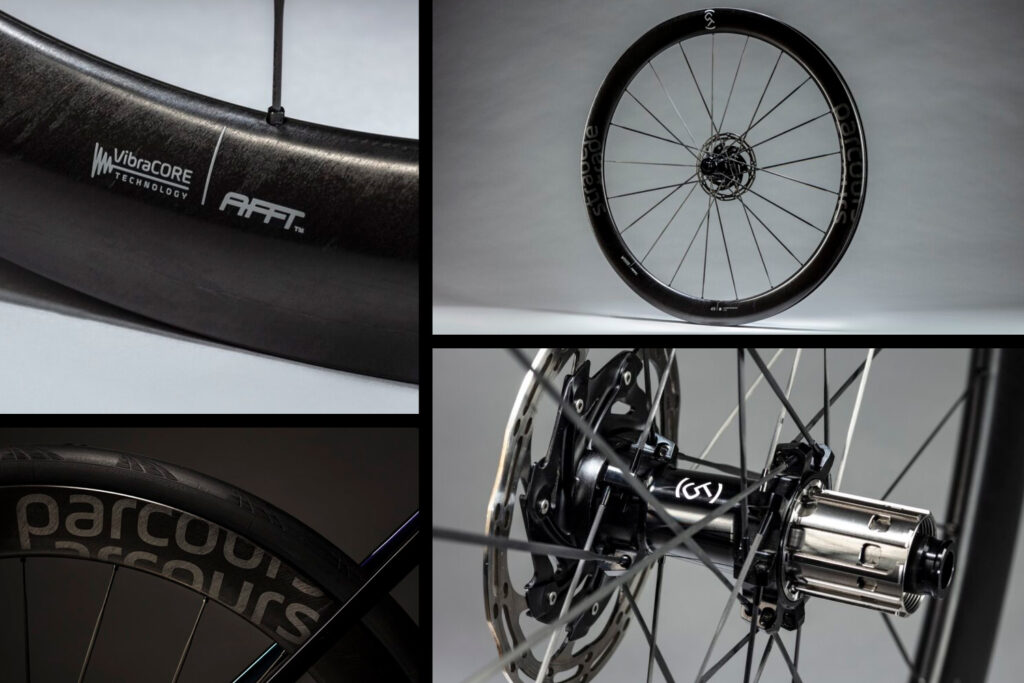

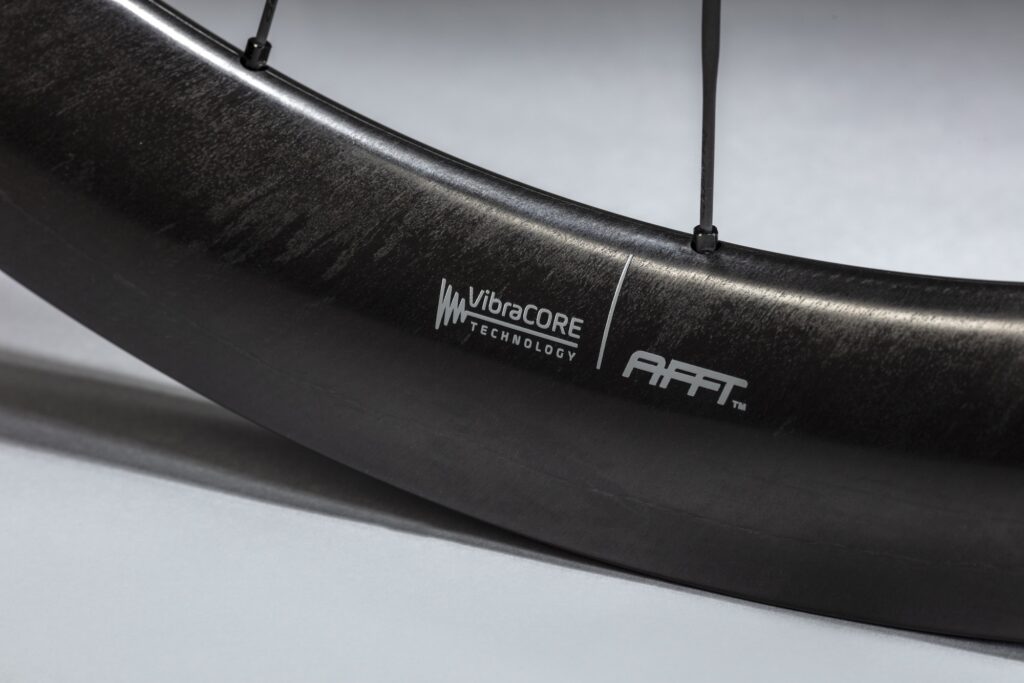
Parcours is introducing a Strade GT road wheelset that uses new VibraCORE tech – incorporating recycled carbon in the rim structure – with the aim of improving both comfort and performance by reducing vibration. At typical road tyre pressures, Parcours says that VibraCORE reduces RMS (root mean square) vibrational energy by 19-23%, equivalent to lowering tyre pressure by 10–15psi, without any losses in rolling efficiency or handling precision.
“This allows Strade GT to deliver a calmer, more controlled ride over long distances, while maintaining the stiffness, responsiveness and aerodynamic performance expected of a high-performance wheelset,” says Parcours.
With a revised rim profile optimised around a 30mm tyre, Parcours says that the Strade GT outperforms the current Strade by 3.2W at 48km/h (29.8mph) in a yaw weighted sweep – in other words, it requires less power than the previous model to hold the Strade GT at that speed – and improves handling stability by 15%.
“Three years ago, when we started this project, making a fast wheel was becoming more and more commonplace,” says Parcours founder Dov Tate. “Now we’re seeing launches where a product is three watts faster, 10g lighter… It’s harder to find those marginal gains, so we started saying: what is the next leap forward in terms of wheel technology? And I started to focus on material.”
The Strade GT sits above Parcours’ existing Strade in the range and Parcours sees it as “a premium platform for riders who want speed, stability and long-distance comfort without compromise”.
What is VibraCORE?
The VibraCORE material is at the heart of things, developed in collaboration with South Wales-based company Lineat and Nottingham Trent University.
VibraCORE integrates Lineat’s AFFT (Aligned Formable Fibre Technology; it’s a patented process) recycled carbon fibre material into the spoke bed – just the spoke bed, not the rim as a whole – the idea being to reduce vibration at a structural level.
“The idea is simple and well-recognised: if vibration transmitted through the wheel system can be reduced, riders can stay fresher for longer, and ultimately ride faster and further,” says Parcours.
“VibraCORE alters how vibration travels through the rim structure, reducing the energy transmitted through the system. Certain frequency ranges have been identified as the most important, either because the body amplifies them or because they drive muscular fatigue. VibraCORE is designed to address this at source. By incorporating Lineat’s AFFT recycled carbon material into the rim structure, the system is able to absorb and dissipate vibrational energy before it reaches the rider.
“The technology specifically targets the frequency ranges most strongly associated with rider‑perceived ‘road buzz’, the high‑frequency vibrations that make rough roads feel harsh and fatiguing.
To validate the performance of VibraCORE, Parcours says that it conducted testing in partnership with Nottingham Trent University “across multiple riders and surfaces in a real-world environment”.
“Vibration sensors were used to capture ride data and results were then analysed in the frequency domain using power spectral density (PSD), with integrated energy and RMS values used to quantify differences in performance,” says Parcours.
RMS (Root Mean Square)? In its white paper to support the launch (available at www.parcours.cc), Parcours says, “ RMS represents the effective magnitude of the vibration signal over time. Unlike instantaneous measurements, RMS reflects the cumulative energy experienced by the rider across the duration of a test.”
Parcours says, “Aggregated across all testing, the data showed that rims using VibraCORE reduced vibration energy by 19-23% compared to an equivalent rim without the technology. In practical terms, the effect is comparable to lowering tyre pressure by around 10–15 psi without the associated loss in rolling efficiency or speed.
“The outcome is a noticeably calmer ride on rough surfaces, with reduced high-frequency ‘road buzz’ and lower cumulative fatigue over longer durations.”
Parcours says that these benefits have been achieved without compromising weight, stiffness or durability.
Greater sustainability too
Although Parcours mainly focuses on the vibration-damping qualities of VibraCORE, it was initially attracted to Lineat’s AFFT materials as a means of improving the sustainability of its products.
“From a materials perspective, the very genesis of the project was saying: carbon fibre as a material probably isn’t the best in terms of sustainability,” says Parcours’ Dov Tate.
“I wouldn’t say it’s a dirty secret, but it’s something that within cycling we generally overlook because the propulsion itself is very green, so I spent some time in the materials and the composites world – trade shows, trade publications, meeting people on the cutting edge. I was really looking at it with a sustainability angle, which is what drew me to Lineat. They were the first people who presented a recycled carbon that actually maintained some material properties.
“Generally speaking, with recycling of carbon, you need to remove the resin, which is done through a number of different ways, and you’re left with the underlying fibres, and that’s what gives the material the strength.
“However, the process will almost invariably involve chopping those fibres into short strands. Lineat is able to realign those fibres. The analogy I often use is that it’s a little bit like a felt material, where you’ve got short fibre wool, and the friction between the fibres creates some level of tensile strength.
“What Lineat can do is recycle post-use carbon into a material that delivers about 30% of the tensile modulus of virgin carbon.”
Parcours says, “While sustainability is not the primary driver of this project, the use of VibraCORE allows recovered carbon to be used in a structurally meaningful, performance‑critical application.”
Dov Tate says, “We’re only using 12-15% recycled material by volume per rim, but that’s 12-15% more than we were yesterday. It’s the first step in that direction, and the guys at Lineat are working incredibly hard to improve the material properties of their output, and that might open the door to more in the future.
“The last thing on the sustainability angle is that we’re also working with a business in Bristol called Uplift360, and we’re looking at whether we can provide the input material for the Lineat process, reclaimed from existing wheels and making it a fully circular process. The end goal that we’re working to – in the coming months, not years – is to be able to recycle old Parcours rims and use that as input material for the VibraCORE in the new rims, which I think would be pretty cool.”
In other words, Parcours is hoping to allow carbon recovered from legacy wheels (including those returned through the brand’s Crash Replacement Programme) to be reprocessed and reused within the VibraCORE component of new Parcours wheels.
That’s something for the future.
Details and prices
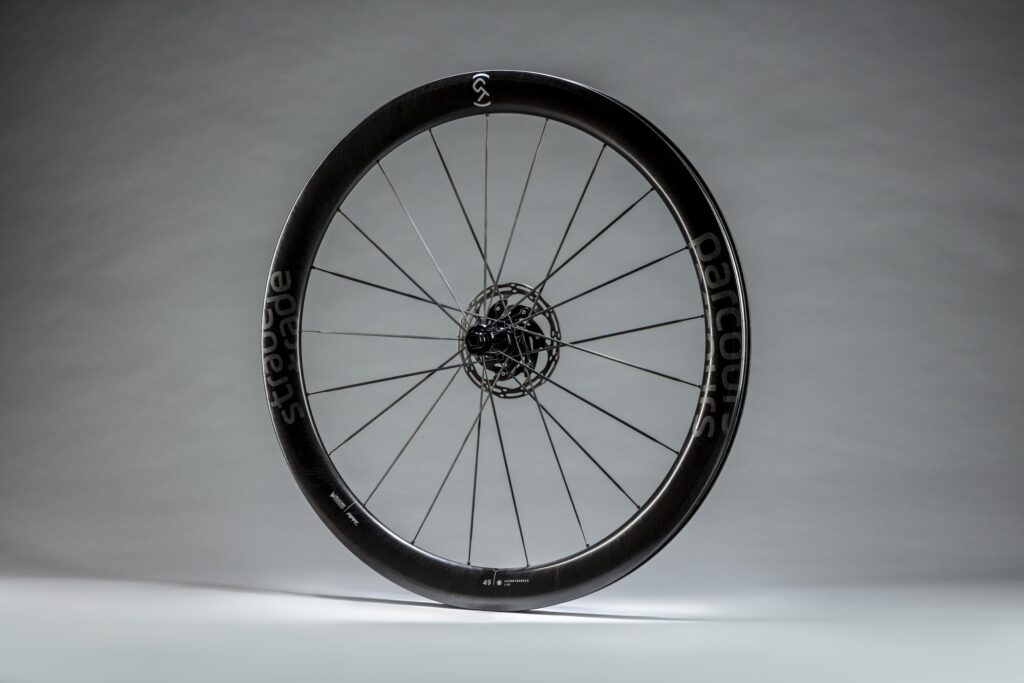
Parcours has developed a new hub platform to accommodate carbon spokes in one of its wheelsets for the first time. The Alpina Carbolite spokes (21 front/24 rear) have been chosen for their narrow-bladed cross-section. Parcours says they offer compliance close to that of a steel spoke while being extremely lightweight.
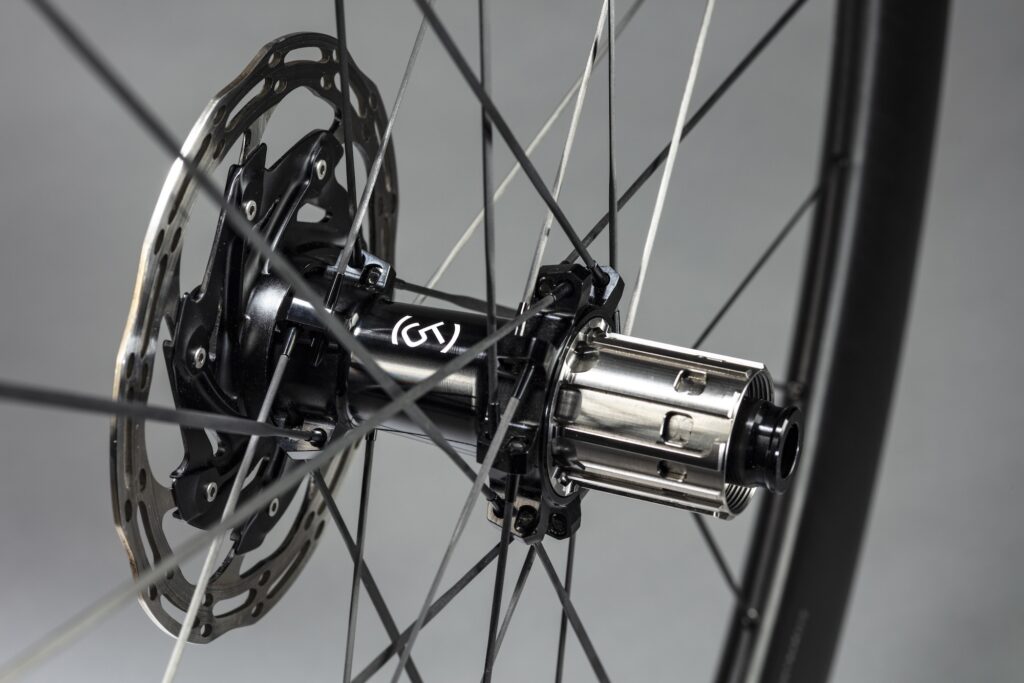
The hubs use a captive spoke design, so the spokes will be retained within the hub flange even if they lose tension or break.
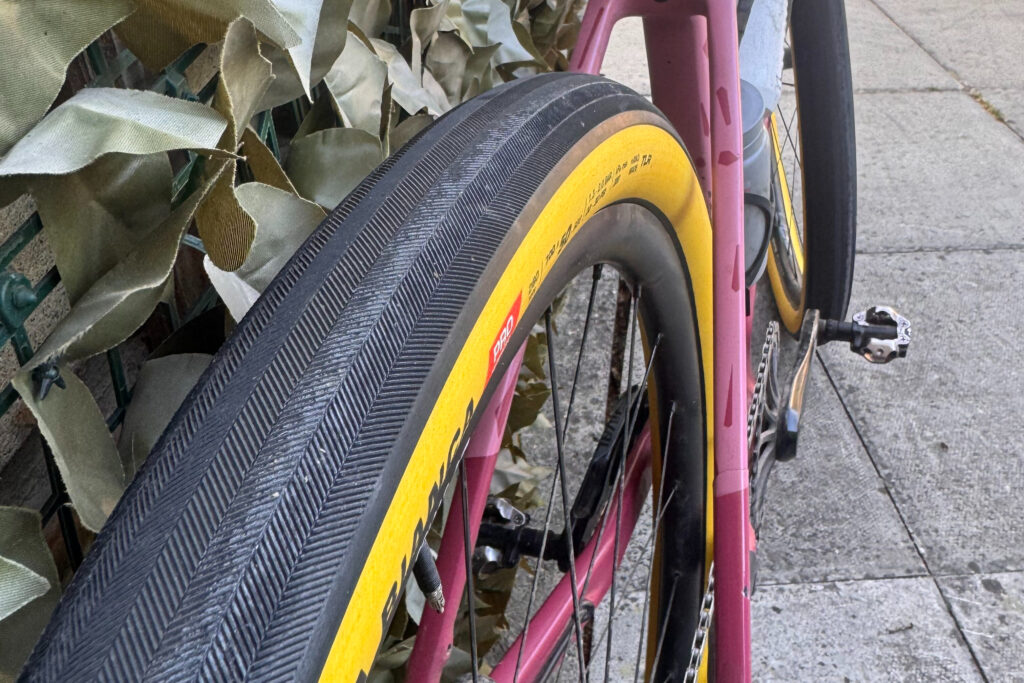
The Strade GT is tubeless-ready and, as with Parcours’ other road wheels, the rims are hooked (Parcours uses hookless rims for its gravel wheels).
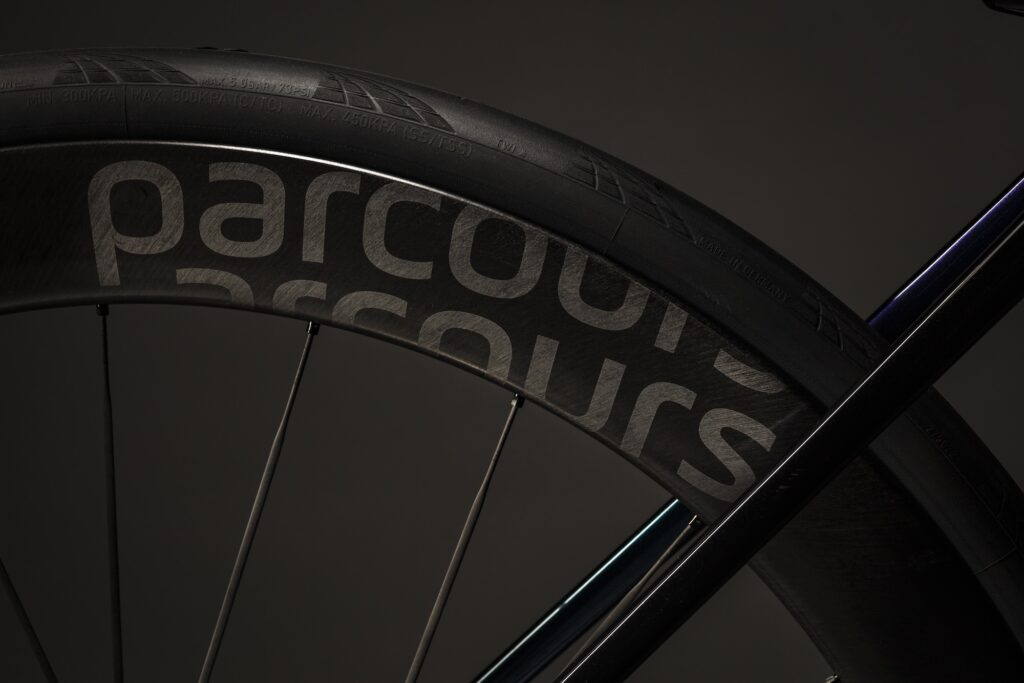
The rims are 49mm (front) and 54mm (rear) deep with a 23.5mm internal width, making them ETRTO-compliant (European Tyre and Rim Technical Organisation) for 28mm tyres.
Parcours claims a complete wheelset weight of 1,130g. You’re looking at a price of £2,499 for a Strade GT wheelset with steel bearings, or £2,719 with ceramic bearings. As we said up top, this is a premium wheelset.
Although it has yet to release details of further options, the Parcours Strade GT is the first model in a new GT Series premium range.
We’ve requested the Parcours Strade GT wheels for a full review here on road.cc.












6 thoughts on “Parcours launches Strade GT wheels with VibraCORE tech, promising 23% less vibration to improve comfort and performance”
did they buy the idea from spank?
Spank uses “vibrOcore”, which is basically a kind of foam.
But given the similar purpose and naming, things may get interesting. Unless Parcours did not know about Spank – which is not so likely – , Spank did not demand for name protection in some parts of the world, including Europe.
Blimey – twice the price of the Strade!
Blimey – half the price of Princeton CarbonWorks!
I suppose it depends to what we are comparing?
It’s a mere 0.0000003% of the US military budget.
Not sure if the people that buy premium wheelsets will be swayed by the comfort aspect. They’re probably more into exclusivity and low weight.
And for people that want comfort, the price is probably WAY to high. By going the polymer spoke route, you can save quite some money. Or you can mount wider tires and be done with it to keep money in your pocket.
A version with steel spokes for a limited surplus compared to the regular Strade will probably be a lot more successful i.m.o.