



The Spatz Pro Stealth Overshoe System takes a two-piece approach for maximum protection against the British winter. While in some ways the results are very good, the design is not without flaws, and it’s an expensive option too.
While the design has evolved since Spatz started making its overshoes almost ten years ago, the ethos remains the same: overshoes that are taller than most, reaching close to the knee, and made primarily from neoprene. And when I first encountered them with during my Roadman II test in late 2020, I saw them as something of a revelation.
Since then, I’ve used several models both on and off-road, with the Roadman III being my main choice for road riding over the past three winters. The Roadman is no longer part of the line-up, however, and there are no more off-road specific models.
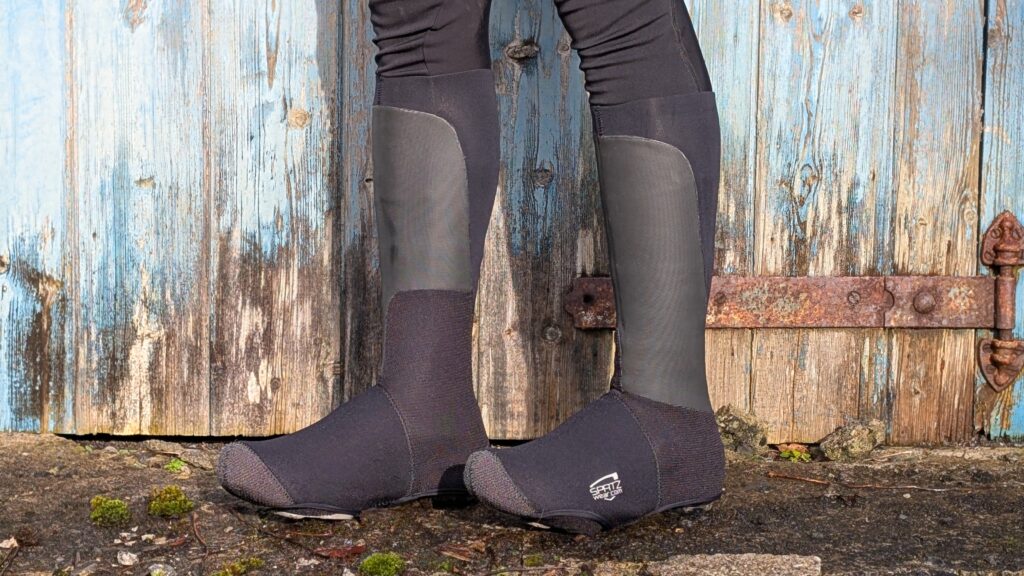
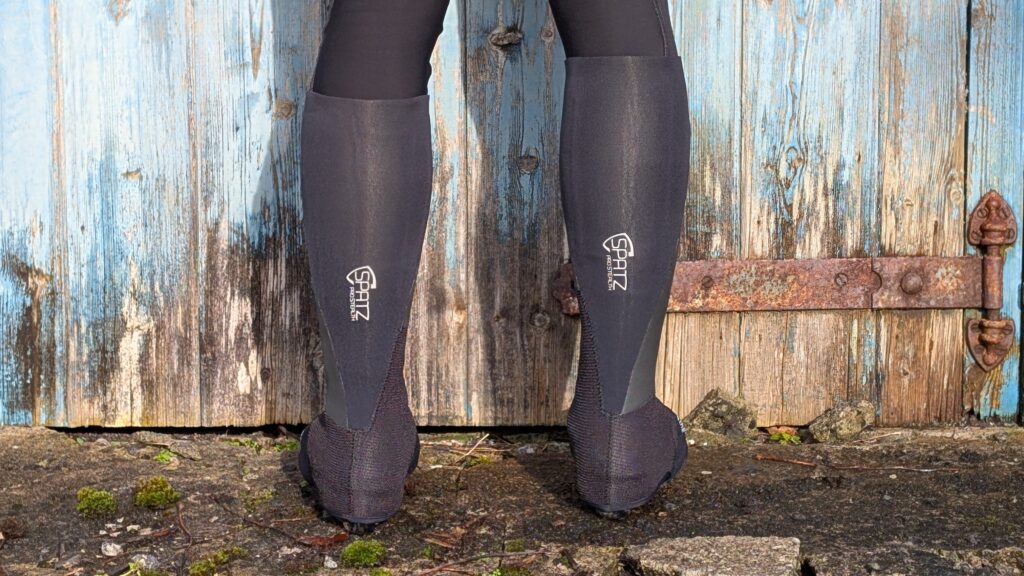
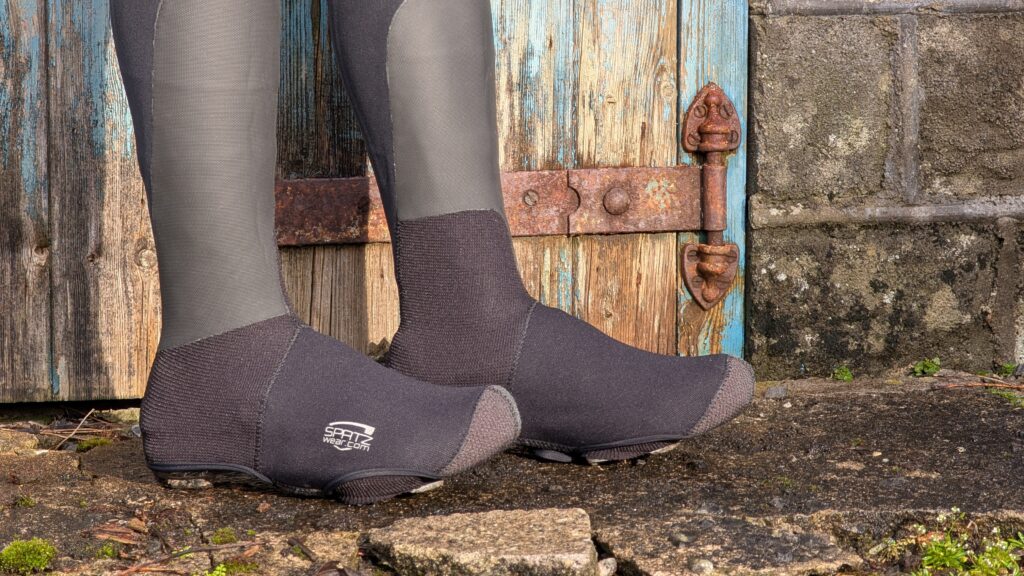
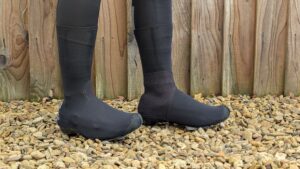
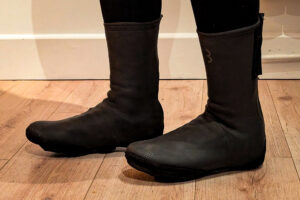
What we have here is a new two-piece design that includes the Protoez toe warmers alongside the main, tall overshoes. Each part can be worn individually or combined for the worst conditions.
It comes in three sizes that cover EU38 (UK5) to EU49 (UK13.5) feet. I tested the smallest size, which weighed 316g all in. That breaks down to 82g for the Protoez and 234g for the overshoes.
I sit on the boundary between Small and Medium sizing and use wide-fit shoes, so I checked with the Spatz team before testing. They advised sticking to the size guide, as there’s enough stretch to accommodate wide shoes, even with Lake shoes’ broad fit.
Fitting Spatz overshoes can be challenging, particularly when they’re new. The toe warmer is relatively straightforward, while the main overshoe requires a similar process to all those I’ve used, with the basic steps as follows:
- Fold the calf section in half
- Pull the overshoe onto the leg before putting the shoe on
- Put the shoe on and tighten as normal
- Fit the toe warmer over the shoe if using both parts
- Pull the toe over the shoe and secure the Velcro strap under the sole
- Unfold the calf section
On first use these were extremely tight, to the point where I wondered whether I should have sized up. However, after a few rides, the neoprene stretched enough to make life noticeably easier. Even so, they are never as quick to put on as more conventional ankle-height overshoes.
The Protoez toe warmer is a simple but effective design, with a Kevlar-reinforced sole for durability and silicone strips to reduce water ingress. They are longer than many toe warmers, extending almost to the end of the shoe’s tongue. Despite the cleat opening appearing very small, there is enough stretch to accommodate Look Grip cleats, and I would expect them to work just as well with Shimano road or MTB cleats, as well as Time and Speedplay.
The main overshoe has no zip, relying solely on a Velcro strap beneath the sole to hold them in place. Fitting them over the Protoez toe warmer is slightly more difficult, but the process remains the same.
I used the Pro Stealth throughout winter in temperatures ranging from below freezing to almost double digits ‘warmth’. They perform best in the latter, and one clear improvement over the Roadman models is their ability to cope when it’s mild. Largely that’s because you can remove the toe warmers.
The biggest limitation on cold rides is heat loss through the sole, which is only lightly protected. For the coldest rides, you might also want a thermal insole or even a DIY solution such as a layer of thick kitchen foil beneath your shoe’s insoles.
On the upside, both the shin and upper foot sections stay warm. However, I do question the focus on shin insulation, as this is not an area where I typically suffer, and I really wonder how many do. Long socks, tights or leg warmers already have this well covered, while your feet are the tricky things to keep warm as they’re more exposed.
Despite the silicone strips, rain and spray still finds its way in, either from underneath or through whatever’s above the overshoes. On the wettest rides, my feet became very wet, and with no airflow they did not dry out while riding. That said, the insulation was sufficient that my feet stayed warm on almost all rides, and you could wear them directly against the skin, with tights or leg warmers on top, for a bit more protection. Worn normally it was only when it was close to freezing, or soaking wet, that I suffered.
I have used Spatz overshoes for several winters, and while most parts last very well (particularly the Kevlar-reinforced soles), the Velcro straps have consistently been the first point to wear out. While these identical straps should last several seasons, it is frustrating when the main materials remain in good condition, but the Velcro no longer holds securely.
Value
There is still very little that directly competes with Spatz when it comes to protection in the worst weather. The closest alternative comes from GripGrab, with the Arctic 2 Waterproof Deep Winter Road Shoe Covers priced at £70. These use a much thicker 5mm neoprene, but sit lower on the leg. They’re a significant upgrade on the original Arctic Overshoes we reviewed about 150 years ago, which is quite good going as those seriously impressed our tester back then anyway.
Other options include the Sportful Deep Winter Shoe Covers at £90 and the Castelli Unlimited Shoecover at £75. All of these reach to mid-calf level.
During testing, I regularly switched between the Pro Stealth and a well-used pair of Roadman 3 overshoes. There are aspects of the older design that I still prefer, and I found myself choosing the Roadman 3 for several long winter rides. In coldest and wettest conditions I found the Roadman 3 provided a similar amount of warmth and protection – the Pro Stealths are technically more versatile but feel more of a faff for it, and performance is not actually improved.
The Roadman 3 was £90, and while prices have increased across the board, the Pro Stealth’s jump to £124.99 for the Pro Stealth is significant. The Spatz Pro Stealth Overshoe System sits among the most expensive shoe coverings available.
Overall
While the quality and warmth are undeniably good, these represent a serious investment. However, while some rivals are edging closer with taller designs, very few match the protection offered here against a true British winter. If maximum warmth and coverage are your priority, the Pro Stealths – while not flawless – are a strong option. The high price and limited performance gains over previous models, though, are unfortunate.
Test Report
What does the manufacturer say about this product?:
Spatz says: “The 2025/26 version is updated with Protoez toe warmers, cut specifically for ease of use and incredibly easy to put on and take off.
“Designed as a two-part layering system, the Pro Stealth Overshoes ship together with the Protoez Toe Warmers. The overshoes can be worn alone in temperatures above 3–5°C. When the temperature drops, we recommend adding the Protoez underneath. Worn together, the cleverly designed silicone seals (on the inside and outside of the toe warmers) integrate perfectly with the seals inside the overshoes—forming a barrier that drastically reduces water ingress and creates unmatched insulation.
In addition to enhanced warmth and water protection, the Pro Stealth Overshoes are made from a combination of materials not previously used in cycling. Throughout the design and development process, we focused on toughness, resilience, comfort, longevity, water resistance, and aerodynamics. The overshoes combine Kevlar-covered neoprene, tough Cordura-covered neoprene, and super-flexible nylon-covered neoprene.”
Tell us some more about the technical aspects of this product:
Spatz lists:
Two-Part System – Includes overshoes and Protoez toe warmers for full coverage
Engineered Materials – Kevlar, Cordura and neoprene for durability and performance
Seamless Integration – Designed to pair perfectly with Spatz tights and legwear
Maximum Weather Protection – Double silicone seals reduce moisture and increase warmth
Designed in the UK – Developed by Olympic pros for harsh winter riding
Any further comments on performance?:
Warm in wet weather, but not dry.
How does the price compare to that of similar products in the market, including ones recently tested?:
At £124.99 the price has jumped compared to the Spatz Roadman 3, which are £90, and while they didn’t have toe covers the protection and warmth are similar. The Gore Sleet Insulated overshoes are £99.99 and the MAAP Deep Winter overshoes are £90, but both are ankle height.
Did you enjoy using the product? Yes
Would you consider buying the product?
I prefer the older, cheaper Roadman III model.
Would you recommend the product to a friend?
Potentially, yes.
Use this box to explain your overall score
The Spatz Pro Stealth provide a good level of protection and kept my feet warm in miserable British winter conditions. They are tight when new, making them tricky to put on, but this eases with time and use. The two-piece design puts them among the most expensive overshoes we’ve tested, and while they perform well, there’s little – if any – advantage over the (sadly discontinued) Roadman 3s.
About the tester
Age: 41Height: 168cmWeight: 61kg
I usually ride: Road / Gravel / MTBMy best bike is: Cannondale SystemSix
I’ve been riding for: Over 20 yearsI ride: Every dayI would class myself as: Semi-pro or ex-pro
I regularly do the following types of riding: Cyclocross, Gravel riding, Indoor riding, Bikepacking, Audax, Mountain bike XC


2 thoughts on “Spatz Pro Stealth Overshoe System”
Haven’t tested these… but do you actually want full waterproofing?
I don’t even want to imagine what would be going on inside my shoes during a long ride in fully waterproof knee-high boots, considering that all the sweat just runs down your calves into the shoes. By the end of the second hour, the microbes would probably have developed their own language and electricity.
I tried some of the Spatz gravel over shoes but returned the. They didn’t fit my shoes despite me being in the middle of the size range. I wasn’t prepared to swing really hard on them as they felt a touch fragile. They also were only mid shin length which was less than expected. Might as well go right to the knee I felt as they were meant for cold wet winter riding. The idea is sound but not especially well developed. I am in the middle, taking months as I forget, of grafting thin neoprene tubes onto the top of cheap Chinese shoes. Knackered wet suits provide the shin cover, sewing a zip in is easy. They worked well with just a few safety pins replacing the stitching so when finished should be fine