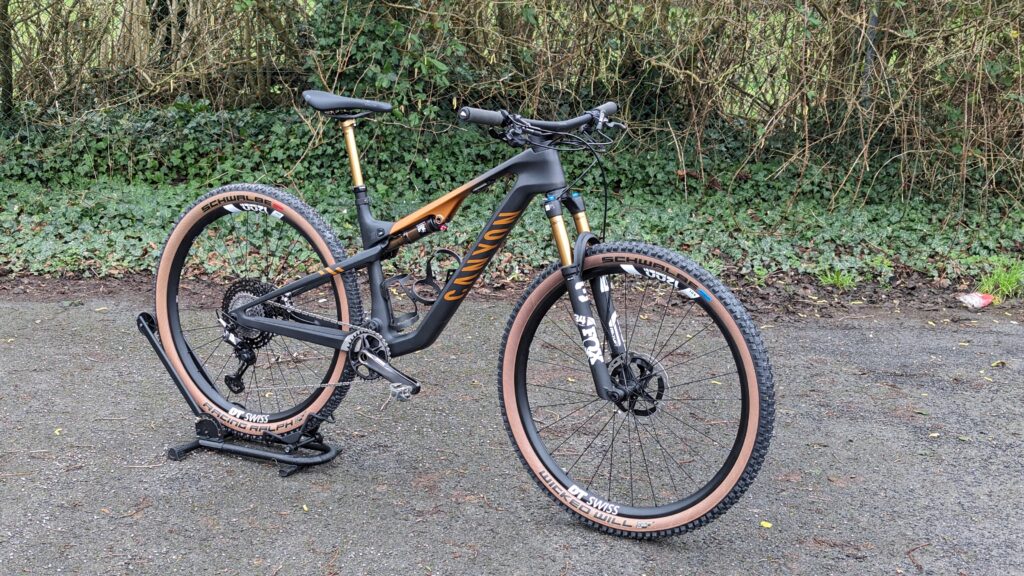

Canyon has updated the Lux platform and the Trail CFR pictured here utilises a revised frameset with 115mm of rear travel and design elements that make it suitable for all-day marathon rides or racing. The Lux has been a lot of fun to ride and is quite capable but it has left me more conflicted than any other bike I’ve recently tested with constant questions about components and prospective changes. Despite its name, Canyon has not classified the Lux as a trail bike – so where does this fit in among Canyon’s line up and the best mountain bikes on the market?
- Rockrider RACE 900S mountain bike review
- 2021 Specialized Epic Comp review
- Merida Ninety-Six RC 9000 review
The Canyon Lux Trail, unlike the more race-focused 100mm-travel Lux World Cup variant, has 115mm of rear wheel travel and is designed to be paired with a 120mm fork. Both versions may appear similar at first glance but the framesets have different angles and the Lux Trail’s suspension delivers a much more progressive curve than the World Cup version.
Whether you call it down-country, fast XC or leave the taglines off entirely, there are questions about the bike’s design as well as who Canyon is targeting with the Lux Trail. To make matters even more complicated, Canyon has not included the bike in its Trail category – instead, classifying it as a cross-country mountain bike with the Lux World Cup, Exceed and Grand Canyon hardtail bikes.
Canyon Lux Trail CFR – Technical details
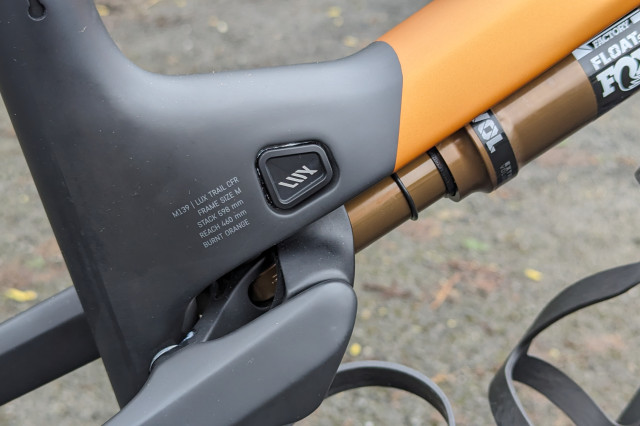
The redesigned Lux Trail keeps a linkage-driven single-pivot design but now features a hanging rocker to improve small-bump sensitivity.
Canyon offers two tiers of framesets starting with the CF, which has a claimed weight of 2,101g without the shock and continuing with the CFR, which has a claimed weight of 1,996g. Full builds begin at £3,199 with the CF6 which gets a Shimano Deore 12 groupset and Fox 34 Step-Cast fork. The CF9 costs £5,450 and comes with SRAM GX Eagle AXS and a RockShox SID Select+ fork before moving on to the CFR versions.
There are two CFR versions, with the most costly being the CFR LTD at £8,100. The build includes a SRAM Eagle XX AXS drivetrain, DT Swiss XRC carbon wheels, a RockShox SID Ultimate fork, AXS Reverb and a power meter. The Lux Trail we’re testing costs £6,700 and has a 12-speed Shimano XTR mechanical drivetrain and a Fox 34 Step-Cast factory fork.
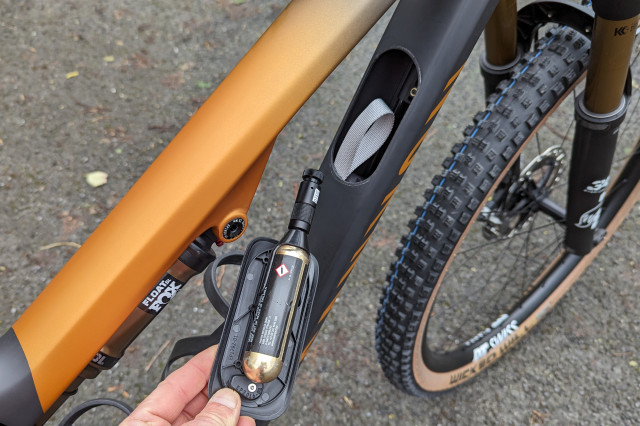
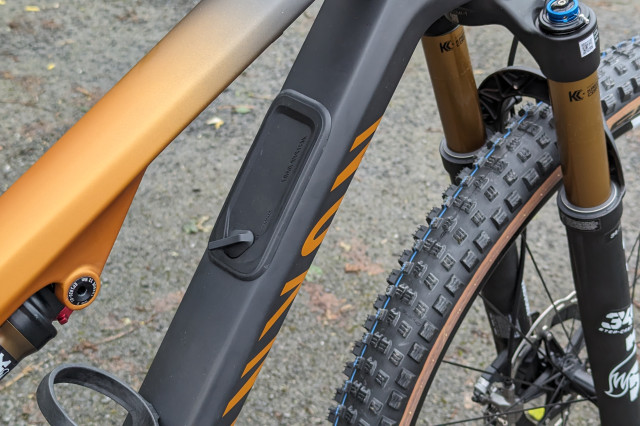
All CF and CFR designs include the same innovative integrated storage options, which are similar to the current Canyon Grail gravel bike. A lever opens a small hatch that allows access to storage in the downtube, as well as the possibility of storing a multi-tool under the top tube. Except for a bag designed to fit inside the downtube, all of these are additional purchases. The frame features two bottle cage mounts within the main frame, pn all sizes – even the XS size bike. You will be limited to a smaller bottle on the seat tube, which is still a significant advantage over many other marathon/cross-country bikes.
T
he frame’s basic geometry numbers include a 67-degree head angle, 76-degree seat angle, 435mm chainstay, and 38mm BB drop in all sizes. Reach spans 412mm (XS), 438mm (S), 460mm (M), 480mm (L) and 500mm (XL), while stand-over begins at 768mm on the XS and S and increases to 772mm (M), 777mm (L) and 783mm (XL).
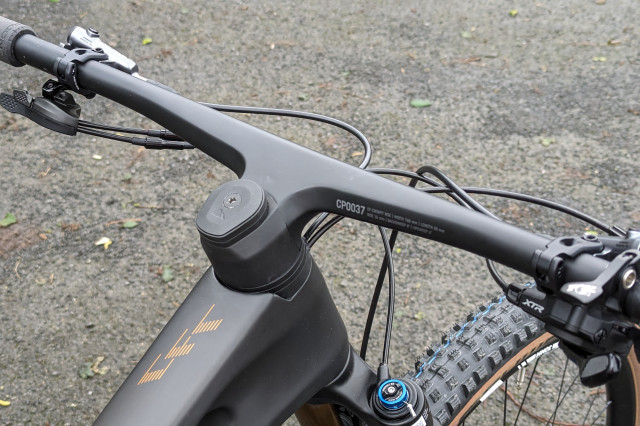
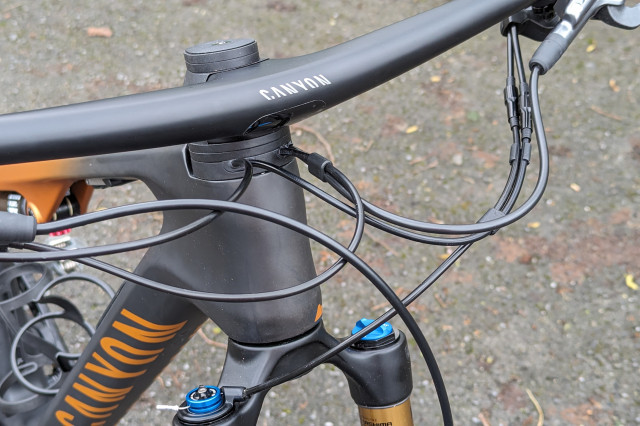
The Canyon Trail CFR is yet another new bike with internal cable routing that is fed through the headset; a move that will almost probably be driven by frame manufacturing costs and one for which I see no benefit and only downsides for the end user. For road bikes with entirely clear cables, there is some possibility for cleaner looks; but, for a bike that will be ridden off-road and in all weathers, with cables for gearing, lockout and dropper seatpost all internal, this will increase maintenance time and costs. One good thing is seeing a return to a standard threaded BSA bottom bracket shell on all frames.
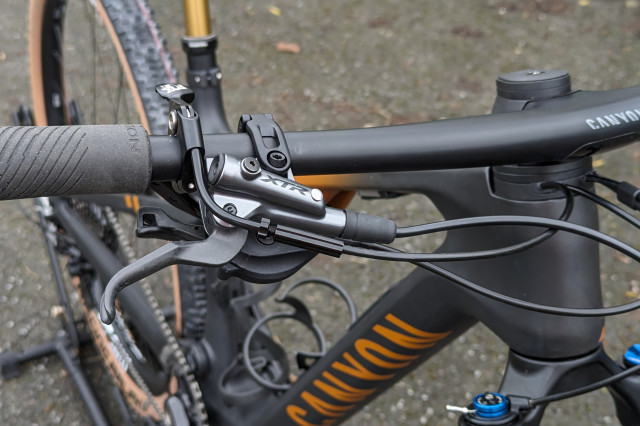
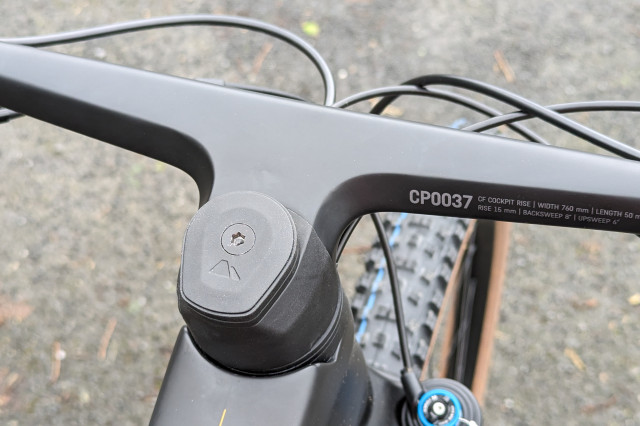
According to Canyon’s sizing recommendations I’m considered small at 168cm tall. But key geometry measurements such as reach and stack were more comparable to my medium-sized personal bikes so that was the size I decided to pick. A key factor in the decision is having a 50mm integrated stem length on all sizes, which eliminates the opportunity to adjust the reach. Given the shock placement inside the frame and the addition of two bottle cages, the stand-over height is quite low and this might give some riders the flexibility to size up if desired. Stem length should not be a key factor when choosing a bike frame but when the alternative is an expensive (the Canyon CP0008 is £200) extra part, in addition to the time and workshop costs that will be needed for a possible brake bleed due to the cables going through the headset, it may be a reality for some. If you are not completely fixed on an integrated cockpit, a standard handlebar and stem will fit, as seen on Lux Trail CF models but the cables will still need to be internally routed.
Canyon Lux Trail CFR – Specification
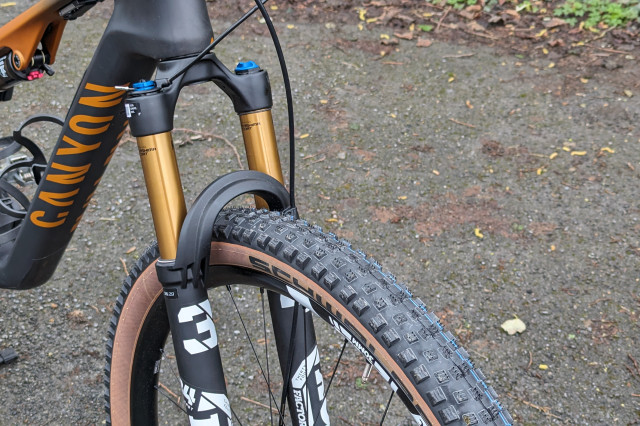
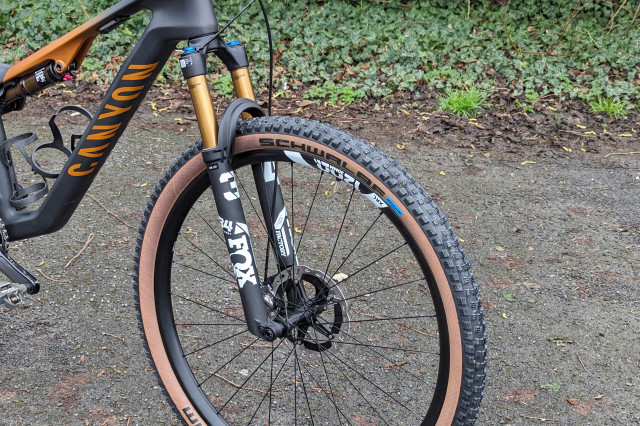
The Canyon Lux Trail CFR pictured here is the lightest of all the models in the range with a claimed weight of 11.25kg (24.8 pounds) and the spec is built around a Shimano XTR 12-speed mechanical groupset and Fox 34 Step-Cast Factory fork. The front are rear suspension are controlled by a three-position dual-lockout switch activated on the handlebar.
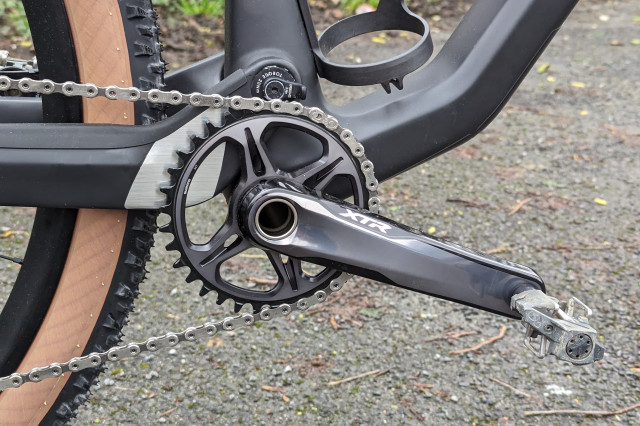
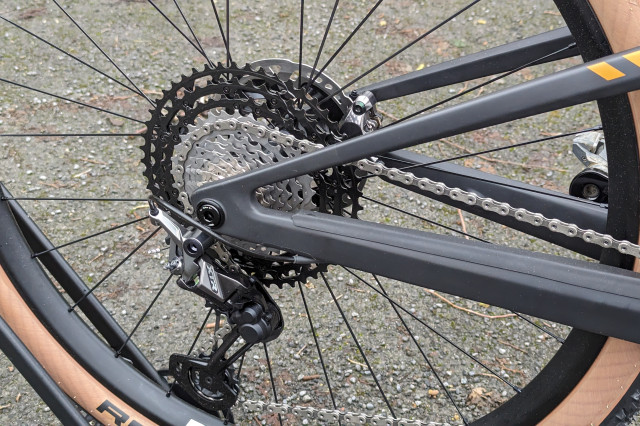
There is a full XTR mechanical groupset with 10-51T cassette and 34T chainring, which is surprisingly big for a model that is not aimed as a pure race bike. The XTR theme continues with the brakes where two-piston M9110 calipers bite down on 180mm/160mm front/rear rotors.
The integrated CP0037 cockpit system has a 50mm stem and 760mm width handlebar across all frame sizes, which means just a limited number of installations. Canyon makes a Garmin or Wahoo compatible mount for an additional £23. It’s disappointing that it’s an additional purchase, considering practically every rider will want to utilise a head-unit computer. The cockpit is completed with a pair of Ergon GXR grips.
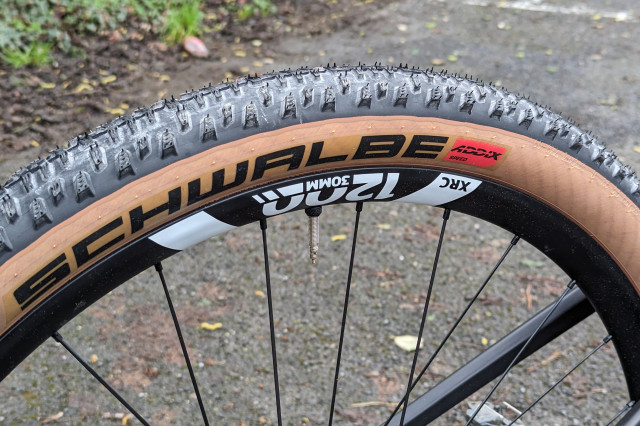
The DT Swiss XCR 1200 wheels, featuring full carbon rims with a 30mm internal diameter and ultra-high-end DT Swiss 180 hubs, are among the most expensive currently available.
With the Lux World Cup model also available, it’s evident that the Lux Trail isn’t designed to be a pure race bike. Some of the component selections are strange such as the tyres. The 2.4in Schwalbe Wicked Will and 2.35in Racing Ralph combination is light and fast but fragile. The Addix Speed compound, matched to the Super Race carcass, has only a minimal protective layer beneath the tread area and nothing on the sidewalls. They are excellent race tyres but, for normal riding, they may be too delicate.
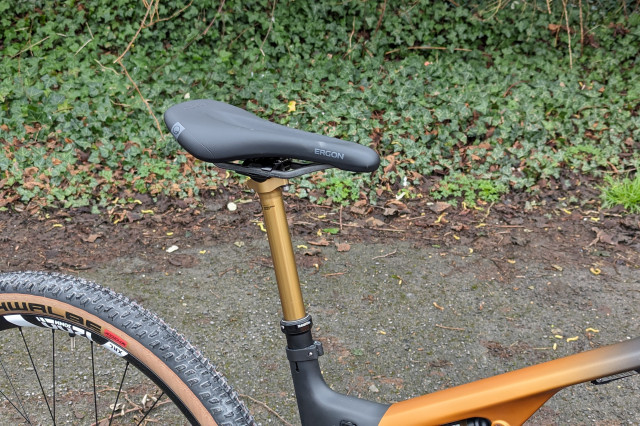
Canyon specifies a Fox Transfer SL Factory dropper seatpost with the Kashima coating. Drop lengths vary from 150mm on medium and up, 125mm on small and 100mm on XS. The bike comes standard with an Ergon SM10 Pro saddle.
Canyon Lux Trail CFR – Performance
After some adjustment and experimentation, the Lux Trail was set up with 25% rear sag and a slow shock rebound. The Fox 34 has a large range of adjustments and this was set to the firm side for the desired weight and quicker rebound.
The more upright riding position on the Lux Trail feels faster and easier to ride on climbs thanks to the steep seat tube angle that puts you right above the bottom bracket. Even steeper, more technical climbs are easier to negotiate as your weight further forward which makes it easier to adjust to the trail and the open suspension feels quite effective when climbing.
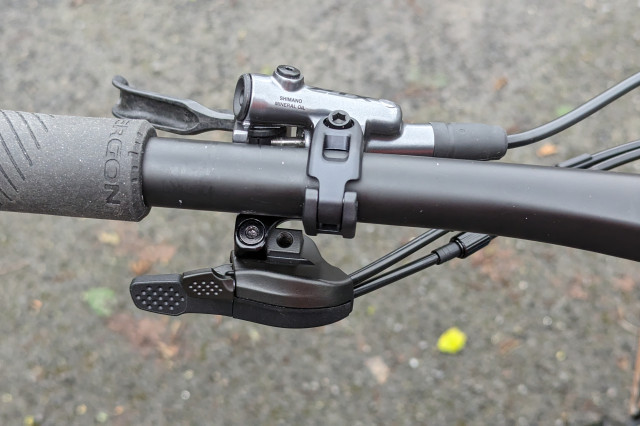
The option of a three-position lock-out over a simple two-position model is a good choice for the style of the bike and the lever was effective, although cable tension needs to be closely controlled.
The rear end seems very efficient and I didn’t find myself reaching for the lockout lever as often as usual, except when getting out of the saddle on smoother forest roads and tracks. The only issues had while climbing were on tighter uphill switchbacks because the longer wheelbase, reach and slacker head tube angle all work against you. The geometry numbers result in a bike that provides a good combination of confidence on faster, more technical sections while maintaining faster steering for more general riding and racing.
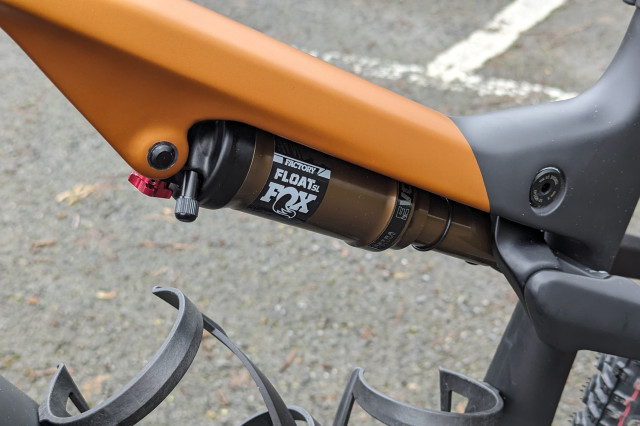
Much of the testing was done on waymarked trails, such as the Welsh trail centres in Afan Forest and it is on these trails that the bike’s true handling and capability show. There is some feedback and vibration through the frame on higher-frequency bumps and this persisted even when testing with more sag and different rebound settings.
Except for the chatter on braking bumps, the suspension works well and does not dive or sink too far into the travel, even when the rebound damping is set on the slower side. The Fox 34 Step-Cast has a lot of adjustments, and there’s a noticeable difference between the fastest and slowest rebound settings, allowing you to set it up exactly how you want. And the three-position lockout is better suited to normal riding than a more race-oriented two-position option.
One area that continued to frustrate me was the Transfer SL dropper seatpost, which has a smooth and rapid action with a functional lever. However, the lightweight design and simplified internals only allow for two positions: up or down. Some may argue that it is best suited to racers – though as a racer myself, I disagree – but for general cross-country riding with a big 150mm drop where it is all or nothing, I found myself using the drop action far less than other infinite drop designs.
The in-frame storage is neat and while everyone’s riding circumstances vary, for race situations or those who prefer not to carry a waist or backpack, it means virtually everything can be carried on the bike. The frame storage bag comes with the bike but not the other parts. However, Canyon does offer a tool bundle and, to give an idea of what can be carried, I had the small mini-tool under the top tube, a 25g CO2 canister and an inflator under the hatch. The frame storage bag was big enough for two lightweight inner tubes and some smaller parts, including a tyre lever, patch and chain-link.
The Shimano XTR groupset was faultless with a precise shift action. The XS and Small size frames have 170mm crankarms while all others utilise 175mm cranks. While Canyon is not the only manufacturer that does this, I believe a shorter crank arm on the XS would benefit shorter riders.
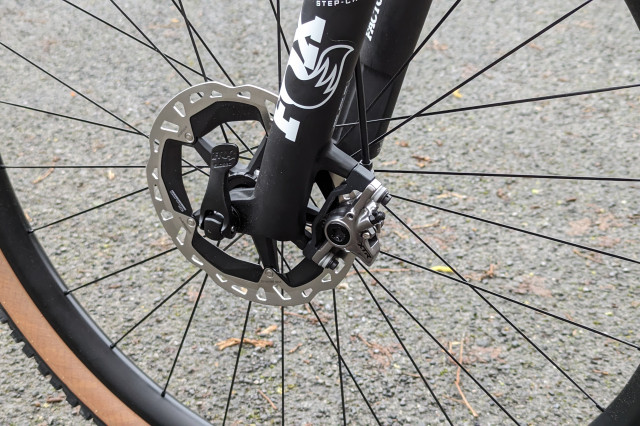
The DT Swiss XRC 1200 wheels are fantastic, providing a wheelset that holds a line on even the most challenging descents, and a 30mm internal width that helps give larger tyres a better shape with more support and reassurance of the brand’s reputation for reliability.
Canyon Lux Trail CFR – Trail or Race?
Our test bike weighs 11.29kg (24.9 pounds) without pedals making it reasonably light for a trail bike but against more race-focussed bikes at a similar price point (which can be closer to 10kg/22 pounds), it’s not very competitive. For the UK market, the term “trail” will most often refer to waymarked forest trail centres, which are often rockier and rougher. The Schwalbe tyres are fast, grippy, and excellent race tyres for their weight and size, but the thinnest carcass and fastest compound make them a risky choice for trail-centre riding.
Fitting a smaller 30- or 32T chainring may be better suited to some riders and locations with steep climbs; the integrated bar/stem makes it impossible to mount almost any extra accessories and the long 150mm Transfer SL dropper seatpost with its two-position drop may suit the most extreme technical situations but not general riding where you want to lower it just a little bit.
These are all fixable at a cost but everything adds up: £400 for a Factory Transfer, £50 for a chainring, £200 for an integrated cockpit if the measurements don’t suit and £100-150 for some more trail friendly tyres are all significant additions, though the factory fitted tyres could be saved for races. Then there’s the additional cost of fully utilising the internal frame storage and buying an extra computer mount.
The Lux Trail is a lovely bike that performs exceptionally well but there are some drawbacks. The stock build is best suited to someone who enjoys the occasional race but prefers longer, faster days in the saddle with some technical riding. The progressive design, with a slacker head angle than the previous Lux, follows the trends, making it confident and capable downhill while maintaining a comfortable and efficient pedaling position suitable for all-day riding or racing.
Canyon Lux Trail CFR – Verdict
The Canyon Lux Trail is positioned between the Lux World Cup, which has 100mm travel front and rear and the Spectral 125, a full suspension bike with 140mm front and 125mm rear travel, which is part of the Canyon Trail bike line.
There are an increasing number of bikes classed as ‘downcountry’, which share characteristics with a design that combines general trail riding with a mix of racing and longer rides on the bike. The Rockrider RACE 900s that I recently tested has less progressive geometry but the choice of components would give me more confidence in taking it on rougher, more technical trails with both at factory specifications. It’s also £3,700 less expensive and still features fantastic specifications including AXS wireless shifting and Reynolds carbon wheels.
Tom has tested the Giant Anthem Advanced Pro 29 1, which has the highest specification and he enjoyed the racy feel and agility, although it costs £7,500, which is even more than the Lux Trail. It also only has one bottle cage mount, which may not be to everyone’s liking.
Canyon has updated the Lux and created a bike that is quite capable and adaptable but there is some confusion over where it is best suited, which could be related to our definition of the word trail rather than the bike itself.
The frameset is superb on its own and the main flaws I see are related to the components specified rather than the overall ride and capabilities. All Lux Trail versions have the same internal cable routing issues but the cheaper versions lack an integrated handlebar and stem. If you’re set on the Lux Trail, the CF9 model stands out for me, with an SRAM GX AXS wireless groupset that eliminates some of the cables and a wireless Reverb AXS seatpost that doesn’t just have the two positions. Add a separate handlebar and stem for more fit flexibility, as well as DT Swiss XR 1501 carbon wheels, and you’ll save £1,200. The disadvantage is an additional 1.2kg in claimed weight but even if you are a weight weenie, the benefits would outweigh this.
You might also like:
- How to choose the best dropper post for your mountain bike
- Fastest Known Times – everything you need to know
- Bike check: Lukas Baum’s Orbea Oiz
About the bike
Tell us what the bike is for, and who it’s aimed at. What do the manufacturers say about it? How does that compare to your own :
From shredding to racing, the Lux Trail CFR does it all at the very highest level, with its advanced CFR frame, legendary Shimano XTR shifting, and premium FOX Factory suspension.
Total control linkage
Get brilliant traction and control with the Lux Trail’s reactive suspension. 115 mm of rear travel is just a number, when you point it downhill it rides like a whole lot more.
The right angles
We’ve found the sweetspot for trail riding geometry. Steep enough seat tubes that keep you riding efficiently and comfortably all day long. And a slack enough head angle that puts you in the driving seat on long and challenging descents.
Remote lockout suspension
Quickly react to changes on the trail with the remote suspension lock-out control. The 3-position-adjustment lets you easily switch between Open, Pedal, and Locked.
Proper frame protection
Our Impact Protection Unit (IPU) helps protect your frame when you crash by preventing the bars from rotating into the top tube. A lightweight chain guide prevents chain drops on rough trails.
Clever storage
The fix is always within reach on the Lux Trail. Store a mini-tool in the top tube and Canyon Sahmurai Sword Plug Set in the bar ends for fast fixes.
Drink more water
Staying hydrated on epic marathon routes is absolutely essential. Some bikes in this category might have room for one bottle but the Lux Trail has been designed to hold two within the frame, even on XS frames. Leave your hydration pack at home and fill your bottles instead.
State the frame material and method of construction. List the components used to build up the bike.:
Formidable CFR frame
This is carbon without compromise. The super lightweight and relentlessly tough CFR frame is the epitome of industry-leading carbon engineering. Feature-packed medium frames weigh only 1,999.6 g, making the Lux Trail one of the lightest on the market – it’s a work of art.
Canyon specification list:
Frame:
Canyon Lux Trail CFR
Superlight, pro-level CFR build of the ultra-capable Lux Trail down-country bike, delivering the highest levels of climbing efficiency and descending performance.
Axle dimension: 12×148 mm
Material: Carbon (CFR)
Rear Shock:
FOX Float SL Factory Remote
Suspension Fork:
FOX 34 Stepcast Factory Remote
Axle dimension: 15×110 mm
Travel: 120 mm
Fork steer tube diameter: 1 1/8″ – 1,5″
Drivetrain:
Rear Derailleur
Shimano XTR, 12-speed
Cage length: long
Weight: 230 g
Shift Lever
Shimano XTR, 12-speed
Weight: 131 g
Cassette
Shimano XTR CS-M9101 12s 10-51
Number of sprockets: 12
Crank
Shimano XTR M9125 34T
Number of chainrings: 1
Bottom bracket
Shimano BSA BB93
Bottom bracket standard: BSA 68/73
Chain
Shimano M9100 XTR Chain
SIL-TEC treatment for extended offroad durability, HYPERGLIDE+ shift technology, quick link for easy connect and tool-free assembly
Brakes
Shimano XTR M9110
Number of pistons: 2
Brake Rotor Shimano RT-MT900
Size: 180 mm / 160 mm
Wheels:
Front:
DT Swiss XRC 1200 Spline
Axle dimension: 12×148 mm
Rotor mount: Center Lock
Inner width: 30 mm
Weight: 799 g
Rear:
DT Swiss XRC 1200 Spline
Axle dimension: 15×110 mm
Rotor mount: Center Lock
Inner width: 30 mm
Weight: 679 g
Tyre
Schwalbe Racing Ralph SR TLE EVO 2.35″
Width: 2.35″
Tyre
Schwalbe Wicked Will SR TLE EVO 2.4″
Width: 2.4″
Thru Axle
Canyon GP0254-01 Thru Axle 148X12
Axle dimension: 12×148 mm
Cockpit:
Canyon CP0037
Material: Carbon (CF)
Grips
Ergon GXR
Saddle
Ergon SM10 Pro
Weight: 235 g
Seatpost
FOX Transfer SL Factory
Clamp diameter: 31,6 mm
Material: Aluminium (AL)
Weight: 421 g
Frame & Fork
How much suspension travel does the fork have?:
Was the bike comfortable to ride? Tell us how you felt about the ride quality.:
How was the bike in terms of sizing and angles? How did it compare to other bikes of the same stated size and intent?:
Overall rating for frame
How much suspension travel does the rear end have?:
Did the bike feel stiff in the right places? Did any part of the bike feel too stiff or too flexible?:
Tell us about the build quality and finish of the frame:
Tell us about the geometry of the frame:
Tell us about the materials used in the frame:
Riding
How did the bike transfer power? Did it feel efficient?:
How would you describe the steering? Was it lively, neutral or unresponsive?:
Tell us some more about the handling. How did the bike feel overall? Did it do particular things well or badly?:
Rate the bike for sprinting:
Rate the bike for high speed descending
Rate the bike for technical descending:
Rate the bike for flat cornering:
Rate the bike for technical climbing:
Rate the bike for climbing efficiency:
Rate the bike for agility:
Suspension
Rate the fork for performance:
Any comments on fork performance?:
Rate the fork for durability:
Rate the fork for efficiency:
Any comments on fork efficiency?:
Rate the fork for value:
Tell us some more about the fork. Anything you particularly did or didn’t like? Any features which didn’t work well together?:
Rate the rear suspension for performance:
Rate the rear suspension for durability:
Rate the rear suspension for efficiency:
Any comments on rear suspension efficiency?:
Rate the rear shock for value:
Tell us some more about the rear suspension. Anything you particularly did or didn’t like? Any features which didn’t work well:
Rate the balance and performance of the suspension overall:
Drivetrain
Rate the drivetrain for performance:
Rate the drivetrain for durability:
Any comments on drivetrain durability?:
Rate the drivetrain for weight:
Any comments on drivetrain weight?:
Wheels & tyres
Rate the tyres for weight:
Rate the tyres for value:
Summary
Did you enjoy riding the bike?:
Would you consider buying the bike?:
Which components had the most effect (good or bad) on the bike’s performance? would you recommend any changes?:
Would you recommend the bike to a friend?:
Rate the bike overall for performance:
Use this box to explain your score:
All the deals displayed on our review pages are pulled from a constantly updating database feed of the best affiliate deals available. The criteria for deciding on what are the best deals is who is offering the lowest, delivered price. In most cases we will be showing the very best deal available online, but sometimes you may be able to find an item cheaper. If you can please feel free to post a link in the comments box below. To find out more about affiliate links on road.cc click here.