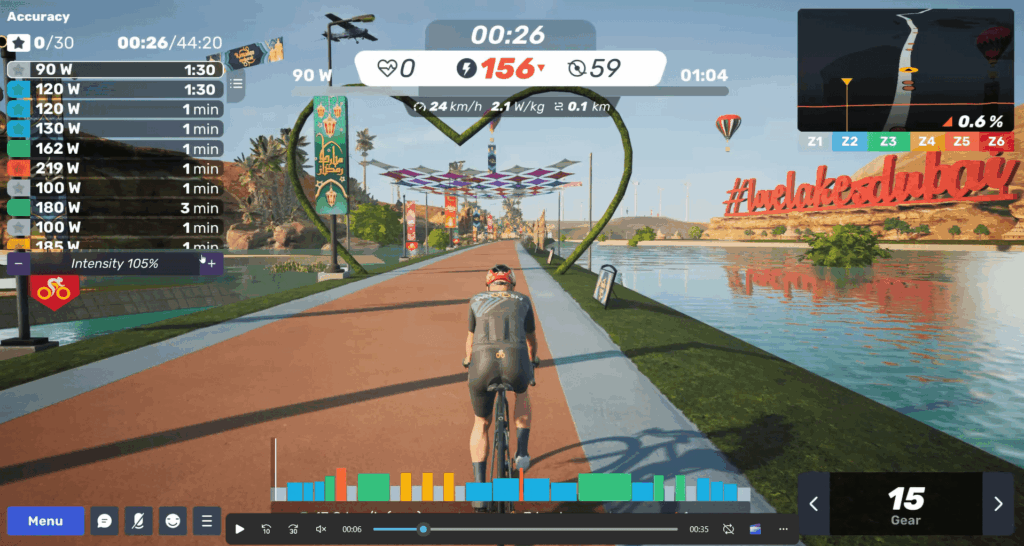
When it comes to virtual racing, discussions around cheating tend to focus on tech-based shortcuts like data hacking, bots, or even carbon fibre exoskeletons. But the brave new world of e-cycling has gone decidedly old school this week, with the news that MyWhoosh is introducing random drug tests for racers on its platform.
MyWhoosh, which has hosted the UCI Esports World Championships since 2024, runs a weekly Sunday Race Club competition, where the prizes on offer range from around £15 to £1,600.
Starting this weekend, the top riders taking part in the Sunday Race Club and the Esports World Championships will be subject to MyWhoosh’s anti-doping protocol, established in collaboration with International Doping Tests and Management (IDTM), an independent anti-doping provider.
According to the programme, selected riders will be notified before, during, or after a race that they must remain at their declared location for up to three hours, to enable IDTM testers to reach them. They will then have to provide urine, blood, or dried blood spot samples.
700 riders will be part of MyWhoosh’s first testing pool, with the platform aiming to test around 10 per cent of them a year. The WADA Prohibited List will be used as the reference list for banned substances and methods, the platform says, establishing a “private contractual and sporting integrity framework” that draws from recognised international standards.
Riders will be selected for testing based on random selection, podium finishes, performance data, or intelligence-led targeting.
Any rider who refuses to comply with the new rules, by failing to provide an accurate location, or refusing to provide a sample, evading testers, or tampering with their sample will face “severe” sanctions, MyWhoosh says, including disqualification, prize money losses, and suspension from the platform.
The programme will get under way on Sunday 10 May, with the first round of testing scheduled to take place the following Sunday.
This new form of tradition biological testing is the first of its kind to be introduced in the virtual racing world and will sit alongside MyWhoosh’s existing hardware, software, and performance verification systems.
As prize money booms in e-cycling – MyWhoosh currently dishes out $5 million a year – the platform says its new anti-doping programme marks “a significant step” towards further professionalising the sport, while also “addressing integrity concerns” and ensuring competition results “reflect genuine performance”.
“The introduction of anti-doping and integrity testing is about protecting fair competition and rider trust,” Matt Smithson, director of e-sports and game operations at MyWhoosh, said in a statement.
“As our Sunday Race Club grows, the standards around fairness must match the seriousness of the event. Our goal is to protect clean riders and ensure that our global community can trust in the integrity of every podium finish”.

While doping stories have largely been confined to real-world bike racing, virtual cycling hasn’t been immune to its own unique forms of cheating.
Since the dawn of the e-racing era, riders have tried to gain an illegal advantage by lying about their weight, increasing their power data by calibrating their equipment inaccurately, and even availing of bots capable of producing huge power (a method Britain’s inaugural e-sports champion Cameron Jeffers used back in 2019, earning him a six-month suspension).
In 2022, South African Eddy Hoole, a member of the Toyota CRYO RDT racing team, qualified for the 2023 world championships, but was later sacked by his team and banned from racing for six months after the stunning ride that secured his spot was found to be the result of a hacked data stream.
> Cheating on Zwift with an exoskeleton: is this the future of assisted cycling?
Speaking to the Guardian this week, MyWhoosh’s Smithson said the new anti-doping programme adds another layer to the platform’s bid to ensure a level playing field.
“Our goal is to protect clean riders and ensure that our global community can trust in the integrity of every podium finish,” he said. “Nobody in any other sport has to compare someone in their garage in Australia with someone in the garage in Sweden at the same time. It’s difficult and this is the next phase in the evolution.
“If someone’s cheating, they’re probably mechanically cheating. But we’ve got a lot of verification to try to stop that now. Riders have to use a specific trainer to race, with two ways of showing their power.
“We also get our athletes to do what we call a power passport test. That includes a film test, so we know it’s that person. We can see their power, we can see their heart rate. We can see all of those things. And that gives us a physiological print of who they are.
“Our drug testing, which is the first of its kind, is another way to help everybody feel that they are racing on a level playing field.”