



Protective wands have been installed on a cycle lane in the centre of Boscombe – four years after residents and councillors complained that the infrastructure in the Bournemouth suburb was being constantly “abused” by motorists illegally parking in it.
In 2023, several local cyclists started campaigning for Bournemouth, Christchurch, and Poole (BCP) Council to clamp down on illegal parking in Boscombe by posting countless images and videos of pavement and bike lane-blocking motorists on social media.
At the same time, independent councillor Andy Jones said the painted cycle lane’s lack of protection had led to “consistent complaints” from his constituents, and that the situation had deteriorated since he first raised the issue the previous year.
And now, over four years on from those first complaints, protective, flexible cycle lane posts – designed to stop drivers encroaching or blocking the route – have finally been installed on one of the busier sections of the A35, between Heathcote Road and Portman Road.
The move, funded by the Department for Transport, forms part of the council’s Safer Roads Project, which aims to cut road collisions on the corridor Iford Roundabout and St Paul’s Roundabout by improving conditions for people walking and cycling.
An open survey which took place as part of a public consultation on the matter found that 352 locals supported the wands’ installation, while 328 opposed.
However, the local authority’s face-to-face survey saw 74 per cent of residents voice their support for the wands.
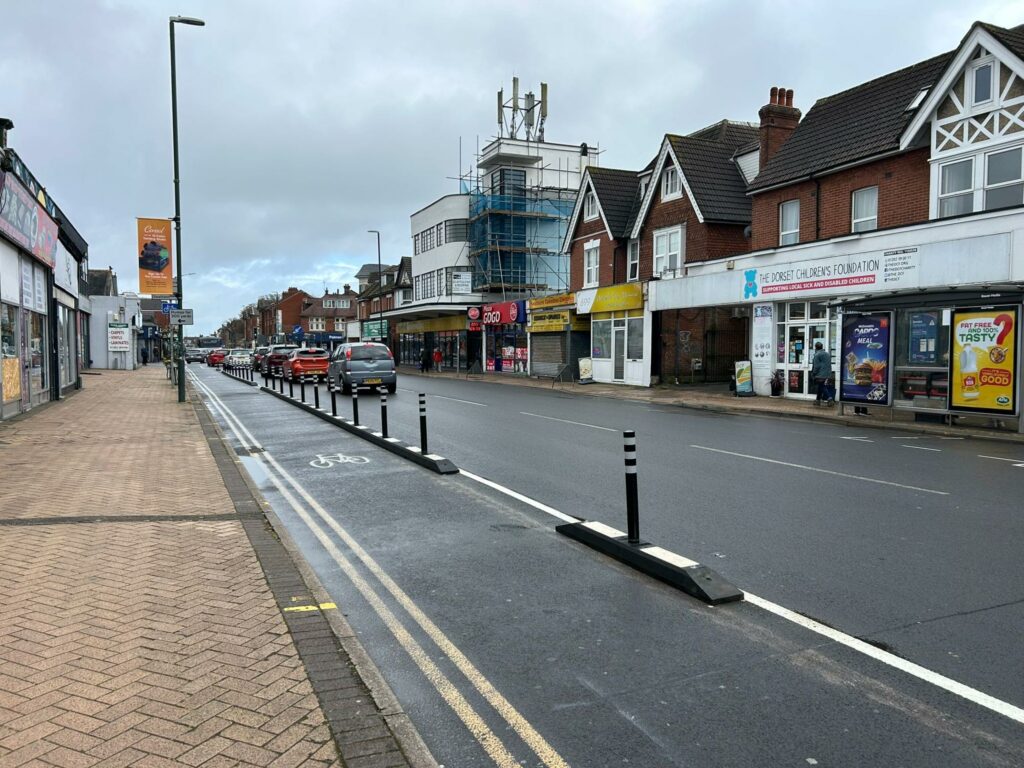
One respondent noted that they were in “strong support” of the wands, due to the existing painted cycle lane being “continually abused” by drivers.
“With the existing parking restrictions there is no justification for any of the businesses to oppose this and I for one support this immensely,” they said.
“The addition of wands on the westbound carriageway of Christchurch Road should improve safety and reduce unnecessary illegal parking,” another added, the Bournemouth Daily Echo reports.
However, some locals expressed concern that the wands would limit access and parking, fearing they would make it more difficult for motorists, delivery drivers, and blue badge holders to reach local businesses and their homes.
Meanwhile, others used the survey to warn that the wands would leave the road feeling narrower and “cluttered”, while arguing that they aren’t, in fact, even needed along that stretch of road.
“The installation of bollards/wands will reduce the width of the road, interfere with the passage of buses and other traffic, and make the road more dangerous to use,” said one respondent.
> ‘Cycle lane parking puts lives at risk’: Cyclist’s sticker justice for bike lane van driver
In a bid to assuage these concerns, as part of the changes, the loading bay outside 693 Christchurch Road is being extended, while a new loading and disabled bay is being installed nearby on Heathcote Road, which the council says will maintain space for deliveries and blue badge holders.
“The implementation of road safety measures in the Christchurch Road area of Bournemouth are funded by central government,” a BCP council spokesperson said.
“BCP Council was awarded £1.89 million by the Department for Transport (DfT) with grants under their Safer Roads Fund programme, designed to reduce casualties on approximately 50 roads across the UK.
“The wands installed on Christchurch Road are an important feature to protect cyclists and help users of all confidence levels to safely use the route.
“We consulted on the measures and considered the views of businesses and residents as part of the planning and design process.”
Back in 2023, Boscombe resident Dean Hawthorne, who described the scale of the illegal parking in the area as “an accident waiting to happen”, said he keeps a record of the number of motorists blocking the cycle lane on the Christchurch Road – a phenomenon he said he witnesses “every time” he drives down the road.
Hawthorne argued that, by allowing drivers to clog up the town’s bike lanes, an opportunity was missed to improve Boscombe’s cycling infrastructure and to combat pollution.
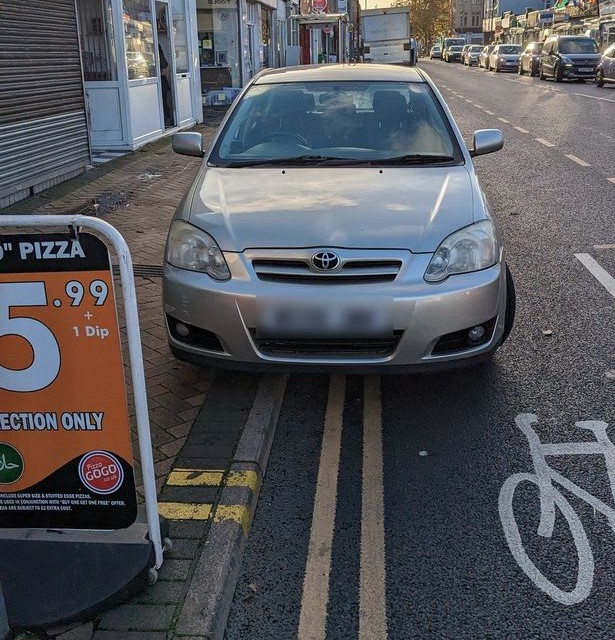
“They’ve put something in place that isn’t working for a number of reasons. There is a legitimate reason why we need to encourage more people to cycle,” he said.
“I don’t even own a bike; I drive a van. On paper I’m the cyclist’s nightmare, but I’m not, I can see the absolute benefits of having decent cycling infrastructure.”
> Bike lane meltdown: New road markings prompt Mail to ask, “is there any room left for cars?”
The installation of cycle lane wands in Boscombe comes four years after the council’s relatively benign decision to paint bicycle symbols on the area’s roads – to encourage cyclists to take a “prominent” position – caused something of a meltdown in the national press.
The symbols, which have been in use in the UK since 1975, prompted the Mail and Daily Telegraph to claim that cyclists in Boscombe were being encouraged to “ignore” the town’s dedicated bike lane – the one which, until this week, has been littered with parked cars for years.














35 thoughts on “Protective wands installed on “abused” cycle lane notorious for parked cars after “strong support” from locals – but some claim they’ll make the road “more dangerous””
This story displays the usual pseudo-concern for the disabled when the real sorrow is for the loss of all those convenient parking spaces on the cycle lane. I hope it does make ‘things more difficult for motorists’- sorting the idle b******s out is the whole point – but it’s more likely there will be systematic destruction of the wands so that the rightful use of those long thin carparks can be restored
Is the Council incapable of directing their parking inspectors to ticket these cars?
They have to import traffic enforcement officers from London during the busy season as they don’t have enough to combat all the illegal parking!
ttps://www.bournemouthecho.co.uk/news/26026832.man-given-parking-ticket-bournemouth-traffic-warden-london/
Ticket AND tow one and the word gets around VERY FAST! Ticket and tow regularly and consistently and within a month, the issue will be 99% solved!
Ticket and tow regularly and consistently and within a month, the issue will be 99% solved!
Cruel and unusual punishment! What about the blind and disabled drivers, those who are grey/ yellow colourblind etc. etc!
A double yellow with two chevrons means you can’t park there even if you are disabled or making a delivery.
Although you can stop there to drop off/pick up passengers, which is pretty annoying if they are able-bodied; sure, it may only be for 30 seconds or whatever but that still means a cyclist has to pull out into the main stream of traffic unless they want to actually stop and wait while people sort out their bags, goodbyes et cetera. There should be much more use of red routes as we have in London (I believe also in Leeds and Edinburgh?) with absolutely no stopping for any reason (suitable disabled bays are provided at intervals).
No you cant. Double yellow lines with double yellow curb markings means you cannot stop even to drop off passengers or load/unload, go read the HWC
OK, I have. See below. “You may stop while passengers board or alight.” Red routes are the only markings that prohibit any stopping at all.
Slight correction: “A double yellow with two chevrons ” *should mean* / in theory means – “you can’t park there …”
Just from my experience in Edinburgh, one of the few places in the UK they’ve even said they will take the law on pavement driving (and even parking now) “seriously”…
I appreciate the concern, but magic wands are for Harry Potter. In the real world they often end up as additional hazards for cyclists as motorists drive into them / over them, people detach them due to boredom etc.
Unfortunately a parking motorist is often “desperate” under great perceived pressure. If you think you need wands, you likely already need bollards and a budget to repair and replace them for the next few years. (And then a smaller one forever, because a low but non-zero crash rate appears inevitable with humans driving cars.)
BOLLARDS >>>>>> crappy plastic wands.
The world needs more bollards.
BOLLARDS >>>>>> crappy plastic wands.
The world needs more bollards. I love bollards.
Anyone who says things like:
“… but some claim they’ll make the road “more dangerous… ”
or
“… “and make the road more dangerous to use,” said one respondent.”
is explicitly admitting they are unsafe to drive and should be immediately disqualified.
And: “… which aims to cut road collisions…”
Wait…
Are roads colliding with each other now?
Also, those wands and bases are relatively weak.
Whilst I’ve not seen the impacts, my assumption that drivers of most new/larger cars (not to mention vans/lorries) will feel almost nothing if they hit them.
I’ve seen the aftermath of them being dislodged and left astray in the “cycle lanes”.
The only suitable separation, in my mind, is a solid raised curb like a pavement.
That can basically deflate a tyre like a traffic island:
All the time. We call them ‘junctions’.
@mdavidford you’re right – that’s where most of the “accidents” are reported!
If only we had “road police” to discourage them from doing that – and a “road tax” so that those roads would pay for the damage they cause…
The cycle lane (is it a track, as it is segregated?) has double yellow lines; so no waiting for the cyclists (or errant motorists)?.
Do the double yellows still apply to the main carriageway, from which thet are segregated by a row of whales?
Just asking for a friend.
“they are segregated”
Edit, wherfore art thou edit?
I don’t have your answer but aren’t cycle *lanes* essentially (in the rules) another lane/part of the main road? In which case the double yellows should apply?
OTOH the normal situation I’ve observed is that if there are markings within the cycle lane it’s simply because nobody bothered to remove pre-existing ones.
After all cycle *lanes* (as opposed to separated paths) are almost always a way of “doing it on the cheap”. That is avoiding digging up / raising the main road surface, dealing with drainage, altering kerbs etc. which would be needed to do it properly.
Half a point for “row of whales” – would be full marks for “row of killer whales”.
In many places in the UK we probably need “full bollard”, but as has been shown here and even in NL if there are “obstructions in public space” some vulnerable road users will bump into them / trip over them.
In some places in NL they’ve reviewed safety where they initially installed bollards and judged that as motor traffic has slowed and reduced in volume it’s now safer overall to remove those. I do hope they keep that under permanent review though: the deleterious effect of mass motoring being so great, and the motor industries still existing and planning on continuing.
Quarter of a point. “Row of dolphins” would have got half a point for greater specificity.
These bollards aren’t really fit for porpoise.
Excellent pedantry as always. (“I would get out more but I’m hiding on an ice floe … oh no, they combined to make a wave!”)
Do double yellow lines only apply to “the road bit”, or do they apply to the pavement too? Where I live, there are a number of vehicles which are regularly parked fully on the pavement, thereby avoiding the double yellow lines because they are painted only on the road bit.
They apply to the whole of the highway, carriageway, pavement and verge right up to the adjacent property boundaries; unless there’s a sign permitting pavement parking or painted parking bays on the pavement, those cars in your picture are all illegally parked.
and have illegally been driven on the pavement as well.
“The installation of bollards/wands will reduce the width of the road, interfere with the passage of buses and other traffic, and make the road more dangerous to use,” said one respondent.”
Where is the danger coming from?
Agreed, one thing we can be sure of is that the ‘one respondent’ affords no thought to buses and the people who ride in them other than the thought that they shouldn’t be there getting in the way of respectable drivers
And bollards/wands will not reduce the width of the ‘road’ by one millimetre. Just the part of the road that to which “one respondent” has laid unfounded claim.
So the danger is coming from the vulnerable road users. If we make everything hostile enough to anyone who isn’t in a metal cage, we can massively reduce the casualties from shit drivers. Its basically foolproof. Its just another paradox that comes with motoring. The utter acceptance that when there is a danger issue to anyone, the solution doesn’t lie with drivers, it lies with everyone else despite the drivers ALWAYS being the root cause.
Yup, that’s been the (mostly unconscious) policy for over half a century now.
All that’s required is to not question that the direct routes that people want to go should always be made easy to drive. Everything else follows automatically.
Being direct and easy those routes become busy. Then congested because motor traffic is space-inefficient. So we need more space (from footways) / another lane.
Now it’s less pleasant to walk, and people walking find it hard to cross. OK, put in a signalised crossing. Those make it possible but even less convenient (waiting, drivers don’t expect informal crossing elsewhere). And now people driving complain this causes delay to them (and perhaps that backs up and blocks another junction…).
Fine, there are fewer people walking now so … maybe just remove the lights and perhaps put up barriers to crossing – for safety? Or if people are still crossing build an overpass or underpass. At great expense! But – safety.
And look – it turns out most of those ungrateful pedestrians stop wanting to descend into the smelly pit or climb to the concrete trench in the sky anyway. Perhaps they didn’t really want to walk anyway? So no need to maintain this “facility”…
All that is logical. Proceeding from good motivations eg. concern for safety, catering to the needs of the majority.
All it took was that one assumption at the start.
For those of us who only use a bike as a means of transport, for shopping/to work or school etc. ‘All that’s required is to EXPECT that the direct routes that people want to go should always be made easy to CYCLE or WALK’ (not just drive). and then surely the road planners (ha,ha) would change their thinking……I’ll carry on waiting for that to happen.
This spot was exactly where, as I cycled home from work, a young couple in a VW Beetle overtook me then pulled in to the kerb so that the young lady could get out with her gym mat to walk the 5 paces accross the pavement to her yoga/pilates class. Having nearly crashed into the back of the car, I shouted an expletive, whereupon the driver emerged to confront me for shouting at his partner. I stood balnced on the pedals and forcefully pointed out that had he used the loading bay around the corner to drop her off, and she walked the extra distance, she might not have needed to attend the gym anyway!
Going slightly beyond the point of this article but another much needed correction to “but we simply don’t have the space…”:
The “spotters guide to redundant space” is brilliant.
I think the point at the start about using where drivers go in the snow to show “wasted space” is slightly underexplained. As a commentor pointed out people *do* both significantly change their driving style (and speed…) AND transport patterns (maybe they don’t drive). BUT that points to a wider truth – it is *possible* for UK folks to get by – at least few a few days – with *quite* different motor vehicle use to their usual patterns!
Of course explaining why to those who say “yeah but it makes no sense to take away space from drivers when nobody cycles *now*” is a different task…
Cambridge has these wands, and in practice they are fine.