


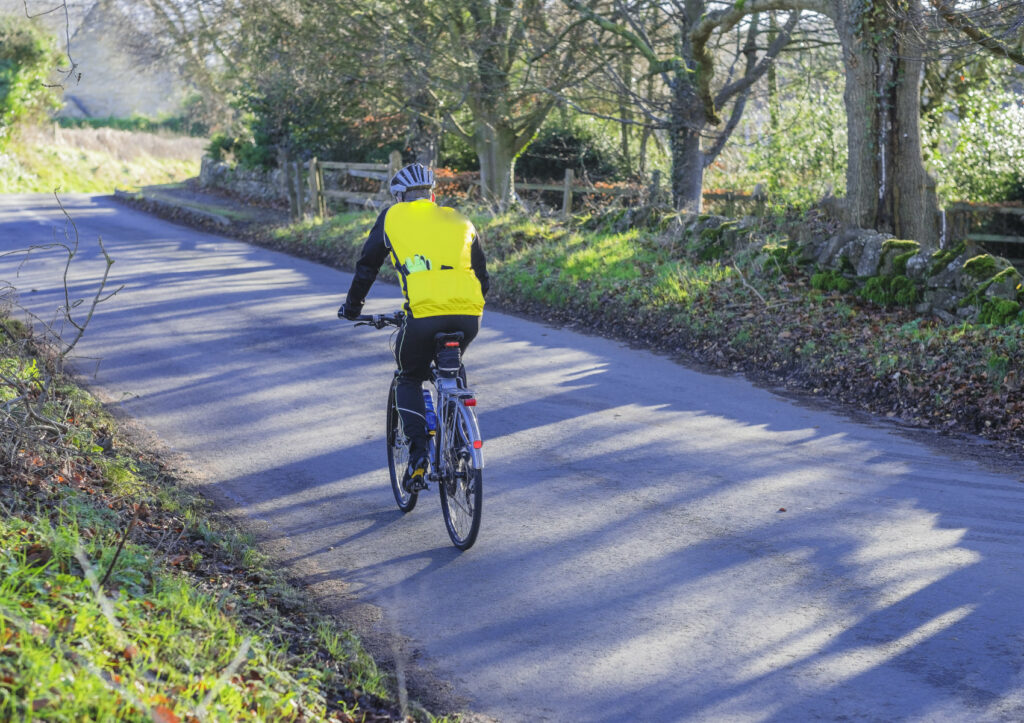

A series of new ‘quiet lanes’ are set to be rolled out across Oxfordshire, which will restrict motor traffic, reduce speeds, and encourage active travel on designated minor roads, as part of a pilot scheme designed to make rural areas “calmer and safer” for cyclists, pedestrians, and horse riders.
However, the county council’s plans to clamp down on motorists using rural roads as cut-throughs has sparked an intense game of anti-cycling bingo among some disgruntled locals, with one driver complaining that the scheme amounts to “special treatment” for cyclists.
Popular in Denmark, ‘quiet lanes’ are small, often narrow roads with low traffic volumes where active travel is encouraged and prioritised through traffic-calming or restrictive measures. A number of quiet roads have already been introduced in Oxfordshire in recent years, while Monaghan County Council in Ireland last week announced plans for its own take on the infrastructure.
This week, Oxfordshire County Council announced that a pilot scheme has been approved by its cabinet that will see the rollout of more quiet lanes on a county-wide basis.
Where implemented, the quiet lanes will remove through traffic and reduce vehicle numbers and speeds, which the council says will “lower the risk and severity of collisions” and “make minor roads feel calmer and safer”. Access for motor traffic will be maintained for residents, farmers, businesses, and emergency services.
The council noted that new lanes will only be introduced where there is a suitable alternative route for motor traffic, and where there is local support for the scheme.
According to the local authority, this new approach to active travel infrastructure represents an “enhancement to existing Department for Transport policy, going beyond traditional signage-based lanes to achieve the safest outcomes”.
All roads involved in the pilot scheme will feature physical measures to prohibit through traffic, such as gates and bollards, quiet lane signage, and reduced speed limits, which will mostly drop to 20mph.
The council also pointed out that overall journey times for drivers will only be slightly affected by any quiet lanes introduced, as larger, nearby roads must be available for the scheme to go ahead.
> “We cannot build more roads”: Cycling campaigners call for “bold” congestion charge to tackle car-dependency in Oxford
However, that doesn’t appear to have appeased some of Oxfordshire’s motorists, who have already taken to social media to argue that a ‘cycling tax’ should be introduced in exchange for a quieter, calmer rural environment.
“If cyclists are getting special treatment, then a tax for using the roads should be introduced. And before someone gets negative with me, I cycle,” Richard Price wrote on Facebook after the council’s announcement.
“Cyclists should pay tax and have insurance if they want to use the road,” added Haji Abdul Karims, continuing the round of anti-cycling bingo started by Price.
“Last time I encountered something like this in Oxford, I ended up driving in circles for over half an hour trying to get to the next street,” claimed Michelle Soinne.
“On my way, I encountered several other vehicles doing three-point turns, looking as lost as I was. Just avoid Oxford altogether.”
Soon after, GB News – inevitably – got involved, reporting on the news by claiming that drivers are being “pushed off Oxfordshire’s roads”.
Announcing the scheme, Oxfordshire County Council’s cabinet member for transport management Rebekah Fletcher noted that the local authority will ensure that all new quiet lanes are “safe, effective, and sensitive to their surroundings”.
“Quiet lanes are about making sure local roads work for the communities that live there, not as cut-throughs for traffic they were never designed to carry,” she said.
“This new approach will help us to prioritise walking, wheeling, cycling and horse riding, and give us a clear and consistent way to provide quiet lanes where there is strong local support.
“We will use evidence to make sure schemes are safe, effective and sensitive to their surroundings. By piloting schemes first, we can get them right before any permanent decisions are made.
“I look forward to working with parish and town councils and local councillors on this locally led and innovative programme.”
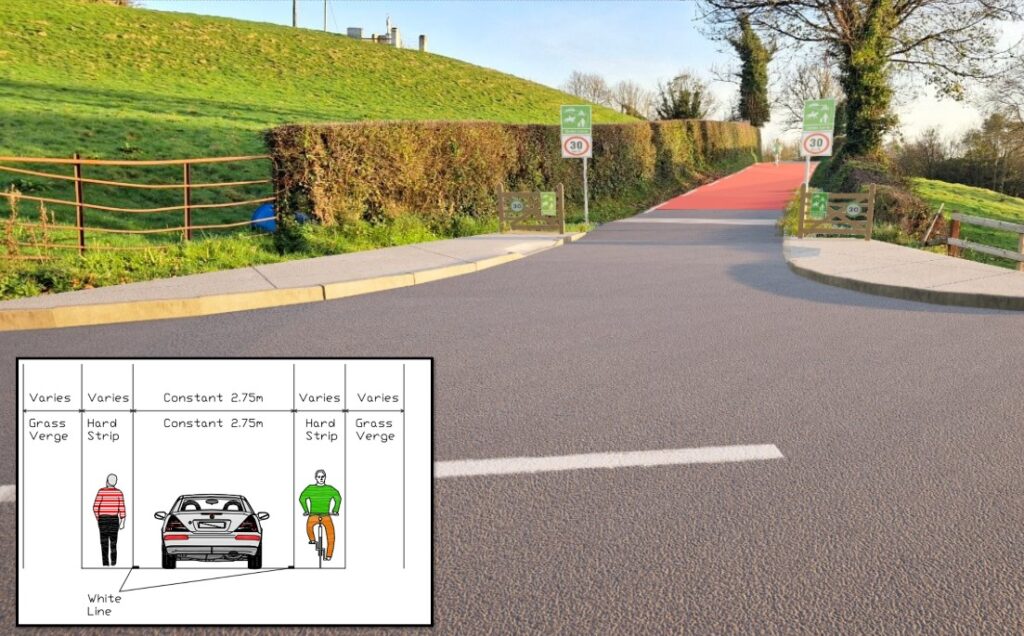
Last week, we reported that Monaghan County Council is set to become the first local authority in Ireland to officially introduce a quiet lane scheme, which it says will create a “safer, shared road space” for pedestrians, cyclists, and local traffic in rural areas, without the need for expensive infrastructure projects.
“Innovation in rural mobility doesn’t always require major infrastructure projects. It can start simply with rethinking how existing road space is allocated and how road layouts can be designed to enhance safety for all users,” Robert Burns, the chief executive of Monaghan County Council, said in a LinkedIn post announcing the beginning of a public consultation on the project.
“The concept reflects approaches already used successfully in countries such as Denmark, where low-speed, shared rural roads help create safer environments for pedestrians, cyclists, local residents and farm traffic, while maintaining the character of the landscape.
“What makes this pilot particularly interesting is that it treats rural roads not only as transport corridors, but as shared community spaces.
“The successful design and implementation of the Quiet Road concept could significantly improve road safety and the comfort of pedestrians and cyclists on rural roads and support a shift to more sustainable transport modes like walking and cycling in rural communities.
“The Quiet Road concept, if replicated at scale, offers enormous potential to enhance road safety and improve connectivity within rural communities right across Ireland.”












36 thoughts on “Drivers slam “special treatment” for cyclists as council proposes new ‘quiet lanes’ to make rural areas calmer and lower risk of crashes”
Restricting roads to certain vehicles, spending plenty of public money despite a large portion of that public unable to use them? Heard of motorways lads..?
If you’re as incompetent at driving as all that, then yes – please do avoid it.
@mdavidford I take it the likes of Waymo will be sueing her for copying their patented “drive round in circles when confused” strategy?
@mdavidford they probably typed that comment using a smartphone. So they could perhaps use Google Maps to navigate an unfamiliar environment.
@mdavidford they probably typed that comment using a smartphone. So they could perhaps use Google Maps to navigate an unfamiliar environment.
Ah finally, I’ve been advocating for something like this for years. It’s been ridiculous that so many back lanes that are barely wide enough for a single car are signposted as NSL and recommended by GPS units for cut-through traffic despite there being a perfectly good dual carriageway for them nearby. Making them access-only for the majority of motor vehicles would be huge. I really hope this catches on in the rest of the country.
You … and the Dutch! Although they have also been doing it with more “physical” means.
More expensive / less “smart” … but more likely to actually deter the (fool)hardy UK motorist…
That’s two different issues.
i) Most roads used to be NSL; 30mph in urban areas, 60mph in rural. It was the motorist’s responsibility to drive safely within those limits.
ii) Many people will blindly follow their sat nav in the same way they blindly drive at, or slightly above, the posted “target speed”.
The “solution” is to increase the number (& complexity) of rules & introduce more technological solutions. But this is done without adequate training & very limited enforcement. Hence the status quo remains (can I say that?) & will do so in the future.
@ChrisA As “direct mitigation” it’s hard to get past a bollard! And why not simply make the default urban speed limit 20 instead of 30? Hey presto, fewer deaths and injuries and average speeds go down, even without extra enforcement (before you can say “blanket limit”)! *
On training: If only we had (far more) traffic gardens where all kids could train (but… we also need to sort adult expectations somehow as kids follow their behaviour and expectations)…
Retraining adults seems to be really hard. Look at what needed to happen RE drink driving to shift that.
Ideally we could bring the idea of a driving “licence” instead of a driving members club or a driving rite-of-passage. Something that works like other licensable activities, with a time limit after which you would be re-evaluated / have to undertake refresher training to renew.
On rules: we have a ton of them; I suspect with a “sustainable safety” approach there might even be fewer! That’s also outside scope here though.
* This sounds too good to be true but studies appear to show it happens. Although it wouldn’t hurt to eg. tweak the current exceptionally forgiving legal points system.
@thrawed I mean, I would much rather they reduced the speed limit on these little roads to 20 and brought in rules that say drivers have to slow down when passing cyclists coming in the opposite direction.
Completely baffles me that we’re supposed to have 1.5m when overtaking cyclists (which most people do broadly adhere to) but as soon as it comes to head on passes everything is fine. I have people coming within 30cm or less of my bars doing 40+ mph because they don’t think they have to slow or worry about cyclists when they are heading in the opposite direction despite it being, if anything, more dangerous if we hit each other.
Not a lot different (well it is really) to some police forces who believe that the 1.5m doesn’t apply if you are within your own respective lanes. Yet another reason to abandon painted cycle lanes!
new lanes will only be introduced where there is a suitable alternative route for motor traffic, and where there is local support for the scheme…
Which there won’t be, and there won’t be any enforcement either = useless. There are designated Quiet Lanes in Lancashire with a cosy little logo on the signs. They mean nothing at all- they can’t put gates up because the people who live out there will want to drive their Panzers around at great speed, the police will ignore the ‘local lanes for local people’
@wtjs Even without enforcement there would still be an impact from all the drivers blindly following their gps. Google maps isn’t going to want to keep routing you down a road that is on their database as 20mph now from 60mph.
@thrawed Except, nearly all the traffic will be local with large Transits and Panzers charging around under the supposition: I didn’t come across any cyclists this morning, which means that there are never any cyclists
@wtjs In this case, they specifically say that they *will* have gates/bollards to prevent through traffic (though you may have a point that the difficulty of achieving local support for that may just prevent them happening in the first place).
Nope. I know of at least three Oxfordshire villages where the parish council is desperate to sign up to this. The plan is for bollards blocking through traffic, not just “please be nice” signs, so that sorts the enforcement issue.
The big differences here are that they will be closed to through traffic, and proposals have to come from Parish Councils.
The pilot scheme is only 10 lanes, so there will probably be enough proposals, and the thing that is thought to have support is that there have been some in place for many years (closed for various reasons) which have worked well.
… *until* Google thinks the speed on the main road has gone down sufficiently that the other route is (fractionally) better.
I don’t know where it gets its info from currently but possibly in future it may be hallucinating / getting things wrong because of hearsay from the posts it’s processing to squeeze all possible info about everything from?
While it does such a good job with driving that now it seems many people don’t make any route decisions for themselves, it’s not guaranteed to be “working for” anyone other than Google – and possibly “Google USA” also. Here’s how eg. it doesn’t do a good job for European cyclists:
NotJustBike: https://m.youtube.com/watch?v=csHdwHTteOw
The plan is for bollards so that will stop Google routing that way.
@chrisonabike Thats a good point. If they made all these pokey little roads 20’s, google would probably stop sending people down them constantly because they would be considered inefficient. Would be lovely not to come across wankpanzers flying around blind corners going far too fast for the conditions in the rural areas around me.
@mctrials23 This use of Google as virtual enforcement (because there isn’t going to be any real enforcement) sounds believable, but I think the bulk of the Panzer/ massive tractor/ combine traffic which will be out to frighten cyclists off the ‘Quiet Lanes’ will be Local Roads for Local People speeders, not Google Directees, and they will just carry on as normal.
@chrisonabike – Google uses phone locations to figure out average speeds and congestion of roads.
Here’s an amusing example of how they can be tricked: https://www.wired.com/story/99-phones-fake-google-maps-traffic-jam/
Forget Denmark and Monaghan, this is the fawning-over-the-motorist UK! Any roads with large Oxfordshire toff-houses along it will NOT get bollards or gates and the drivers of the massive Panzers of the locals will be terrified of encountering similar coming the other way. They will be enraged at proposals to narrow the Panzerway for nonsense like room for pedestrians and cyclists and grass verges. These proposals are doomed, and even if they were installed, the would be removed later like the infamous Middlesbrough cycle lane and those on the South Coast
I can see positives and negatives for motorists in this proposed scheme.
On the positive side, it will reduce the number of cyclists on open roads, meaning that drivers don’t get stuck behind them for 5 miles before performing a dangerous overtaking manoeuvre.
The downside is that it will reduce opportunities for large articulated HGVs to get stuck on narrow bridges or tight bends in villages, while following sat navs.
That may be difficult as it seems likely that she could be studying Politics, Philosophy and Economics at Merton College (like Liz Truss), en route to being the next leader of the Conservative Party.
In reply to mdavidford re stay away from Oxford.
The May 19th Oxfordshire County Council document on Quiet Lanes shows that they’ve already thought of all the forces acting to derail schemes like these.
A review conducted by the Transport Research Laboratory (TRL) of several Quiet Lane pilot schemes concluded that: “the best documented UK pilots show little to no systematic reduction in speeds or motor traffic volumes from signs alone; user awareness may improve, but the lanes remain open to general traffic without enforceable restrictions”
They already know that If the objective is genuinely safer, lower trafficked minor roads, physical closures or restrictions are the only reliably effective intervention. The farmers and Panzer drivers will soon see those off. I think the council has underestimated just how stupid are the stupid.
I fear this idea is doomed in the irredeemably cyclist-hostile and pro-speeding UK, but I hope I’m wrong. I still think massive tractors will come along during the night and smash down any bollards, planters etc. and the Panzer drivers will still be speeding along these quiet lanes in 5 years time. After all, they state themselves: OCC does not enforce speed limits; the responsibility of this function lies with Thames Valley Police
@wtjs I have never understood the point “Quiet lanes”, I should already be driving at an appropriate speed for the conditions. Signs already exist to warn me of specific “dangers” (eg. Blind, children, ducks, horses, etc.). The extra burocracy serves no purpose. People either drive appropriately, or they don’t. Without education and/or the big stick it’s pointless.
Aaargh! Run for your lives!!
That’s why this field needs a dual carriageway (with parking) and there is no room for cyclists there! Won’t you think of the disabled blind young horseriding ducks (and the frail elderly ferrets they have to care for)?
@ChrisA I’m all in favour of Quiet Lanes if they work. I suspect they’re set up to fail, with the same pandering to drivers as has been shown with the recent subsidy to maintain petrol prices at below inflation levels. We’ll have to see how the pilots go, but it will need a long follow-up to assess how the ‘physical barriers’ survive the persistent onslaught of the local nutters
This a really good news story https://hedgehogcycling.co.uk/wp/2026/05/21/oxfordshire-quiet-lanes-policy/, and is *very* disappointing that road.cc has turned it into a rage bait article.
There is a reason why I don’t watch GB News, and I don’t need its reporting served up cold here.
This is a great story, with little downside for drivers, and the upside that non-motorised modes will prefer the other route.
I live on one of these in Notts – a 500m 4-5m lane subsumed into a town, which has had “no motor traffic except for access” signs since the 1970s; we still get several hundred rat runners every day, in addition to the hundreds of pedestrians and dog walkers.
But at What3Words https://what3words.com/wiser.dripped.gilding there is one of these just over in Derbyshire where the through route was closed 30 years ago, and it still just works.
The Oxford scheme has been driven partly by Cllr Emily Kerr, whom many will know, and they have gone for suitable but minimalist measures. It’s a rural long, thin mini-LTN.
If I put my even more optimistic hat on, it is a small step on the development of separate networks for different modes.
Here’s a 1 minute intro at Active Travel Cafe this week:
@mattw We’ve actually had (for decades) all the contentious “radical innovations” * that could be used more widely to rebalance public space and transport.
And they’re often individually popular! I’m thinking cul-de-sacs and pedestrianised town centres.
It’s when we want to get to (more often *through*) somewhere else by driving that the problem arises.
* LTNs, modal filters, bus gates, road diets, novel priority systems to favour things other than private motor transport, separate cycle paths, grade-separated junctions, bus stop bypasses, 20mph our lower speed limits…
@mattw the road (aha) to “better for everyone” perhaps must be paved with selfish intentions (“keep through traffic out of *our* road).
As you say often there’s little down-side to motorists.
BUT a) there’s often a *perception* to be overcome (somewhere between “they’ll get rid of ‘my’ parking space” and “they’re trying to trap us in 15-minute LTNs”)
b) in a sense vulnerable road users aren’t in the fight. It’s really drivers fighting other drivers for space. With everyone else as colateral damage – occasionally literally. Even a little less space can make it more likely the place will be clogged! (Motoring being space-inefficient congestion can be brought on by relatively few extra drivers).
And … actually, we need have to have that – “congestion” is both just a side effect and one of the more effective feedbacks managing how much people drive.
I think this is good. Should be open to cycling, wheelchair users, motorbikes going slow like 15 20mph giving way to other users
Basically all vulnerable road users.