


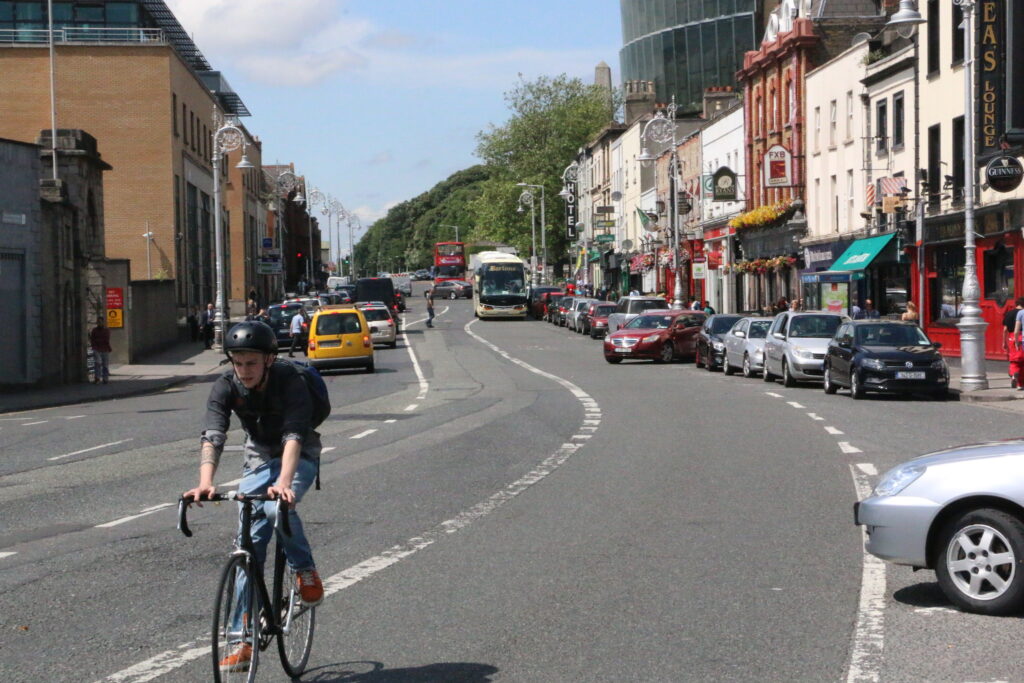

A transport researcher from Dublin has said that he believes the city has become less bicycle-friendly due to a lack of connected infrastructure and policing to keep cycling spaces clear, with many cyclists now fearing for their safety as they are not being recognised and being bullied by other road users.
In 2011, Dublin was named among the 20 most bicycle-friendly cities. However, the Global Bicycle Cities Index published last year placed it at the 60th spot, and it is the only Irish city to make it to the list.
Dr Robert Egan, an engineer and research fellow at Trinity College Dublin’s Centre for Transport Research, told The Hard Shoulder radio programme: “Fundamentally there’s too many cars in the city. That makes it a very hostile and precarious environment for cyclists.”
> Cyclists wearing helmets seen as “less human” than those without, researchers find
His work has involved interviewing men and women using cycling as a form of transport in Ireland, and he mentioned that one of the most common issues that pops up is the lack of connected cycling infrastructure. “There are pockets where you are in a cycle lane, and then suddenly you are amidst cars doing 30, even 50km/hr,” he said.
He added: “But another big part is the disregard for dedicated cycling spaces. You see cars being illegally parked where cyclists are supposed to go, but then where you’re on the road, you’re being beeped at, honked, and being close-passed, so you’re not being treated as a full, entitled road user.
“And finally, there’s a lack of protection for cyclists as well. There’s a lack of policing keeping dedicated cycle spaces clear, and a lack of appreciation for how frightening cycling can be, when you can be bullied off the road if somebody is not confident.”
> What’s keeping Brits off the bike? In a word: fear, says new study
Dr Egan pointed out that the current scenario was caused by years and years of policy-making which prioritised driving, dependency on cars, and led to unchecked urban sprawl.
“You can see in the countries with high levels of cycling have fantastic integration of cycling with public transport. One of the aspects of that can be really good cycle parking, at railway stations, in particular,” he said, referring to studies and practices prevalent in countries like the Netherlands, also emphasising having good connectivity with trams.
But what about buses? “There’s a huge amount of work on that too,” said Dr Egan. “What I have looked at, in particular, is that cycle parking with buses is very effective, possibly because of the types of journeys that buses take, maybe because they are travelling long distances in some instances as well.”
“So yeah, that can work with buses too, but it works especially well with trains, and that’s visible from the investment in the long-term.”
> Why don’t cyclists use cycle lanes? Because it’s a car park…
Dr Egan said proper cycle parking is particularly important in Ireland now due to the increasing number of people buying cycles through schemes such as Cycle to Work, as well as the explosion of e-bike purchases, which being more expensive make people less hesitant to leave in places susceptible to theft.
He also said that from his interviews, and other UK-wide research based on near-misses, which are way more common for cyclists than most people perceive, so much so that road.cc has a ‘NMotD’ series based on documenting driving resulting in dangerous close-passes, that there’s a lack of respect towards cyclists as road users.
“It’s about legitimacy on the road. It’s got to do with being subordinated, being bullied in a public space. It’s also very humiliating to be beeped at, for example. So I suppose aspects of cycling may not just be around danger, which is obviously awful to experience when trying to get from A to B, but also just being stigmatised,” he said.

















20 thoughts on ““There’s a fear of being bullied”: Cyclists don’t feel “recognised” by other road users, says transport expert”
Was it a bad dream???
Was it a bad dream???
This is off the main topic, but I logged on this morning and the comments sections of many articles would appear to have been on a diet overnight, they are much leaner than yesterday.
KYA has left the building!!!
Yes. For the moment.
Yes. For the moment.
I fear, like a bad smell, s/he will be back.
essexian wrote:
Any guesses on the new username (or theme for the username)?
I would suggest: “Established
I would suggest: “Established Red Light,” “Fan of Mr Loophole,” “Never cycled in my life,” “Born to troll” or “Wide of the mark.”
Or: “I’m so sad, no one loves me.”
Steve K wrote:
Well, martin79 (IIRC – another revenant but apparently a different contrarian) was requested to return as “Tinfoil Dave”. I believe that’s still up for grabs?
My betting’s on a short holiday followed by returning under a novelty persona. It’s impossible to know for sure (except for the case of Rakia where they admitted this) but previous efforts include at least one foreigner and I suspect others. Seems they pretend to be what they personally dislike to wrong-foot others. Maybe they’ll be back as a woman, or even a cyclist?
Possibly using an account (or several at once…) they’d created some time previously with a couple of innocuous posts – that seems to have been a thing.
I recall the days of
I recall the days of SocratesCyclist and all the postings regarding cycling to school. Over recent years there have been many news items of schools threatening to ban pupils from locking their cycles on school premises, unless they cycled to school wearing a helmet and an identity number.
Does anyone know whether any school has implemented such a policy?
I always thought they were exceeding thier authority, especially regarding the idea of requiring cycling pupils to wear an ID number.
73 please.
73 please.
Same everywhere I find. Was on a cycle super highway SW London end July. Could see I would be left hooked so shouted Oi, Oi to be told to fuck off.
Good job I’d seen a few nmotd with the same scenario so I was prepared for the situation arising.
I find it is a real mixed bag
I find it is a real mixed bag where I am. In my experience in London, probably due to the number of cyclist, there is better awareness from drivers.
Locally on the hill up to my road its probably 50/50 on whether someone will overtake stupidly or hold back until suitable to pass, and we are through a pinch point under a railway bridge.
On the dual carriageway where there is narrow cycle lane, the worst culprits are Arriva buses. A large number of HGV’s and even cars will move into the second lane as they pass, whereas the buses just thunder past in the nearside lane.
“You see cars being illegally
“You see cars being illegally parked where cyclists are supposed to go, but then where you’re on the road, you’re being beeped at, honked, and being close-passed, so you’re not being treated as a full, entitled road user.”
I’m struggling to see how that is different to any other city in the British Isles.
The question is why we, as a society, allow a minority to be bullied and attacked. If it was for any other reason than our means of transport, e.g. sexuality, skin colour, there would be outrage, but cyclists, silence.
I would really like to know
I would really like to know how Highways Engineers are educated.
Outside city centres, this profession are clueless on how road users actually use their schemes, and how this impacts on road safety.
The scheme in this picture should be described as a death trap.
The problem is, the Engineer responsible for this absurdity will never be prosecuted for installing a negligent road design should a cyclist be seriously injured or killed. This is because Engineers can always hide behind the argument that the incident was caused by driver error.
It is too difficult to prove that driver error was caused by negligent design.
TBH, that is an issue in
TBH, that is an issue in general and not just applicable to understanding cycling.
Some of the junction “improvements” near me have you wondering if those behind them have ever been near a road in any type of vehicle.
Submit an FOI for a copy of
Submit an FOI for a copy of the Stage 1/2 Road Safety Audit.
Then pick out all the omissions of the obvious road safety issues.
I did this on a local scheme and I was utterly amazed at the number of obvious, signficant road safety issues they had left out of the RSA.
Adam Sutton wrote:
That’s a ridiculous accusation!
The designers spend a considerable time with sophisticated traffic flow modelling tools such as this one before they’re handed the crayons and allowed to get to work
I think the biggest issue is
I think the biggest issue is from top to bottom we just don’t know what we’re missing out on. We can’t think beyond our motor-dominated streets.
Or we look at something better and think it could never happen here, or just misunderstand the fundamentals.
It starts from the top though. The specifications engineers and designers are given by local authorities / councillors / managers. Engineers are not volunteers or unskilled interns – they’re doing what they’re instructed, according to a given budget and under existing constraints.
However I do believe we have a shortage of designers and engineers who “get it”*. Obviously the existing culture of generations of “build it for motor vehicles” is going to strongly shape what advice they can give those ordering the work. And it doesn’t help that the UK is struggling with “standards” – “more a set of guidelines…” – which is part of the reason for us constantly trying to reinvent the wheel.
* Example of one who does being the Ranty Highwayman – especially rare as he’s actually skilled at making cycling and pedestrian designs work well in UK streetscapes.
Typically, Highways Engineers
Typically, Highways Engineers are qualified civil engineers, so they can calculate shear stresses, bending moments and work out the Californian bearing ratio.
I suspect their education does not include psychology or humanities related training. For example, when on one side of a junction there are three lanes, but on the other side there are only two (as per picture 1), do they not understand this causes conflict between road users?
Too many cycling infrastructure schemes are ill-conceived, piecemeal, box-ticking tokenism by professionals who should know better.
The projects they are tasked to do may directed down from the top, but they still have a duty of care to design and implement new road schemes that are safe and competent.
Trevor Anderson wrote:
Hopefully one will appear here with some information!
I would guess it does since almost all engineering does involve at least implicit “human interface” / “human factors” consideration. After all almost everything made has a human involved at some point. We definitely have these considerations in the road designs and rules we use already *. The issue is how the overall goals we set ** determine how we apply this consideration.
I’d love to see the goals change to something like “safe and efficient movement of people” with an emphasis on more efficient modes (cycling) and active travel. That’s what the “sustainable safety” paradigm has done [articles/videos here and here].
We could even add something about “pleasant spaces to be in / near” which I think the Dutch do also.
* Tons of examples – motorways built in curves (keep drivers more alert), street lights, traffic lights, rumble strips and energy absorbing barriers (“forgiving” infra / harm minimisation after something’s gone wrong), central barriers (prevent escalation of consequences of one person’s error).
** Goals see to be cost, maximising motor vehicle capacity and indeed permeability, while maintaining safety. Apparently safety for non-motorised modes can come at the expense of convenience, usability or indeed any access at all.
I represented our local
I represented our local Residents Association at an Inquiry into services at J4 of the M42.
There were several Highways experts present. I did some googling and discovered that decision points were a thing. I worked out that there a minimum of 40 decisions required for each visit to the services for each motorist, (lane choice, traffic lights, etc).
This turned out to be a factor in the Inspector’s decision. None of the experts had addressed this.
Another oddity was that this was credited to a barrister in the final decision document, who had essentially repeated my point, not to me. I believe that was deliberate to avoid it being inexpert opinion.
Trevor Anderson wrote:
Exactly. There’s a difference between solving a problem from an engineering standpoint and analysing that solution from a human behavioural/psychology standpoint. The above picture “solves” the problem of having parking, active travel, and motor vehicles in the same space, but no thought has been given to how the average person is going to interact with the solution.
It’s the same in software – I can implement what I would think is a perfect, elegant solution to a problem from a software engineering perspective, but you give it to an end user, and they’ll misuse/break it in ways that you wouldn’t even consider possible. That’s why we have specific UX specialists that understand the way that users interact with UI and the psychology behind that behaviour.
It begs the question why the same isn’t true of these infrastructure schemes? Why there is no evaluation of the “human element” of these schemes before they’re implemented? Why don’t they bring on behaviourists/psychologists, cycle groups/consultants to evaluate the designs before implementation? If the recommendation of these experts proves not to be cost effective, then there should be a review of the initial proposal to see if it’s actually better to do nothing at all. In the above case, I’d say it’s safer to have no lane there at all – because they’ve built a lane that no cyclist is going to want to use, and now you’ll have conflict between cyclists in the main carriageway and drivers who don’t understand why they’re not using the shiny new lane. Any cyclist on that road now has to pick between a guaranteed dooring and a guaranteed road-rage altercation.
I have lived in Ireland for
I have lived in Ireland for over 23 years.
I would NOT cycle in Dublin.
The road infrastructure is absolute dross in the city centre, with lanes swapping left, right and centre…and that is not a pun.
It’s confusing for drivers, switching lanes every 100 yards, so imagine how it is for cyclists?
Segregated cycle lanes (barely) that are about the width of most MTB handlebars, mini bollards (collapsible) that offer no protection.
In/out of shared bus/taxi lanes. Sometimes the cycle lane switches from the left side to the right side!!
Traffic that gives not a jot about cyclists (because cyclists are worse than East European immigrants/asylum seekers…apparently). Advance Cycle boxes, blatantly straddled, and yes cars do jump red lights…
Plenty of Dublin City bikes around the place, some left as far afield as 7 or 8km outside the city centre…
However, I have seen some really bad cycling, which is not due to the infrastructure…just bad cycling. Ped X’s ignored, no such thing as a red light for cyclists here…90% (observation) of cyclists do not heed any. Pedestrians milling about the place, yes even they (peds) don’t stop for red lights.
Obviously, it doesn’t have the same amount of traffic as London, etc. But, it has enough that the infra is just totally inadequate.
And trying to get travellers (no not that type) to use public transport…?
I live 60km from Dublin city centre. It takes 2 hours on a bus, which runs every two hours at peak time and three hours at others.
The total infra for commuters is trash, if you live outside the city centre. Train availability…well there is very little. You also need to book a ticket in advance for a lot of destinations, and there are few local/rural stations – you need to travel to get to a train station, on the (shite) buses that may or may not turn up as scheduled.
I don’t visit Dublin very often, because it is too stressful, and it is far too expensive to park.
Now the alternative is cycling close to home, in the midlands, where every car is out to get you (no joke).
If any of you are on X (Twitter) or whatever it may be called next week, you can see the perils of being on two wheels by having a look at @righttobikeit…he’s a very brave man.
The infrastructure that’s
The infrastructure that’s being introduced in Dublin city is over the top in some places.
Some of it you would expect to see in a child’s preschool learning course.
There doesn’t seem to be any responsibility given to cyclists for right of way at junctions , it’s all black and white. lights adding time to traffic and giving other road users a reason to get annoyed.