


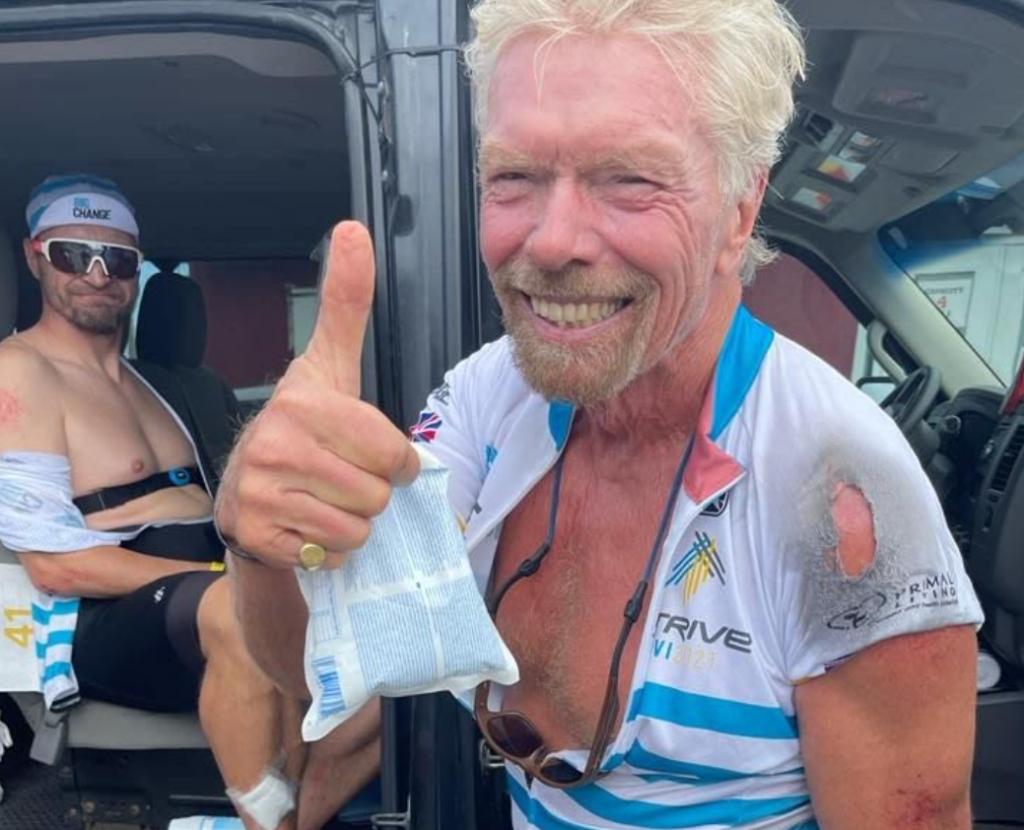

Sir Richard Branson has been treated in hospital after what he described was a “colossal” bike crash while taking part in an event in the British Virgin Islands.
Writing on his blog, the 71-year-old revealed that he thought the brakes on his bike had failed, and said that in his opinion there was “no question” his cycle helmet had saved his life.
The billionaire businessman and adventurer was taking part in the Strive BVI challenge, a fundraising event comprising several disciplines to raise funds for the educational charity Big Change, founded by his children.
On the second day of the challenge, Branson had completed the 60km ride on the island of Tortola when he decided to do an optional additional 15km.
“I was navigating a steep corner, with a massive cliff drop to my left, a car coming up the hill, and my fellow Striver, Felix Stellmaszek, in front of me passing the car,” he said.
“I pulled on both of my brakes, but they didn’t respond. I was going faster and faster, with my options being to drop off the cliff, hit the car, or potentially run into Felix.
“I gripped both brakes as tight as I could (later learning I should have tried taking one hand off the brake and then squeezing it again), but they didn’t work. I cried out to Felix a warning – ‘brakes not working!’ – but he had no chance of getting out of the way. We crashed – hard.
“We both fell off our bikes and our heads and bodies slammed into the concrete road,” Branson continued. “There is no question that wearing helmets saved our lives – not the first time that has been the case.
“We both lay flat out on the road as the rest of the team gathered around us. I stayed still, hoping I hadn’t broken my back or paralysed myself. Slowly, I moved my limbs and was relieved they responded. Thankfully, Felix was ok too,” he added.
Branson was taken to Virgin Gorda hospital to be treated for “some severe cuts and bruises on my elbow, an extraordinarily big bump on my hip and a massive hematoma on my leg.
“But it could have been so much worse,” he added.
It’s the second time that Branson has had a serious bike crash in the British Virgin Islands.
In 2016, he said, “my life flashed before me” when he crashed after hitting a speed bump during a training ride for that year’s edition of the Virgin Strive Challenge, with his bike “completely destroyed” after it was thrown over a cliff.
> “I thought I was going to die” – Sir Richard Branson cheats death in bike crash
“I really thought I was going to die,” Branson continued. “I went flying head-first towards the concrete road, but fortunately my shoulder and cheek took the brunt of the impact, and I was wearing a helmet that saved my life (however, perhaps they should build bike helmets that protect the side of the face too – does anyone know of one?).
“My bike went flying off the cliff and disappeared. We’ve since recovered the crumpled bicycle, completely destroyed. My cheek has been badly damaged and my knee, chin, shoulder and body severely cut.
“As I landed, once I realised I was alive, I began testing my movement. I really couldn’t believe I was alive, let alone not paralysed,” added Branson, who sustained a fractured cheek and torn ligaments in that crash.











75 thoughts on “Sir Richard Branson hospitalised after “colossal” bike crash”
Not the first time a helmet
Not the first time a helmet saved his life. Was he also wearing one when he ended up upside down in his crashed 4×4 on the M42 (I think?)
How could both brakes have
How could both brakes have failed at the same time.. ideas, anyone? He is one lucky billionaire, glad he’s OK.
Rear brake wouldn’t do too
Rear brake wouldn’t do too much at speeds without front. Might have over cooked them abit as well.
It has been suggested the
It has been suggested the bike may have been put upside down for a while. Although a closed system, any trapped air could conceivably then rise to the calipers and thus the first application or two might not put the brakes on effectively. It is interesting that Branson was quoted as saying someone told him the correct reaction to hydraulic brake failures such as this would be to release and reapply the brakes – makes it sound like they recovered his bike and on inspection a couple of pumps had the brakes working fine again.
Quote:
There is no question: it didn’t. Not if the crash happened at any significant speed (which a brakeless descent causing loss of control suggests it might)
Still, I’m quite glad he’s not seriously injured (although torn ligaments in a septuagenarian can be life-affecting). I quite like the old cove, really.
I won’t believe it until he
I won’t believe it until he shows it was split in two. Helmet also saved his mates glasses life as well it seems.
AlsoSomniloquism wrote:
I always thought that split in two means that the helmet failed in its job. Compression marks in the polystyrene would be the sign that it worked.
So all those pics are wrong?
So all those pics are wrong? Nooooo.
hawkinspeter wrote:
I’m not sure either outcome is a reliable measure of the marginal point between life and death.
Incidentally, I can only think of one instance where a helmet has saved me. What it saved me from was, by my estimation, a bruise and lump on the upper forehead and quite possibly a bit of a headache, when I overestimated my ability to brake on wet ground behind an artic trailer whose tractor unit’s ability and propensity to brake exceeded mine.
I can only think of one
I can only think of one instance where a helmet has saved me. What it saved me from was, by my estimation, a bruise and lump on the upper forehead and quite possibly a bit of a headache
This all sounds like the rubbishy 50s thrillers on R4X, where people have ‘flesh wounds’ and a ‘touch of concussion’, so no harm done. Except, concussion doesn’t exist and it’s all different degrees of traumatic brain injury. The less TBI you suffer, the better. The more ‘a bit of a headache’s you avoid the better. The oft-quoted pseudo-statistics are just that- the application of sense means you can ignore the ‘you’re more likely to suffer an injury if you wear a helmet’ story and just make your own assessment about whether you want the collision that breaks the helmet applied to your head directly
hawkinspeter wrote:
Correct, if it splits it failed, it didn’t contain any impact in its structure. Almost all these “A helmet saved my life” are images of failed helmets that did nothing but save some nasty road rash.
Nope, split in two implies
Nope, split in two implies that the force of the impact went into destroying the helmet, instead of the skull or the squishy brain inside.
Fursty Ferret wrote:
Except that polystyrene is very weak under tension (strong under compression) and isn’t designed/tested to work that way.
It will still have deflected
It will still have deflected energy of the impact away from the head. It doesn’t need to absorb it, just reduce the amount that reaches the head in some way.
When I had an “off” riding through a ford at the bottom of a hill (there are some in Lincs) I didn’t claim the helmet had saved my life but I definitiely preferred seeing the dent in a replaceable piece of plastic than in my head.
SimoninSpalding wrote:
It’d definitely absorbed/deflected some energy but not as much as if it hadn’t failed. I just doubt the logic of claiming that a helmet “worked” when it shows signs of failure. It’d make more sense if it was a polycarbonate motorbike helmet as they take a lot of energy to crack.
I’m not saying that helmets don’t provide any protection, but that they’re mainly a distraction. In this case, the brake failure seems the thing to focus on.
SimoninSpalding wrote:
I’m always curious about this notion of “deflecting” or “absorbing” the “energy of an impact”, prevent it “reaching the head”.
Energy is not a vector, it has no direction, so talk of “deflecting” it is misguided.
The notion of the “energy of the impact” is also a bit wooly. Impacts don’t have an energy, they have a force. The only energy in the scenario is the kinetic energy of the head in motion, and since that is already a property of the head it makes no sense to talk about deflecting it from reaching the head.
It makes more sense to think in terms of force and deceleration acting on the head, and in particular the brain. If your head is travelling at 20mph before the incident and 0mph after, then what matters is the time over which that change takes place. Anything which increases the time reduces the force and deceleration experienced by your head.
The idea behind EPS is that by crushing and compressing it extends the time to slow your head. It might also, by dint of its thickness, prevent objects penetrating through to the skull. However if the EPS simply splits apart without first crushing then it achieves nothing.
SimoninSpalding wrote:
Try taking some expanded polystyrene, a ceiling tile will do nicely, and try snapping it between your fingers; easy isn’t it, taking almost no effort. Now try crushing it between your fingers; much more difficult, taking a lot more effort and not very successful. That’s the difference in energy required to split a helmet and to crush it, and if it’s split, it has absorbed very little energy, but there are thousands of “helmet saved my life” stories with pictures of helmets that failed catastrophically, and provided almost no protection.
You appear to be making
You appear to be making assertions from a non-expert position. You can’t simply say ‘it will still have deflected energy of the impact away from the head’. What is the scientific basis for your statement? Like I replied above, follow @FastOrFar on twitter – he’s a cycling coach and automotive safety testing engineer who does this stuff for a living. He will debunk your theories in seconds.
That’s not true. You need to
That’s not true. You need to follow @FastOrFar on twitter – he is an automotive testing engineer who has tested cycle helmets professionally. He categorically states that a cracked helmet has failed as it has fractured and NOT dissipated the forces as designed, certainly not preventing the forces being transferred to the head of the wearer. A cracked helmet in the very simple EN1078 certification process would fail the test. Having said that, the tests don’t even drop a helmet from adult head height – from 1.5m with no forward momentum onto a flat surface, and from 1m with no forwards momentum onto an angled kerb. Good luck believing a helmet will ‘save your life’ descending a mountain at speed and having an off with any significant forward momentum and from a head height greater than 1.5m. You’ll need it.
AlsoSomniloquism wrote:
A helmet that has split has provided very little protection. They are supposed to work by deforming the inner layer, but I’ve never seen a helmet which did that before it split.
GMBasix wrote:
Just FYI, that was his 2016 crash, he wasn’t a septuagenarian then.
Across the world the deaths
Across the world the deaths of a number of young children have been attributed to their wearing of cycle helmets. The most usual cause of death has been strangulation.The children were not cycling when the tragedies occurred, but it is common for children at play to swap between activities without changing what they wear.
Four pathologists writing in The Medical Journal of Australia say that “Accidental hanging is still occurring among young children who wear bicycle helmets while engaging in activities other than bicycle riding. … Although such deaths are rare, it is important for parents and child carers to ensure that bicycle helmets are only worn by children for their intended purpose.” (Byard, Cala, Ritchey and Woodford, 2011)
In absolute terms, the risk of death through wearing a helmet is very small. The information is significant mainly in the context that it is the only unambiguous evidence showing any relationship between fatalities and cycle helmet use. Fatalities are recorded comprehensively and accurately in most countries, but there is no statistically reliable evidence across any population of fewer deaths as helmet use has increased. A doctor in Sweden lamented, with regard to strangulations in that country and its child helmet law, “We know we have killed, but we can’t show we have saved anyone”.
Crikey. Everyone’s favourite
Crikey. Everyone’s favourite NHS-suing philanthropist doesn’t half have his fair share of scrapes.
A quick Google search refreshes the memory (but the list is not exhaustive so you are advised to seek out ‘Finding My Virginity’ in which Sir Richard reveals some 75 of his closest shaves)…
1985 rescued from a capsized transatlantic speedboat
1987 rescued from a crashed transatlantic hot air balloon
2011 escaped the lightning strike and burning down of the Great House by staying in a spare house on his private island
2016 bitten by a stingray, cutting his head open running in to a bullet proof door and surviving that earlier bicycle prang.
And as if he hasn’t come close enough to death it now seems likely that our man has been riding about on a bike with disc brakes! Crazy guy!!!
I was unfortunate enough to
I was unfortunate enough to work for Branson at Necker Island a couple of decades ago.
Putting it bluntly, he’s an egotistical, know-it-all, yet continues to make the same mistakes time after time. I doubt the helmet saved his life, his head is far too big to actually fit in one.
As usual he will have been trying to do something outside of his skill capabilities. Nothing wrong with that, it’s how you get better, but passing it off as the helmet being the answer is probably missing the point.
It’d be far better to say “I made an error of judgement while acting like a total tosser”, but that wouldn’t fit his nicely curated, self-centred, image of himself.
I could go on, but I think you get the picture…..
Owd Big ‘Ead wrote:
but but but but he’s a self-made man from a background of no privilege or educational opportunities that started everything off himself with no out side help
Unlike those ‘self-made’
Unlike those ‘self-made’ millionaires who had to do absolutely everything for themselves (after first being loaned £2m by their parents…).
brooksby wrote:
Exactly, it’s almost like we were thinking of the same example…
I made I wrote a reply to
I made I wrote a reply to another one on this thread before reading yours. Seems to confirm what I suspected – someone who has very little working knowledge, limited skills (due to lack of regular participation), and little mechanical experience or awareness of issues and how to deal with them.
I was more generous saying that I don’t blame him, and thought someone would offer him an educated/ expert opinion and he might learn from it. By the sounds of it you think he is too big headed to do that. That’s a shame and he will eventually kill himself continuing to ride in such terrain. His helmet won’t save him if he goes over the edge next time…
I’ve certainly got some
I’ve certainly got some ‘elmit saved me life’ stories, 3 to be exact, but the truth is probably more like, helmet saved me a trip to A&E and some nasty bleeding. The one thing each of those anecdotes has in common is that I would not have been doing what I was attempting without having the helmet on. There is surely an element of pushing your limits in the mistaken belief that PPE will save you from serious injury in the Branson story.
He may be a egotistical tw@t but if he wasn’t he probably wouldn’t be a billionaire. I wish him a speedy recovery and the chance to do many more stupid things for many years to come.
To be fair, it doesn’t sound
To be fair, it doesn’t sound like he was pushing his limits, but just descending a hill.
I’m more interested in why his brakes weren’t working and whether pumping them would have fixed it.
Hawkinspeter wrote:
For a man of his age, there is more truth there than he’d like to admit!
If thye are hydraulic brakes
If thye are hydraulic brakes and you had the bike upside down for a bit the pressure can drop off and a few pumps might be needed to get it back. Its usually pretty obvious because the lever comes right back to the handle bar with little or no resistance. First thing I do when i get on my bike is a quick brake check but I did that with rim brakes as well.
nicmason wrote:
Yep, I always check my brakes work as soon as I set off. Not that i’d put my bike upside down – that’s blasphemy!
It seems odd that Branson didn’t check his brakes until he was already going too fast downhill. Either he was airlifted to the top of the hill or he’d cycled to it without ever needing to slow down.
hawkinspeter wrote:
Well I do it all the time. Ha, yes sometimes in vain. What’ve you got to say to that??
Captain Badger wrote:
Every time someone turns their bike upside down, Lord Cthulhu eats a kitten, so I hope you’re happy now!
hawkinspeter wrote:
Really? I’m off to my garage. And I warn you, both my wife and daughter have bikes. And I, as a keen cyclist, own 2….
Captain Badger wrote:
Also hydraulic brakes can
Also hydraulic brakes can suffer fade if they get very very hot , say on a long decent . I’ve not had that on a bicycle but have had it on a motorbike dropping down out of the hills above Nice to the Mediteranean coast. (and I wish I was there now) .
nicmason wrote:
I believe it’s much less likely to get hydraulic brake fade on bicycles unless you’re doing some extreme riding/braking, although dragging your brakes could be an issue.
Maybe he rode to the top of
Maybe he rode to the top of the hill,had a quick rest & laid the bike down, then did the descent part ?
But mechanical disc brakes could fade from working to not working, as you can wear the pad through in a ride, so it loses any real contact with the disc and it wont adjust itself. Normally you feel it developing as an increasingly long braking handle action. But it all depends on pad material, feel on the bike etc, the rear never brakes with same force as the front anyway so can feel like it’s not doing anything, and as its rarely used you get less feel about it and it might be more prone to glazing.
Without knowing anything about the bike its impossible to say with certainty what the actual problem was.
Awavey wrote:
How long is this ride that wears a disc brake pad through?
well unless you fit new pads
well unless you fit new pads every ride, youll always be dealing with a degree of wear from previous rides, its up to you as the rider how you maintain your bike with that, but with mechanical discs the onus is on you to make adjustments to keep the pad in contact with the disc and it can wear out during a ride
Ive been in that position where I started a ride, and I might be unusual in that I cant literally get on a bike without using the brakes to stop the bike moving away from me in the first place so I always know the brakes are working to some extent…and it was all fine till I was approaching a junction which had a downhill approach, not a steep one but one I could freewheel towards.
and I pulled the front brake handle, as I had to stop to join this normally busy road ahead and literally nothing happened, obviously something was happening but I was just grabbing at maybe a millimetre difference of thin air vs disc contact, maybe it had worn off on the initial application I dont know, all I know was I was heading towards a junction and not slowing down no matter how hard I pulled the brake.
panicked, I tried the back brake, but that didnt seem to be helping at all,or not as responsive as the front should have been, so I deployed what I did as a kid and ruined many pairs of school shoes as a result to the ire of my mum, I just put both feet down and combination of that and the back brake I slid to a stop, with my front wheel fully over the junction, if anything had been coming Id have been hit for sure.
but it taught me to pay closer attention to the wear on the pads with mechanical disc brakes, if the brake ever felt like it was getting long on application especially in points where weight/speed/gravity might be overpowering what would be fine even on level ground, and definitely uphill, Id adjust the pads to be closer to the disc.
it taught me to pay closer
it taught me to pay closer attention to the wear on the pads with mechanical disc brakes
There seem to be at least 2 universes existing in parallel- one in which disc brakes are the source of unending problems and worry, and mine. I recently did most of the Pennine Bridleway. Before I left, I glanced at the pads and thought the fronts could wear out during the trip. I would have carried a spare pad set anyway. Just beyond the point in the photo, where the Pennine Way turns right away from the Bridleway at Standedge, there was a sudden odd noise coming from the front brake area. This turned out not to be pad wear, but some freak incident where a stone had got in and broken one leg of the return spring- there was a score line over the pads. The replacement took 10 minutes, and the difficult bit is not losing the tiny clip which prevents the pad holding bolt unscrewing accidentally. Those pads are now the spare pair, but I now carry an additional return spring. Pads last about a year, and the ‘adjustment’ consists of tightening the cable barrel adjuster- having lubricated it to prevent seizing.
I didnt say it caused me
I didnt say it caused me “unending problems and worry” I said it taught me to play closer attention to the wear on the pads, which is just something I monitor akin to chain wear, or tyre pressure loss, or overall wear and tear on the bike, that I cover when I periodically clean it, because thats the thing you learn when you ride a bike regularly over time that it needs some TLC to keep it working properly from time to time.
No, indeed you didn’t, but
No, indeed you didn’t, but yours was only one end of a spectrum of comments describing disc brake difficulties which don’t seem to exist, when discs obviously have to be compared with the brakes that went before which were worse in every way- except possibly on professional racing bikes. Of course, I may just have been lucky with TRP Spyres, but looking down at the discs to see how much pad is left and twisting the adjuster don’t seem arduous maintenance to me.
I suspect the reason he didn
I suspect the reason he didn’t check them, will be the same reason he would put his bike upside down;
I doubt he does any of his own maintenance, doesn’t understand the technicalities, doesn’t know the potential pitfalls, doesn’t know the rectification actions and really doesn’t ride that much.
I don’t blame him, he obviously can decide exactly how he wants to spend every minute of his day, and doing bike maintenance and logging hundreds of miles a week probably aren’t high on his priority list. That’s how you end up as an ‘occasional cyclist’ with little in-depth knowledge and few skills to deal with situations that many would find easy to rectify. Chances are the comment about just pumping the brakes is true – someone at the scene, or subsequently, did this and pointed out the brakes then worked as designed again. Hopefully they will also have explained that he shouldn’t leave his bike upside down, but if he does it would be wise to pump/ test his hydraulic brakes before descending a steep hill next time.
I’ve heard this about not
I’ve heard this about not inverting a bike with hydraulic brakes before. Anyway, I got a puncture and, what the hell, I inverted my bike to facilitate the repair. Nothing happened. Did I invert it wrong? What is supposed to happen?
No, it’s just a possibility
No, it’s just a possibility that if there is a tiny amount of air in the system, it will naturally rise to the highest point. With an inverted bike that would be the caliper.
On first application of the brakes subsequently, there is a possibility that the brakes will not come on as designed due to that air.
The lever houses a reservoir. As you apply the brake, fluid from the reservoir if forced under pressure along the line to operate the pistons in the caliper which actuate the pads into contact with the rotor. If there is a tiny amount of air in the reservoir the brakes may still work as long as that air is not squeezed into the brake line/ to the caliper. It remains on the ‘low pressure’ side in the reservoir.
If the bike is inverted that air will naturally start to rise to the highest point, which will now be your caliper (front brake) or possibly somewhere in the line to the rear brake (the brake hose around the bottom bracket area may be higher than the rear caliper now). Either way, those tiny air bubbles are now on the ‘high pressure’ side of the system when the brake is applied. The air will compress rather than the fluid actuate the pistons as designed. You will not get full (or possibly any) braking force applied.
If your brakes are well bled and there are absolutely no air bubbles trapped in the system you shouldn’t have any such problems.
So, I’m not saying don’t ever put your hydraulic disc braked bike upside down, but just be aware of what may occur should you do so.
Obviously storing the bike for any time inverted as opposed to just putting it upside down whilst fixing a puncture will facilitate more tiny bubbles (if present) migrating to the caliper.
If it is only a tiny amount of air, standing the bike the right way up and a couple of applications of the brake maybe enough to force it back to the reservoir and get your brakes working again. If there is too much this won’t work and they will need bleeding to remove it.
Mungecrundle wrote:
TBH, I’ve no problem with the idea that a helmet can prevent head injury and a trip to A&E. And lightening the load on the NHS is what it’s all about.
But the subtext of these stories is always, “and so helmets should be legally compulsory”. Which is where I struggle, because it is shown that such measures increase the burden on the NHS.
So I think those who press for legislation are disingenuous.
Sriracha wrote:
Far too polite; they are blinkered zealots who don’t care about anything except getting cyclists to wear helmets. If they were really interested in making them safe, helmets are the last place they’d start.
Mungecrundle wrote:
And in all the other “helmet saved my life” stories too.
Risk compensation is a well documented phenomenon, and it’s why providing safety equipment for the user is rarely, if ever, effective; certainly not in the case of cycle helmets. The safer you feel, the more risks you take.
So, no ambulance, no broken
So, no ambulance, no broken bones, no deaths; how was this “colossal”?
Just another jumped up man-boy billionaire publicity junkie getting his fix.
And the helmet didn’t save his life.
It emerges from its hiding
It emerges from its hiding place. And there it is. The spotted cave troll slowly creeps across the grassy divide, occasionally stopping to fling its own feces in every direction. Its mating call, a cross between a hungry seal and howling gibbon, pierces the moonless night. Tonight, his wailing goes unanswered. The spotted cave troll slinks back to its den, and the sun rises to a new day.
I’ve given you a like for
I’ve given you a like for imaginative use of English. Which creative writing course did you attend?
David Attenborough
David Attenborough
Blackthorne wrote:
Oh dear, he’ll be so disappointed; or did you not pass the course?
Blackthorne wrote:
If you’re going to go for it go all out. https://www.youtube.com/watch?v=LNOAJvtWqYA
Fabulous; thanks.
Fabulous; thanks.
‘Faeces’
How can both brakes fail at the same time? I have never heard of that, unless they were tampered with?
Was he riding with rim brakes
Was he riding with rim brakes?
I wonder if they asked for
I wonder if they asked for the long number on his credit card before the hospital allowed him treatment ? ? ? ? !
disc brakes – give it 10,000
disc brakes – give it 10,000 years and natural selection will have whittled cyclists down to only the rim brake master race as intended by god emperor dual pivot
check12 wrote:
Blasphemy!
The only true brake is the spoon brakePutting both boots flat on the ground either side of your Drasine is good enough for anyone.chrisonatrike wrote:
My wife’s old runabout has rod brakes. Do they count?
chrisonatrike wrote:
I had a friend who was getting into various kinds of yoga and took to walking around Bristol barefoot – the idea being that your feet naturally toughen up. However, his bike didn’t have good, working brakes, so he’d slow down by dragging his bare feet on the ground.
hawkinspeter wrote:
Call Fred Shred! https://youtu.be/OH5W1Z23wPg
OK, off topic, but what is
OK, off topic, but what is that spoke lacing?
Sriracha wrote:
It’s an abomination is what that is!
I think some people believe that twisting spokes provides greater lateral wheel strength, but I believe it stops the spokes from working as effectively, requires longer spokes (more weight!) and is less aerodynamic.
Here’s a similar style, but made into a pretty flower
hawkinspeter wrote:
It’s an abomination is what that is!
I think some people believe that twisting spokes provides greater lateral wheel strength, but I believe it stops the spokes from working as effectively, requires longer spokes (more weight!) and is less aerodynamic.
Here’s a similar style, but made into a pretty flower— Sriracha
What you said. Fashion martyr. I do like classic car wire spoked wheels though – it’s a bit like a fat bike tyre but… more.
Referred to as “snowflake”
Referred to as “snowflake” (no really…).
Quite a big thing in the 90s, MTB thing. Merlin added a cost of £8 for their wheelbuilding if I remember correctly.
Amen
Amen
Did anyone look at the blog?
Did anyone look at the blog? Did you see the photo of his… Honestly, I don’t know what part of him it was – it looked like his hip was trying to make a bid for freedom
I think the hip photo was a
I think the hip photo was a from different incident.
Oh, OK – I just thought it
Oh, OK – I just thought it was the same jersey, so same incident…
Still a f-ing horrible picture, though!
rookie mistake..at least
rookie mistake..at least check the essentials, y’know like brakes, or in this case breaks..